This joke took me a while to understand, but it’s quite clever…
What’s funnier than seeing a cat,fish?
Seeing a fish,bowl.
Shared by Toni Erkinharju.
All about Fish Vetting – Dr Richmond Loh
This joke took me a while to understand, but it’s quite clever…
What’s funnier than seeing a cat,fish?
Seeing a fish,bowl.
Shared by Toni Erkinharju.
After having drowned two Olympus tough cameras (at only 4m depth, both times!), I’m now on my third which is a Panasonic Lumix. But it had a small piece break off whilst I was in the US. I’m starting to think that these things aren’t living up to their name.
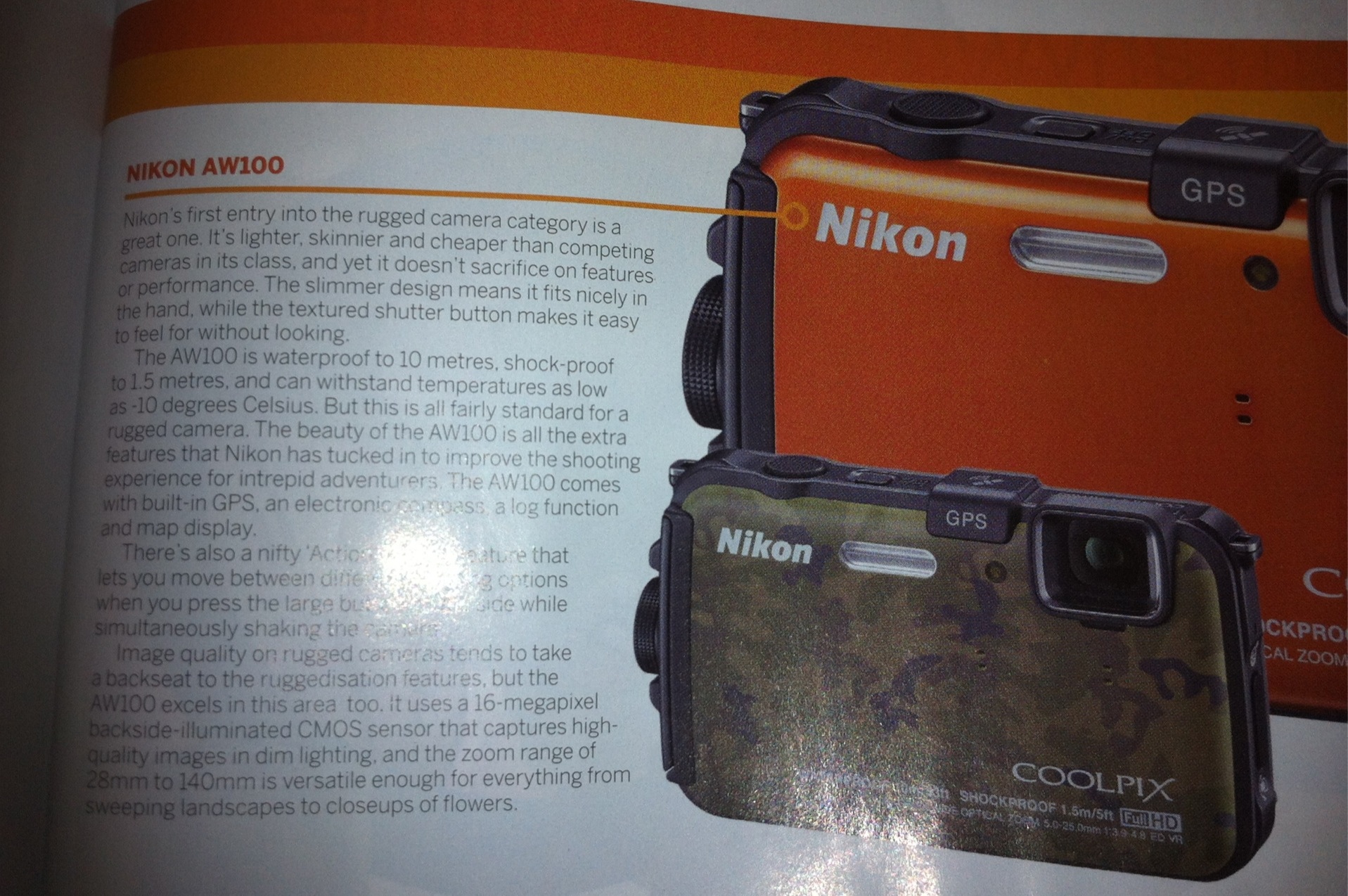
One of my friends shared with me a magazine, “Tech living.” It has a section in it that reviews the popular makes of such cameras, namely Olympus, Fuji, Nikon and Panasonic. Of these, it sounds like Nikon comes out the winner.
See the review pictured below:
Are you doing research in the field where you have to catch and release fish? What can you use to sedate the fish and still be able to release it immediately, avoiding any witholding periods?
The USDA has just authorised the use of Aqui-S for such work. Read more by clicking on this link.
This same drug is registered in Australia for use in salmonids, lobsters and abalone with nil withholding period (i.e. the fish can be humanely euthanised with this product and the flesh is safe for human consumption immediately).
I was contacted by the Guru of Fish Pathology (Prof. Ron Roberts is the veterinarian who published "Fish Pathology" which is considered the "bible" on fish diseases) last week to review a scientific paper for the Journal of Fish Diseases. I used to think that writing a paper was difficult, but editing it is not that easy either! I just finished reviewing and lodged it online and I received this thank you message:
Thank you for reviewing manuscript # JFD-2012-*** "*.*" for the Journal of Fish Diseases.
On behalf of the Editors of the Journal of Fish Diseases, we appreciate the voluntary contribution that each reviewer gives to the Journal. We thank you for your participation in the online review process and hope that we may call upon you again to review future manuscripts.
Sincerely,
Prof. Ron Roberts
Editor, Journal of Fish Diseases
heronpisces
—
Follow me on: Facebook "Fin Page" – Linkedin – YouTube – Twitter – Blog —
Yours sincerely,
Dr Richmond Loh
BSc, BVMS, MPhil (Vet Path), MANZCVS (Aquatics), MANZCVS (Pathobiology), DipPM.
Veterinarian | Adjunct Senior Lecturer Murdoch University | WAVMA Communications Committee Member |
Secretary Aquatic Animal Health Chapter – Australian and New Zealand College of Veterinary Scientists (ANZCVS)
The Fish Vet, Perth, Western Australia. Mobile Veterinary Service for fish and other aquatic creatures.
http://www.thefishvet.com.au
Ph: +61 (0)421 822 383
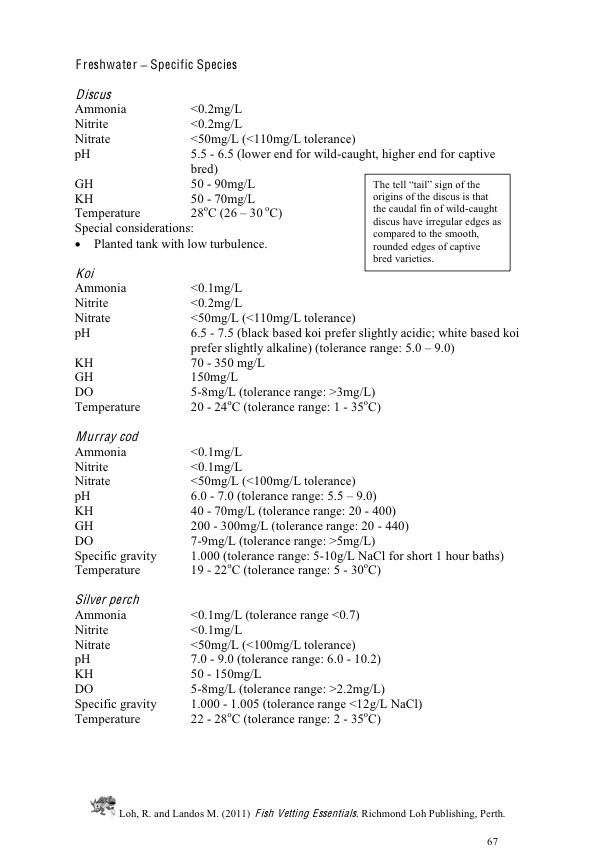
What’s good water quality for one species is not necessarily good water quality for another. And when some people say they have good water quality, they mean that their water looks good and they have only tested their pH.
Check out the optimal water quality parameters for the different fish species in the picture below (excerpt from Fish Vetting Essentials):
| Aquaculture | |||||||||||||||||
| Volume 359, Number 5 (August 2012) | |||||||||||||||||
 |
Optimum temperature of rearing water during artificial induction of ovulation in Japanese eel | ||||||||||||||||
| Authors: | Tatsuya Unuma, Sayumi Sawaguchi, Natsuki Hasegawa, Noriko Tsuda, Toshiomi Tanaka, Kazuharu Nomura, Hideki Tanaka | ||||||||||||||||
| Author Affiliations: |
|
||||||||||||||||
| Source: | Aquaculture, Volume 359, Number 5 (August 2012) | ||||||||||||||||
| Page Numbers: | 216 – 223 | ||||||||||||||||
| Available Full Text: |
|
||||||||||||||||
| Abstract: | To obtain fertilized eggs of the Japanese eel Anguilla japonica, mature females are injected with maturation-inducing steroid (MIS) to induce final oocyte maturation and ovulation and then paired with mature males for spawning (induced spawning method) or stripped to collect eggs for insemination (stripping and insemination method). Progress of final oocyte maturation and ovulation and consequent egg quality are affected by the environmental water temperature. To detect the optimum temperature of the rearing water during artificial induction of ovulation by MIS injection, we investigated the effects of water temperature on ovulation, egg quality, and its deterioration due to over-ripening using the stripping and insemination method. Mature females injected with 17a-hydroxyprogesterone were stocked in tanks maintained at 17.5°C, 20°C, 22.5°C or 25°C. Earlier ovulation occurred at the higher water temperatures. Viability of the eggs that were collected from females immediately after observation of ovulation was similar at 20°C and 22.5°C but inferior at 17.5°C and 25°C. After eggs are retained in the body cavity for an hour, their viability was increasingly reduced due to over-ripening at the higher temperatures between 20°C and 25°C. Moreover, hatchability of unfertilized eggs placed in tubes and maintained at 15°C, 17.5°C, 20°C, 22.5°C or 25°C for 3h showed a time-dependent decrease due to over-ripening, which progressed slower at the lower temperature band between 20°C and 25°C. However, 15°C and 17.5°C did not delay the progress of over-ripening compared to 20°C. We conclude that 17.5°C and 25°C are not appropriate for ovulation induction, because egg quality just after ovulation is lower than at 20°C and 22.5°C. In the stripping and insemination method, 22.5°C is disadvantageous compared to 20°C because of the faster progress of over-ripening, though this does not matter in the induced spawning method as spawning behavior and consequent fertilization are expected to occur at an appropriate timing after ovulation. | ||||||||||||||||
| Citation: | Tatsuya Unuma, Sayumi Sawaguchi, Natsuki Hasegawa, Noriko Tsuda, Toshiomi Tanaka, Kazuharu Nomura, Hideki Tanaka . Optimum temperature of rearing water during artificial induction of ovulation in Japanese eel. Aquaculture, Volume 359, Number 5 (August 2012), pp. 216-223, <http://ejournals.ebsco.com/direct.asp?ArticleID=4FB6826A3BC2F93BDD89> | ||||||||||||||||
| URL: | http://ejournals.ebsco.com/direct.asp?ArticleID=4FB6826A3BC2F93BDD89 | ||||||||||||||||
I’ll be doing a spot of training for the final year veterinary students during their elective, Wildlife Conservation & Zoo Medicine, in a couple of weeks.
After attending the recent Aquavet course (with many thanks to FRDC’s people development program), I’ve been inspired with new ideas on how to teach more effectively.
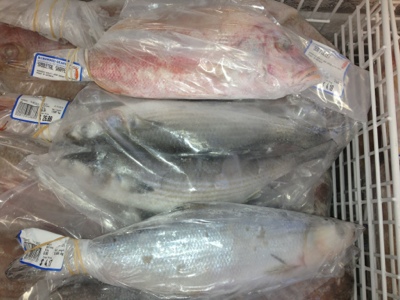
For these series of practical sessions, I’ll be using freshly thawed frozen fishes (pictured) to coach the students on non-lethal diagnostic techniques, learn the external and internal anatomy of fish, administer medication and performing a full necropsy. No fish practical is complete without discussing water quality. So, I’ll be preparing water samples spiked with ammonium chloride and sodium nitrite to simulate the conditions in ‘new tank syndrome’. These chemicals are also ideal for fish-less biofilter cycling.
A great article by Dr William Wildgoose regarding the perennial problem of upside down goldfish.
For the short version, excerpts from the abstract is pasted below:
There were almost equal numbers of short-bodied and long-bodied goldfish. In many cases, there were no external lesions and no consistent environmental factors could be identified… Several radiographic abnormalities were found in goldfish including over-inflation (44%), displacement (22%), fluid accumulation (12%) and rupture (2%) of the swim bladder and intestinal tympany (6%)… There was a very poor response to treatment and several environmental, medical and surgical approaches are discussed.
For the long version, click on this link.
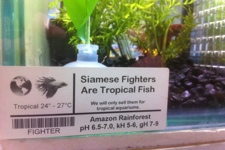
Did you know that the Siamese fighting fish comes from Siam? Siam is the old name for Thailand. As such, they are tropical fish and the water in which they are kept should reflect that (i.e. 24-28 degrees celsius). Today, the fish is bred in captivity virtually anywhere in the world, provided you can maintain such tropical water conditions for them. The majority of those you purchase from the local fish shop would be from south-east Asia.
On another note, if your Betta is looking a bit lethargic or off its feed, it may be because the water is much too cold for it. Obtain advice from your fish veterinarian or local fish shop about giving them a good healthy environment.