Check out the latest pics on my Facebook "Fin Page" on the recent teaching stint I had at Murdoch University –
http://www.facebook.com/media/set/?set=a.408385752543713.89724.188036301245327&type=3&l=af40e514e2
DJ squid
Check out the cool video at this link –
http://laughingsquid.com/insane-in-the-chromatophores-cypress-hill-played-through-squid-cells/
Congratulations to Dr Loh who has been elected to serve as the President of the World Aquatic Veterinary Medical Association.
From Dr David Scarfe PhD, DVM, MRSSAf, Parliamentarian, WAVMA:
Please join me in congratulating the following members that will server as WAVMA Officers and Directors-at-Large on the Executive Board, from January 1-December 31, 2013. We thank all those members that cast their votes in this election, both online and during the Annual General Meeting. Those individuals new to the Executive Board will serve as advisors to the Board for the remainder of 2012.
2013 Executive Board
President Mohamed Faisal, 2013 (USA)
Immediate Past-President Dusan Palic, 2012 (Germany)
President-Elect Richmond Loh, 2014 (Australia)
Secretary Chris Walster (UK)
Treasurer Nick Saint-Erne (USA)
Director-at-Large Devon Dublin (Guyana/Japan)
Director-at-Large Lydia Brown (UK)
See what WAVMA does for the world aquatic veterinary profession by visiting the site – http://www.wavma.org/

Fish Joke for Monday-itis
Nothing makes a bigger fish than ‘almost being caught’!
Ornamental fish in veterinary practice.
Check out Dr William H Wildgoose’s thoughts on the subject – click on this link.
How do you protect your fish tank from toxic fumes?
I had a client who lost their entire tank of discus to toxic when they had someone re-do their wooden floors. How could this have been prevented?
You could move your entire tank somewhere else? Re-home them? What if it’s not possible?
What I suggest (but wonder if it’d work) is to do the following:
– stop feeding fishes for 2-3 days prior tithe event to decrease the tanks’ oxygen demand.
– turn off the aerator to prevent the toxic fumes from being pumped into the tank.
– heavily plant the tank and turn the lights on for the duration to ensure oxygen supply by the plants.
– keep the filter running and also run charcoal through the system to adsorb harmful chemicals.
– seal the top of the tank with several layers of glad wrap and tape all the edges to ensure there are no gaps.
– cross your fingers that it’ll all work out well.
Any more precautionary measures you can add would be most appreciated.
Do goldfish have a stomach?
Why raise such a question?
I was watching an episode of “Tanked” (Animal Planet Discovery Show) and there was a pop-quiz that I hate to admit it, but I got wrong…. well… according to them anyway.
The question was… which of these fish do not have a stomach?…. The answer they gave was Goldfish. And so it was proposed that goldfish need very much more regular feeding than twice a day.
Whether a goldfish has a stomach has been a subject for debate on may fish forums on the net – just Google “tanked tv show goldfish stomach” and you’ll see.
In animals, the stomach is located between the oesophagus and the duodenum (the most anterior part of the small intestine).
Many texts and scientists (and the producers of “Tanked”) believe that goldfish do not have a stomach. In a reply by Dr Brian Jones, he pulled out this excerpt:
About 15% of teleosts, including cyprinids, have no stomach and no region of low pH or pre-digestion. Anterior portion of intestine has some storage function, intestine in these species is usually very long compared to, say, a trout (Rombout, et al. 2011. Teleost intestinal immunology. Fish and shellfish immunology 31:616-626.).
I looked up Balliere’s Comprehensive Veterinary Dictionary for the definition of stomach and this is what I found – the curved, muscular, saclike structure that is an enlargement of the alimentary canal between the oesophagus and the small intestine.
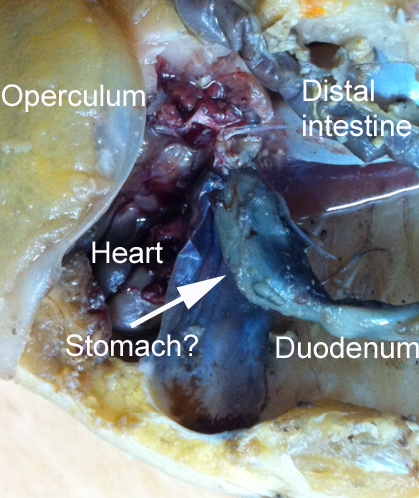
Then I carefully dissected the carcass of a formalin-fixed goldfish I had spare on my shelf (as you do) to see whether the goldfish has a stomach. I found that there was certainly a saclike distension to the anterior part of the alimentary tract, immediately caudal to the oesophagus.
So what would you call the dilated portion of the gut immediately posterior to the oesophagus in the goldfish?
In birds, you have a crop, a proventriculus (the secretory stomach) and a gizzard (the muscular stomach) between the oesophagus and duodenum.
Ruminants are known to have 4 stomachs, they have the rumen, reticulum, omasum and abomasum between the oesophagus and duodenum.
In an alpaca, you have compartments 1, 2 and 3 between the oesophagus and duodenum.
So, if you do not call the structure (arrow) in the diagram a stomach, what would you call it?
“Intestinal bulb” was proposed.
I may have to accept defeat on a technicality….
I open it up to you now for debate…
Aquatic biosecurity. Junk can spread diseases!
For those interested in aquatic biosecurity, a great read here.
Find the article at this link – http://onlinelibrary.wiley.com/doi/10.1111/j.1365-2761.2011.01323.x/pdf
Duckling feeds koi.
Sentinel testing of koi.
Following on from my previous post regarding “sentinel testing” (https://thefishvet.wordpress.com/2012/07/24/sentinels-in-quarantine/), Singapore has been using it for quite a while.
The excerpt below is taken from Ling & Poh, Quarantine, Surveillance, and Monitoring of Koi Herpesvirus in Singapore. The Israeli Journal of Aquaculture – Bamidgeh 61(3), 2009.
For high value koi, taking samples would be cost prohibitive to the traders. In such cases, the consignment is cohabited with sentinel KHV-free koi for one week, after which the latter are tested for KHV. The high value consignment continues its quarantine for three
weeks. If the sentinel koi test negative for KHV, the consignment is released, but if the sentinel koi test positive, the consignment is destroyed. Strict controls are imposed to ensure that koi exports from Singapore are also free from KHV. These include a compulsory quarantine period of a minimum three weeks prior to the issuance of a KHV-free certificate.