What is good water quality for fish?

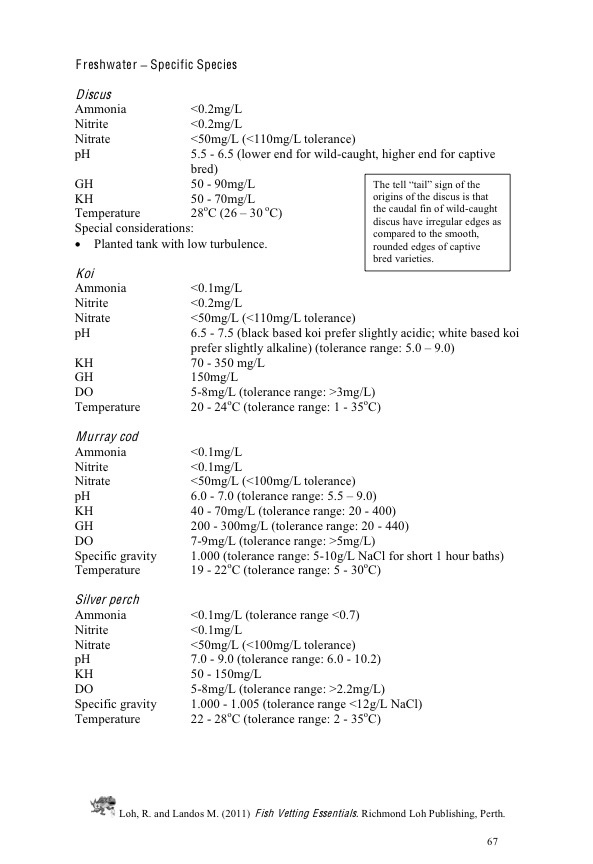
What’s good water quality for one species is not necessarily good water quality for another. And when some people say they have good water quality, they mean that their water looks good and they have only tested their pH.

Check out the optimal water quality parameters for the different fish species in the picture below (excerpt from Fish Vetting Essentials):

20120823-153340.jpg

What’s the best temperature for artificially spawning Japanese eels?

Aquaculture
Volume 359, Number 5 (August 2012)
Optimum temperature of rearing water during artificial induction of ovulation in Japanese eel
Authors: Tatsuya Unuma, Sayumi Sawaguchi, Natsuki Hasegawa, Noriko Tsuda, Toshiomi Tanaka, Kazuharu Nomura, Hideki Tanaka
Author Affiliations:
no affiliations available
Source: Aquaculture, Volume 359, Number 5 (August 2012)
Page Numbers: 216 – 223
Available Full Text:
Full Text: Subscription Required to view full text
Format: PDF
Size: Unknown
Location: Publisher’s Site
Authentication: Publisher’s Site
Abstract: To obtain fertilized eggs of the Japanese eel Anguilla japonica, mature females are injected with maturation-inducing steroid (MIS) to induce final oocyte maturation and ovulation and then paired with mature males for spawning (induced spawning method) or stripped to collect eggs for insemination (stripping and insemination method). Progress of final oocyte maturation and ovulation and consequent egg quality are affected by the environmental water temperature. To detect the optimum temperature of the rearing water during artificial induction of ovulation by MIS injection, we investigated the effects of water temperature on ovulation, egg quality, and its deterioration due to over-ripening using the stripping and insemination method. Mature females injected with 17a-hydroxyprogesterone were stocked in tanks maintained at 17.5°C, 20°C, 22.5°C or 25°C. Earlier ovulation occurred at the higher water temperatures. Viability of the eggs that were collected from females immediately after observation of ovulation was similar at 20°C and 22.5°C but inferior at 17.5°C and 25°C. After eggs are retained in the body cavity for an hour, their viability was increasingly reduced due to over-ripening at the higher temperatures between 20°C and 25°C. Moreover, hatchability of unfertilized eggs placed in tubes and maintained at 15°C, 17.5°C, 20°C, 22.5°C or 25°C for 3h showed a time-dependent decrease due to over-ripening, which progressed slower at the lower temperature band between 20°C and 25°C. However, 15°C and 17.5°C did not delay the progress of over-ripening compared to 20°C. We conclude that 17.5°C and 25°C are not appropriate for ovulation induction, because egg quality just after ovulation is lower than at 20°C and 22.5°C. In the stripping and insemination method, 22.5°C is disadvantageous compared to 20°C because of the faster progress of over-ripening, though this does not matter in the induced spawning method as spawning behavior and consequent fertilization are expected to occur at an appropriate timing after ovulation.
Citation: Tatsuya Unuma, Sayumi Sawaguchi, Natsuki Hasegawa, Noriko Tsuda, Toshiomi Tanaka, Kazuharu Nomura, Hideki Tanaka . Optimum temperature of rearing water during artificial induction of ovulation in Japanese eel. Aquaculture, Volume 359, Number 5 (August 2012), pp. 216-223, <http://ejournals.ebsco.com/direct.asp?ArticleID=4FB6826A3BC2F93BDD89&gt;
URL: http://ejournals.ebsco.com/direct.asp?ArticleID=4FB6826A3BC2F93BDD89

Frozen fish for learning.

I’ll be doing a spot of training for the final year veterinary students during their elective, Wildlife Conservation & Zoo Medicine, in a couple of weeks.

After attending the recent Aquavet course (with many thanks to FRDC’s people development program), I’ve been inspired with new ideas on how to teach more effectively.

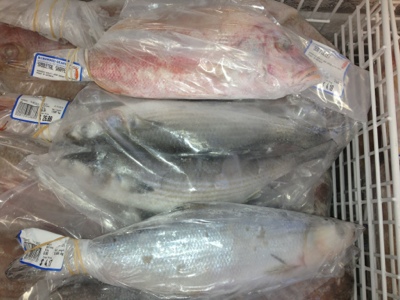
For these series of practical sessions, I’ll be using freshly thawed frozen fishes (pictured) to coach the students on non-lethal diagnostic techniques, learn the external and internal anatomy of fish, administer medication and performing a full necropsy. No fish practical is complete without discussing water quality. So, I’ll be preparing water samples spiked with ammonium chloride and sodium nitrite to simulate the conditions in ‘new tank syndrome’. These chemicals are also ideal for fish-less biofilter cycling.

20120820-181438.jpg

Buoyancy disorders of ornamental fish: a review of cases seen in veterinary practice.


A great article by Dr William Wildgoose regarding the perennial problem of upside down goldfish.

For the short version, excerpts from the abstract is pasted below:

There were almost equal numbers of short-bodied and long-bodied goldfish. In many cases, there were no external lesions and no consistent environmental factors could be identified… Several radiographic abnormalities were found in goldfish including over-inflation (44%), displacement (22%), fluid accumulation (12%) and rupture (2%) of the swim bladder and intestinal tympany (6%)… There was a very poor response to treatment and several environmental, medical and surgical approaches are discussed.

For the long version, click on this link.


Fish-e Trivia for Monday-itis. Where do Bettas come from?

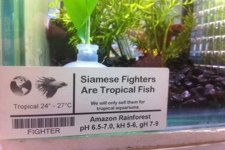
Did you know that the Siamese fighting fish comes from Siam? Siam is the old name for Thailand. As such, they are tropical fish and the water in which they are kept should reflect that (i.e. 24-28 degrees celsius). Today, the fish is bred in captivity virtually anywhere in the world, provided you can maintain such tropical water conditions for them. The majority of those you purchase from the local fish shop would be from south-east Asia.

On another note, if your Betta is looking a bit lethargic or off its feed, it may be because the water is much too cold for it. Obtain advice from your fish veterinarian or local fish shop about giving them a good healthy environment.

20120818-092345.jpg

Survival after being gutted! The sea turd’s story.

Aquaculture
Volume 359, Number 5 (August 2012)
Growth, metabolism and immune responses to evisceration and the regeneration of viscera in sea cucumber, Apostichopus japonicus
Authors: Yuanqi Zang, Xiangli Tian, Shuanglin Dong, Yunwei Dong
Author Affiliations:
no affiliations available
Source: Aquaculture, Volume 359, Number 5 (August 2012)
Page Numbers: 50 – 60
Available Full Text:
Full Text: Subscription Required to view full text
Format: PDF
Size: Unknown
Location: Publisher’s Site
Authentication: Publisher’s Site
Abstract: Growth, metabolism and immune responses of sea cucumber, Apostichopus japonicus, following evisceration induced artificially, were investigated in this study. The body weight, specific growth rate (SGR), oxygen consumption rate (OCR), activities of immunoenzymes including acidic phosphatase (ACP), alkaline phosphatase (AKP) from hydrolytic system, and catalase (CAT), superoxide dismutase (SOD), total antioxidant capacity (T-AOC) and malonyl-dialdehyde (MDA) from antioxidant system in muscle, intestine and respiratory tree were measured to evaluate the physiological responses of A. japonicusto evisceration and regeneration of viscera. The results showed that body weight of sea cucumber significantly dropped following evisceration and then increased gradually with digestive function resumed. Accelerated growth rates were observed in the regeneration group from the 10th day to 20th day, but there was no significant difference between the regeneration group and control group at the end of the experiment. OCR reduced rapidly after evisceration and increased gradually afterwards. Compared to the control, no significant difference in OCR was found on the 45th day (P0.05). The immune responses of A. japonicuswere highly tissue-specific during the regeneration of viscera. Both ACP and AKP activities in muscle peaked on the 10th day after evisceration, then decreased gradually to normal on the 45th day (P0.05), while those in the regenerated tissues exhibited a differential rising trend from the 20th day after evisceration. SOD activity in muscle was not significantly influenced by evisceration; however, in the regenerated tissues it was enhanced and significantly higher than those in the control on the 45th day (P<0.01). CAT activity in muscle of the regeneration group was significantly higher than in the control during the experiment (P<0.05). Comparatively, CAT activity in the respiration tree increased invariably after evisceration, while in the intestine CAT activity was not significantly affected by evisceration (P0.05). Significant increase was found in both T-AOC and MDA in all three tissues after evisceration (P<0.05); however, they all returned to normal at the end of the experiment. Results of this study indicated that growth, metabolism and immune responses including hydrolytic and antioxidant enzymes in sea cucumber were significantly influenced by evisceration. Although the regeneration group did not catch up with the control in body weight, SGR, OCR, major non-specific immune parameters resumed to normal level within 45days after evisceration, indicating that A. japonicusmight have recovered physiologically from evisceration. Results from this study first presented comprehensive and valuable data of physiological responses to evisceration and the regeneration of viscera in A. japonicus, which would have important implications for those farmers engaged in sea cucumber culture.
Citation: Yuanqi Zang, Xiangli Tian, Shuanglin Dong, Yunwei Dong . Growth, metabolism and immune responses to evisceration and the regeneration of viscera in sea cucumber, Apostichopus japonicus. Aquaculture, Volume 359, Number 5 (August 2012), pp. 50-60, <http://ejournals.ebsco.com/direct.asp?ArticleID=469494601EB864391BCF&gt;
URL: http://ejournals.ebsco.com/direct.asp?ArticleID=469494601EB864391BCF

Daughterless carp project.

We really should be supporting the channelling of funds towards the  “daughterless” carp project instead, see link –
http://www.abc.net.au/landline/content/2012/s3550676.htm

Natural plant extracts to combat Saprolegnia fungus.

Sounds promising!


Aquaculture
Volume 359, Number 5 (August 2012)
The efficacy of selected plant extracts and bioflavonoids in controlling infections of Saprolegnia australis(Saprolegniales; Oomycetes)
Authors: S. Caruana, G.H. Yoon, M.A. Freeman, J.A. Mackie, A.P. Shinn
Author Affiliations:
no affiliations available
Source: Aquaculture, Volume 359, Number 5 (August 2012)
Page Numbers: 146 – 154
Available Full Text:
Full Text: Subscription Required to view full text
Format: PDF
Size: Unknown
Location: Publisher’s Site
Authentication: Publisher’s Site
Abstract: Saprolegniainfections can account for the significant loss of salmonid eggs and adults in breeding condition and although there are a number of chemical agents available to control infections in hatcheries, treatment is difficult and there are reservations regarding their efficacy, prompting a search for suitable replacements. Here, the efficacy of 24 crude plant extracts and 3 bioflavonoids on the growth of Saprolegnia australis were assessed using an in vitro agar diffusion method against a set of synthetic chemotherapeutants commonly used within the aquaculture industry. The 12 best extracts inhibiting growth at =100ppm, were then added to cultures of S. australisin a GP broth and the daily growth was monitored spectrophotometrically over a 7-day period. All 12 plant extracts reduced growth, however, only Atractylodes macrocephala, Zingiber officinale seed, Chrysanthemum and Yucca were as effective as 10ppm malachite green in slowing growth. A subsequent trial, where doses of the plant extract were given at 72 and 120h post-inoculation, found that Rumex obtusifolius, Sophora flavescens, Echinaceaand Z. officinale were the most effective compounds impacting growth. The study demonstrates that certain plant extracts impact on the growth dynamics of S. australisbut further research is required to assess their performance in vivo.
Citation: S. Caruana, G.H. Yoon, M.A. Freeman, J.A. Mackie, A.P. Shinn . The efficacy of selected plant extracts and bioflavonoids in controlling infections of Saprolegnia australis(Saprolegniales; Oomycetes). Aquaculture, Volume 359, Number 5 (August 2012), pp. 146-154, <http://ejournals.ebsco.com/direct.asp?ArticleID=4010BD15760B69FA953A&gt;
URL: http://ejournals.ebsco.com/direct.asp?ArticleID=4010BD15760B69FA953A

Dr Loh, The Fish Vet, in print media.

Check out the interesting articles on my Facebook "Fin Page" – http://www.facebook.com/media/set/?set=a.403427183039570.88397.188036301245327&type=3&l=12842bc857

—
Follow me on: Facebook "Fin Page" – Linkedin – YouTube – Twitter – Blog —
Yours sincerely,

Dr Richmond Loh
BSc, BVMS, MPhil (Vet Path), MANZCVS (Aquatics), MANZCVS (Pathobiology), DipPM.
Veterinarian | Adjunct Senior Lecturer Murdoch University | WAVMA Communications Committee Member |
Secretary Aquatic Animal Health Chapter – Australian and New Zealand College of Veterinary Scientists (ANZCVS)

The Fish Vet, Perth, Western Australia. Mobile Veterinary Service for fish and other aquatic creatures.
http://www.thefishvet.com.au
Ph: +61 (0)421 822 383