What do American fish call their mobile phones?
Shell (cell) phones.
All about Fish Vetting – Dr Richmond Loh
What do American fish call their mobile phones?
Shell (cell) phones.
This is essentially what the Dept of Fisheries WA has been doing. Protecting nurseries, minimum and maximum size limits and controlling fishing quotas so that we’ll have fish for the future.
North Sea cod figures backed by the scientific evidence
Reports from Scottish fishermen of a huge abundance of cod in the North Sea is a direct result of a dramatic decline in fishing effort combined with the introduction of a number of conservation initiatives by the fishing fleet, says the Scottish Fishermen’s Federation (SFF).
With dramatic video footage being aired on some TV news bulletins today, Thursday, showing a large haul of cod being taken aboard the fishing vessel Budding Rose in the North Sea, the SFF says the scientific evidence is also backing the experience of fishermen on the fishing grounds. The skipper of the vessel, Peter Bruce, said that when the film was taken he was 20 miles away from the closed (to fishing) cod spawning area and was actually fishing for haddock.
He added: “I was in contact with another skipper who was 75 miles away having similar experiences and he had to land 10 tons of cod to Peterhead from his trip. The recovery in the cod stock is not by any means patchy.”
According to Scottish Sea Fisheries Statistics, the amount of fishing effort by the Scottish fleet has declined by a massive 70% between 2000 and 2011. Furthermore, the latest scientific figures from the International Council for the Exploration of the Sea (ICES) reveals that the spawning stock biomass of North Sea cod has increased by 250% from 2006 to 2012. Fishing mortality for cod (or the amount of fish being taken out of the sea) has declined by 43% between 2000 and 2011.
Bertie Armstrong, chief executive of the SFF, said: “The decline in fishing effort and the amount of cod being taken out of the North Sea is quite dramatic and helps explain the relative abundance of fish that our fishermen are now finding on the grounds.
“It should not be forgotten that fishermen have made huge sacrifices over the last 10 years or so to reach this stage. The number of fishing vessels has dramatically declined and there have been strict effort controls as well. In addition, we have developed our own measures such as technical alterations to nets to significantly reduce discards and implementing real-time area closures to protect juvenile and spawning fish.
“In essence, our fishermen are by regulation taking much longer to catch much less fish, which has been achieved against a background of high operating costs. The important step now is to ensure that fishermen are rewarded for this increasing stock of cod and other fish through enhanced catching opportunities in the future. Survival of the fishing communities will depend on this.
“However, this must be achieved through careful fisheries management based on the science so as to ensure the continuation of sustainable harvesting that enables the stock to prosper. Our fishermen completely understand this – but given the cycle of time it takes for scientific data collection and analysis, the recovery actually occurs before official recognition. This first detection of increased fish abundance is made by the men at sea – the fishermen. Every effort is now being made to incorporate this early warning that fishermen can provide on stocks – which would equally apply if any stock was declining – into the scientific assessment process.
“With the horse-meat scandal and other food scare stories being prominent in the media at the moment, the recovery of cod and other fish stocks in the North Sea is a good news story for the consumer. Scottish fish is an extremely high quality food product that has a low carbon footprint and is healthy to eat. Our resounding message to consumers is to demand from retailers and restaurants more Scottish fish.”
Taken from : http://www.fishupdate.com/m/fullstory.php/aid/19129/North_Sea_cod_figures_backed_by_the_scientific_evidence.html
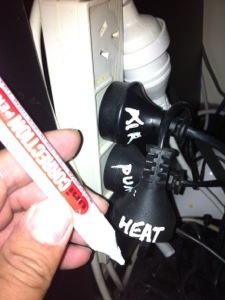
Is there a mess of power boards and innumerable plugs for the number of electric gadgets? How can you tell which belongs to which? This is especially important when conducting water changes where you for want the heater to crack if the water level gets too low, or when treating fishes in the tank when you need to turn off the UV to prevent rapid breakdown of the drug? Of course, for this might not be a problem for fish owners because we can usually work out what’s what by trial and error, plugging and unplugging each one in turn. But what if you’re not going to be home for some time and require your partner or house mate to unplug something for you?
I’ve come up with a simple solution to your issue. Just use a liquid correction orn
—
Yours sincerely,
Dr Richmond Loh
DipProjMgt, BSc, BVMS, MPhil (Pathology) Murdoch, MANZCVS (Aquatics& Pathobiology).
The Fish Vet, Perth, Western Australia.
Veterinary Medicine for fish.
W: http://www.thefishvet.com.au
E: thefishvet
P: +61 (0)421 822 383
| Aquaculture Research | |||||||||||||||||
| Volume 44, Number 4 (March 2013) | |||||||||||||||||
 |
Effects of different light intensities on growth, survival, reproductive and life span characteristics of Artemia urmiana(Günther 1890) | ||||||||||||||||
| Authors: | Shima Masoudi Asil, Abolghasem Esmaeili Fereidouni, Hossein Ouraji, Khosrow Jani Khalili | ||||||||||||||||
| Author Affiliations: |
|
||||||||||||||||
| Source: | Aquaculture Research, Volume 44, Number 4 (March 2013) | ||||||||||||||||
| Page Numbers: | 554 – 566 | ||||||||||||||||
| Available Full Text: |
|
||||||||||||||||
| Abstract: | Effects of light intensities on growth, survival, reproductive and life span traits of Artemia urmianawere investigated under laboratory conditions. Nauplii of A. urmianawere hatched and raised in 100 g L-1at four illuminations including 0, 100, 2000 and 5000 lx with 14:10 (light:dark) photoperiod. Mating pairs of mature animals were randomly isolated and reared continuously under similar conditions. The mode and potential of reproduction as well as adult survival shown by each pair were determined throughout their life span. Results showed that percentages of nauplii survival were significantly (P =0.05) different at 5000 and 0 lx (76.50% compared with 26.25%) respectively. Total number of offspring was highly correlated with the light intensities showing increased numbers at higher light intensities compared with darkness or 100 lx. Reproduction mode was relatively affected by various light intensities. Significant (P =0.05) differences were found both in reproductive period and life span at different illuminations. Maximum and minimum offspring productions per reproductive day were found at 5000 and 100 lx respectively. The relative degree of oviparity increased as the illumination decreased (57.92% compared with 22.65% at 0 and 5000 lx respectively). The optimum light intensities appear to be between 2000 lx and 5000 lx in this study. These findings could probably be useful for mass culture of A. urmianain indoor or recirculating systems as well as in outdoor systems for intensive cyst and biomass production. | ||||||||||||||||
| Citation: | Shima Masoudi Asil, Abolghasem Esmaeili Fereidouni, Hossein Ouraji, Khosrow Jani Khalili . Effects of different light intensities on growth, survival, reproductive and life span characteristics of Artemia urmiana(Günther 1890). Aquaculture Research, Volume 44, Number 4 (March 2013), pp. 554-566, <http://ejournals.ebsco.com/direct.asp?ArticleID=429198886C615FCEE332> | ||||||||||||||||
| URL: | http://ejournals.ebsco.com/direct.asp?ArticleID=429198886C615FCEE332 | ||||||||||||||||
Much of the literature talks about photoperiods affecting fish growth and reproduction, but I think this is one of the few papers that address light intensity. This is interesting.
| Aquaculture | |||||||||||||||||
| Volume 387, Number 13 (March 2013) | |||||||||||||||||
| |
Low light intensity can reduce Atlantic salmon smolt quality | ||||||||||||||||
| Authors: | Sigurd O. Handeland, Albert K. Imsland, Lars O.E. Ebbesson, Tom O. Nilsen, Camilla D. Hosfeld, Grete Baeverfjord, Åsa Espmark, Trond Rosten, Ove T. Skilbrei, Tom Hansen, Gunnar S. Gunnarsson, Olav Breck, Sigurd O. Stefansson | ||||||||||||||||
| Author Affiliations: |
|
||||||||||||||||
| Source: | Aquaculture, Volume 387, Number 13 (March 2013) | ||||||||||||||||
| Page Numbers: | 19 – 24 | ||||||||||||||||
| Available Full Text: |
|
||||||||||||||||
| Abstract: | The objective of this study has been to investigate the effect of light intensity (10, 21, 43, 200 and 650lx) during smolting and its potential influence on gill Na+,K+-ATPase (NKA) activity, endocrinology, ion regulation, growth, morphology, and spinal development in Atlantic salmon. Gill Na+,K+-ATPase activity, plasma glucose and blood PCO2were all affected by time (study duration 176days), while no differences were seen as a result of the different light intensity treatments. Growth rate was positively correlated to light intensity. Lower body silvering index, reduced fin area (5–7% lower in the 10 and 21lux groups) and increased percentage of skeletal abnormalities (6.9% in the 10lux group vs. 1% in the 650lux group) at low light intensity were seen. In a second experiment juvenile Atlantic salmon parr were reared in August at LD12:12, at either 1lx or 1000lx and circulating plasma thyroxin (FT) levels measured. Plasma FT4 levels remained low in the low light intensity group (1lx), whereas FT4 levels increased significantly from 2 to 5h in the high intensity group (1000lx). Total T4 levels were nearly 2-fold higher 5h after lights-on in the high intensity group compared with the low. Overall, the present data suggests that a minimum light intensity of 43lx is needed to secure optimal smolt quality, development, welfare and growth in Atlantic salmon. | ||||||||||||||||
| Citation: | Sigurd O. Handeland, Albert K. Imsland, Lars O.E. Ebbesson, Tom O. Nilsen, Camilla D. Hosfeld, Grete Baeverfjord, Åsa Espmark, Trond Rosten, Ove T. Skilbrei, Tom Hansen, Gunnar S. Gunnarsson, Olav Breck, Sigurd O. Stefansson . Low light intensity can reduce Atlantic salmon smolt quality. Aquaculture, Volume 387, Number 13 (March 2013), pp. 19-24, <http://ejournals.ebsco.com/direct.asp?ArticleID=4A8F89D39BD2CC96FD9A> | ||||||||||||||||
| URL: | http://ejournals.ebsco.com/direct.asp?ArticleID=4A8F89D39BD2CC96FD9A | ||||||||||||||||
The findings not only make it clear that all giant squid around the world are the same species, but they also hint that the animals came close to extinction at some point in the not too distant past.
“What could possibly have caused giant squid to vanish on such a global scale? And what changed that allowed them to spread again?”
“… changes in ocean conditions somehow altering the nutrient-rich deep waters that these animals need?”
“It would be very interesting to compare patterns and timings of this low diversity and see if they correspond to some historic event,” says Morin.
Learn more here-
http://www.nature.com/news/dna-reveals-giant-squid-had-brush-with-death-1.12641
—
Yours sincerely,
Dr Richmond Loh
DipProjMgt, BSc, BVMS, MPhil (Pathology) Murdoch, MANZCVS (Aquatics& Pathobiology).
The Fish Vet, Perth, Western Australia.
Veterinary Medicine for fish.
W: http://www.thefishvet.com.au
E: thefishvet
P: +61 (0)421 822 383
See pictute
This topic is a follow up of a previous post (https://thefishvet.com/2012/08/31/do-goldfish-have-a-stomach/).
Recently, I was at Murdoch University and bumped into my first year lecturer for Anatomy, Assoc. Prof. Ken Richardson. Of course all conversations with me lead to fish… Anyway, I asked him this question… Does the goldfish have a stomach? I went into great lengths trying to get him to agree with me that they DO have stomachs based on the definition of a ‘dilated region in the anterior GIT’. He didn’t buy it and says that true stomachs have specialisations and has the ability for digestion at low pH rather than in the intestine where the pH is higher. The examples I gave about the cow stomach was explained away with this reasoning and that the rumen, reticulum and omasum are actually specialisations of the oesophagus rather than the stomach.
OK, I give up trying to prove I’m right on this topic…. until I get another opportunity…
One day… I can say AHA! I thought so! But sadly, not today 😦
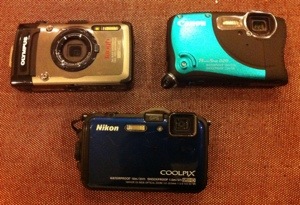
I’ve now managed to have a play with these three makes.
The new cameras are great I that you don’t have to switch between modes to take a picture or a video. They have ready to go, single push buttons to trigger a photo shoot or a video.
Now on to the comparisons. I would not normally recommend Olympus after having drowned two of the tough cameras, both times at a depth of only 4m while checking out the sharks at AQWA when it was built to survive 10m. But I was drawn to this one because of its quick reaction time. It also boasts a 12m water resist and 2m ‘drop proof-ability’ when other tough cameras tend to have a 10m water resist and 1.5m ‘drop proof-ability.’ I won’t be putting these to the test though because I don’t want to drown yet another (unless if Olympus will sponsor me another camera ;P). I really like its ability to shoot in low lighting which is particularly advantageous when shooting underwater if there is an amount of suspended solids or sand, since using flash photography will create distracting specks as the light bounces back. It is also good for users who are accustomed to holding the camera with both hands because the central location of the lenses means no dodgy fingers getting in the way of a great picture. But with this central location, it leant that the flash is placed in the top corner. Users with ‘two left hands’ may block the flash or cause the picture to be over-exposed. The downside of this camera is that it is relatively heavy, weighing in at 231g. The other minor inconvenience is that you have to scroll through each individual special scene selection rather than use the arrow keys to navigate to the selection more quickly on a grid system. The other minor hassle you’ll have with the Olympus is that you need to recharge the battery by connecting the camera to the power. This means that the camera is out of action until the charging is done. The other issue I have with this model is that when using the zoom while in video mode, you can really hear the noise when zooming in and out.
In terms of being user-friendly, the Canon camera is a real dud. There are three buttons on the top right part of almost equal size, shape and texture – the buttons are the on/off, photo taking and the photo review. All too often, an unaquainted user will be pressing all the wrong buttons and miss the perfect photo opportunity and become rather frustrated or feel a little less than smart. It might not be a problem after a while but it’ll get you every time you ask someone to take a picture of you/your group. And even more frustrating, is the 5 step method to delete a photo you’ve just taken. It’s not quick off the mark in terms of reaction time and not ideal for taking photos in low lighting. It is also rather bulky.
With the Nikon, it doesn’t have the advantages of the Olympus but at the same it doesn’t have the disadvantages of the Olympus or the Canon. It is easy to use, light (weighs 178g) and compact. It comes with a brush so you can brush off dirt to keep the seals clean each time you open and shut the battery/memory card compartment. This camera is great for taking panoramic photos because it takes the picture as you pan through rather than the Olympus where you have to try and match up the targets and them end up with horrible lighting differences after the pictures are stitched together by the camera program. The other pro about this make is that you can charge the battery in a charger, without connecting it to the power source. This means you can have several batteries on the go and the only thing limiting your happy snapping is the size of your memory card. The zoom on the Nikon is greater at 5x optical, plus it has a digital zoom too.
All in all, I’d recommend this model of Olympus for a better user experience and good quality photos. A close second is the Nikon. I’d avoid the Canon.