Q: What do you call a shoe fish?
A: a cobbler.
All about Fish Vetting – Dr Richmond Loh
Q: What do you call a shoe fish?
A: a cobbler.
From: The University of St Andrews and TheFishSite.com
Date: 11 April 2013 21:34:39 AWST
To:
Subject: Advanced Fish/Shrimp Courses in Sustainable Aquaculture
Reply-To: The University of St Andrews and TheFishSite.com
NEW ADVANCED COURSES START 28th MAY 2013
Our TWO NEW on-line Postgraduate Certificates in Sustainable Aquaculture will start the last week in May 2013.
Enquire/Apply Now!
If you are interested in gaining an advanced qualification in either sustainable SHRIMP (invertebrates) or FISH (vertebrates) production from the University of St Andrews, now is the time to enquire/apply.
The award of Postgraduate Certificate in Sustainable Aquaculture requires 60 credits gained from taught modules over a one year period. There are two courses available, one focusing on vertebrates (fish) and the second on invertebrates (shellfish, molluscs etc.).
Benefits of e-Learning
There are many advantages to online learning. Here are a few to consider:
Convenience and Flexibility
Your learning can be organised to meet your schedule
There is no need to physically attend college
Learning is delivered at a pace to suit you
No time restrictions – courses are available 24/7
No physical restrictions – study at home, work, or on the road
For more details on both courses visit the Course Details page.
If you would like to discuss any aspect of the course please feel free to contact the course director:
Dr Neil Hazon
Scottish Oceans Research Institute
University of St Andrews.
Telephone: + 44 1334 463451
e-mail: nh1@st-andrews.ac.uk
—
Yours sincerely,
Dr Richmond Loh
DipProjMgt, BSc, BVMS, MPhil (Pathology) Murdoch, MANZCVS (Aquatics& Pathobiology).
The Fish Vet, Perth, Western Australia.
Veterinary Medicine for fish.
W: http://www.thefishvet.com.au
E: thefishvet
P: +61 (0)421 822 383
Do we really want to introduce it to Australia (see link to a previous post)?
Once released, you can never take it back.
The latest research on the epidemiology of KHV below, shows this is what could happen.
| Journal of Fish Diseases | |||||||||||||||||
| Volume 36, Number 5 (May 2013) | |||||||||||||||||
 |
Do wild fish species contribute to the transmission of koi herpesvirus to carp in hatchery ponds? | ||||||||||||||||
| Authors: | M Fabian, A Baumer, D Steinhagen | ||||||||||||||||
| Author Affiliations: |
|
||||||||||||||||
| Source: | Journal of Fish Diseases, Volume 36, Number 5 (May 2013) | ||||||||||||||||
| Page Numbers: | 505 – 514 | ||||||||||||||||
| Available Full Text: |
|
||||||||||||||||
| Abstract: | The koi herpesvirus (KHV) has spread worldwide since its discovery in 1998 and causes disease and mortality in koi and common carp populations with a high impact on the carp production industry. Many investigations have been conducted to examine ways of distribution and to identify possible transmission vectors. The answers, however, raise many new questions. In the present study, different wild fish species taken from carp ponds with a history of KHVinfection were examined for their susceptibility to the virus. In the tissue of these fish, the virus load was determined and it was tested whether a release of the virus could be induced by stress and the virus then could be transferred to naive carp. Wild fish were gathered from carp ponds during acute outbreaks of virus-induced mortality in summer and from ponds stocked with carp carrying a latent KHVinfection. From these ponds, wild fish were collected during the harvesting process in autumn or spring when the ponds were drained. We found that regardless of season, temperature variation, age and infection status of the carp stock, wild fish from carp ponds and its outlets could be tested positive for the KHVgenome using real-time PCRwith a low prevalence and virus load. Furthermore, virus transfer to naive carp was observed after a period of cohabitation. Cyprinid and non-cyprinid wild fish can therefore be considered as an epidemiological risk for pond carp farms. | ||||||||||||||||
| Citation: | M Fabian, A Baumer, D Steinhagen . Do wild fish species contribute to the transmission of koi herpesvirus to carp in hatchery ponds?. Journal of Fish Diseases, Volume 36, Number 5 (May 2013), pp. 505-514, <http://ejournals.ebsco.com/direct.asp?ArticleID=488DAFFC68095DEB75FE> | ||||||||||||||||
| URL: | http://ejournals.ebsco.com/direct.asp?ArticleID=488DAFFC68095DEB75FE | ||||||||||||||||
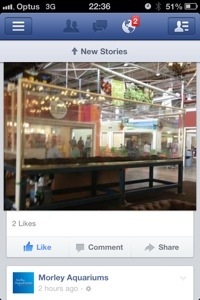
Hot off the press! Coventry Village in Morley is installing 2 x 9000 litre units and 5 x 2700 litre units. This is an opportunity unlike any that has been seen for freshwater fish keeping in this state (if not Australia). How cool!
http://www.coventryvillage.com.au/contact-us/
Open until 7pm everyday (9pm Thursday’s)
Morley Aquariums have been tasked to set these up over the next fortnight and the displays will include 1 koi tank, 1 stingray/tank buster tank, 3 cichlid tanks, 1 red parrot cichlid tank & 1 rainbowfish tank.
Congratulations to Morley Aquariums for scoring the gig. I’m sure they’ll be in good hands!
Follow me on: Facebook "Fin Page" – YouTube – Blog – Linkedin – Twitter
—
Yours sincerely,
Dr Richmond Loh DipProjMgt, BSc, BVMS, MPhil (Pathology) Murdoch, MANZCVS (Aquatics & Pathobiology).
Veterinarian | Adjunct Lecturer Murdoch University | WAVMA President-Elect |
Secretary Aquatic Animal Health Chapter – Australian and New Zealand College of Veterinary Scientists (ANZCVS).
The Fish Vet, Perth, Western Australia, AUSTRALIA. Mobile Veterinary Medical & Diagnostic Services for fish and other aquatic creatures.
http://www.thefishvet.com.au
Ph: +61 (0)421 822 383
Looking for more books? Check out this site.
This is the question asked by one of my clients recently. It’s not a ‘church fellowship", so I thought the question was rather funny. And then, when explaining it to a classmate of mine, they asked if I had to sit exams similar to that I sat for my ‘Memberships’. Then it started me thinking that this fellowship business is not plainly understood. I did not have to sit exams for this. Then I looked up the definition of ‘fellowship’ online (http://www.thefreedictionary.com/fellowship) and came up with a whole heap of other meanings –
fellowship [ˈfɛləʊˌʃɪp] n1. the state of sharing mutual interests, experiences, activities, etc.
2. a society of people sharing mutual interests, experiences, activities, etc.; club
3. companionship; friendship
4. the state or relationship of being a fellow
5. (Christianity / Ecclesiastical Terms) a. mutual trust and charitableness between Christians
b. a Church or religious association
6. (Social Science / Education) Education a. a financed research post providing study facilities, privileges, etc., often in return for teaching services
b. a foundation endowed to support a postgraduate research student
c. an honorary title carrying certain privileges awarded to a postgraduate student
7. (Social Science / Education) (often capital) the body of fellows in a college, university, etc.
This Fellowship I received is definition #6a. I had to fill out an application form and attend a very rigorous interview process. So, it’s like a Scholarship where you go on a fact-finding trip, but with a Fellowship, you have a duty to disseminate the knowledge you have gained with your peers.
Thus, it is my intention to gather a list of relevant contacts so that I can disseminate the information upon my return as part of my Fellowship. I would like to start collating any questions you may have for me to ask the experts, so that the information I’ll be disseminating will be relevant to you. I’ve started a Google Document that you may add your questions to, under the respective headings. Questions can relate to finfish, sharks, rays, pinnipeds, cetaceans, manatees, turtles and penguins.
The virtual file will be called “Seavet 2013 Questions from ISSI Distribution List” and you can access it by clicking on this link.
Note that this file will be available to anyone with the link, so be careful not delete anyone else’s questions. Thank you for your interest and support.
Follow me on: Facebook "Fin Page" – YouTube – Blog – Linkedin – Twitter
—
Yours sincerely,
Dr Richmond Loh DipProjMgt, BSc, BVMS, MPhil (Pathology) Murdoch, MANZCVS (Aquatics & Pathobiology).
Veterinarian | Adjunct Lecturer Murdoch University | WAVMA President-Elect |
Secretary Aquatic Animal Health Chapter – Australian and New Zealand College of Veterinary Scientists (ANZCVS).
The Fish Vet, Perth, Western Australia, AUSTRALIA. Mobile Veterinary Medical & Diagnostic Services for fish and other aquatic creatures.
http://www.thefishvet.com.au
Ph: +61 (0)421 822 383
Could the silk produced from hagfish slime be turned into tights or breathable athletic wear, or even bullet-proof vests. How about lingerie and wedding dresses? The possibilities are endle
Read more here:
http://m.bbc.co.uk/news/magazine-21954779
If you’re free and would like to attend the workshop presented by Ruth Haight, click on the link below to download the detailed information.
Turtle Rehab Workshop Details.pdf
The worshop will cover these aspects of turtle rehabilitation:
You may also wish to contact the organisers directly – http://www.turtleoblonganetwork.org.au/contact-us.html
I often wonder why, after so many years, has noone thought of including peas into fish food. Could this be the perfect diet for goldfish in the prevention of swimbladder dysfunction? What’s more is that peas should be a much cheaper source of protein than fish meal.
In this article, researchers show that pea protein can substitute 35% of the fish meal, making it more economical for crayfish production.
| Aquaculture | |||||||||||||||||
| Volume 391, Number 2 (April 2013) | |||||||||||||||||
| |
Replacement of fish meal by pea protein concentrate in practical diets for juvenile crayfish (Pacifastacus leniusculusDana, Astacidae) from the onset of exogenous feeding | ||||||||||||||||
| Authors: | J.B. Fuertes, J.D. Celada, J.M. Carral, M. Sáez-Royuela, Á. González-Rodríguez | ||||||||||||||||
| Author Affiliations: |
|
||||||||||||||||
| Source: | Aquaculture, Volume 391, Number 2 (April 2013) | ||||||||||||||||
| Page Numbers: | 159 – 164 | ||||||||||||||||
| Available Full Text: |
|
||||||||||||||||
| Abstract: | The aim of this study was to evaluate different replacement levels of fish meal (FM) with pea protein concentrate (PPC) on survival and growth of juvenile crayfish (Pacifastacus leniusculus). A 100-day experiment was conducted with stage 2 juveniles from the onset of exogenous feeding. Four practical diets (50% crude protein) differing in the level of replacement of FM protein by PPC protein were prepared: 0% (control diet), 25% (20.2% dietary PPC), 35% (28.2% dietary PPC) or 45% (35.5% dietary PPC). Each diet was tested on grouped or individually isolated crayfish. The 25% or 35% replacement of FM protein by PPC protein resulted in survival (average of grouped and isolated: 83.6%) and growth (grouped and isolated: 14.44mm carapace length, 674.9mg weight) similar to those obtained with the control diet. Final growth of isolated crayfish was significantly higher than that of grouped crayfish with all diets. The relation among the amino acid profile of the diets, the performance of juveniles and the amino acid requirements determined for other crustacean species is discussed. The present study provides the first data on the substitution possibilities of FM by PPC in diets for freshwater crayfish. A 28.2% PPC (35% replacement of FM protein) can be included in formulated diets (50% crude protein) for juvenile P. leniusculusduring the first 100days of intensive rearing without impairing growth or feed conversion. | ||||||||||||||||
| Citation: | J.B. Fuertes, J.D. Celada, J.M. Carral, M. Sáez-Royuela, Á. González-Rodríguez . Replacement of fish meal by pea protein concentrate in practical diets for juvenile crayfish (Pacifastacus leniusculusDana, Astacidae) from the onset of exogenous feeding. Aquaculture, Volume 391, Number 2 (April 2013), pp. 159-164, <http://ejournals.ebsco.com/direct.asp?ArticleID=41D49E7F7FDDE3515FAC> | ||||||||||||||||
| URL: | http://ejournals.ebsco.com/direct.asp?ArticleID=41D49E7F7FDDE3515FAC | ||||||||||||||||
This is a case of a seahorse that had a period of inappetance, weight loss and a weak snick. For humane reasons, it was euthanased for laboratory analysis by The Fish Vet. Microscopically, there was severe, diffuse, subacute enteritis along its entire length, there were multifocal, acute, branchial necrosis with intralesional bacilli, occasional gill ciliates and marked, diffuse hepatocellular atrophy. In this video
we discuss what might be the primary cause of the disease and why we think so.
For notes about seahorse nutrition, follow this link to my blog – https://thefishvet.com/?s=seahorse+feed
With over 1000 blog posts, who knows what other gems of knowledge lie there!