New and practical information on the maturation of females seahorses exposed to different temperatures and photoperiods.

Pertinent findings below in bold.


Aquaculture
Volume 391, Number 2 (April 2013)
Maturation of Hippocampus guttulatus and Hippocampus hippocampusfemales by manipulation of temperature and photoperiod regimes
Authors: Miquel Planas, Patricia Quintas, Alexandro Chamorro
Author Affiliations:
no affiliations available
Source: Aquaculture, Volume 391, Number 2 (April 2013)
Page Numbers: 147 – 152
Available Full Text:
Full Text: Subscription Required to view full text
Format: PDF
Size: Unknown
Location: Publisher’s Site
Authentication: Publisher’s Site
Abstract: The present study provides new and practical information on the maturation of females seahorses Hippocampus guttulatus and Hippocampus hippocampus exposed to different temperatures (15°C constant, 15–18°C or 15–21°C) and photoperiods (10L:14D–16L:8D cycle or 10L:14D constant). Egg production (total eggs, clutch size and clutches per female) resulted notably reduced under both short photoperiods and low temperature, especially in H. guttulatus. Egg clutches were mainly released with temperatures above 16°C and increasing photoperiods beyond 14L:10D. The highest efficiency under a natural light regime was achieved at 21°C. Biometrics performed in H. guttulatus eggs showed that egg volume (VE) was not affected by temperature level but yolk volume (VY) and VY/VEratio in eggs of females exposed at 15°C were lower than in eggs released at 15–18°C and 15–21°C cycles. VE, VYand VY/VEin eggs were not correlated with the photoperiod regimes applied. The present study also provides the first results on shifting of maturation in H. guttulatus females submitted to photothermic manipulation of the environment (Treatment D — advanced and drastic change; Treatment A — advanced and accelerated change) or to natural conditions (Treatment N). The response of females to artificial environmental changes was successful and fast. First egg clutches in treatments D and A were released 11 (Treatment D) and 9 (Treatment A) weeks before than in females exposed to natural temperature and photoperiod regimes. However, the best overall results were achieved under natural regimes. In Treatment N, total eggs production and average egg clutch size (3690 and 461 eggs, respectively) were noticeable higher than in treatments D (3533 and 294 eggs, respectively) and A (150 and 1809 eggs, respectively). The study demonstrates the feasibility of shifting in female maturation of seahorses and its practical use in the artificial manipulation of the breeding season under captive conditions.
Citation: Miquel Planas, Patricia Quintas, Alexandro Chamorro . Maturation of Hippocampus guttulatus and Hippocampus hippocampusfemales by manipulation of temperature and photoperiod regimes. Aquaculture, Volume 391, Number 2 (April 2013), pp. 147-152, <http://ejournals.ebsco.com/direct.asp?ArticleID=47AE83EF758BE7B1E4A5&gt;
URL: http://ejournals.ebsco.com/direct.asp?ArticleID=47AE83EF758BE7B1E4A5

Real life ecotoxicology – metal pollutants effects in fish.

Fish Cannot Smell in Polluted Waters

Fish in lakes tainted with heavy metals are losing their sense of smell.

By Brian Bienkowski and Environmental Health News

“We’ve tested everything from leeches to water fleas to several species of fish,” Pyle said. “Every species and every metal we’ve observed has had effects at low, environmentally relevant concentrations.”

Some metals attack specific neurons in the nostrils that respond to certain smells, Pyle said. Nickel targets the neurons that help fish smell food, while copper – at low concentrations – targets the neurons that help fish avoid predators. At higher concentrations, copper impairs their smell for everything.

“Copper is intensively used as a pesticide, fungicide…It’s found in cars, in boat paint, so boatyards are often contaminated. And it’s often found in industrial discharge and near legacy mining operations. It’s a rare pollutant that’s both agricultural and urban.”

The problem is “likely to be widespread in many freshwater aquatic habitats,” according to a NOAA report. The report said that increases in salmon response time to smells came within 10 minutes of exposure in some cases.

Some pesticides also affect fish smell, including atrazine and chlorpyrifos, according to research by Oregon State University and Canadian scientists, respectively.

Learn more here: http://www.scientificamerican.com/article.cfm?id=fish-cannot-smell-in-polluted-waters

Happy World Veterinary Day!

From: “Dr. David Scarfe”
Date: 26 April 2013 22:46:25 GMT+08:00
Subject: AquaVetMed e-News: World Veterinary Day – April 27, 2013

April 27, 2013
WORLD VETERINARY DAY – 27th April 2013

Tomorrow in many countries around the world, World Veterinary Day (WVD) will be celebrated for its thirteenth year. On this occasion the veterinary profession highlights its various contributions to the health of both animals and humans, underlining the vital role of veterinarians in also ensuring animal welfare, food safety, food security, safe world trade in animals and animal products as well as protecting public health.

World Veterinary Day was initiated by the World Veterinary Association (WVA) in 2000 in order to celebrate the veterinary profession annually on the last Saturday of April. The objective is to bring the importance of the Veterinary Profession to the society as well as individuals in focus and World Veterinary Day activities around the world vary from seminars, workshops, “open doors” activities at clinics, hospitals and veterinary schools, social and media events to inform the general public about the key role played by veterinarians in our daily life.

In 2008 the WVA and the World Organisation for Animal Health (OIE) agreed on the creation of the World Veterinary Day Award. The aim of this award is to reward the most successful celebration of the veterinary profession. The first WVA-OIE World Veterinary Day Award was given in July 2008 to the Kenya Veterinary Association. Every year the WVA and OIE are choosing a different theme for the World Veterinary Day Award. The selected theme for World Veterinary Day Award 2013 is Vaccination. In previous years themes were Antimicrobial Resistance, Rabies, the One Health Concept and the Diversity of the veterinary profession.

The veterinary profession, through effective and efficient Veterinary Services, is crucial to the success of vaccination campaigns in animal health and consequently, in protecting human health from diseases of animal origin.

A vaccine is a biological preparation that improves immunity to a particular disease. The term vaccine derives from Edward Jenner’s 1796 use of cow pox, to inoculate humans, providing them protection against smallpox. Today, vaccines are valuable tools to stop the spread of a large number of transmissible diseases that threaten the health and welfare of animals and people. Through well organised campaigns, vaccination contributes to the eradication of diseases from certain areas and even from the world. The use of mass vaccination campaigns also limits, in many situations, recourse to depopulation in case of disease outbreaks.

___________________________
AquaVetMed e-News provides information to veterinary and veterinary-allied subscribers concerning aquatic animal medicine, health, welfare, public health and seafood safety, obtained from a variety of sources (largely AquaVetMed subscribers). While provided by the American Veterinary Medical Association’s, Aquatic Veterinary Medicine Committee and are for public distribution, they do not necessarily reflect the opinion of the AVMA or the veterinary profession. See the AVMA Terms of Use (http://tinyurl.com/29h2rf) for further information.

If e-News information is used elsewhere please acknowledge AquaVetMed as the source. Encourage individuals to subscribe rather than distribute through list serves.

Messages may contain attachments that will have been scanned for known viruses.

Subscription and Contributions: Interested veterinarians and veterinary-allied professionals can subscribe, unsubscribe, or contribute pertinent news or information, by sending a message with “For AquaVetMed -” and the topic in the subject line, to dscarfe@avma.org.

Note: Undelivered e-mails will not be resent; Subscribers will be deleted from the list after repeated undelivered or bounced messages and will have to re-subscribe.

Visit our website: http://www.avma.org

________________________________

How do you hand feed a seadragon?

If your fish is failing in sight, you can hand feed them.

Check out this link to a video a colleague shared with me –  http://interactive.sheddaquarium.org/2013/04/blind-seadragon-gets-a-helping-hand.html

Notice that the fish is held underwater at all times.

BBC’s Seas of Life: extraordinary footage of sea life.

Learn about the hagfish, flying fish, fishing fish (frog fish), stingrays, face changing flounder and buoyancy control.

It’s not all about fish, but also smart squids, scallops with eyes, sea squirts, super snails, stromatolites and smashing mantis shrimp with their eyes!

Check out some of the extraordinary footage of sea life at the following link:

http://www.bbc.co.uk/programmes/p002sjrb/clips

Fish Pathology Workshop by international expert fish veterinarian, Prof. Miyazaki, Murdoch University, WA – 16 May 2013.

Don’t miss this great opportunity to learn about fish diseases.

Topics covered include:

9.00 – 9.45 Lecture 1: Chasing the true pathogen – investigating the aetiology of new and emerging diseases in finfish.(Loneragan LT)

  • Re-emerging ulcer disease of koi
  • Goldfish sleepy disease
  • Koi sleepy disease
9.45 – 10.30 Lecture 2: Disease investigations and pathology of shrimp and mollusks. (Loneragan LT)

  • Pearl oyster mass mortality
  • Taura syndrome of vannamei shrimp
  • WSS in kuruma prawn
10.30 – 11.30 Morning tea and coffee
11.30 – 13.30 Practical glass slides session – conundrums. (Microscope suite VBSEC3.107)
13.30 – 14.30 Lunch
14.30 – 15.15 Lecture 3: Newly emerging and exotic diseases, highlighting the role of electron microscopy in the investigation of aquatic animal health, to reveal the nature of viruses. (VBS3.023)

  • Alloherpesviruses
  • IgY-immunizathion for Goldfish hematopoietic necrosis with CyHV-2
  • Megalocytivirus disease
15.15 – 16.00 Lecture 4: Newly emerging nutritional and metabolic disease of finfish. (VBS3.023)

  • Methemoglobinemia
  • Melamine-induced nephropathy
  • Nutritional myopathy syndrome in cultured fishes
16.00 – 16.30 Afternoon tea
16.30 – 17.15 Lecture 5: Special topics – To be announced (VBS3.023)


Click on the link below to download the detailed itinerary and registration form.

Registration form

Please complete this form and send to: Dr. Susan Kueh

Email: S.Kueh@murdoch.edu.au

A background on visit

2012-2013 FRDC Visiting Expert Bursary – Prof. Eimeritus Teruo Miyazaki.

This visit forms part of an Australia wide tour by Prof. Miyazaki under the ‘People development program: Aquatic animal health training scheme’ and is funded by the FRDC on behalf of the Australian Government.

Improving aquatic animal health diagnostic capacity is a priority for FRDC specifically to prevent and manage disease incursions, and to develop diagnostic procedures and techniques to rapidly detect and identify pathogens. This is also a priority for state jurisdictions.

Viral diseases are among the most important of all health issues in aquaculture and fisheries. Their rapid and accurate recognition is central to the prevention of spread and the control of emerging diseases. Morphological diagnosis based on gross pathology, histopathology and electron microscopy is vital in the diagnostic process, and is essential to complement accurate molecular aetiolgical diagnosis. However, practitioners of morphological diagnosis are becoming scarce.

The FRDC Visiting Expert Bursary awarded to Dr Teruo Miyazaki from Japan enables knowledge transfer from one of the world’s foremost experts, in a small group setting, with plenty of opportunity for discussion. In addition to viral diseases, Dr Miyazaki has career long expertise in general fish pathology, so his visit presents diverse opportunities for continuing education of Australian aquatic animal health diagnosticians. Molluscs and crustaceans will also be covered at the workshops.

Beneficiaries include aquatic animal health diagnostic laboratories throughout Australia and the potential impact is enhanced diagnostic capacity, enabling more rapid and accurate diagnosis of finfish diseases, which facilitates disease prevention and control, and greater industry awareness of aquatic animal health. The visit provides a unique opportunity for exchange of technical information pertaining to the diagnosis of internationally significant diseases of aquatic animals, and for specific instruction of Australian laboratory diagnosticians.

Dr Teruo Miyazaki is Professor Emeritus in the Graduate School of Bioresources, Mie University, Japan. He has an extraordinary career history spanning 40 years of active engagement in aquatic animal health. He is the author of several textbooks including the highly regarded “Color Atlas of Fish Histopathology” (Vols 1 and 2) and numerous scientific papers.

Professor Teruo Miyazaki

Teruo Miyazaki is Professor Emeritus at the Graduate School of Bioresources, Mie University since 2012. From 1973 to 1975 he was Assistant Professor at the Faculty of Fisheries, MiePrefecturalUniversity, from 1975 to 1984 Assistant Professor at the Faculty of Fisheries, MieUniversity, from 1984 to 1987 Associate Professor in the Faculty of Fisheries, MieUniversity, and from 1987 to 1994 Associate Professor in the Faculty of Bioresources, MieUniversity. He gained a Bachelor of Fisheries (1971) in Mie Prefectural University, a Master of Agriculture (1973) in the University of Tokyo, and a Ph. D. (1979) also in the University of Tokyo.

His research is focused on histopathological features of major bacterial, fungal, parasitic, nutritional and viral diseases of cultured marine and freshwater fishes. His work has also involved demonstrating the ultrastructural features of major viral diseases by TEM. He has published over 100 papers in international journals and two books entitled “ Color Atlas of Fish Histopathology; Volumes 1 & 2”. He is also involved in supervision of many Japanese and foreign students for doctorate and master degrees.

Click on the link below to download the itinerary and registration form.

Registration form

A microscopic walk through – Velvet disease in a Siamese fighting fish.

Did you know that the fish parasite that causes a condition called velvet disease, Oodinium, is actually an algae? This is the reason that the treatment of choice is a copper-based medication, and that keeping the aquarium lights off are some of the best methods for control? Re-infection is common since they are able to colonise the gut, so make sure that you treat continuously for at least 10 days.

Check out the most recent video I’ve uploaded – http://youtu.be/nksJqTOQMbk

You can read more about it by getting Dr Loh’s book, “Fish Vetting Essentials“.

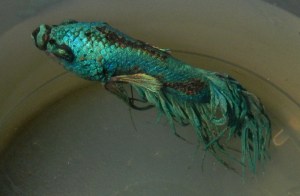
Siamese fighting fish with velvet disease.

What causes the salmon to stress during summer?

This is a question asked of me by a colleague recently. What happens when the water temperature rises? Is it due to reduced dissolved oxygen levels or anoxia (link to article)? Is it due to impaired cardiovascular function (link to article)? Is it due to the increased presence of dangers such as jellyfish or algae? Is it immunosuppressive? Maybe reovirus might be playing a role?

When working at the labs in Tasmania as a veterinary fish pathologist, I did see quite a number of fish hearts which we described as having a “mural reaction” on microscopic examination. In simpler terms, there was a fuzziness to the look of the heart, indicating inflammation. Since such findings are not specific to any particular disease, there was also testing to look for the presence or absence of various pathogens, bacterial or viral. A thorough study would be indicated to correlate these findings with the water temperature and presence of pathogens.

Have a read of the articles below and see if it adds to more information.


Journal of Fish Diseases
Volume 36, Number 5 (May 2013)
Piscine reovirus (PRV) in wild Atlantic salmon,Salmo salarL., and sea-trout, Salmo truttaL., in Norway
Authors: Å. H. Garseth, C. Fritsvold, M. Opheim, E. Skjerve, E. Biering
Author Affiliations:
no affiliations available
Source: Journal of Fish Diseases, Volume 36, Number 5 (May 2013)
Page Numbers: 483 – 493
Available Full Text:
Full Text: Subscription Required to view full text
Format: PDF
Size: unknown
Location: Publisher’s Site
Authentication: EBSCOhost EJS
Abstract: This is the first comprehensive study on the occurrence and distribution of piscine reovirus (PRV) in Atlantic salmon, Salmo salarL., caught in Norwegian rivers. PRV is a newly discovered reovirus associated with heart and skeletal muscle inflammation (HSMI), a serious and commercially important disease affecting farmed Atlantic salmon in Norway. A cross-sectional survey based on real-time RT-PCRscreening of head kidney samples from wild, cultivated and escaped farmed Atlantic salmon caught from 2007 to 2009 in Norwegian rivers has been conducted. In addition, anadromous trout (sea-trout), Salmo truttaL., caught from 2007 to 2010, and anadromous Arctic char, Salvelinus alpinus(L.), caught from 2007 to 2009, were tested. PRVwas detected in Atlantic salmon from all counties included in the study and in 31 of 36 examined rivers. PRVwas also detected in sea-trout but not in anadromous Arctic char. In this study, the mean proportion of PRVpositives was 13.4% in wild Atlantic salmon, 24.0% in salmon released for stock enhancement purposes and 55.2% in escaped farmed salmon. Histopathological examination of hearts from 21 PRV-positive wild and one cultivated salmon (Ct values ranging from 17.0 to 39.8) revealed no HSMI-related lesions. Thus, it seems that PRVis widespread in Atlantic salmon returning to Norwegian rivers, and that the virus can be present in high titres without causing lesions traditionally associated with HSMI.
Citation: Å. H. Garseth, C. Fritsvold, M. Opheim, E. Skjerve, E. Biering . Piscine reovirus (PRV) in wild Atlantic salmon,Salmo salarL., and sea-trout, Salmo truttaL., in Norway. Journal of Fish Diseases, Volume 36, Number 5 (May 2013), pp. 483-493, <http://ejournals.ebsco.com/direct.asp?ArticleID=4F948FD160688861678E&gt;
URL: http://ejournals.ebsco.com/direct.asp?ArticleID=4F948FD160688861678E

National recognition of veterinary registration in NSW.

I’ve fallen slightly behind the times, but when the NSW Dept of Primary Industries called me recently to ask me to be their consultant fish veterinarian, I had to do some calling around to get veterinary registration in that state.

Then I found that if I was already registered in another Australian state, I didn’t have to get a secondary registration!

The NSW Veterinary Practice Act 2003 has been amended to accommodate National Recognition of Veterinary Registration (NRVR) as of 20 September 2011.

from: http://www.ava.com.au/newsarticle/national-recognition-veterinary-registration-nsw

Sweet!

Now I’m not only confined to working in WA, Victoria and Tasmania (see link to previous post), but I’m also now allowed to practice in NSW!

So, if you need to book me in for a site visit, there’ll be no delays in getting me out there to see your fish facility.

Follow me on: Facebook "Fin Page"YouTubeBlogLinkedinTwitter


Yours sincerely,

Dr Richmond Loh DipProjMgt, BSc, BVMS, MPhil (Pathology) Murdoch, MANZCVS (Aquatics & Pathobiology).
Veterinarian | Adjunct Lecturer Murdoch University | WAVMA President-Elect |
Secretary Aquatic Animal Health Chapter – Australian and New Zealand College of Veterinary Scientists (ANZCVS).
The Fish Vet, Perth, Western Australia, AUSTRALIA. Mobile Veterinary Medical & Diagnostic Services for fish and other aquatic creatures.
http://www.thefishvet.com.au
Ph: +61 (0)421 822 383

Looking for more books? Check out this site.