Q: Why do fish live in salt water?
A: Because pepper makes them sneeze!
Ok, I’m really running out of jokes. I’ve to admit this one’s pretty lame.
All about Fish Vetting – Dr Richmond Loh
Q: Why do fish live in salt water?
A: Because pepper makes them sneeze!
Ok, I’m really running out of jokes. I’ve to admit this one’s pretty lame.
They’ve developed bio-sensors that that can measure the heartbeat of an oyster to see how they respond to changes in their environment such as temperature and salinity levels.
Why? To help the aquaculture industry improve productivity and manage risks.
Learn more here – http://csironewsblog.com/2013/02/21/tassie-oysters-wear-their-heart-on-their-shells/
Light is a very interesting thing. The most common general uses for lighting in aquaculture include altering photoperiods are used for breeding and increasing the photoperiod for increased feeding and hence, growth. In Artemia culture, it is used to separate the cysts from the newly hatched nauplii by using light to attract them to your dispenser. But did you know that salmon can be coaxed to do the same thing? This article talks about its application to improve salmon growth. But what about this other application?
When I was working in Tasmania as a fish pathologist, almost every summer, at least some salmon pens would be hit by jellyfish stingers. The jellyfish tend to float along the top during the day and waft along with the water currents. Sometimes the water currents direct them towards the fish pens and their stingers come into contact with the fish, either directly or like a carrot through the grater, they break up as they pass through the nets. It is not always possible or practical to move the pens away from the arriving jellyfish. What else could we do? In such events, could you use light to attract the salmon to the depths and thus avoid contact with the jellyfish? It’s definitely worth a try.
| Aquaculture | |||||||||||||||||
| Volume 391, Number 2 (April 2013) | |||||||||||||||||
 |
Modelling of Atlantic salmon (Salmo salarL.) behaviour in sea-cages: Using artificial light to control swimming depth | ||||||||||||||||
| Authors: | Martin Føre, Tim Dempster, Jo Arve Alfredsen, Frode Oppedal | ||||||||||||||||
| Author Affiliations: |
|
||||||||||||||||
| Source: | Aquaculture, Volume 391, Number 2 (April 2013) | ||||||||||||||||
| Page Numbers: | 137 – 146 | ||||||||||||||||
| Available Full Text: |
|
||||||||||||||||
| Abstract: | Submerged artificial light sources are commonly used to control sexual maturation in farmed Atlantic salmon, but may also be a tool to steer salmon to swim at depths which are optimal for production. In this study, we used an individual-based model of the behaviour of salmon toward environmental variability to simulate the swimming depths of salmon in different seasons, production environments and artificial light regimes. Model outputs agreed with direct observations of salmon swimming depths from literature, suggesting that the model accurately simulated the behavioural mechanisms behind responses toward artificial lights superimposed upon different environmental conditions. We used the model in a series of in silico experiments to predict the behavioural effects of submerged artificial lights placed at different depths in environmental conditions typical for coastal waters in winter, spring and summer. The model indicated that artificial lights controlled salmon swimming depths most efficiently in winter. Further, lights may be more efficient in sites with a more homogeneous environment throughout the water column (e.g. open coast) than sites that are thermally stratified (e.g. fjords). Placing submerged lights at the right depths could produce better culture conditions, ultimately resulting in increased growth. With standard measurements of temperature at several depths as a sole user input, the model could act as a tool to inform farmers of which depths to place their lights on any given day or season. | ||||||||||||||||
| Citation: | Martin Føre, Tim Dempster, Jo Arve Alfredsen, Frode Oppedal . Modelling of Atlantic salmon (Salmo salarL.) behaviour in sea-cages: Using artificial light to control swimming depth. Aquaculture, Volume 391, Number 2 (April 2013), pp. 137-146, <http://ejournals.ebsco.com/direct.asp?ArticleID=4764ABC6CAF1C6005D07> | ||||||||||||||||
| URL: | http://ejournals.ebsco.com/direct.asp?ArticleID=4764ABC6CAF1C6005D07 | ||||||||||||||||
This is a case of a freshwater cichlid that was looking gaunt, produced little amounts of pale/white faeces. It was euthanased for laboratory analysis by The Fish Vet. Microscopically, there was severe, diffuse, subacute, enteritis and a mild to moderate degree of hepatocellular atrophy. Citrobacter freundii was isolated on cultures. This bacteria tends to be a secondary invader, but has been implicated as primary pathogens too. It can be found in eutrophic freshwater or seawater. True to the textbook, the antibiotic sensitivity tests (disc diffusion method) on this isolate indicate that it is resistant to a multitude of antibiotics, and is sensitive only to enrofloxacin. This means that you would not get a cure if you were to use any other kind of antibiotics. This case is discussed in the video with practical advice on management.
Check out my latest Youtube video here –
Follow me on: Facebook "Fin Page" – YouTube – Blog – Linkedin – Twitter
—
Yours sincerely,
Dr Richmond Loh DipProjMgt, BSc, BVMS, MPhil (Pathology) Murdoch, MANZCVS (Aquatics & Pathobiology).
Veterinarian | Adjunct Lecturer Murdoch University | WAVMA President-Elect |
Secretary Aquatic Animal Health Chapter – Australian and New Zealand College of Veterinary Scientists (ANZCVS).
The Fish Vet, Perth, Western Australia, AUSTRALIA. Mobile Veterinary Medical & Diagnostic Services for fish and other aquatic creatures.
http://www.thefishvet.com.au
Ph: +61 (0)421 822 383
Looking for more books? Check out this site.
Now we are approaching the cooler months of the year in the southern hemisphere and backyard aquaponics guys will be stepping down their barramundi culture and will be starting to look at sourcing rainbow for the winter months.
So, why this change from barramundi to rainbow trout? This is because their temperature requirements are different. In a previous post, I outlined the temperature requirements for barramundi (Lates calcarifer) (link to previous post). But to summarise the findings, the optimal temperature range is 26-32°C and their tolerance range is 15-37°C. This is why they make a good summer crop in Perth and harvesting should be underway.
But what about rainbow trout? In “Fish Vetting Essentials”, we published that the optimal temperature range for rainbow trout is 14-18°C and their tolerance range of 1 – 25°C. The Food and Agriculture Authority (FAO) publishes optimal temperature ranges of 9 – 21°C and a tolerance range of 0 – 27°C (link to source). The Department of Primary Industries Victoria considers the optimum water temperature range is 10 – 22°C and a tolerance range of 0 – 30°C (link to source). The Southern California Edison who published a literature review on (rainbow) Trout Temperature Requirements found that the upper incipient lethal temperature (UILT) for rainbow trout is within the range 25 – 30°C, but were able to maintain weight at 25°C for 30 days (link to source).
The combined experiences of myself and my co-author of “Fish Vetting Essentials” are that the water temperatures in Tasmania this summer (2012/2013) hit 25oC. Whilst it did stress the trout, most survived. We have clients with aquaponics setup who do not experience any signs of ill-health in their rainbow trout until the water temperature exceeds 24-25oC. There was another case at a hatchery in Victoria where most fish survived despite the water temperature reaching 25oC during the summer of 2009.
So, what’s the correct “optimal” and “tolerance” ranges? Well, you’ll have to decide on these based on a combination of literature reviews of natural occurrences and experimental data, and professional experience. Note that the natural optimal and tolerance ranges of any species are a lot wider than their commercial production values. Having revisited my published data, I am staying firm with our published optimal and tolerance temperature ranges for rainbow trout (i.e. optimal as 14-18oC, and tolerance as 1-25oC), although the research shows they can tolerate up to 30oC! I guess that these ranges can be extended or restricted within biological limits, and will also be influenced by genetic differences, other environmental parameters, health and nutrition and so on and so forth.
So, what does all this mean for you? With outdoor pond water temperatures at the moment of below 25oC, the time is about right for stocking rainbow trout, but make sure you monitor the water temperature that it you don’t continue to rear the fish when the water temperatures rise again during late spring.

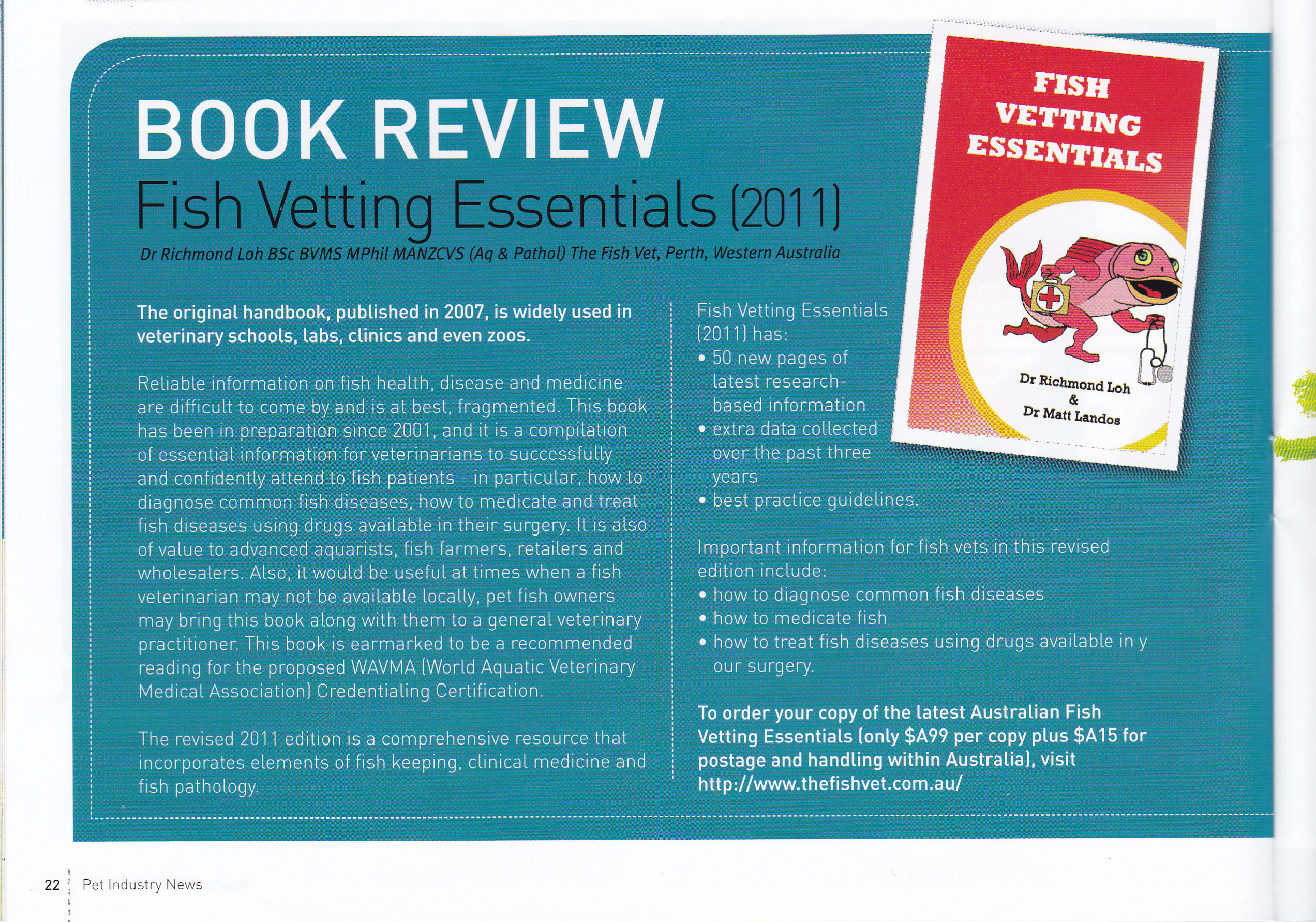
I’m a bit biased, but I’d have to say that this is the most practical book that’s currently available on the medical aspects of fish health. The information published in “Fish Vetting Essentials” a combination of literature reviews of natural occurrences, experimental data and professional real life experience. The inclusion of the latter means that some of this information is not found elsewhere and it is the unique point of difference.
View free sample pages here – eFishVetEssentialswLinks.
Get your copy of the latest Fish Vetting Essentials (only $A99 per copy plus $A15 for postage and handling within Australia), now at www.thefishvet.com.au or click here to proceed directly to the shopping cart.
PRACTICAL FISH KEEPING
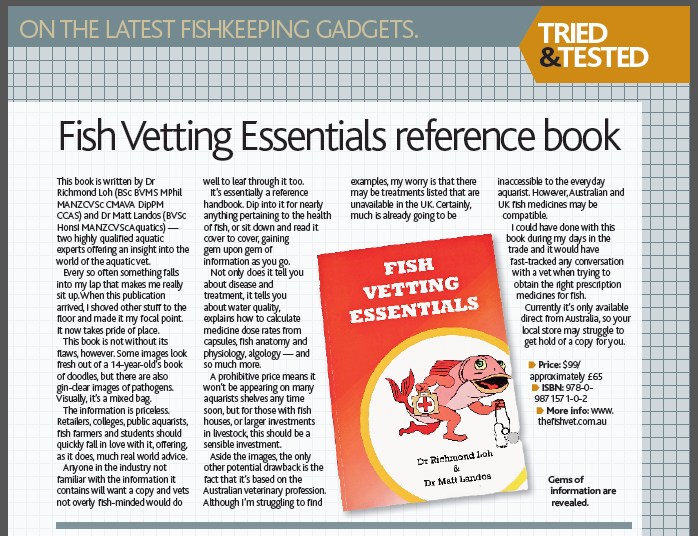
VETERINARY RECORD
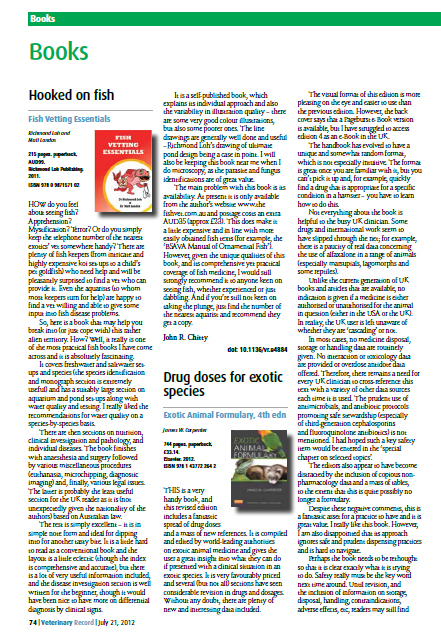
WORLD AQUATIC VETERINARY MEDICAL ASSOCIATION
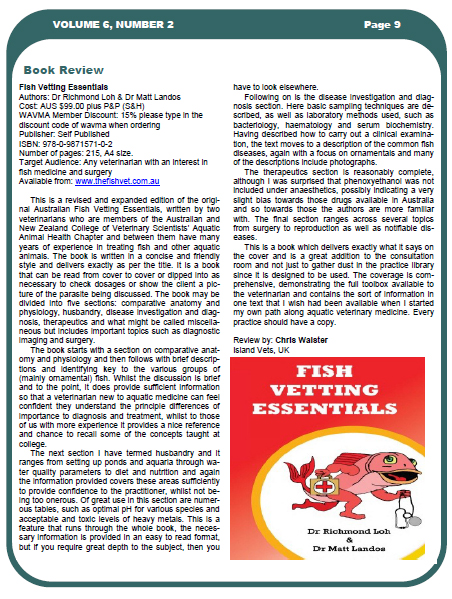 ‘
‘
PET SCANDINAVIA
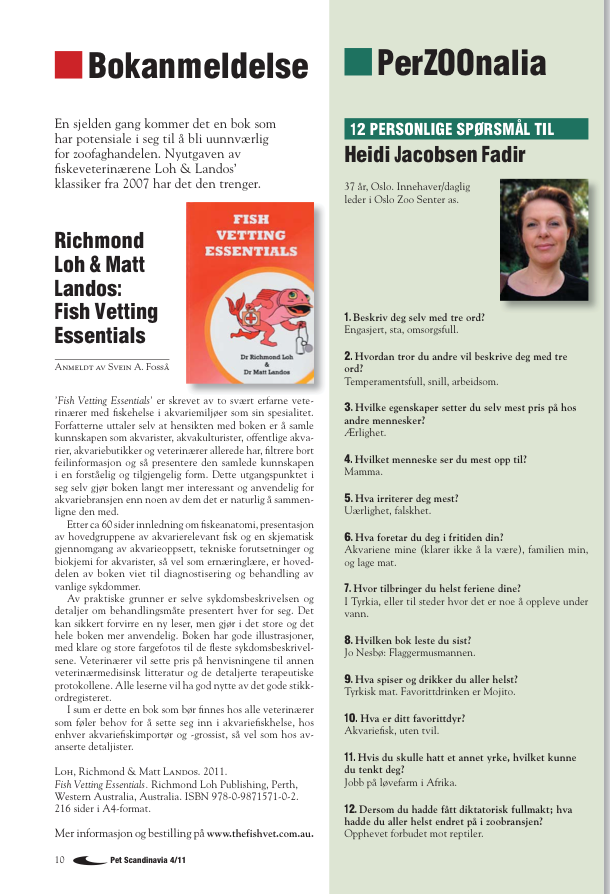
PET INDUSTRY NEWS
KOI

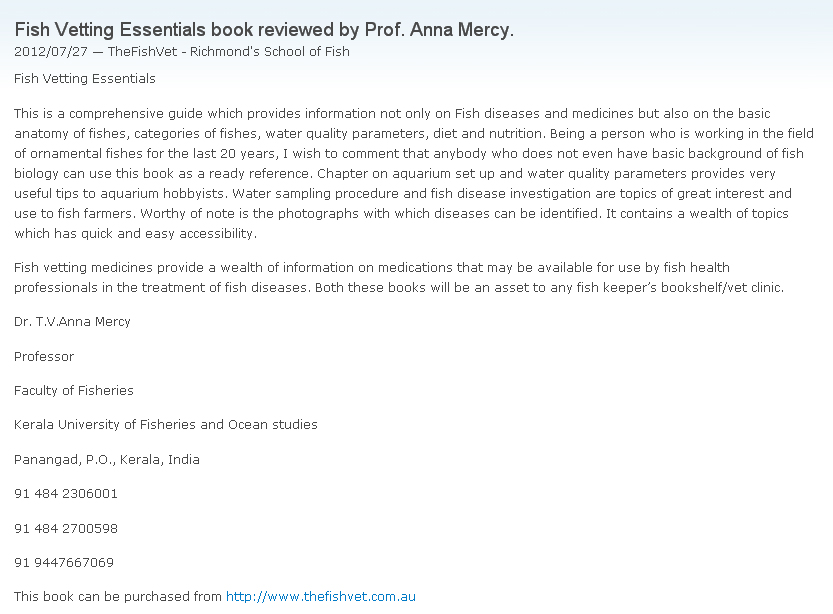
PROF. ANNA MERCY
Testimonials
I use “Fish Vetting Essentials” as my first reference for matters pertaining to aquatic animal health. Its clear, concise layout and colour photographs make it a highly practical source of information. The information on diagnostic sample collection and treatment is easy to follow and has enabled us to develop the skills necessary to manage disease cases in fish effectively. I highly recommend “Fish Vetting Essentials” for veterinarians dealing with aquatic species.
Dr Simone Vitali BSc, BVMS, PhD, MACVS (Zoo Animal Medicine), Senior Veterinarian, Perth Zoo.
<><
I have owned a veterinary general practice for 30 years and my copy of Fish Vetting Essentials has been an excellent resource for me when I am asked to treat exotic aquarium fish. Previously the only readily available information on treating and diagnosing fish were anecdotal, unreliable and outdated popular press publications or high-end scientific material that was not useful from a practical point of view. Fish Vetting Essentials is concisely written and contains everything a general practitioner needs to take a logical, helpful approach to aquarium fish problems.
Dr Owen Lavers BVSc, Earlville Vet Surgery, Queensland.
<><
As a veterinary clinician with an interest in the “unusual and exotic” fish species, I am frequently asked to consult with clients who present their fish for examination, diagnosis and treatment. I have an extensive medical library, and Fish Vetting Essentials is by far the most useful reference on fish diseases and fish treatments.
Dr James M Harris BSc, DVM, FRSPH, Mayfair Veterinary Clinic, Tasmania.
<><
FishVetEssentials_2011 eSample.pdf
Watch Dr Loh talk about what’s in the book and how it’s organised – click here.
To order your copy of the latest Fish Vetting Essentials, visit thefishvet.com.au or click here to proceed directly to the shopping cart.
Feel free to pass it on to others who you think might be interested.
As you know, I have been awarded The George Alexander Foundation International Fellowship, officiated by the International Specialised Skills Institute (http://www.issinstitute.org.au/). With that, I’ve registered to attend the Seavet course (http://conference.ifas.ufl.edu/ame/seavet/) during June 2013 in Florida, USA. The 2-week course will cover veterinary aspects of marine megafauna such as sharks, stingrays, fish, pinnipeds, cetaceans, manatees, turtles and penguins. I will also be visiting Hawaii Dept Agriculture, the University of Hawaii at Hilo and The University of Florida’s Tropical Aquaculture Laboratory in Ruskin, FL, USA.
It is my intention that I gather a list of relevant contacts so that I can disseminate the information upon my return as part of my Fellowship. I would like to start collating any questions you may have for me to ask the experts, so that the information I’ll be disseminating will be relevant to you. I’ve started a Google Document that you may add your questions to, under the respective headings.
The virtual file will be called “Seavet 2013 Questions from ISSI Distribution List” and here is the link – http://tinyurl.com/couut99
Note that this file will be available to anyone with the link, so be careful not delete anyone else’s questions. Thank you for your interest and support.
Also, you may wish to register with my various social media platforms (see links below) for more informal chatter about aquatic animal health matters.
—
Follow me on: Facebook “Fin Page” – YouTube – Blog – Linkedin – Twitter
—
Yours sincerely,
Dr Richmond Loh
DipProjMgt, BSc, BVMS, MPhil (Vet Path), MANZCVS (Aquatics), MANZCVS (Pathobiology).
Veterinarian | Adjunct Senior Lecturer Murdoch University | President-elect World Aquatic Vet Med Assoc|
Secretary Aquatic Animal Health Chapter – Australian and New Zealand College of Veterinary Scientists (ANZCVS)
The Fish Vet, Perth, Western Australia, AUSTRALIA. Mobile Veterinary Service for fish and other aquatic creatures.
http://www.thefishvet.com.au
Ph: +61 (0)421 822 383
Question: when i was young ‘fish’ was used for singular and plural. In recent years i’ve heard people use ‘fish’ and ‘fishes’ for plural. I was taught the latter was wrong, but maybe now it’s considered correct? Your thoughts?
Answer:
My dad was old school taught and he says that ‘fishes’ refers to multiple fish species. Otherwise, ‘fish’ is like ‘sheep’, to be used plural or singular.
So, it’s legit if it’s for multiple fish species. If you’re talking about a pen of a thousand salmon, then it’s ‘fish’ in the plural sense if the word. But a thousand ‘fishes’ in the coral reef because there are lots of different species.
I received this via an email forward…
But Claude the Tasmanian giant crab was saved from death when the fisherman who caught him sold him to a British aquarium for £3,000.
Now, after a 29-hour plane journey from Australia – where giant crab meat is a delicacy – and two weeks in quarantine, Claude is ready to meet his public.

Catch of the day: Held up by Sealife aquarist Jemma Battric, Claude weighs a mighty 15lbs and measures 15 inches wide – when he is fully grown he will weigh a whopping 30lbs and gain an extra three inches
Currently he is being kept on his own in a specially made cylindrical tank, ten feet tall and six feet wide, but the aquarium will intro duce some coldwater fish once he is settled.
Mini me: Claude dwarfs a British Shore crab who is put on his back for size and to show just how gigantic he isBig crab, small appetite: ‘The crabs don’t eat very much despite being one of the largest species and they will feed on shrimp, prawns, and squid when they are here,’ said Jemma Battrick, aquarist at Weymouth Sea Life
In the wild, crabs eat any dead or dying matter they find on the seabed but Claude is currently dining on diced mackerel and squid and is reportedly very happy with his gourmet diet.
Rob Hicks, head marine biologist for Sea Life, said: ‘They are such impressive creatures we thought that it was worth the cost and effort of flying them halfway round the world so the y can flourish in an aquarium display.
‘They had a stopover in Hong Kong and arrived with us two weeks ago. It took them a few days to get over the jet-lag but now they’re feeding happily and don’t seem any the worse for their trip.’
Jemma Battrick, aquarist at Weymouth Sea Life said: ‘When I found out we were getting the crabs in I was really excited.
Massive claws: Rob Hicks, head marine biologist for Sea Life, said: ‘They are such impressive creatures we thought that it was worth the cost and effort of flying them half-way round the world to so they can flourish in an aquarium display’
‘We already have a tank here for them so it will be easy to move them in, and they will go on display straight away.
‘The crabs don’t eat very much despite being one of the largest species and they will feed on shrimp, prawns, and squid when they are here.
‘We want to increase their numbers but in Australia people eat them and I think visitors to the Sea Life will be shocked when they find that out because they look so magnificent.
Reading this article made me think of an alternative use for Artemia nauplii. What if, we can harness their hunger for bacteria to help with cases of pathogenic bacterial blooms? This might be particularly useful in hatchery situations, provided of course that the Artemia nauplii do not predate on your cultured organisms.
| Aquaculture | |||||||||||||||||
| Volume 391, Number 2 (April 2013) | |||||||||||||||||
| |
Bacteria contribute to Artemianutrition in algae-limited conditions: A laboratory study | ||||||||||||||||
| Authors: | Huynh Thanh Toi, Pascal Boeckx, Patrick Sorgeloos, Peter Bossier, Gilbert Van Stappen | ||||||||||||||||
| Author Affiliations: |
|
||||||||||||||||
| Source: | Aquaculture, Volume 391, Number 2 (April 2013) | ||||||||||||||||
| Page Numbers: | 1 – 7 | ||||||||||||||||
| Available Full Text: |
|
||||||||||||||||
| Abstract: | We investigated the effect of the stimulation of bacterial growth on Artemia performance in combination with a standard and with a low algal feeding regime. In both regimes, organic carbon (supplied as sucrose or soluble potato starch) and 15N labeled inorganic nitrogen (supplied as NaNO3) were used to stimulate bacterial growth in the Artemia cultures at C/N ratio 10 and 50. After a culture period of 15days, significantly improved biomass production was obtained in all treatments with the low algae feeding regime, supplemented by carbohydrate addition. In addition, results of 15N accumulation and fatty acid analysis in Artemia indicated that Artemia utilized more bacteria in algae-limited conditions. Our study shows that bacteria can be used as a nutrient source for Artemia compensating for suboptimal algae supply. In Artemia pond cultures, carbohydrate addition may hence potentially be used to stimulate the conversion of nitrogen waste into heterotrophic bacterial biomass. This can be converted into protein-rich Artemia biomass, especially when algae are in sub-optimal supply. These findings open perspectives for alternative Artemia pond production protocols, in addition to the present management procedures that exclusively focus on phytoplankton blooms as nutrient source to sustain dense Artemia populations. | ||||||||||||||||
| Citation: | Huynh Thanh Toi, Pascal Boeckx, Patrick Sorgeloos, Peter Bossier, Gilbert Van Stappen . Bacteria contribute to Artemianutrition in algae-limited conditions: A laboratory study. Aquaculture, Volume 391, Number 2 (April 2013), pp. 1-7, <http://ejournals.ebsco.com/direct.asp?ArticleID=456F9ACE297733BDC76B> | ||||||||||||||||
| URL: | http://ejournals.ebsco.com/direct.asp?ArticleID=456F9ACE297733BDC76B | ||||||||||||||||