As a food producer, whether it be in agriculture or aquaculture, can you afford NOT to use a veterinarian?

I just received this in my email inbox, and thought I’d share it with you.

There may be many types of consultants with different qualifications out there, but out of these, who’s going to be accountable if there are drug residues, or for biosecurity breaches?

It is the veterinarian who will take the time to practice good biosecurity measures to ensure they do not transfer diseases from one property to another. They are the ones who are charged to be judicious with the provision of medicines, and only after making efforts at obtaining a proper diagnosis.

We take our jobs very seriously because our lifelihoods are at stake.

So, please consider, can you afford NOT to use a veterinarian?

How do you treat fish with chlorine toxicosis?

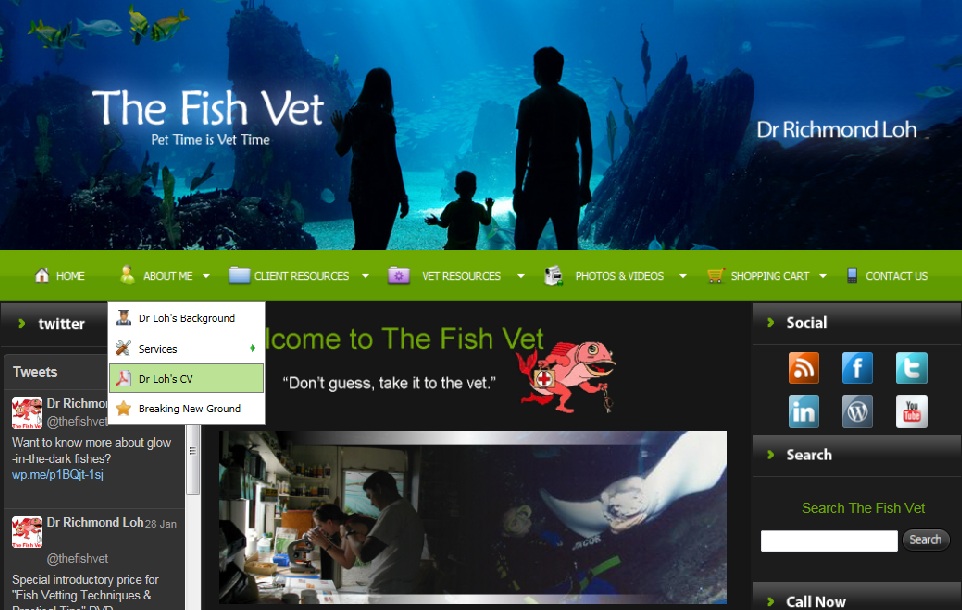
Check out what steps my colleague took, to treat fish affected by chlorine toxicity, in the post pictured below.

Make sure you share this with your fishy friends too.–
Yours sincerely,

Dr Richmond Loh
DipProjMgt, BSc, BVMS, MPhil (Pathology) Murdoch, MANZCVS (Aquatics& Pathobiology), CertAqV WAVMA.
THE FISH VET, Perth, Western Australia.
Veterinary Medicine for fish.
W: http://www.thefishvet.com.au
E: thefishvet
P: +61 (0)421 822 383

Avoid chlorine toxicosis when filling up your ponds, using tap water.

Did you know that in the last week, I have come across 4 instances of chlorine toxicosis with people overfilling their ponds?

With the recent spate of hot days and warm nights, evaporation rates are much faster. People top up their ponds with hoses, and because of the large volumes needed to be refilled, people walk away, and forget to turn the tap off when it’s time.

There are a couple of simple solutions to this. You may install a tap timer to your tap, or a float valve in your pond or filter sump. Another method is to install an inline carbon cartridge to adsorb the chlorine before the water enters your pond.

Make sure you share this with all your fishy friends.


Yours sincerely,

Dr Richmond Loh
DipProjMgt, BSc, BVMS, MPhil (Pathology) Murdoch, MANZCVS (Aquatics& Pathobiology), CertAqV WAVMA.
THE FISH VET, Perth, Western Australia.
Veterinary Medicine for fish.
W: http://www.thefishvet.com.au
E: thefishvet
P: +61 (0)421 822 383

World Aquatic Veterinary Medical Association (WAVMA) – President’s Welcome Letter, 2014.

The President’s Welcome Letter outlines the direction the new WAVMA President, Dr Richmond Loh, would like WAVMA to take during 2014 and includes information on developing member services.

The first objective in our WAVMA Mission Statement is “To serve aquatic veterinary medicine practitioners of many disciplines and backgrounds by developing programs to support and sustain members, and the aquatic species industries that they serve.

Read the letter at this link –http://tinyurl.com/l73tf7q


Yours sincerely,

Dr Richmond Loh
DipProjMgt, BSc, BVMS, MPhil (Pathology) Murdoch, MANZCVS (Aquatics& Pathobiology), CertAqV WAVMA.
THE FISH VET, Perth, Western Australia.
Veterinary Medicine for fish.
W: http://www.thefishvet.com.au
E: thefishvet
P: +61 (0)421 822 383

Master B8r, my new credential! KSWA southern branch meeting – Rodney Hansen talked about artificial Koi breeding.

Last night’s presentation was given by Mr Rodney Hansen, about his experiences with artificial koi breeding; working with Mr Dave Lake, and myself.

When we got to the part where we were stripping the fish, someone awarded me a new credential – Master B8r!

I said, do you mean the fishing kind (Master baiter)?

It was a most enjoyable presentation and Rodney picked up on some very interesting points, comparing the pros and cons of hormonal induction, versus, the traditional method of camping out with your fish over several nights.

Some of the advantages of the hormonal induction method include:

  1. More exact and predictable results.
  2. Better pairing.
  3. Use fewer fish.
  4. Can be done even if you don’t have extensive set ups.
  5. Increased rates of fertility.
  6. Higher percentage of fertilised eggs means less bacterial and fungal infection of eggs.
  7. Less likely to become egg bound, get infected or incidence of ovarian tumours with unspawed females.
  8. Less injuries and stress to parents because natural spawning can be quite ‘voilent’.
  9. Quicker and so, no exhaustion of parents.
  10. Can continue to show parents.

So, if you’re interested in doing this too, you can enquire with me.

Follow me on: Facebook "Fin Page"YouTubeBlogLinkedinTwitter


Yours sincerely,

Dr Richmond Loh DipProjMgt, BSc, BVMS, MPhil (Pathology) Murdoch, MANZCVS (Aquatics & Pathobiology), CertAqV.
Aquatic Veterinarian | Adjunct Lecturer Murdoch University | President WAVMA |
Secretary Aquatic Animal Health Chapter – ANZCVS.
The Fish Vet, Perth, Western Australia, AUSTRALIA. Mobile Veterinary Medical & Diagnostic Services for fish and other aquatic creatures.
http://www.thefishvet.com.au
Ph: +61 (0)421 822 383

HUGE carp fished out of the Swan River!

Check out this HUGE carp what was fished out of the Swan River!

http://www.watoday.com.au/environment/save-our-swan/giant-feral-goldfish-invade-was-river-systems-20131011-2vcwk.html

Can we start a debate?
Does the presence of carp or goldfish in rivers indicate they have out-competed native aquatic animals and are destroying the environment? Or does it mean that there was significant environmental degradation (increased salinity, decreased water volume and flow, increased effluent, herbicides, fertilisers) that they are the only ones that can survive/flourish in this type of habitat?

Another question we could ask is,

    are there

, or

    what are

the beneficial impacts of having these fishes in our waterways? Perhaps the suppression of other invasive creatures such as the mosquito fish and mosquitoes? Carp and goldfish are prey species and so they might provide food for other aquatic animals. The article mentions they eat algae and so could it be that they may be playing a role in keeping algae in check?

Dr Loh’s planning his trips for 2014.

In case you’d like to catch me at a conference, I’m planning several trips around the place.

Feb 5: Sydney Australia & New Zealand Zebrafish Husbandry Workshop

http://www.garvan.org.au/symposium/anzzebrafish/husbandry-workshop

Topics I’ll be presenting:

26-29 July: DenverAmerican Veterinary Medical Association’s Annual Convention

https://www.avma.org/Events/Convention/Pages/default.aspx

Topics I’ll be presenting:

  • The Fish Vet’s pharmacy: What an aquatic veterinarian needs and what for?
  • Treatment protocols for infectious diseases: The art behind the choice of drugs and method of administration.
  • Case study: Who am I? A run through of fish pathogens providing a series of clues before arriving at the diagnosis.
  • There will also be a wet workshop where I’ll be part of the demonstration crew – diagnostic and necropsy procedures.

28-30 November: Singapore – Federation of Asian Veterinary Associations Congress

http://fava2014.com/

Topics I’ll be presenting:

  • Clinical signs of fish disease and routine diagnostic procedures.
  • Common fish parasites – diagnostic features of parasites on microscopy and treatment options.
  • We are planning a workshop where I’ll demonstrate diagnostic procedures, common surgical procedures and more.

jet setting

Fish Vetting Techniques and Practical Tips – instructional DVD: Fish Vetting Secrets revealed!

There is no better way to teach or learn, than to show, or be shown.

FISH VETTING TECHNIQUES & PRACTICAL TIPS reveals the best ways to treat any type of fish.

This DVD is the most valuable resource for all fish vets, aquarists, fish shop owners, vet schools and zoos – so buy it now!

All your questions about veterinary procedures on treating all fish types are answered in this DVD.

Experienced Australian fish vet Dr Richmond Loh takes you on an absorbing journey into the world of fish vetting: learn how to take skin mucus scrapes and blood samples, inject fish, videos of live microscopic fish pathogens and more… That’s right, I’m giving away all my secrets so that fish clients can have greater access to trained aquatic veterinarians no matter where they are in the world.

Don’t wait! Order a copy of Fish Vetting Techniques & Practical Tips.

Buy a copy now – soon you will be able to treat any fish with full confidence!

This DVD is ideal for fish veterinarians, aquarists, aquaculturalists, public aquaria, local fish shops and to have handy as a training resource in veterinary schools, laboratories, clinics and zoos. It is a comprehensive resource that incorporates aquatic medicine and pathology.

Make your purchase NOW at http://thefishvet.com.au/shop/shopping.html
Available in two formats: PAL & NTSC (please select the correct item when making your purchase).

dvd

In this series are the following books:

  • Fish Vetting Essentials.
  • Fish Vetting Medicines – Formulary of Fish Treatments.

Dr Richmond Loh (BSc, BVMS, MPhil, MANZCVS, CertAqV) is the 2014 President of the World Aquatic Veterinary Medical Association (WAVMA), Secretary of The Aquatic Animal Health Chapter of the Australian & New Zealand College of Veterinary Scientists (ANZCVS), an adjunct lecturer at Murdoch University in Western Australia, an eHow Pets Expert and is a George Alexander Foundation International Fellow. His skill set is unique, having been admitted as a Member of the Australian & New Zealand College of Veterinary Scientists (ANZCVS) by examination in the subjects of “Aquatic Animal Health” and in “Pathobiology”. As “The Fish Vet”, he provides veterinary services for a range of clients and they include individual pet fish owners, public aquaria (Aquarium of Western Australia), retailers, wholesalers, fish farmers (ornamental and food fish) and educational institutions (Murdoch University, Edith Cowan University & University of Western Australia).

Free Neptune webinar: Fish Dermatopathology by Dr Brian Jones.

Hi Everyone,

I am pleased to invite you to attend Dr Brian Jones’ presentation on Piscine dermatopathology.

Details for the webinar:

  • Time & Date: Tuesday, January 28, 2014, 1:00 PM – 2:00 PM Eastern Time – Brisbane. (Check in your time zone)
  • Click on the following link to join the meeting: https://www.anymeeting.com/998-336-438
  • *Please disregard AnyMeeting’s audio options when you click on the link when entering the meeting select the “phone” icon but don’t use their number, use the one below. Also, please note that the audio will only be available via phone, not by computer speakers.
  • The Australian Toll-Free Number: Phone Number: 1 800 804 723 Participant passcode: 389 131 7648

First time joining a meeting on AnyMeeting? Check out our guides for Attendees to see how easy it is!

Have you taken the System Test? Make sure that your computer is ready to go by clicking here.

If you have any questions, please contact:

Dr Marissa McNamara
Project Manager – Neptune

PO Box 3300 | South Brisbane BC | Queensland 4101 | Australia
t: +61 (0)7 3842 9173 e: marissa.mcnamara@qm.qld.gov.au