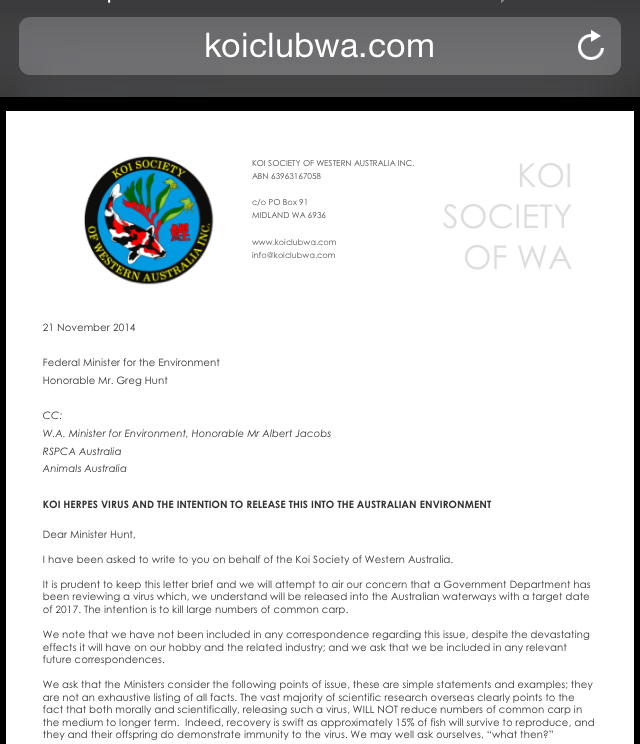
Let’s hope that people will see sense by this well laid out letter.
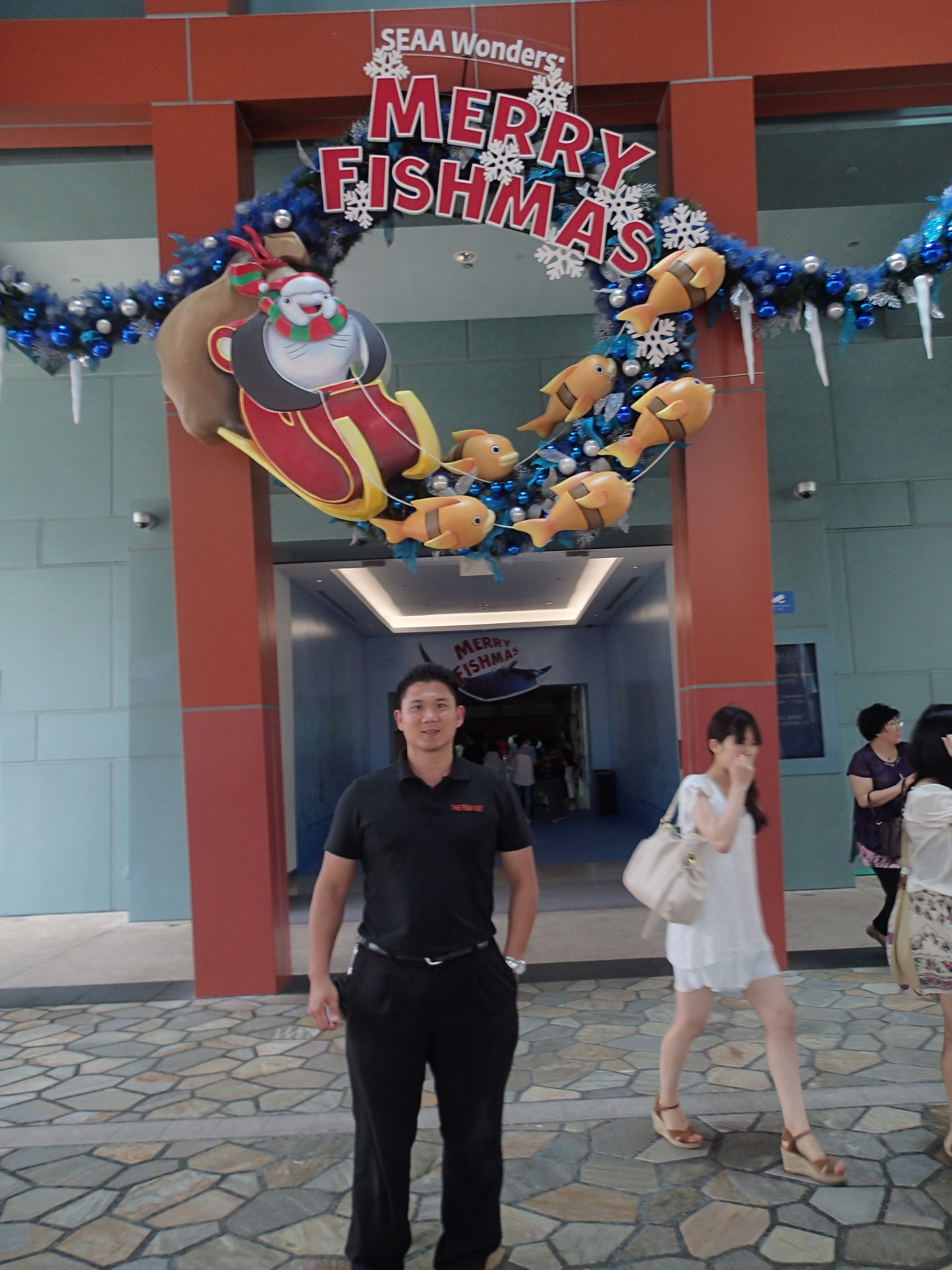
All about Fish Vetting – Dr Richmond Loh
Thank you for your continued support through this year. It has been a wonderful year of meeting wonderful clients and colleagues and many many fishes!
Just letting you know that I will be in Melbourne from Wednesday 24 December to Monday 6th of January 2015. It will be possible to visit clients there if pre-arranged.
So if you’re in Perth and need me to check on your fish, I still have time slots available for this Saturday.
Please contact us now to arrange orders particularly consumables to be dispatched before the Christmas shutdown period <http://thefishvet.com.au/shop/shopping.html>
Urgent enquiries over the Christmas period, please use this link – http://thefishvet.com.au/contact_us.html
Follow me on: Facebook "Fin Page" – YouTube – Blog – Linkedin – Twitter
—
Yours sincerely,
Dr Richmond Loh DipProjMgt, BSc, BVMS, MPhil (Pathology), MANZCVS (Aquatics & Pathobiology), CertAqV, CMAVA, NATA Signatory.
THE FISH VET, Perth, Western Australia, AUSTRALIA.
Mobile Aquatic Veterinary Medical & Diagnostic Services.
http://www.thefishvet.com.au
Ph: +61 (0)421 822 383

Skype: thefishvet
President WAVMA 2014

Adjunct Lecturer Murdoch University | Secretary Aquatic Animal Health Chapter – ANZCVS.
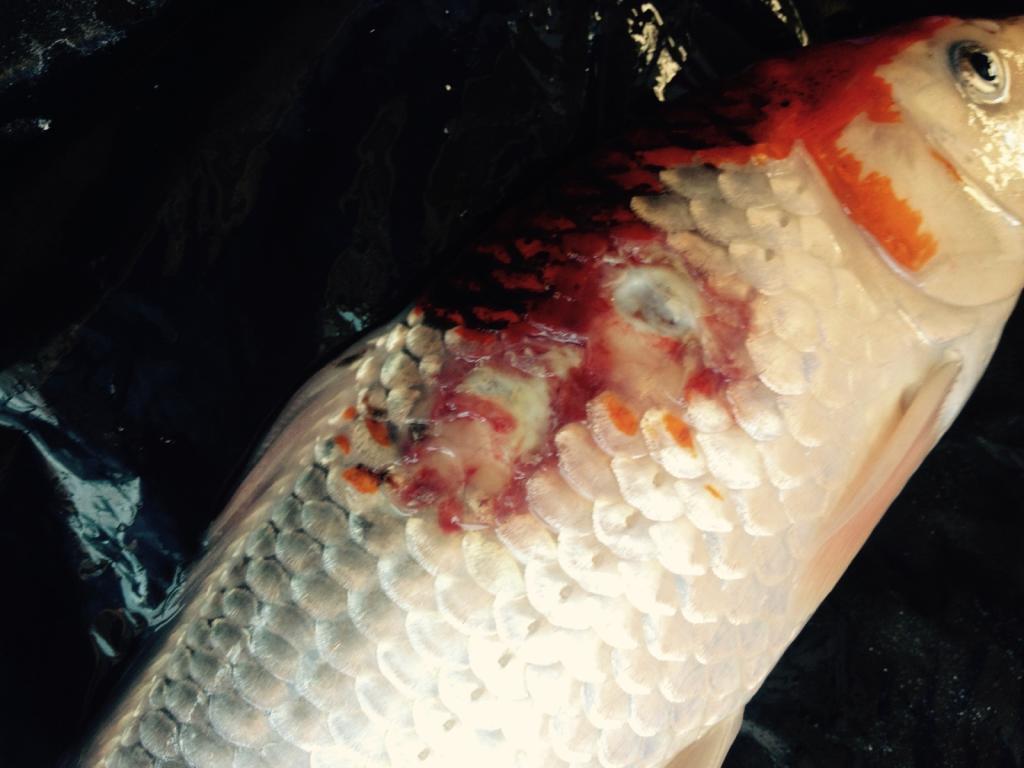
Skin ulcers in fish can be due to a large variety of causes including water quality, immunosuppression, stress, bacterial infection and a host of parasitic diseases.
Just this week I’ve attended several cases of skin ulcers in fish that were caused by multiple factors.
The key to a cure is to first, get the right diagnosis prior to treating.
Thus, to treat merely with antiseptics (e.g. Potassium permanganate) or antibiotics may not achieve a cure. You’d end up frustrated, and prolong the inevitable; fish will continue to suffer and die.
In this case we were able to diagnose skin flukes (on microscopic exam) as the primary cause of skin ulcers in the pond of koi fish. So, in addition to antibiotics and supportive therapy, the fish were also treated for flukes.
See how I treated this individual <
The Powder Gel I used is available from <http://thefishvet.com.au/shop/shopping.html>. I’ve used it on many species including freshwater and marine turtles, seahorses, koi, goldfish, marine sharks and more. The only species it hasn’t worked in was the wobbegong shark. A must-have for every fish ulcer treatment.
I’d like to thank my client for allowing me to share this case with you.
—
Yours sincerely,
Dr Richmond Loh
DipProjMgt, BSc, BVMS, MPhil (Pathology) Murdoch, MANZCVS (Aquatics& Pathobiology), CertAqV, CMAVA, NATA Signatory.
THE FISH VET, Perth, Western Australia.
Veterinary Medicine for fish.
W: http://www.thefishvet.com.au
E: thefishvet
P: +61 (0)421 822 383
President WAVMA.org
Q: What name would you give to a newborn female sea monkey?
A: Briony (shrimp).
WAVMA WebCEPD B-1007 – Tropical Fish Tranquilization, Anesthesia & Euthanasia
Join us for a free webinar on Saturday, December 21, 2014 at 1:00 AM Australian Western Standard Time (Perth/Singapore/Hong Kong).
Click http://tinyurl.com/mt9faw5 to check your local time
Register now!
https://attendee.gotowebinar.com/register/7386512880671218690
This webinar will review veterinary procedures, drug dosages and routes of administration that can be used to sedate, anesthetize and euthanize tropical or pet fish. Sedating or tranquilizing fish prior to handling for physical examinations and diagnostic tests, or surgery makes the process easier. Anesthetizing the fish prior to surgical procedures is essential, and euthanasia with an overdose of anesthetic (oral, injected or in the water) is sometimes necessary and can be quick and painless. This webinar is suitable for veterinarians, vet techs/nurses, vet students, research scientists and aquarists/aquarium husbandry staff.
Speaker
Dr Nick Saint-Erne DVM, CertAqV (Quality Assurance Veterinarian, PetSmart, Inc.)
Learning Objectives – participants will learn:
1. How to use available anesthetic drugs, anesthetic depth monitoring & post-anesthetic recovery
2. How to construct and use anesthetic equipment and surgical tables, suitable for tropical fish
3. How to euthanize tropical fish using available anesthetic agents, when necessary
NOTE: this webinar will be recorded. If you register for the live webinar and are unable to attend, you will be sent a link to view the webinar at a later time.
Want CEPD credit? (Registration is required)
Information on how to access the recorded webinar (at no cost), and a short knowledge & skills assessment (KSA or quiz) covering the webinar’s principle learning objectives, in order to earn 1.5 hours of veterinary Continuing Educational & Professional Development (CEPD) credit will be e-mailed to all registrants in 7-10 days after the webinar.
As CEPD credit can be used towards re-licensing or registration requirements to practice veterinary medicine, we provide WAVMA Members a discount off the US$25.00 fee for CEPD ($5 for student members, $15 for all others).
Register now for this free live WAVMA WebCEPD webinar at https://attendee.gotowebinar.com/register/7386512880671218690
After registering, you will receive a confirmation email containing information about joining the webinar.
___________________________
AquaVetMed e-News provides information to veterinary and veterinary-allied subscribers concerning aquatic animal medicine, health, welfare, public health and seafood safety, obtained from a variety of sources (largely AquaVetMed subscribers). While provided by the American Veterinary Medical Association’s, Aquatic Veterinary Medicine Committee and are for public distribution, they do not necessarily reflect the opinion of the AVMA or the veterinary profession. See the AVMA Terms of Use (http://tinyurl.com/29h2rf) for further information.
Subscription and Contributions: Interested veterinarians and veterinary-allied professionals can subscribe, unsubscribe, or contribute pertinent news or information, by sending a message with “For AquaVetMed -” and the topic in the subject line, to dscarfe@avma.org. If e-News information is used elsewhere please acknowledge AquaVetMed as the source. Encourage individuals to subscribe rather than distribute through list serves.
Note: Undelivered e-mails will not be resent; Subscribers will be deleted from the list after repeated undelivered or bounced messages and will have to re-subscribe. Messages may contain attachments that will have been scanned for known viruses.
Visit our website: http://www.avma.org
________________________________
Have you asked someone to help feed the fish while you’re away? Have you recently introduced new fish to your tank/pond? Have you recently cleaned the filter and tank/pond?
Well… if you answered “Yes” to any of these, you might be in for a shock!
Can your fish survive you being away?
Many non-fish people don’t know how much to feed fish and aren’t attuned to checking for signs of poor water conditions or sick fish. And your instructions on feeding might go astray because well-meaning friends feel they want to feed them more.
New introductions can be a source of new diseases. And while you’re away, there’s no one who knows your fish better than you, to check on their health.
Some people can over clean their filters and aquaria/ponds and disturb their healthy biofilters and biofilm. You might run into ‘new tank syndrome’ where ammonia and/or nitrite can reach dangerous levels.
If you’re going away for less than two weeks, fish can readily fast for that period. Alternatively, prepare multiple containers with pre-measured amount of feed, one for each day.
In terms of water quality issues, never wash your filters too thoroughly. It’s a good idea to get your water tested regularly (weekly is recommended).
For infectious diseases, it’s a good idea to get your fish regularly screened by your fish veterinarian (once or twice a year is recommended).
Q: Why do whales migrate annually?
A: For a sea change.