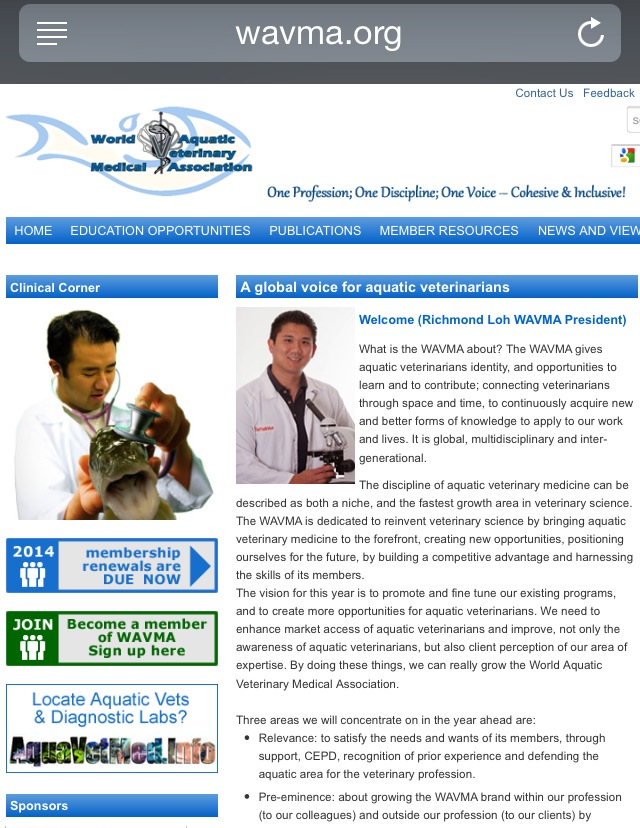
Join Doctor Loh, TheFishVet, at the Aquatic Vet Program – 2014 Asian Veterinary Associations Congress (Singapore, Nov 28-Dec 1).

Join me and say, “G’day!” in Singapore. I’ll be representing the WAVMA at this event.

See below.

From: “Dr. David Scarfe”
Date: 14 November 2014 1:05:23 AWST
Subject: AquaVetMed e-News: Aquatic Vet Program – 2014 Asian Veterinary Associations Congress (Singapore, Nov 28-Dec 1)

November 13, 2014
8th Federation of Asian Veterinary Associations Congress

The Rise of the Asian Veterinary Profession – the Emerging Global Player, is the theme for the 18th Federation of Asian Veterinary Associations (FAVA 2014) Congress, being held from 28th – 30th November 2014 at the Marina Bay Sands in Singapore. This Congress will provide many opportunities to learn, share and network with acclaimed veterinarians from the Asia-Pacific region and beyond and is expected to draw some 600 delegates.

Join colleagues in Singapore, Asia’s leading animal healthcare and veterinary hub for 3 days of lively debates, insightful discussion, and fruitful collaborations. With international and regional speakers, lectures, plenary sessions and free paper presentations, pre- & post-congress workshops in livestock, small animal and aquatic veterinary medicine, this congress is made to fit everyone.

Aquatic veterinary highlights (November 29/30) and a full day post-congress wetlab dealing with “Practical Veterinary Aspects of Fish Veterinary Medicine” (December 1), include:
· Clinical signs of fish disease and routine diagnostic procedures – Richmond Loh (Australia)
· Common fish parasites – diagnostic features of parasites on microscopy and treatment options – Richmond Loh (Australia)
· Applications of Biotechnology in Aquaculture – Jiang Jun Hui (Singapore)
· Integrated Multi-Trophic Recirculating Aquaculture System – T.J. Lam (Singapore)
· Sustained Drug Delivery for Animals and Aquaculture – V. Subbu (Singapore)
· Practical use of technology in Aquaculture – Matthew Tan (Singapore)
· Rapid Microbial Detection and Source Tracking in Aquaculture – Emily Tay
· New developments EMS therapeutics – Ung Huan (Malaysia)
· Selective breeding program for Asian Sea Bass in Singapore: Approaches to develop disease-resistant lines – Laszlo Orban (Singapore)
· Aquaculture Education in Singapore – Chan Wei Loong (Singapore)
· Continuing Aquaculture Education – Diana Chan (Singapore)

For more information, including registration, accommodation and social programmes, go to http://fava2014.com.
___________________________
AquaVetMed e-News provides information to veterinary and veterinary-allied subscribers concerning aquatic animal medicine, health, welfare, public health and seafood safety, obtained from a variety of sources (largely AquaVetMed subscribers). While provided by the American Veterinary Medical Association’s, Aquatic Veterinary Medicine Committee and are for public distribution, they do not necessarily reflect the opinion of the AVMA or the veterinary profession. See the AVMA Terms of Use (http://tinyurl.com/29h2rf) for further information.

Subscription and Contributions: Interested veterinarians and veterinary-allied professionals can subscribe, unsubscribe, or contribute pertinent news or information, by sending a message with “For AquaVetMed -” and the topic in the subject line, to dscarfe@avma.org. If e-News information is used elsewhere please acknowledge AquaVetMed as the source. Encourage individuals to subscribe rather than distribute through list serves.

Note: Undelivered e-mails will not be resent; Subscribers will be deleted from the list after repeated undelivered or bounced messages and will have to re-subscribe. Messages may contain attachments that will have been scanned for known viruses.

Visit our website: http://www.avma.org
________________________________

Aquaculture Research Coordinator position at Challenger Institute of Technology WA

Anyone looking to come live in beautiful Perth and want a fishy job?

From: <Joanne.Slater@csiro.au>
Date: Mon, Nov 17, 2014 at 1:07 PM
Subject: Aquaculture Research Coordinator position at Challenger Institute of Technology WA
To: Joanne.Slater@csiro.au

Dear Health Highlights subscribers,

Please see link for an Aquaculture Research Coordinator position at Challenger Institute of Technology in WA http://search.jobs.wa.gov.au/index.php?AdvertID=168559

Regards,

Jo Slater

12 Month Fixed-Term Contract Opportunity

Fremantle (Maritime) Campus

Advertised Vacancy Number: CHG29.14

In this position you will be required to coordinate the design and implementation of, and manage and report on a suite of research projects that will be undertaken in a Yellowtail Kingfish pilot Trial in Western Australia.

The key function is the co-ordination of research activities in this collaborative project to ensure the most effective use of the resources available, of previous research results and of current research providers.

The position has potential for collaboration with other states on certain aspects of common commercial interest to broaden the body of knowledge available to the wider YTK aquaculture industry in Australia.

The project will be operated by the Marine Fish farmers Association and Indian Ocean Fresh Australia on behalf of the Midwest Development Commission. A steering group will be formed in the first instance to oversee the project, including industry, government and researchers.

Challenger Institute of Technology is an industry and community-focused organisation with a driving commitment to high quality training and development. The Institute has several training centres and campuses spread across a number of South Metropolitan locations, that offer nationally recognised qualifications developed and endorsed by industry.

For more information about Challenger Institute of Technology please visit our website at:

http://www.challenger.wa.edu.au/about-us

Further Job Related Information

The attached Job Description Form (JDF) provides details about the duties and responsibilities of this position.

If youwould like more information about this position please contact Greg Jenkins, Director Australian Centre for Applied Aquaculture Research on (08) 9239 8030.

Work Benefits and Other Conditions

Our employees are covered by industrial agreements providing a significant range of employment benefits including:

  • Flexible working hours
  • 10 paid Accrued Days Off per year (for working an additional 1 ½ hours per week)
  • 14 weeks paid Parental Leave
  • Up to an additional 10 weeks of Purchased Leave
  • Long Service Leave after 7 years continuous service
  • Salary/remuneration packaging (e.g. novated lease for vehicle, laptop computer or superannuation)

Whilst this selection process will initially be used to fill the above vacancy, it may also be used to fill other "similar" vacancies throughout our agency. In addition to this, should the successful applicant decline or vacate the advertised position, then the next most suitable applicant may also be selected from this process. Both of these options remain valid for a period of six (6) months from the initial date of the appointment.

Should no suitable applicant be identified, or an offer declined, the panel may search for further applicants beyond the closing date.

Eligibility for employment at Challenger Institute of Technology is subject to obtaining a satisfactory Department of Education Criminal Clearance.

How To Apply

Please read the attached Application Information document for detailed information regarding applying for this position.

Our aim is to make it easy for you to apply for a position with Challenger Institute of Technology.

Applicants are required to apply online and need to submit:

– Current Resume including two (2) professional referees

– A 2 page statement of claims addressing the Key Position Requirements.

We are interested in how your skills, knowledge and experience indicate your ability to carry out the duties and responsibilities of the position. Your responses and resume will be assessed by the selection panel with reference to the Key Position Requirements as the basis for shortlisting.

To submit your application, please click on the Apply for Job button. If you are experiencing any technical difficulties, please contact Training Business Centre on (08) 9203 3735.

Applications close Monday, 24 November 2014 at 4:00pm (WST).
Late applications cannot be accepted.

Free on-line listing for fish vets.

Get listed in the on-line Directory of Aquatic Veterinarians and subscribe to AquaVetMed e-News by registering at www.AquaVetMed.info

30% of Shrimp are Mislabeled!

Check this out!
forwarded message:

From: “Dr. David Scarfe”
Date: 4 November 2014 3:07:19 AWST
Subject: AquaVetMed e-News: Oceana Study ~30% of Shrimp are Mislabeled

November 3, 2015
Mislabeled Shrimp at Restaurants, Grocers (see study Summary & Highlights below)

AP News – Ever thought that big, pink Gulf coast shrimp you ordered at the restaurant or bought from the store didn’t taste juicy or salty enough? Maybe it wasn’t from the Gulf.

From New York to New Orleans to Oregon, consumers are being misled about the shrimp they’re buying, according to a survey by the advocacy group Oceana. Cheap, imported farm-raised shrimp is being sold as prized wild-caught Gulf shrimp while common, more plentiful shrimp is being sold as premium. And shrimp of all kinds is sold with no indication whatsoever about where it came from, the group said.

Shrimp caught in the open oceans is considered superior in taste, texture and healthiness compared with farm-raised shrimp that tend to be more rubbery and without the distinct salty taste of the sea. Imports of farm-raised shrimp have skyrocketed in recent years, coinciding with shrimp’s ascent as the nation’s most popular seafood.

Oceana said it found about 30 percent of 143 shrimp products bought from 111 vendors were not what the label said. Bad labeling was discovered on shrimp sold at national and regional supermarkets and smaller grocery stores alike. Restaurants, from national chains to high-dollar eateries, were also selling poorly labeled shrimp, the group said.

The survey looked at shrimp sold in Washington, D.C.; Portland, Oregon; and various spots around the Gulf of Mexico as well as New York City, which it deemed the worst offender. But the group acknowledged that the survey was a small sample, but said it used a technique involving DNA to trace the shrimp’s roots. “It was a first good look at shrimp,” said Kimberly Warner, a marine scientist with Oceana. She went out and obtained many of the samples. The group did a similar survey last year for fish and made similar findings. In that report, Oceana said consumers routinely are misled into believing they’re buying tuna and red snapper when in reality they’re getting less expensive fish.

Oceana is urging Congress and regulators to enforce proper labeling … … .

See the source (http://tinyurl.com/mpfxslb) for the full AP story. From the Study Report (available at http://oceana.org/en):

Executive Summary
With shrimp, it is almost impossible to know what you are getting. Shrimp is the most commonly consumed seafood in the United States and the most highly traded seafood in the world. However, this high demand has led to many environmental and human rights abuses in the fishing, farming and processing of shrimp. Despite the popularity of shrimp, as well as the associated sustainability, human rights and environmental concerns, U.S. consumers are routinely given little information about the shrimp they purchase, making it nearly impossible to find and follow sound sustainability recommendations.

Oceana’s previous studies have shown that species substitution, a form of seafood fraud, is common in the U.S. Last year, Oceana found that one-third of the more than 1,200 fish samples it tested nationwide were mislabeled, according to Food and Drug Administration guidelines. We have now turned our attention to shrimp, American’s most popular seafood, to investigate mislabeling as well as the information that consumers are given about the products they purchase.

Consumers may wish to choose their shrimp more carefully for many important social and ecological reasons. For instance, consumers may wish to avoid shrimp caught in fisheries that are not responsibly managed, that have high rates of waste or discards, or that are associated with human rights abuses. At the same time, consumers may wish to avoid farmed shrimp due to health and environmental impacts. Similarly, consumers may want to actively choose shrimp caught from nearby wild populations in the U.S., rather than shrimp caught overseas, or they may wish to purchase shrimp that are farmed using stat-of-the-art techniques that minimize pollution and provide ecological benefits.

Most labels and menus do not provide consumers with enough information to make such choices. There is very little information provided, and in many cases, the information given about shrimp misrepresents the actual identity of the product. This makes it difficult, if not impossible, for consumers to make informed choices.

Oceana surveyed shrimp in grocery stores and restaurants to see what information consumers typically receive and compared it to what they actually got. Oceana’s investigation included surveying how shrimp were labeled on menus and in grocery stores and collecting samples for genetic species identification. Oceana’s study covered shrimp producing states in the Gulf of Mexico as well as Portland, OR, Washington, D.C. and New York City in 2013.

Highlights
Overall, 30 percent of the 143 shrimp products tested from 111 vendors visited nationwide were misrepresented, while 35 percent of those 111 vendors sold misrepresented shrimp. Of the 70 restaurants visited, 31 percent sold misrepresented products, while 41 percent of the 41 grocery stores and markets visited sold misrepresented products.
• The most common species substitution was farmed whiteleg shrimp sold as “wild” shrimp and “Gulf” shrimp.
• Forty percent of the 20 shrimp species or categories collected and identified were not previously known to be sold in the U.S.
• No samples that were labeled as “farmed” were mislabeled, while over half of the samples labeled simply “shrimp” were actually wild species.
• A banded coral “shrimp,” which is an aquarium pet not intended to be consumed as food, was found commingled with another unidentifiable shrimp in a bag of frozen wild salad-sized shrimp.
• New York City had the highest amount of misrepresented shrimp at 43%.
• Products from Washington, D.C. and the Gulf of Mexico region were misrepresented about one third of the time.
• In Portland, only 5% of products were misrepresented, the lowest rate among regions investigated.
• Overall, 30% of the shrimp products surveyed in grocery stores lacked information on country of origin, 29% lacked farmed/wild information and one in five did not provide either.
• The majority of restaurant menus surveyed did not provide the diner with any information on the type of shrimp, whether it was farmed/wild or its origin.

Misrepresenting shrimp not only leaves consumers in the dark, but it also hurts honest fishermen who are trying to sell their products into the market. Instituting full-chain traceability and providing more information at the point of sale will benefit all stakeholders in the supply chain, from fishermen and seafood businesses to consumers. Traceability can also prevent illegally caught seafood from entering the marketplace and deter human rights violations around the world, while giving consumers the information they need to make fully informed, responsible seafood choices.
___________________________
AquaVetMed e-News provides information to veterinary and veterinary-allied subscribers concerning aquatic animal medicine, health, welfare, public health and seafood safety, obtained from a variety of sources (largely AquaVetMed subscribers). While provided by the American Veterinary Medical Association’s, Aquatic Veterinary Medicine Committee and are for public distribution, they do not necessarily reflect the opinion of the AVMA or the veterinary profession. See the AVMA Terms of Use (http://tinyurl.com/29h2rf) for further information.

Subscription and Contributions: Interested veterinarians and veterinary-allied professionals can subscribe, unsubscribe, or contribute pertinent news or information, by sending a message with “For AquaVetMed -” and the topic in the subject line, to dscarfe@avma.org. If e-News information is used elsewhere please acknowledge AquaVetMed as the source. Encourage individuals to subscribe rather than distribute through list serves.

Note: Undelivered e-mails will not be resent; Subscribers will be deleted from the list after repeated undelivered or bounced messages and will have to re-subscribe. Messages may contain attachments that will have been scanned for known viruses.

Visit our website: http://www.avma.org
________________________________

Register now for the FREE Webinar on diseases of seahorses, seadragons and pipefishes. Courtesy of the WAVMA.

I believe subscribers and clients of TheFishVet will be most interested in this.

The speaker did her Masters thesis on this and I’d consider her a world expert on pathology of Syngnathids, and I’m so lucky to have "hooked" her as the speaker.

See the email below for more information on this FREE event, and how to register.

Follow me on: Facebook "Fin Page"YouTubeBlogLinkedinTwitter


Yours sincerely,

Dr Richmond Loh DipProjMgt, BSc, BVMS, MPhil (Pathology), MANZCVS (Aquatics & Pathobiology), CertAqV, CMAVA, NATA Signatory.
THE FISH VET, Perth, Western Australia, AUSTRALIA.
Mobile Aquatic Veterinary Medical & Diagnostic Services.
http://www.thefishvet.com.au
Ph: +61 (0)421 822 383
Skype: thefishvet

WebCEPDB-1006 – Diseases of Syngnathids (seahorses, seadragons and pipefishes)

Join us for a free webinar on November 28, 2014 at 7:00 am (AWST, +8 GMT)

Click http://tinyurl.com/pprk3ly to check your local time.

cid:theme.jpegRegister now!

https://attendee.gotowebinar.com/register/8726501994123337218

This lecture will cover diseases of captive seahorses, sea dragons and pipefish. The focus will be primarily on inflammatory, environmental and neoplastic aetiologies. Diagnostics and treatments for the most common causes of diseases will also be addressed.

This webinar is suitable for veterinarians, vet techs/nurses, vet students, research scientists and aquarists/aquarium husbandry staff.

Speaker: Dr Véronique LePage DVM, MSc (Department of Pathobiology, Ontario Veterinary College, Guelph, Canada)

Learning Objectives – participants will:
1. Understand the most common causes of morbidity and mortality in sygnathids.
2. Be able to clinically evaluate and necropsy syngnathids to arrive at a diagnosis of common diseases.
3. Consider various treatment modalities for these diseases.
4. Understand the challenges and limitations of diagnostics and treatments options.

NOTE: this webinar will be recorded. If you register for the live webinar and are unable to attend, you will be sent a link to view the webinar at a later time.

Want CEPD credit? (Registration is required)

Information on how to access the recorded webinar (at no cost), and a short knowledge & skills assessment (KSA or quiz) covering the webinar’s principle learning objectives, in order to earn veterinary Continuing Educational & Professional Development (CEPD) credit will be e-mailed to all registrants in 7-10 days after the webinar.

As CEPD credit can be used towards re-licensing or registration requirements to practice veterinary medicine, we provide WAVMA Members a discount off the US$25.00 fee for CEPD ($5 for student members, $15 for all others).

Register now for this free live WAVMA WebCEPD webinar at
https://attendee.gotowebinar.com/register/8726501994123337218.

After registering, you will receive a confirmation e-mail containing information about joining the webinar.

View System Requirements

Fish Joke for Mondayitis: What did one whale say to the other during an argument?

Q: What did one whale say to the other during a heated argument?

A: Is there a porpoise to this?