Whale 1: How did your migration go?
Whale 2: We had a whale of a time!
All about Fish Vetting – Dr Richmond Loh
Whale 1: How did your migration go?
Whale 2: We had a whale of a time!
Keep these numbers handy for when you see any injured or sick freshwater turtles.

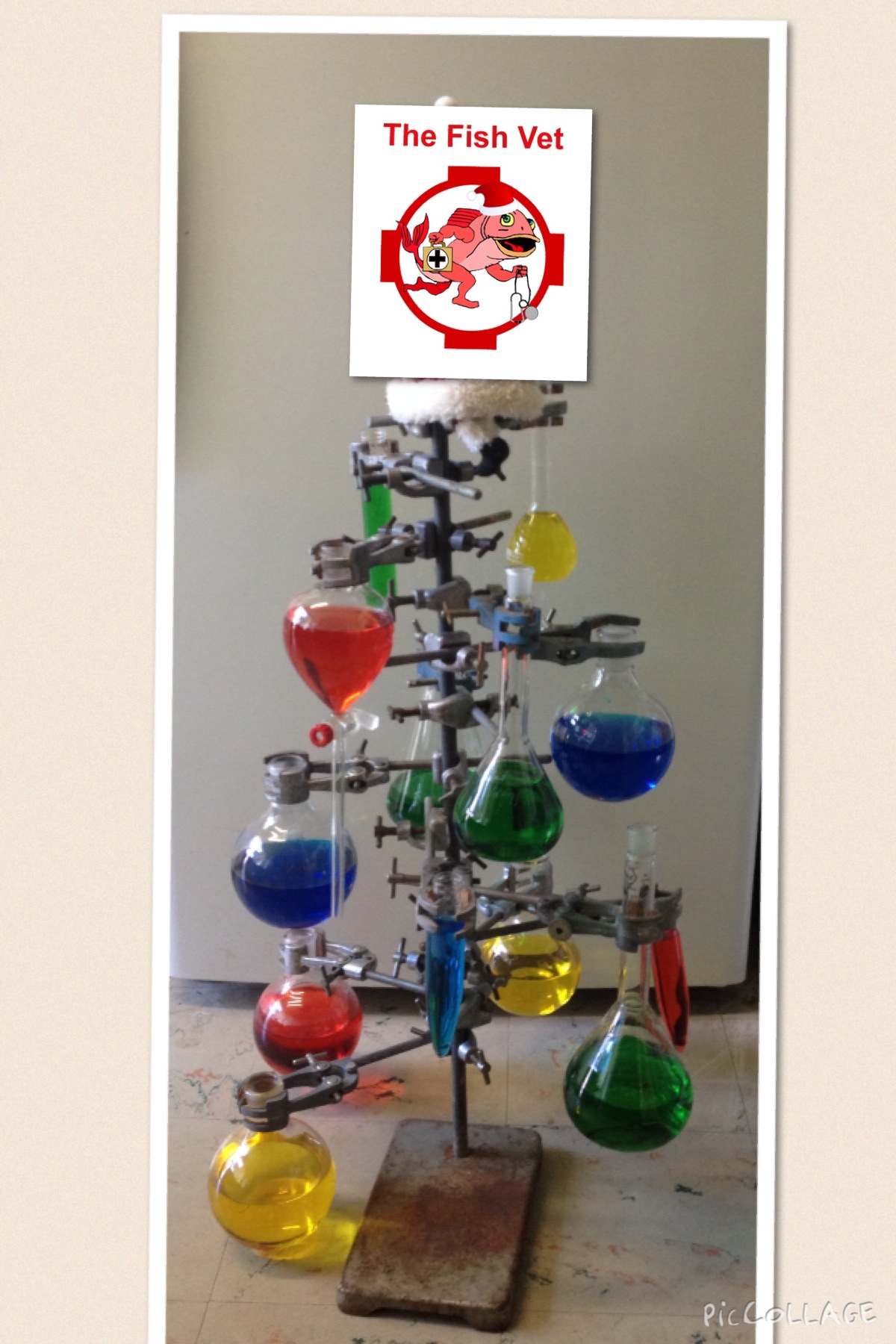
Can you name all the objects that make this Christmas tree?
—
Yours sincerely,
Dr Richmond Loh
DipProjMgt, BSc, BVMS, MPhil (Pathology) Murdoch, MANZCVS (Aquatics& Pathobiology), CertAqV, CMAVA, NATA Signatory.
THE FISH VET, Perth, Western Australia.
Veterinary Medicine for fish.
W: http://www.thefishvet.com.au
E: thefishvet
P: +61 (0)421 822 383
President WAVMA.org
Enjoy!
—
Yours sincerely,
Dr Richmond Loh
DipProjMgt, BSc, BVMS, MPhil (Pathology) Murdoch, MANZCVS (Aquatics& Pathobiology), CertAqV, CMAVA, NATA Signatory.
THE FISH VET, Perth, Western Australia.
Veterinary Medicine for fish.
W: http://www.thefishvet.com.au
E: thefishvet
P: +61 (0)421 822 383
President WAVMA.org
Another timely reminder.
—
From: “Dr. David Scarfe”
Date: 16 December 2014 5:52:13 AWST
Subject: AquaVetMed e-News: Antibiotics in Aquaculture – Are They Needed? / Global Shift to Antibiotic-free Production
December 15, 2014
Antibiotics in Aquaculture – Are They Needed?
The miracle drugs of the 20th century are in danger of running out of power. Antibiotic use in both humans and animals is contributing to a reservoir of resistant bacteria resulting in increased human mortality and increased hospital stay lengths globally, writes Øistein Thorsen in October 2014 edition of Sustainable Aquaculture Digital. The World Health Organization (WHO) warns the misuse of antimicrobial medicines and new resistance mechanisms are “making the latest generation of antibiotics virtually ineffective”, while at the 2013 G8 Summit, scientific ministers issued a statement calling antimicrobial resistance (AMR) “a major health security challenge of the twenty first century.”
Antibiotic use is an integral part of intensive animal agriculture and aquaculture. Increased public concern about antibiotic resistance and the need to preserve the ever-diminishing arsenal of antimicrobials that work in humans for as long as possible, has brought about increased scrutiny of the use of antibiotics in animal agriculture – especially for prophylactic and growth enhancing purposes. The mechanisms by which antimicrobial resistant bacteria, initially derived from food-producing animals, contribute to the emergent and increasing threat of antibiotic resistance in people are complex and varied. The main routes bacteria can take to move from animals to humans include via food or other animal product contamination, occupational exposure for farm workers and fish keepers, abattoir workers, veterinary surgeons and health workers. Bacteria can also transmit through environmental contamination like manure containing resistant bacteria, resistance genes, and antibiotic residues, along with recreational pursuits like swimming and fishing. The prevention of buildup of resistant bacteria in waterways as a result of fish farming practices, terrestrial agriculture run-off or sewage outflow surrounding fish farms is a major concern for the aquaculture industry.
Despite difficulties of measuring the exact contribution of animal agriculture and aquaculture to the overall development of antimicrobial resistance, a consensus is emerging around the need for everyone to use these powerful drugs carefully and responsibly, especially those deemed critically important for human health by the WHO. With the explosive growth in production and demand for farmed seafood, how can the aquaculture industry lead the charge for responsible use of antibiotics without compromising food safety, the environment and human health, as well as animal health, welfare and productivity?
See the source (http://tinyurl.com/oaqbql4) for more information on Current Use in Aquaculture, Bad Data, The Certification Approach, & The Path of Least Resistance.
See a related story “A global shift to antibiotic free production” at http://tinyurl.com/jvtwvm2.
___________________________
AquaVetMed e-News provides information to veterinary and veterinary-allied subscribers concerning aquatic animal medicine, health, welfare, public health and seafood safety, obtained from a variety of sources (largely AquaVetMed subscribers). While provided by the American Veterinary Medical Association’s, Aquatic Veterinary Medicine Committee and are for public distribution, they do not necessarily reflect the opinion of the AVMA or the veterinary profession. See the AVMA Terms of Use (http://tinyurl.com/29h2rf) for further information.
Subscription and Contributions: Interested veterinarians and veterinary-allied professionals can subscribe, unsubscribe, or contribute pertinent news or information, by sending a message with “For AquaVetMed -” and the topic in the subject line, to dscarfe@avma.org. If e-News information is used elsewhere please acknowledge AquaVetMed as the source. Encourage individuals to subscribe rather than distribute through list serves.
Note: Undelivered e-mails will not be resent; Subscribers will be deleted from the list after repeated undelivered or bounced messages and will have to re-subscribe. Messages may contain attachments that will have been scanned for known viruses.
Visit our website: http://www.avma.org
________________________________
Are Tasmanian waters still pristine (without carp), when they’ve introduced monstrous, top-predator, non-native Atlantic salmon into their natural waterways?
http://www.examiner.com.au/story/2781518/hadspen-angler-snags-monster-in-secret-spot/?cs=95
—
Yours sincerely,
Dr Richmond Loh
DipProjMgt, BSc, BVMS, MPhil (Pathology) Murdoch, MANZCVS (Aquatics& Pathobiology), CertAqV, CMAVA, NATA Signatory.
THE FISH VET, Perth, Western Australia.
Veterinary Medicine for fish.
W: http://www.thefishvet.com.au
E: thefishvet
P: +61 (0)421 822 383
President WAVMA.org
Firstly, before we jump to treatment, we’d need to establish what’s causing the swollen abdomen. Swollen belly can be due to several common things:
•cancer (not contagious, possibly treatable depending),
•cysts (not contagious, possibly treatable depending),
•a range of external parasitic diseases (contagious, treatable),
•septicaemia (highly contagious, treatable in early stages),
•mycobacterial infection (slowly contagious, not treatable),
•egg bound (not contagious, treatable),
•fat (not contagious and requires dietary changes).
Treatment and management will rely on an accurate and correct diagnosis.
Q: Why is the lawyer watching the Discovery Channel?
A: Because he was told NOT to go on a fishing expedition.
This was created by my cousin JL who’s a new law graduate. I’ve to admit that this went over my head. So here’s her explanation:
‘discovery’ is a process whereby each party is supposed to disclose all related documents in a matter to each other.
however. it is not supposed to be a ‘fishing expedition’.
you can’t ask for everything under the sun hoping to get something that is related.
Yep, I still don’t get it. How about you?
Some people come from a view point of keeping a balance in systems of pathogens, host and environment as occurs in nature. I do not disagree with that, however, we ARE keeping animals in less than natural environments. Additionally, from a medical stand-point, we would prefer to keep pathogens out.
Many of the parasites I deal with are obligate pathogens (e.g. skin flukes [Gyrodactylus], gill flukes [Dactylogyrus], white spot disease [Ichthyophthirius multifilis], etc.) and do not exist as commensals, nor are they found free-living in the environment (although they may be temporarily recovered from the water, environment and objects, associated with infected fish).
Some apparently healthy looking fish can be carrying pathogens, however, you cannot see evidence of the parasites (they are microscopic) or they may not be showing signs of disease… yet. Over time, the pathogens may cause stress (even in low numbers), picking off the most susceptible fishes first, as they slowly build in numbers. Then suddenly, their population explodes and you have to deal with whole tanks of sick fish.
How do we prevent this?
Well, you’d have to practice good biosecurity and you’ll have no issues. I’ve attached a section from my book on what sorts of treatments you’d need to apply to new fish before introducing them to your tank/pond. This is ideal for high through-put systems such as ornamental fish retailers/wholesalers and re-sellers. This should remove the bulk of pathogens. For those who have time on their side (e.g. home pond owners), or those dealing with highly valuable fish (e.g. koi and discus), there is an additional step.
What’s this additional step?
Sentinels! After following the prophylactic dips, the new fish are held in quarantine in a separate pond/tank for 4-6 weeks. At this time, 2-3 of your resident fish are placed in the pond/tank to cohabit with the new fish. The reason for doing this is because the different populations of fish have not been exposed to each other’s mix of microflora (and possibly viruses). This will give you time to react in a closely monitored system, without exposing your beloved collection to disease.
And to make it even more fool-proof, there is an additional “pre-step”!
A pre-purchase exam. Just as they do for farm and domestic pets, we can also apply this to fish. The new fish can be examined for health by microscopic exam, blood tests and their environment checked. Preventive medicines can be given and advise of low stress methods in transporting fish can be given. So, before you make that next big purchase, make sure you book TheFishVet to check everything out.
Follow me on: Facebook “Fin Page” – YouTube – Blog – Linkedin – Twitter
—
Yours sincerely,
Dr Richmond Loh DipProjMgt, BSc, BVMS, MPhil (Pathology), MANZCVS (Aquatics & Pathobiology), CertAqV, CMAVA, NATA Signatory.
THE FISH VET, Perth, Western Australia, AUSTRALIA.
Mobile Aquatic Veterinary Medical & Diagnostic Services.
http://www.thefishvet.com.au
Ph: +61 (0)421 822 383

Skype: thefishvet
President WAVMA 2014

Adjunct Lecturer Murdoch University | Secretary Aquatic Animal Health Chapter – ANZCVS.