Why choose The Fish Vet for your prawn farm?

Considering the recent WSSV outbreak events in Australian prawn farms, that’s taken down 7 shrimp farms and found in the wild populations in Logan River and Moreton Bay, it is vital to employ professionals with actual firsthand expertise on diseases exotic to Australia. Our dynamic team can help prevent diseases on your valuable prawn farm and hatchery.


Aquatic Animal Health Specialist, Giana Gomes, has extensive experience with farmed prawns and has first-hand experience white spot outbreaks in Brazilian farms. After completing her veterinary degree, she worked as a veterinarian for Aquatec Ltd and Genearch Ltd, one of the largest shrimp hatchery and the first SPF hatchery in Brazil, respectively. Giana’s Master’s thesis was on prawn disease NHPB (necrotising hepatopancreatitis bacterium) which causes significant economic losses in Central and South America. In Australia, she has worked at the Australian Institute of Marine Science (AIMS) to establish histology techniques for tropical rock lobster larvae and the ornamental cleaner shrimp.


Giana’s expertise is illustrated in her presentation for the World Aquatic Veterinary Medical Association, “The most effective biosecurity actions you can take are monitoring and keeping a record of the health of your shrimp crops.” – FREE to watch at this link


Let’s not reinvent the wheel. 


Together we can help you maximise your farm’s potential.


ENQUIRE NOW.

DOWNLOAD OUR SERVICES MANUAL


Yours sincerely,

Dr Richmond Loh 

DipProjMgt, BSc, BVMS, MPhil (Pathology), MANZCVS (AquaticsPathobiology), CertAqV, CMAVA, NATA Signatory.

Aquatic Veterinarian & Veterinary Pathologist

THE FISH VET, AUSTRALIA – PERTH | SYDNEY | MELBOURNE | TOWNSVILLE | BRIBIE ISLAND

Mobile Aquatic Veterinary Medical & Diagnostic Services.

“Don’t come the raw prawn!” MAJOR THREAT to the aquaculture industry – 71% of imported green prawns tested positive for the WSSV – The BIGGEST aquaculture CRISIS in Australian history.

The ABC headlines:

Agriculture department accused of ‘dropping the ball’ as new figures show higher rates of diseased prawn imports.


In effect, the article (see link) states that the government was irresponsible in not alerting prawn farmers of the fact that a significant proportion of imported prawns are a major threat to local producers.

The APFA’s executive officer, Helen Jenkins, has also accused the department of “failing in its duty of care” to protect the industry from the major biosecurity risk, white spot disease (WSD).

Now seven (7) Queensland prawn farms  have succumbed, and there have been multiple detections in the wild, in Logan River, and more recently, in Moreton Bay. The picture could be worse if it’s not contained soon, and  if we’re not utilising all the resources we have available.

This virus is highly contagious, causes massive mortalities, and can infect virtually all kinds of crustaceans. Could they wipe out the Moreton Bay bugs? How about the rock lobster fishery? Marron, yabbies and gilgies? How about our endangered giant freshwater lobster? Yes, yes, yes, yes…
Just imagine if the we were allowed to import meats known to be infected with the highly contagious Foot-and-mouth disease! The Australian government has now imposed a ban on raw prawn products, conducting thorough testing. But is it all a little too late… for the six affected prawn farms…? And if the disease is established in Australia, it is too late for the nation’s prawn farms. 
This WSSV disease would likely set back Western Australia’s extensive prawn farming venture in Project Sea Dragon. It would scare off the investors. They may have to reconsider their options, and on how they can achieve better biosecurity than their Queensland counterparts.
We’ve been a “lucky country” for a long time now. But this luck is running out, and we need to be turning to people with firsthand experience in handling this outbreak.
The Australian Prawn Farmers Association is taking court action on the Australian Government (see article link).

The traditional Australian expression comes to my mind: “Don’t come the raw prawn!” or “Don’t come the raw prawn with me!” is very fitting.


 Shrimp Pathology Short Course on “Disease Diagnosis and Control in Marine Shrimp Culture”

Aquaculture Pathology Laboratory, School of Animal and Comparative Biomedical Sciences, University of Arizona, Tucson, AZ (USA)

July 17-22, 2017


After a hiatus, the Aquaculture Pathology Laboratory will again offer an intensive one-week course combining lectures with hands-on laboratory sessions, demonstrating the methods used for detection and diagnosis of the diseases farmed shrimp.  


The following topics will be covered:

·       Short-course introduction, purpose, scope and schedule.

·       Major shrimp diseases listed by World Animal Health Organization (OIE)

·       The baculovirus diseases: white spot syndrome virus (WSSV), monodon-type baculovirus

·       (MBV), baculovirus penaei (BP)

·       The parvovirus diseases: infectious hypodermal and hematopoietic necrosis virus

·       (IHHNV), hepatopancreatic virus (HPV)

·       RNA viruses infecting penaeid shrimp: Taura syndrome virus (TSV), yellow head

·       virus (YHV), infectious myonecrosis (IMNV), Penaeus nodavirus (PvNV), white

·       tail disease (WTD)

·       Bacterial diseases: acute hepatopancreatic necrosis disease (AHPND; caused by a

·       unique strain of Vibrio parahaemolyticus), necrotizing hepatopancreatitis (NHP-B),

·       Vibrio harveyi.

·       Microsporidian diseases: Enterocytozoon hepatopenaei (EHP), cotton shrimp disease

·       Methods of disease prevention and/or treatment.

·       Development of biosecurity and quarantine protocols


Topics to be covered in the labs include:

  • Sample preparations for histology and PCR.
  • PCR/RT-PCR for diagnosis of WSSV, AHPND, EHP, TSV
  • qPCR/qRT-PCR for diagnosis of WSSV, AHPND, TSV
  • Laboratory bioassay: AHPND
  • Review of histopathology of viral and bacterial diseases.


Registration is limited to 30. Cost: $2,000 (USD) if the deposit is received on or before June 1, 2017; $2,500 (USD) if the deposit is received on or after June 2, 2017.

For more information about the course or to register, go to https://acbs.cals.arizona.edu/aqua, or contact:

Dr. Arun K. Dhar or Ms. Deborah Huie

Aquaculture Pathology Laboratory

School of Animal and Comparative Biomedical Sciences

University of Arizona

1117 E. Lowell Street, Room 102

Tucson, Arizona 85721 USA

Phone: 520-621-4438; Fax : 520-626-5602

Email: adhar@email.arizona.edu;  dhuie@email.arizona.edu


Crimes against crustaceans: Nicholas Seafood convicted of CRUELTY to lobster

Nicholas Seafood are in hot water after being convicted of an Act of Animal Cruelty and sentenced to a $1,500 fine at Sydney Downing Centre on Tuesday 14 February 2017.


The seafood company trades at Sydney Fish Markets and was videoed on 25 January 2016 by a member of the public, butchering lobsters without any attempt to stun the animals unconscious to mitigate suffering, before separating the tail from the body – which causes immense pain and does not kill the lobster.


The lobster is seen struggling vigorously as the monger attempts to butcher it. It remains alive after its tail is cut off, before being put through a ban saw about 20 seconds later.

The video can be downloaded here.

The expert veterinary witness on the case has been studying fish cognition and behaviour for 20 years, and is a recognised world expert in fish intelligence and welfare, and stated that the method of butchering from a welfare perspective is “very poor indeed.”


Crustaceans were added to the Prevention of Cruelty to Animals Act in 1997 after it was medically proven they feel pain. Consequently, they should be rendered unconscious prior to butchering and there is a specific technique to the butchering process that limits the potential for pain and suffering, specifically destroying the cerebral and ventral nerve ganglions as quickly as possible, initially by longitudinal section and then targeted removal of the ganglions.


The method of cutting off the tail from the body is sometimes used in response to the demand for lobster sashimi, but is brutal and causes agonising pain to the animal.


RSPCA attended Nicholas Seafood at the Sydney Fish Markets on 12 February 2016 after receiving a formal complaint about animal cruelty and undertook an investigation. RSPCA NSW supplied the business with the readily available Department of Primary Industry’s pamphlet ‘Guidelines for Avoiding Cruelty in Shellfish Preparation’ which outlines the industry standard for the humane treatment of crustaceans. They were issued with a fine, but instead opted to take the matter to court.


Nicholas Seafood have since taken steps to ensure best practice in their animal handling in the future.


The legislation is very specific in relation to crustaceans and is restricted to “only when at a building or place where food is prepared or offered for consumption by retail sale in the building or place” making it notoriously difficult to prosecute. In this case, the business supplies cooked food on the premises and so it falls under this legislation. This matter is the first crustacean conviction RSPCA NSW has seen.


For more information on how to humanely kill crustaceans, please visit:http://kb.rspca.org.au/What-is-the-most-humane-way-to-kill-crustaceans-for-human-consumption_625.html

All charges brought under the Prevention of Cruelty to Animals Act.

For more information, or an interview with a RSPCA NSW 
spokesperson, please contact Stefania Kubowicz 
Mobile: 0488 905 353 | Email: skubowicz@rspcansw.org.au.

For all the latest RSPCA NSW news, be sure to read our blog and follow us on Facebook and Twitter.


Stefania Kubowicz

Media Liaison

This week will be a bit crusty.

The theme for this week’s blogs will be about crustacea.

Trust me when I say it’s not all about crab!


Yours sincerely,

Dr Richmond Loh
DipProjMgt, BSc, BVMS, MPhil (Pathology), MANZCVS (Aquatics& Pathobiology), CertAqV, NATA Signatory.

Aquatic Veterinarian & Veterinary Pathologist.
PERTH | MELBOURNE | SYDNEY | TOWNSVILLE | BRIBIE ISLAND.
THE FISH VET – AUSTRALIA.

Aquatic Veterinary Medical & Diagnostic Services.
http://www.thefishvet.com.au
Ph: +61 421 822 383

Fish joke for Monday-itis: female sea monkey name. 

​​Question: What name do you call a female sea monkey? 

Answer: Briony Shrimp. 
Brine shrimp (or Artemia) are sold as novelty gifts under the marketing name Sea-Monkeys or Aqua Dragons.

Have a FINtastic week! R <+>{


How to save your beloved fish from dying with KHV?

There’s no cure for the killer koi disease, but there may be a way to save them from dying.

Scientists have found that fish do regulate their busy temperature to fight off infections. This has been shown with Zebrafish research, where sick individuals seek warmer waters, almost to replicate what we experience as fevers.

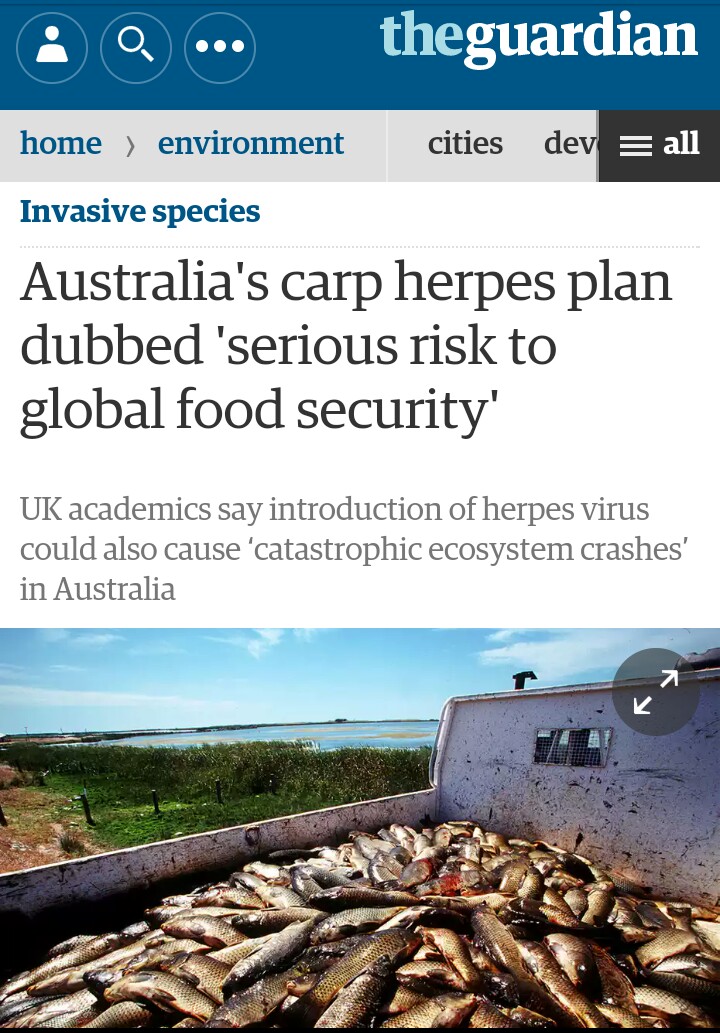
Similarly, carp do the same, when faced with KHV. Speaking with my Israeli colleague, Danny Benjamin (who is a koi farmer), he says in the face of a KHV outbreak, crank up the water temperature, and hold it between 30-32 degrees Celsius for about a month. Your koi will gain immunity, and will not die from the viral disease.

Though, survivors are likely going to be carriers of the herpesvirus, and could spread to non-immune fish, or reactivation of the virus in times of stress (transport, change in seasons, spawning) could prove fatal. Like a ticking time bomb.

This also goes for vaccination of fish for the virus.

It’s imperative that you consult your fish veterinarian about the options you have. 

Best ways to control algae in lakes and ponds.

​With the dry season, there’s reduced flushing/dilution of waterways. In fact, in many water bodies, there is increased evaporation, causing concentration of nutrients that algae love.

This creates a nasty looking pond or lake. Based on basic principles, here are possible options for controlling algae:

  • Prevent further nutrients from entering the lake – deviating run off, encouraging more marginal plant growth;

  • Diluting the nutrients by flushing with water;

  • Locking up the nutrients with PhosLock or similar compound;

  • Dredging/vacuuming the bottom of the lake to remove nutrients;

  • Seed the water body with other algae that can out compete the toxic algae;

  • Stock lake with herbivorous organisms that will eat the algae (and in turn be eaten by larger fauna and hence remove nutrients) – e.g. rotifers, brine shrimp, fish (e.g. grass carp, but this is not in Australia);

  • Apply algaecides – natural (barley straw or its extract, grapefruit seed extract) or chemical (e.g. simazine, Diazinon, Endosulfan, Propiconazole, Thiram, Ziram, Quinomanid, Irgarol-1051 and Hydrogen peroxide) – check safety for aquatic organisms where present ;

  • Limit light entering the system – e.g. putting dyes in the water, providing more shade;

  • Allowing the lake to dry out (in fish-less ornamental ponds).