Q: What did the fish say when it swam into a wall?
A: Dam!
All about Fish Vetting – Dr Richmond Loh
Q: What did the fish say when it swam into a wall?
A: Dam!
I heard about this on the radio.
Read more here.
Perhaps there’ll be more information provided at this upcoming webinar. See below:
From: Marissa McNamara [mailto:marissa.mcnamara@qm.qld.gov.au]
Sent: Friday, 6 September 2013 8:55 AM
To: Marissa McNamara
Subject: Neptune webinar
Dear Neptune Users,
I am pleased to invite you to attend an online presentation on aquatic animal health. Dr Shane Roberts will discuss “South Australian marine mortalities – summer 2013.”
The presentation is on Thursday the 19th of September at 2:30 pm NSW/QLD time, 2 pm SA time. (Please disregard the previous invitation time and date.)
The presentation will be held using Adobe Connect. To attend the presentation click on the link below. If you have not attended an ABIN Web Conference previously, please run the test connection link a day prior to the presentation. Audio for the presentation will be via a toll-free teleconference line, also listed below. Simply dial the number, and enter the participant passcode when prompted.
If you do not have access to the website you can still listen to the presentation on the phone, however please do not listen to the presentation over the computer. Listeners who are calling in should mute their computer speakers. Also, listeners should mute their phones until question time if possible, as background noise is sometimes audible in the presentation.
Please feel free to invite any other individuals you think would be interested. I can provide international phone numbers if necessary.
The Australian Toll-Free Number:
Phone Number: 1 800 804 723
Participant passcode: 389 131 7648
ABIN Aquatic Animal Health Webinar Room (Click on this link on the day)
https://connect.abin.org.au/aquaticanimalhealth/
ABIN Test Link (Click on this link prior to the meeting to test your browser will connect to ABINconnect)
http://connect.abin.org.au/common/help/en/support/meeting_test.htm
ABIN Helpdesk (issues and trouble-shooting)
Phone: 1 300 136 376
Email: helpdesk@abin.org.au
ABIN Helpdesk (issues on the day)
Phone: 1 300 136 376
Email: helpdesk@abin.org.au
Please do not hesitate to contact me if you have any questions.
Regards,
Marissa
Dr Marissa McNamara
Project Manager
PO Box 3300 | South Brisbane BC | Queensland 4101 | Australia
t. 07 3842 9173 | marissa.mcnamara@qm.qld.gov.au
Small prey fish can grow a bigger ‘eye’ on their rear fins as a way of distracting predators and dramatically boosting their chances of survival, new scientific research has found.
Researchers from Australia’s ARC Centre of Excellence for Coral Reef Studies (CoECRS) have made a world-first discovery that, when constantly threatened with being eaten, small damsel fish not only grow a larger false ‘eye spot’ near their tail – but also reduce the size of their real eyes.
The result is a fish that looks like it is heading in the opposite direction – potentially confusing predatory fish with plans to gobble them up, says Oona Lönnstedt, a graduate student at CoECRS and James Cook University.
For decades scientists have debated whether false eyespots, or dark circular marks on less vulnerable regions of the bodies of prey animals, played an important role in protecting them from predators – or were simply a fortuitous evolutionary accident.
The CoECRS team has found the first clear evidence that fish can change the size of both the misleading spot and their real eye to maximise their chances of survival when under threat.
“It’s an amazing feat of cunning for a tiny fish,” Ms Lonnstedt says. “Young damsel fish are pale yellow in colour and have this distinctive black circular ‘eye’ marking towards their tail, which fades as they mature. We figured it must serve an important purpose when they are young.”
“We found that when young damsel fish were placed in a specially built tank where they could see and smell predatory fish without being attacked, they automatically began to grow a bigger eye spot, and their real eye became relatively smaller, compared with damsels exposed only to herbivorous fish, or isolated ones.
“We believe this is the first study to document predator-induced changes in the size of eyes and eye-spots in prey animals.”
When the researchers investigated what happens in nature on a coral reef with lots of predators, they found that juvenile damsel fish with enlarged eye spots had an amazing five times the survival rate of fish with a normal-sized spot.
“This was dramatic proof that eyespots work – and give young fish a hugely increased chance of not being eaten.
“We think the eyespots not only cause the predator to attack the wrong end of the fish, enabling it to escape by accelerating in the opposite direction, but also reduce the risk of fatal injury to the head,” she explains.
The team also noted that when placed in proximity to a predator the young damsel fish also adopted other protective behaviours and features, including reducing activity levels, taking refuge more often and developing a chunkier body shape less easy for a predator to swallow.
“It all goes to show that even a very young, tiny fish a few millimetres long have evolved quite a range of clever strategies for survival which they can deploy when a threatening situation demands,” Ms Lonnstedt says.
###
Their paper “Predator-induced changes in the growth of eyes and false eyespots by Oona M. Lonnstedt, Mark I. McCormick and Douglas P. Chivers appears in the latest issue of the journal Scientific reports.
More information:
Oona Lonnstedt, CoECRS and JCU, ph +646 700 21 83 46
Dr Mark McCormick, CoECRS and JCU +61 7 4781 4048 or 0409 371 015
Jenny Lappin, CoECRS, +61 (0)7 4781 4222
Jim O’Brien, James Cook University Media Office, +61 (0)7 4781 4822 or 0418 892449
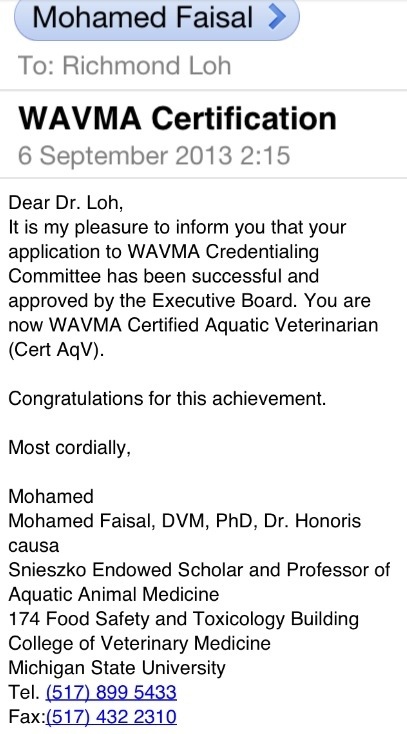
Today is a great day. Not only is it my father’s 76th birthday, but I’ve also received news that I’ve been awarded the WAVMA’s Cert AqV!
Currently, I’m the first and only in Australia to have achieved this status; and only one of two in the Southern Hemisphere (the other is in New Zealand)!
“What’s this all about?” you might ask. It’s a peer-reviewed process of ensuring you meet the global standards to be a practicing aquatic veterinarian. Once you’ve lodged your documentation as proof of attainment of the Knowledge, Skills and Experience (KSE) , which are then scrutinised by your mentor. If all goes well, they’re then brought before the WAVMA (World Aquatic Veterinary Medical Association) board for approval.
The KSE’s include theory, clinical significance, and practical experience in the following areas that are unique to aquatic veterinary practice and they include:
1. Aquatic Environment and Life Support Systems [25 credits minimum]
2. Taxonomy, Anatomy and Physiology [10 credits minimum]
3. Husbandry and Industries [25 credits minimum]
4. Pathobiology and Epidemiology of Aquatic Animal Diseases [25 credits minimum]
5. Diagnostics and Treatment of Aquatic Animal Diseases [25 credits minimum]
6. Clinical Veterinary Experience and Client Communications [25 credits minimum]
7. Public Health, Zoonotics and Seafood Safety [5 credits minimum]
8. Legislation, Regulations, and Policies [5 credits minimum]
9. Principles of Aquatic Animal Welfare [5 credits minimum]
—
Yours sincerely,
Dr Richmond Loh
DipProjMgt, BSc, BVMS, MPhil (Pathology) Murdoch, MANZCVS (Aquatics& Pathobiology), Cert AqV.
The Fish Vet, Perth, Western Australia.
Veterinary Medicine for fish.
W: http://www.thefishvet.com.au
E: thefishvet
P: +61 (0)421 822 383
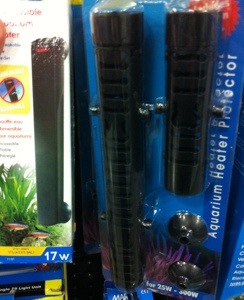
Large fishes can easily knock and break your heater. Some fishes can get burns if they lie on the heater. So, how do you protect your heater from your fish, and how can you protect your fish from the heater?
There are two solutions. One is to purchaser a plastic-encased heater that’s ‘indestructible’. The other option is to purchase a fenestrated sleeve that goes over the glass encased submersible aquarium heater.
See pictures below:
Question from a colleague:
My response:
I believe you are correct. With most fish, gender manipulation may be possible only when very young.
Q: Where do fish go to get ideas?
A: A think tank.
I came across this website and their report recently and thought some of the arguments are interesting.
This report details the welfare of fish in commercial fishing. According to the report 970 – 2,740 billion individual fish are caught each year compared to the farmed 3 billion mammals and 57 billion birds reported by the Food and Agriculture Organisation of the UN in 2008.
Considerable suffering is caused to wild-caught fish during capture, landing and subsequent processing. Fish are likely to experience fear, pain and distress as they are, for example:
Available to be downloaded from http://fishcount.org.uk