Q: Which airline company do fish use to fly?
A: Fin-Air.

This is the plane I took to come to Prague.
All about Fish Vetting – Dr Richmond Loh
Q: Which airline company do fish use to fly?
A: Fin-Air.
This is the plane I took to come to Prague.
What I gathered from this article email alert is the wide ranging impacts a disease could have on the nation.
For example, this one shrimp disease does not only call on bans on exports of all shrimp products, but also prohibited to import aquaculture inputs (artemia cysts and biomass, polychaetes, prebiotics and probiotics) and algae from these countries, and from those nations where this syndrome is present.
This is why each country remains vigilant to prevent diseases entering the country; and if it does, to detect and eradicate the disease at the earliest. This is the gist of biosecurity.
From: “Dr. David Scarfe”
Date: 8 September 2013 21:16:07 AWST
Subject: AquaVetMed e-News: Ecuador calls for OIE shrimp EMS/AHPNS listing
September 8, 2013
Shrimp disease requested to be included in OIE official list
Ecuador – The National Fisheries Institute (INP) of Ecuador requested the acute hepatopancreatic necrosis syndrome (AHPNS) to be included in the official list of diseases, infections and infestations of the World Organization for Animal Health(OIE). INP representatives claim that this inclusion can help to intensify an animal disease surveillance agent.
Institute delegates made this request during the 6th Meeting of the Inter-American Committee on Aquatic Animal Health, which was held on 22 and 23 August 2013, in Mérida, Mexico. After learning about the crisis faced by the Asian shrimp industry due to AHPNS, the Ecuadorian government took preventive measures in the country. Therefore, since 25 July it decided to ban imports of various live shrimp species at any stage of their life cycle, their products and by-products in all presentations from China, Vietnam, Thailand and Malaysia for a year.
According to the Ministerial Agreement No. 043, it is also prohibited to import aquaculture inputs (artemia cysts and biomass, polychaetes, prebiotics and probiotics) and algae from these countries, and from those nations where this syndrome is present. The INP will initiate a training campaign for the shrimp sector in order to take the necessary precautions.
The AHPNS emerged in 2010 in shrimp farms located in southern China and in Hainan Island, and in early 2011 it was seen in Vietnam and Malaysia, the Ministry of Agriculture, Livestock, Aquaculture and Fisheries (Magap) reported. The first signs of the disease may occur between 7 and 10 days after the pool stockings, and the mortality can reach 100 per cent in the first 30 days of culture.
See the source (http://www.agricultura.gob.ec/author/agricultura/page/2/) for more information.
___________________________
AquaVetMed e-News provides information to veterinary and veterinary-allied subscribers concerning aquatic animal medicine, health, welfare, public health and seafood safety, obtained from a variety of sources (largely AquaVetMed subscribers). While provided by the American Veterinary Medical Association’s, Aquatic Veterinary Medicine Committee and are for public distribution, they do not necessarily reflect the opinion of the AVMA or the veterinary profession. See the AVMA Terms of Use (http://tinyurl.com/29h2rf) for further information.
If e-News information is used elsewhere please acknowledge AquaVetMed as the source. Encourage individuals to subscribe rather than distribute through list serves.
Messages may contain attachments that will have been scanned for known viruses.
Subscription and Contributions: Interested veterinarians and veterinary-allied professionals can subscribe, unsubscribe, or contribute pertinent news or information, by sending a message with “For AquaVetMed -” and the topic in the subject line, to dscarfe@avma.org.
Note: Undelivered e-mails will not be resent; Subscribers will be deleted from the list after repeated undelivered or bounced messages and will have to re-subscribe.
Visit our website: http://www.avma.org
________________________________
Dr Loh, The Fish Vet, in Perth, Western Australia is unavailable until 21st September 2013. I am travelling to Prague, Czech Republic to deliver lectures on fish medicine at the World Veterinary Congress as an invited speaker.
Please check the Aquatic Veterinary Directory at www.AquaVetMed.info for a list of veterinarians in your area.
If you require a response from me please resend your e-mail on or after I return if I haven’t already responded. Thank you for your patience and understanding.
In the meantime, please check my blog for information on your topic at www.thefishvet.com
You can also follow me on: Facebook “Fin Page” – YouTube – Blog – Linkedin – Twitter
Thank you for your patience and understanding.
—
Yours sincerely,
Dr Richmond Loh DipProjMgt, BSc, BVMS, MPhil (Pathology) Murdoch, MANZCVS (Aquatics & Pathobiology), CertAqV.
Veterinarian | Adjunct Lecturer Murdoch University | President-elect WAVMA |
Secretary Aquatic Animal Health Chapter – ANZCVS.
The Fish Vet, Perth, Western Australia, AUSTRALIA. Mobile Veterinary Medical & Diagnostic Services for fish and other aquatic creatures.
http://www.thefishvet.com.au
Ph: +61 (0)421 822 383
Over the winter months, you might be right about not needing to conduct water changes in your outdoor pond as often since rain entering the pond naturally dilutes any wastes.
But did you know that a lot of biological processes can make the water rather acidic. At this time of the year, it’s important that you at least check your pH (measure of the acidity) and KH (measure of the buffering capacity of the water against pH fluctuations).
Check out what can happen to your fish in the latest uploaded pictures on my Facebook Fanpage album titled “Under the Microscope.”
The plight of fishermen was brought to my attention recently. The government is introducing more and more marine parks on top of the restrictions that are currently available to ensure a sustainable future for fishing. This puts more pressure on fishermen as they face more restriction in where they can fish and also makes the job of fishing even more hazardous as they have to venture to other areas. These are some of the arguments the fishermen have put forward.
Watch and listen more to their views at this link –
http://www.youtube.com/user/drawingthelinefilm/videos
The main objective with ‘Drawing The Line’ is to provide an avenue in which the average seafood consumer can relate and connect with the seafood and professional fishing industry. Through stories of hope, hardship, love and loss we aim to present the fishing industry in a very entertaining and eye opening way, in a light that will compel the Australian public to care about where their seafood comes from and what is happening to the industry that supplies it.
PhD scholarship to study disease in Australian pearl oysters.
For more information please contact Professor David Raftos at Macquarie University (david.raftos).
—
Yours sincerely,
Dr Richmond Loh
DipProjMgt, BSc, BVMS, MPhil (Pathology) Murdoch, MANZCVS (Aquatics& Pathobiology), Cert AqV.
The Fish Vet, Perth, Western Australia.
Veterinary Medicine for fish.
W: http://www.thefishvet.com.au
E: thefishvet
P: +61 (0)421 822 383
Supervising Research Scientist
WA Department of Fisheries – Hillarys WA
| Supervising Research Scientist
PSGOGA, Specified Calling Level 5 – $127,877 – $138,895 per annum Position number: 2055 Work type: Location: Closing date: The Department of Fisheries manages Western Australia’s marine and freshwater fisheries and the habitats on which they depend. Our vision is for the world class management of fisheries and aquatic ecosystems. Our commitment is Fish for the Future. By working with the community and key stakeholders, the Department’s mission is to conserve, sustainably develop and share the fish and other living aquatic resources of WA, for the benefit of present and future generations. There is currently one (1) Specified Calling Level 5 Supervising Research Scientist position available for filling. OTHER CONDITIONS This is a permanent full-time opportunity. Whilst this selection process will initially be used to fill the above vacancy, it may also be used to fill other similar vacancies throughout Fisheries. In addition to this, should the successful applicant decline or vacate the advertised vacancy, then the next most suitable applicant may also be selected from this process. Both of these options remain valid for a period of six (6) months from the start date of the first applicant appointed. Position Profile: Are you looking for an interesting, challenging and rewarding role in a progressive and encouraging workplace? The role of the Supervising Research Scientist is to manage the Biodiversity and Biosecurity Research Branch to ensure timely delivery of high quality research services to internal and external clients. The Supervising Research Scientist also ensures that planning for research, monitoring and surveillance is undertaken to meet long term resources management needs of the Department. Employee Benefits: In addition to the great salary our employees enjoy an amazing range of benefits which may include (in line with operational requirements): · 9% employer contributed superannuation. (Via Govt Employee Superannuation Board) www.gesb.wa.gov.au · Access to salary packaging arrangements (Region/Position Specific) · Professional Development Opportunities. · Flexible working arrangements. · Flexible leave arrangements. · Other professional and location based allowances. WORK RELATED REQUIREMENTS Applicants are required to submit a comprehensive CV and Cover letter no more than one (1) page long. SELECTION CRITERIA Please see attached Job Description Form FURTHER JOB RELATED INFORMATION For further information about the position, please contact Dr Rick Fletcher on (08) 9203 0114 (not to be contacted for Applicant Information Packs or assistance with lodging your application). If you are experiencing difficulties downloading an Applicant Information Pack please contact Human Resources Officer on (08) 9482 7341. HOW TO APPLY Applicants are requested to lodge their applications on line. When you are ready to lodge your application, please check to ensure that you have completed the attached:
Please refer to the Applicant Information Pack and Job Description Form for full position details as these documents will assist you with the preparation of your application. Please ensure you have plenty of time to submit your application to allow for unanticipated problems, as late and proforma applications will not be accepted. CLOSING DATE: WEDNESDAY 18 September 2013 at 5.00 pm |
Just as they have a method for detecting drug resistance in bacteria against antibiotics, researchers have found a way of doing the same for this parasite, the sea louse, that plagues the salmon industry in the north.
The reasons why it’s important to test for such things are so that you know your treatment will work, you won’t wasting your money on ineffective treatment, and you’re not helping
to select for drug resistant pathogens.
Read more below.
From: “Dr. David Scarfe”
Date: 29 August 2013 3:04:09 AWST
Subject: AquaVetMed e-News: PCR approach for detecting sealice resistance to pyrethroids and organophosphates
August 28, 2013
New Approach for Detecting Sea Lice Resistance to Pyrethroids and Organophosphates
Norway – Recent research by the Sea Lice Research Centre (SLRC) has found new methods for detecting resistant sea lice using PCR technology. Partnering with the University of Bergen, the Norwegian School of Veterinary Science and PatoGen Analysis, SLRC published results regarding new methods for detection of single nucleotide polymorphisms associated with resistance towards pyrethroids and organophosphates in salmon lice.
PatoGen developed a real-time PCR-analysis that have been validated and tested on a selection of laboratory and field strains. The analysis differentiates between the genetic variants identified by genome sequencing, and correlate with results from bioassays regarding sensitivity to the relevant insecticide.
“Efficient and sensitive methods for diagnosing resistance are crucial in order to manage and control drug resistance. Early detection of reduced sensitivity to a chemical can enable effective countermeasures to be enforced at a time point when these have a greater possibility of being effective,” said SLRC. “Therefore, accurate and speedy identification of resistant L. salmonis is crucial. “Detection of resistance prior to treatment, and the use of such analysis after treatment to evaluate treatment efficacy constitutes an important determinant for the integrated pest management in the aquaculture industry.”
For more information see http://www.slrc.no/results/new-products and http://www.slrc.no/files/2012/06/SLRC-Annual-Report-2012.pdf.
___________________________
AquaVetMed e-News provides information to veterinary and veterinary-allied subscribers concerning aquatic animal medicine, health, welfare, public health and seafood safety, obtained from a variety of sources (largely AquaVetMed subscribers). While provided by the American Veterinary Medical Association’s, Aquatic Veterinary Medicine Committee and are for public distribution, they do not necessarily reflect the opinion of the AVMA or the veterinary profession. See the AVMA Terms of Use (http://tinyurl.com/29h2rf) for further information.
If e-News information is used elsewhere please acknowledge AquaVetMed as the source. Encourage individuals to subscribe rather than distribute through list serves.
Messages may contain attachments that will have been scanned for known viruses.
Subscription and Contributions: Interested veterinarians and veterinary-allied professionals can subscribe, unsubscribe, or contribute pertinent news or information, by sending a message with “For AquaVetMed -” and the topic in the subject line, to dscarfe@avma.org.
Note: Undelivered e-mails will not be resent; Subscribers will be deleted from the list after repeated undelivered or bounced messages and will have to re-subscribe.
Visit our website: http://www.avma.org
________________________________
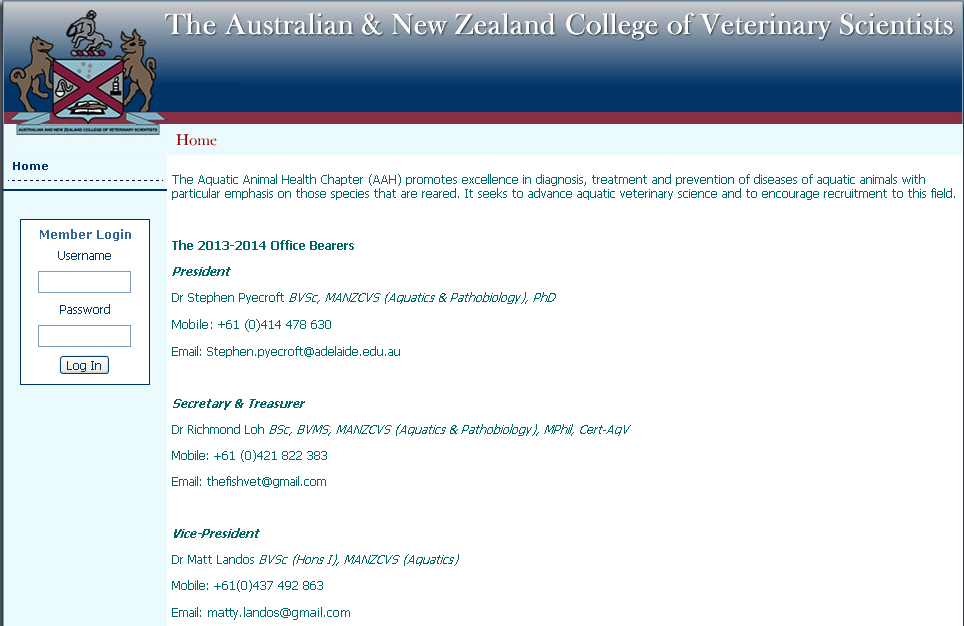
Check it out at this link – http://aquatic.anzcvs.org.au/aquatic/home/
Chapter members, let us know what you’d like it to be populated with.
Richmond.