Super sized shrimp! Interview with “Professor Prawn. “

Prawns are quickly becoming a domesticated farm animal. Imagine, we can grow a chicken to market size in under 6 weeks, we can have chickens producing one egg a day, breeds of sheep for meat, or for wool…

Now prawns are fast becoming domesticated. Imagine tucking into a prawn the size of a lobster!

Imagine carving up a prawn at the Christmas gathering and saying,
"How much prawn would you like?"

Check out the clip at:
https://au.tv.yahoo.com/sunrise/video/watch/32838800/perfecting-the-prawn/#page1

—
Yours sincerely,

Dr Richmond Loh
DipProjMgt, BSc, BVMS, MPhil (Pathology), MANZCVS (Aquatics& Pathobiology), CertAqV, NATA Signatory.

Aquatic Veterinarian & Veterinary Pathologist.
PERTH | MELBOURNE | TOWNSVILLE
THE FISH VET – AUSTRALIA.

Aquatic Veterinary Medical & Diagnostic Services.
http://www.thefishvet.com.au
Ph: +61 421 822 383

FREE Webinar on Humane Control of Birds at Aquaculture Sites – hosted by WAVMA.

Have you ever had problems with birds attacking or taking fish from your ponds? How about fear of birds bringing diseases to your ponds?

This is a perennial problem whether you’re a fish farmer, or a pond owner. Birds not only injure or take fish, they also pose a very biosecurity risk, with the potential to bring diseases, or spread diseases to, and between ponds.

Ducks, herons, pelicans, storks and more. How do we control these birds humanely?

The WAVMA have been fortunate enough to have Dr Podolsky speak to us about this.

Dr. Podolsky has 30 years of experience developing humane methods to keeping bird away from fish farms, orchards, skyscrapers, landfills, wind power facilities, and other places where they do damage or are themselves at risk. Dr. Podolsky’s training is in behavioral ecology and his approach to deterrence is two-prong: first, it entails simulating pest birds most feared predators such as falcons, eagles, fox and coyotes; and second, is to keep pest birds from landing on farms by forcing them into flight which is the most energetically expensive behavior. To accomplish this, he uses, decoys, drones, pyrotechnics, live predators and other safe harassment methods tailored to the crop and the location.

This presentation will cover why fish farms, hatcheries and other related aquatic facilities attract birds, that prey on fish & serve as vectors for disease. Safe and humane methods are therefore necessary to control birds and minimize exposure to disease. "Behavioral deterrence" using decoys, drones, pyrotechnics, live predators and other safe harassment methods tailored to the facilities and location will be emphasized, using examples of a diversity of deterrence that are targeted at numerous sensory channels, and deploying high intensity deterrence both day and night, prior bird arrival of pest birds, to keep them from landing in the first place.

See when it’s on, and register at this link –

https://www.wavma.org/Webinars/b-1029-humane-control-of-birds-at-aquaculture-sites
WA aquaculture state forum write-up.

See a summary of what was discussed at the inaugural forum.

"The need for sustained and patient capital, and an alignment of government and industry effort, were two of the key messages to emerge at a forum discussing the future of aquaculture in Western Australia earlier this year.

The 2016 Aquaculture Western Australia State Forum was the first of its kind for the state – an opportunity for industry, policy makers, regulators and funders to share information to better understand risks and barriers to aquaculture success. Participants also discussed collaborative action needed to support the sector’s development."

I really do hope that the industry can grow, and that we will be clever to utilise all the local human resources we have in the state to maximise success.

Read more at:
http://www.frdc.com.au/knowledge/publications/fish/Pages/24-3_articles/p34_WA-looks-to-aquaculture-for-growth.aspx

—
Yours sincerely,

Dr Richmond Loh
DipProjMgt, BSc, BVMS, MPhil (Pathology), MANZCVS (Aquatics& Pathobiology), CertAqV, NATA Signatory.

Aquatic Veterinarian & Veterinary Pathologist.
PERTH | MELBOURNE | TOWNSVILLE
THE FISH VET – AUSTRALIA.

Aquatic Veterinary Medical & Diagnostic Services.
http://www.thefishvet.com.au
Ph: +61 421 822 383

We can now grow lobster babies!

Check out the excellent work by our Tasmanian counterparts who have cracked the code to breeding and raising lobster larvae!

http://mobile.abc.net.au/news/2016-10-08/lobster-industry-shake-up-predicted-due-to-new-research/7915232?pfmredir=sm

I wonder if some of these critters may find their way into the ornamental trade.

—
Yours sincerely,

Dr Richmond Loh
DipProjMgt, BSc, BVMS, MPhil (Pathology), MANZCVS (Aquatics& Pathobiology), CertAqV, NATA Signatory.

Aquatic Veterinarian & Veterinary Pathologist.
PERTH | MELBOURNE | TOWNSVILLE
THE FISH VET – AUSTRALIA.

Aquatic Veterinary Medical & Diagnostic Services.
http://www.thefishvet.com.au
Ph: +61 421 822 383

Fish joke for Monday-itis: plesiosaur.

Q: What did the fish say to the other, when hiding from a plesiosaur?

A: Do you think he sau-rus?

Have a FINtastic week! R <+>{

Fish smarts! Be amazed! Or say, “I told you so!”

Here’s all the evidence you’ve been looking for, in one article that you can show all your friends who say fish aren’t smart.

Check out fish smarts, when we do real comparisons –
http://m.nautil.us/issue/40/learning/fish-can-be-smarter-than-primates

"When fishes outperform primates on a mental task, it is another reminder of how brain size, body size, presence of fur or scales, and evolutionary proximity to humans are wobbly criteria for gauging intelligence. They also illustrate the plurality and contextuality of intelligence, the fact that it is not one general property but rather a suite of abilities that may be expressed along different axes. One of the reasons that the concept of multiple intelligences is so appealing is that it helps explain how one person can be an excellent artist or an accomplished athlete yet do rather poorly at, say, mathematical or logical tasks. It diminishes the importance we have historically placed on ‘intelligence’ as defined by a selection of human abilities that’s too narrow even for our own species."

Jonathan Balcombe is the director of animal sentience at the Humane Society Institute for Science and Policy and the author of four books, including Second Nature and Pleasurable Kingdom.

—
Yours sincerely,

Dr Richmond Loh
DipProjMgt, BSc, BVMS, MPhil (Pathology), MANZCVS (Aquatics& Pathobiology), CertAqV, NATA Signatory.

Aquatic Veterinarian & Veterinary Pathologist.
PERTH | MELBOURNE | TOWNSVILLE
THE FISH VET – AUSTRALIA.

Aquatic Veterinary Medical & Diagnostic Services.
http://www.thefishvet.com.au
Ph: +61 421 822 383

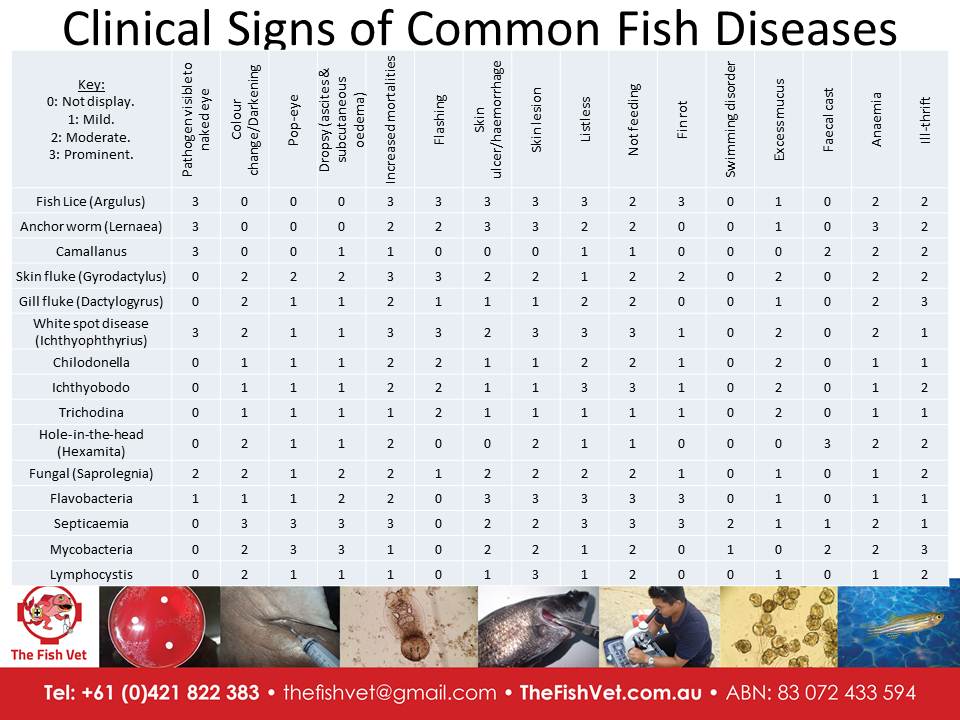
Clinical Signs of Common Infectious Diseases of Fish – Tabulated

Early detection of illness in fish is key to achieving successful outcomes. Fish show a range of clinical signs of disease, however, these are rarely pathognomonic. Fish diagnostics are a vital next step, and it follows a regular routine.

I’ve tabulated some of the common infectious diseases I see in fishes, and their clinical signs.

For a complete list of services and fees, please download the – TFV Services and Fees 2016

Follow me on: Facebook "Fin Page" – YouTube – Blog – Linkedin – Twitter

—
Yours sincerely,

Dr Richmond Loh
DipProjMgt, BSc, BVMS, MPhil (Pathology), MANZCVS (Aquatics & Pathobiology), CertAqV, CMAVA, NATA Signatory.
Aquatic Veterinarian & Veterinary Pathologist
THE FISH VET, AUSTRALIA – PERTH | MELBOURNE | TOWNSVILLE
Mobile Aquatic Veterinary Medical & Diagnostic Services.

W: http://www.thefishvet.com.au
Ph: +61 (0)421 822 383
Skype: thefishvet
President WAVMA 2014
Adjunct Lecturer Murdoch University
See advert on YouTube.
Looking for more books? Check out this site.

Some advice on automatic fish feeders

Just had some enquiries about devices I recommend, and if I could offer any tips/specifics people should look for, when buying one.

See previous post on this subject –
https://thefishvet.com/2015/11/26/should-you-use-automatic-aquarium-fish-feeders-when-going-on-holidays-whats-the-best-type/

—
Yours sincerely,

Dr Richmond Loh
DipProjMgt, BSc, BVMS, MPhil (Pathology), MANZCVS (Aquatics& Pathobiology), CertAqV, NATA Signatory.

Aquatic Veterinarian & Veterinary Pathologist.
PERTH | MELBOURNE | TOWNSVILLE
THE FISH VET – AUSTRALIA.

Aquatic Veterinary Medical & Diagnostic Services.
http://www.thefishvet.com.au
Ph: +61 421 822 383

Job available – Senior Research Scientist – Aquatic Animal Health

The Position

The aquatic animal health research portfolio includes the development and deployment of novel diagnostic techniques (principally fish and prawns), and the application of innovative treatment solutions. It also encompasses integrated approaches to understanding aquatic animal health and how this can be applied to improve production systems and sustainability. The research portfolio is a key component of the Integrated Sustainable Aquaculture Production Program of the Agriculture and Food Business Unit.

In this role you will apply specialist knowledge in aquatic animal health to initiate, lead and contribute to a wide range of research projects which assess disease status, and instigate novel interventions to reduce the impacts of disease on aquatic animal production. This will be done within national and international settings and integrates with complimentary work in genetics, reproduction biology, aquaculture nutrition, environmental management and socio-economics.

Location: Hobart, Tasmania, Australia.

Salary: AUD$106k – $124k plus up to 15.4% superannuation

Tenure: Indefinite

Reference: 25662

To be successful you will need:

  • A PhD in aquatic animal health research and demonstrated record of innovative and impactful scientific outcomes in this field.
  • A record of scientific creativity and innovation with an ability to articulate clear goals and inspire others to achieve those goals (create the science vision).
  • Demonstrated ability to lead, and/or contribute to, large complex projects and provide scientific direction and leadership to multidisciplinary teams across multiple sites and agencies.
  • Proven ability to develop research plans and projects with demonstrated ability to attract and secure external funding from Industry or Government clients to support research plans.

The Company – The Commonwealth Scientific and Industrial Research Organisation (CSIRO)

Apply at –

https://jobs.csiro.au/job/Hobart%2C-TAS-Senior-Research-Scientist-Aquatic-Animal-Health/365243100/