Where to take skin mucus scrape samples from fish? Four sites is my new recommendation.

I’m learning heaps at the FRDC conference here in Cairns.

Take for example, skin scrapes. Many text books (including my own book) always instruct taking samples from the base of dorsal fin, under their pectoral fin, and from the caudal peduncle.

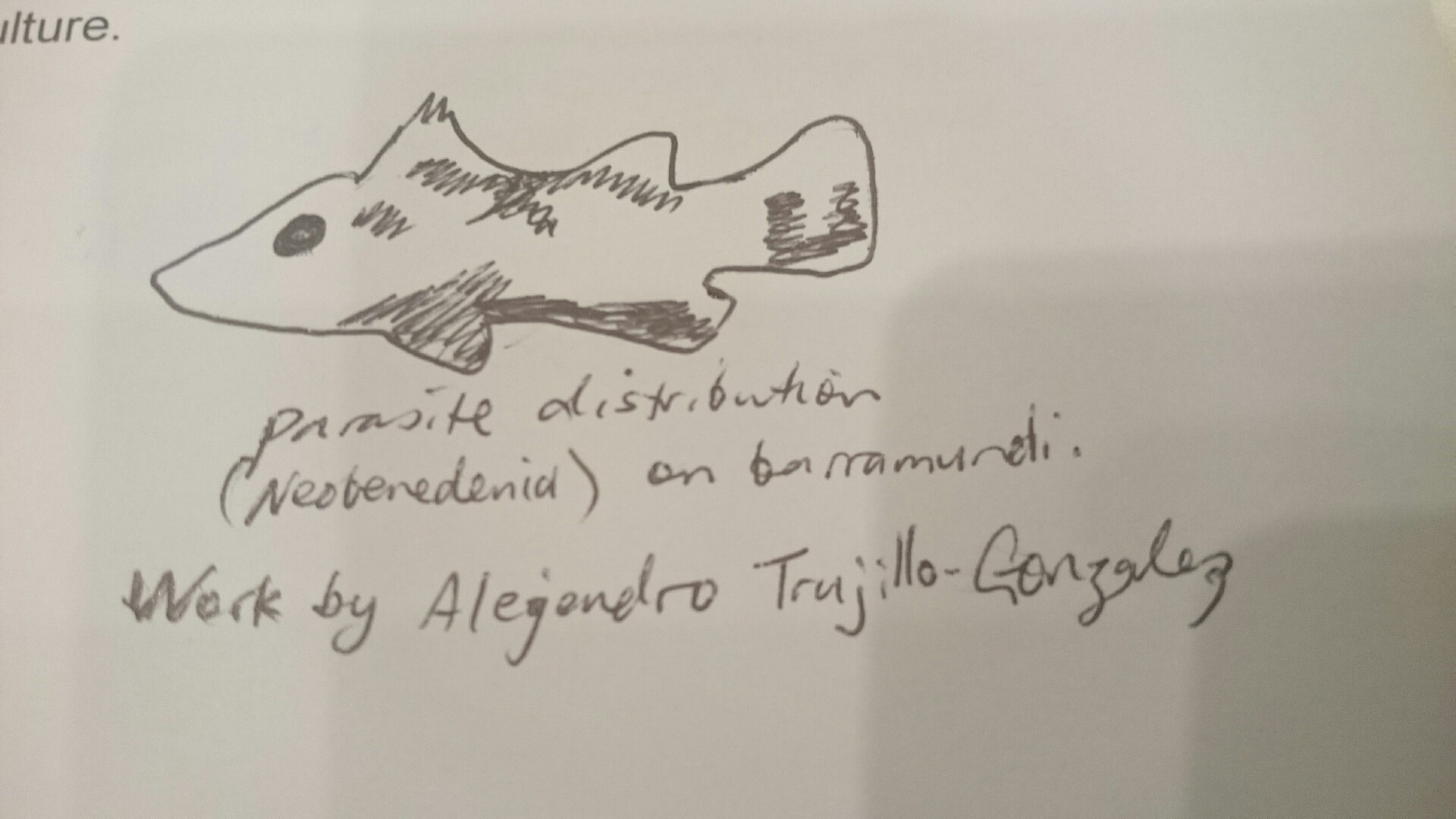
From work done on a particular species of fluke in barramundi, Alejandro has shown differences in distribution of this parasite, depending on the age of the parasite.

See pictured, a map of the combined distribution of different ages of flukes on barramundi.

So, in addition to the three standard sites mentioned, an important fourth site is from the ventral aspect of the body.


For more useful tips, see also,
https://thefishvet.com/2014/01/21/fish-vetting-techniques-practical-tips-instructional-dvd-fish-vetting-secrets-revealed/


Yours sincerely,

Dr Richmond Loh 

DipProjMgt, BSc, BVMS, MPhil (Pathology), MANZCVS (Aquatics& Pathobiology), CertAqV, NATA Signatory.
THE FISH VET, Perth, Western Australia, AUSTRALIA. 

Mobile Aquatic Veterinary Medical & Diagnostic Services.
http://www.thefishvet.com.au
Ph: +61 (0)421 822 383

Goldfish Eluded Huge Predator for Years

Talk about survival instincts!
>
> A goldfish that was meant to be fish food found a hideout and lived in a tank with its predator for seven years, according to Japanese news reports.
>
> The goldfish was tossed into the tank of an arapaima, a massive, predatory fish native to South America. But instead of going quietly to its fate, the plucky goldfish swam into a filtration unit in the tank at Japan’s Shima Marineland aquarium. Workers discovered the lurker after a routine cleaning.
>
> Though it sounds far-fetched, the goldfish’s survival in such a strange environment is not all that surprising, said Sudeep Chandra, an aquatic ecosystems researcher at the University of Nevada, Reno.
>
> “Goldfish and their related cousins are generally very hardy species that can survive under various conditions,” Chandra told Live Science.
>
> Predatory fish
>
> The goldfish was originally intended to be fed to the arapaima, which are among the biggest freshwater fish in the world, with some reaching a whopping 484 pounds (220 kilograms). In the wild, arapaima inhabit the tributaries and drainage waters of the Amazon and Orinoco rivers. Because they live in oxygen-poor waters, the fish have evolved the ability to breathe air, staying submerged for just 10 to 20 minutes at a time. That has made them easy marks for fishermen with harpoons, and the creatures have been hunted to the brink of extinction in some parts of Brazil.
>
> Escape plan
>
> The arapaima at the Japan aquarium was fed live fish, such as the goldfish, but switched to more traditional fish food at least seven years ago. It’s not clear whether the goldfish was hiding the entire time in the filtration system, but to get into that hiding spot, the goldfish needed to swim through a long pipe. Either way, it clearly had access to bits of food that passed into the filtration system, as it had grown to an impressive 10 inches (25.4 cm) long, according to The Register.
>
> Though the goldfish’s seven-year stay in the filtration system seems exceptional, the goldfish could have kept up its stealthy existence even longer if cleaners had not discovered it, Chandra said. Goldfish typically live between 10 and 15 years in captivity, though the world’s oldest goldfish was 43 years old when he died peacefully in 1999, the BBC reported.
>
> “The water pipe had warm water and constantly flowing water bringing oxygenated water to the fish. As long as food was delivered, I imagine the fish could persist for even longer,” Chandra said.
>
> Now, the survival-minded goldfish has gotten a promotion and is the star attraction at the aquarium, the Register reported.
>
> Goldfish aren’t quite the aquatic equivalent of cockroaches, but they’re close. A few years ago, Chandra and his colleagues discovered monster-size goldfish in Lake Tahoe. The goldfish had been tossed into the lake from an aquarium and had grown to a whopping 4.2 lbs. (1.9 kg) and 1.5 feet (45.7 cm) long. And in the Canadian province of Alberta, officials are urging people not to flush goldfish down the drain and are considering labeling the humble childhood pet an invasive species, after several individuals “the size of dinner plates” emerged in local storm ponds,

Survey on Research Masters with training at Murdoch University – emphasis on aquatic animal health professionals

I’m sending this on behalf of my colleague at Murdoch University. See below and I invite you to please respond.

Dear valued colleague,

I would be very interested to know your opinion on a Research Masters with Training (RMT) degree in your area of work.

A Research Masters with Training is designed for industry professionals keen to improve their knowledge and research skills, and will involve both structured postgraduate coursework and a research thesis, typically 18 months full time or 3 years part time.

Applicants should have a Bachelor’s degree and either 2 years’ full time professional experience, or undertaken a graduate course of at least 1 year full time study, or hold a four year degree. For more details see http://our.murdoch.edu.au/Research-and-Development/Resources-for-students/Future-research-students/Degrees-and-eligibility/Our-research-degrees/Research-Masters-with-training/.

This RMT degree will allow professional development in both the discipline of aquatic animal health as well as interdisciplinary areas such as epidemiology, biosecurity, food safety and public health. Please complete this short survey at https://www.surveymonkey.com/r/RMT_MurdochU to register your interest.

Thank you in advance for taking the time to complete this survey. Please contact me at S.Kueh, should you wish to discuss this further.

Yours sincerely,

Susan Kueh

Dr Susan Gibson-Kueh

BVSc, MSc(Aquatic Vet. Studies), PhD (Fish Pathology)

College of Veterinary Medicine

School of Veterinary & Life Sciences

Murdoch University, Perth, Western Australia
https://www.surveymonkey.com/r/RMT_MurdochU

Fish Joke for Monday-itis: Jokes for IT geeks

NETWORK: What you do when you need to repair the fishing net.

INTERNET: Where you want the fish to go.

 NETSCAPE: What the fish do when they discover a hole in the net.


Have a FINtastic week!
R <+>{

Positions Vacant: aquatic animal health and marine pests, epidemiology, emergency animal diseases.

Aquatic job available.

> Are you interested in epidemiology, emergency animal diseases, aquatic animal health or marine pests?
>
> The Department of Agriculture’s Animal Health Policy Branch is seeking suitable candidates to fill vacancies in the Aquatic Pest and Health Policy section, Animal Disease Preparedness and Response section and Animal Health Epidemiology and One Health section. These sections lead and co-ordinate national policy and program development for significant pest and health issues; contribute to enhanced pest and disease emergency preparedness and response and provide leadership in international and regional pest and health activities.
>
> Tertiary qualifications or experience in an area of animal health, aquatic animal health, marine science or related disciplines is highly desirable.
>
> The salary range is $77,602 to $88,315 (plus 15.4% super).
>
> Further information can be found on the department’s website, under the heading policy officers: http://agriculture.nga.net.au/fnt_jobs_list.cfm?
>
> Interested candidates may also wish to contact Dr Ingo Ernst (Ingo.Ernst) for further information.
>
> Please feel free to share this with others who might be interested in these positions.

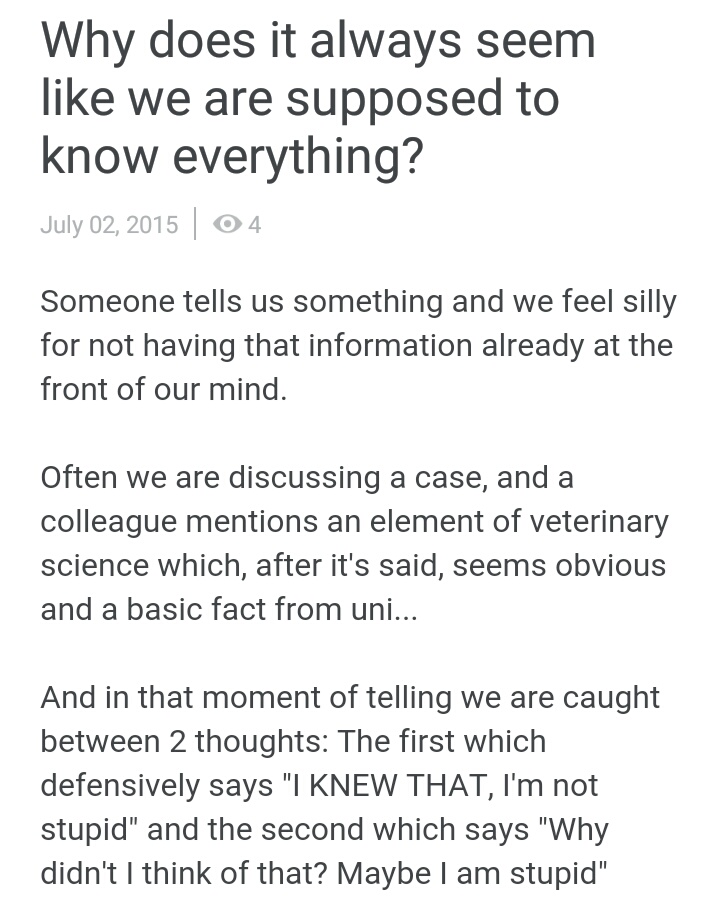
Why does it always seem like we are supposed to know everything?

I quite like these paragraphs on

“Why does it always seem like we are supposed to know everything?”

Source :

https://www.linkedin.com/pulse/why-does-always-seem-like-we-supposed-know-everything-ilana-mendels


Yours sincerely,

Dr Richmond Loh 

DipProjMgt, BSc, BVMS, MPhil (Pathology), MANZCVS (Aquatics& Pathobiology), CertAqV, NATA Signatory.
THE FISH VET, Perth, Western Australia, AUSTRALIA. 

Mobile Aquatic Veterinary Medical & Diagnostic Services.
http://www.thefishvet.com.au
Ph: +61 (0)421 822 383

Sent from my Sony Xperia™ smartphone

Do goldfish eat each other?

Goldfish by nature are not aggressive, and are not predatory. The short answer would be, "No, they don’t eat each other". However, there are some circumstances where goldfish do eat each other. Goldfish tend to browse for food, eating mostly what are bite-sized morsels, of anything edible. But, if they happen to come across small fish (e.g. baby goldfish), they do not discern, and they will eat it if they can catch it.

At breeding time, goldfish produce hundreds of sticky eggs. Goldfish exhibit no parental care, and they will graze on the eggs, regardless of whether it is theirs. Similarly, those eggs that survive and go on to hatch, the baby goldfish will continue to fall prey to anything that is larger – be it other goldfish, or insects (e.g. dragonfly larvae).

Once goldfish are able to swim around, and are of adequate size (e.g. 2-3 centimetres), the rate of intra-specific predation drops dramatically.

Follow me on: Facebook "Fin Page" YouTube Blog Linkedin Twitter


Yours sincerely,

Dr Richmond Loh
DipProjMgt, BSc, BVMS, MPhil (Pathology), MANZCVS (Aquatics & Pathobiology), CertAqV, CMAVA, NATA Signatory.
THE FISH VET, Perth, Western Australia, AUSTRALIA.
Mobile Aquatic Veterinary Medical & Diagnostic Services.
http://www.thefishvet.com.au
Ph: +61 (0)421 822 383
Skype: thefishvet

President WAVMA 2014

Adjunct Lecturer Murdoch University | Secretary Aquatic Animal Health Chapter – ANZCVS.

Looking for more books? Check out this site.
See advert on YouTube.