Why is TheFishVet, now a team?

Having TheFishVet Team distributed around the country means that we’re able to be on the ground, and be able to service our clients personally.

Having team-mates will allow us to grow our expertise collectively to help make a difference particularly in areas such as disease diagnosis and prevention in fish health.

We are a vertically integrated Veterinary Solutions Team, with members on the ground to collect information and samples, qualified Pathologist to do the lab testing, and clinicians to institute treatments.

A team that encompasses experiences in shrimp, abalone, food-fish, turtles and ornamentals. What more can you ask for?

Try us in
PERTH | MELBOURNE | TOWNSVILLE
THE FISH VET – AUSTRALIA.

For all your Aquatic Veterinary Medical & Diagnostic Services.

http://www.thefishvet.com.au

Ph: +61 (0)421 822 383

Making it easier to start an aquaculture business.

The Aquaculture Project

The Department of Finance in collaboration with the Department of Fisheries and other agencies, industry groups and stakeholders will identify compliance points and regulatory hurdles that are impeding the development of the aquaculture sector in WA, including abalone, prawns, pearling, marron, mussels, marine finfish and other species.

The team will look for opportunities to reduce the regulatory burden by working with stakeholders to make practical recommendations that will have a real impact on business operators, while retaining the necessary protections that ensure Western Australia remains a clean, safe, and disease-free location to develop aquaculture.

The team’s red tape targets include the regulatory approvals process, licencing conditions and exemptions, reporting and monitoring systems and other issues that may arise during consultations. They are inviting the public and interested stakeholders to submit any comments to their Aquaculture Survey

Read more here .

Follow me on: Facebook "Fin Page" – YouTube – Blog – Linkedin – Twitter

—
Yours sincerely,

Dr Richmond Loh
DipProjMgt, BSc, BVMS, MPhil (Pathology), MANZCVS (Aquatics & Pathobiology), CertAqV, CMAVA, NATA Signatory.
Aquatic Veterinarian & Veterinary Pathologist
THE FISH VET, AUSTRALIA – PERTH | MELBOURNE | TOWNSVILLE
Mobile Aquatic Veterinary Medical & Diagnostic Services.

W: http://www.thefishvet.com.au
Ph: +61 (0)421 822 383
Skype: thefishvet
President WAVMA 2014
Adjunct Lecturer Murdoch University
See advert on YouTube.
Looking for more books? Check out this site.

Tips when treating fish with copper, that will save your fish!

Copper is a common treatment for many different parasitic diseases in fish, in both freshwater and marine.

Though, saying this, copper is not always the preferred choice for many reasons.

Copper is toxic to certain fish species and invertebrates, and at lower pH.

Where fish can tolerate copper, we are using sufficient amount to kill the parasites, but less than what would kill the fish. The target amount of copper must be maintained at ~0.2 mg/L. There is an art to maintaining this level stable in the water body, for the duration of treatment. And a reliable, easy to use, copper test-kit is a must.

Copper levels may to drop due to adsorption by carbon filtration and so this must be removed. Copper also binds to bicarbonates and carbonates (which is high in marines). This binding of copper may be reversed if salinity increases, so you must maintain salinity.

Ensure you only feed manufactured diet, rather than fresh/frozen crustacea (like brine shrimp) because the latter can bioaccumulate enough copper to be toxic to fish that eat them!

After completion of copper treatment, use carbon to filter it out.

For advice on diagnosis, treatment and test kits, contact The Fish Vet.

—
Yours sincerely,

Dr Richmond Loh
DipProjMgt, BSc, BVMS, MPhil (Pathology), MANZCVS (Aquatics& Pathobiology), CertAqV, NATA Signatory.

Aquatic Veterinarian & Veterinary Pathologist.
PERTH | MELBOURNE | TOWNSVILLE
THE FISH VET – AUSTRALIA.

Aquatic Veterinary Medical & Diagnostic Services.
http://www.thefishvet.com.au
Ph: +61 421 822 383

Dolphin and shark sightings are becoming more common in the Swan River, with a recent report that the 2.5 meter predator came within 15 meters of the shore in Nedlands.

Perhaps our rivers are getting saltier?

Read more here.

Follow me on: Facebook "Fin Page" – YouTube – Blog – Linkedin – Twitter

—
Yours sincerely,

Dr Richmond Loh
DipProjMgt, BSc, BVMS, MPh (Pathology), MANZCVS (Aquatics & Pathobiology), CertAqV, CMAVA, NATA Signatory.
Aquatic Veterinarian & Veterinary Pathologist
THE FISH VET, AUSTRALIA – PERTH | MELBOURNE | TOWNSVILLE
Mobile Aquatic Veterinary Medical & Diagnostic Services.
http://www.thefishvet.com.au
Ph: +61 (0)421 822 383
Skype: thefishvet

President WAVMA 2014
Adjunct Lecturer Murdoch University

Looking for more books? Check out this site.

See advert on YouTube.

Fish joke for Monday-itis: Still waters.

Q: Why do people say,”Still waters run deep”?

A: Because they are highly reflective!

Have a FINtastic week! R <+>{

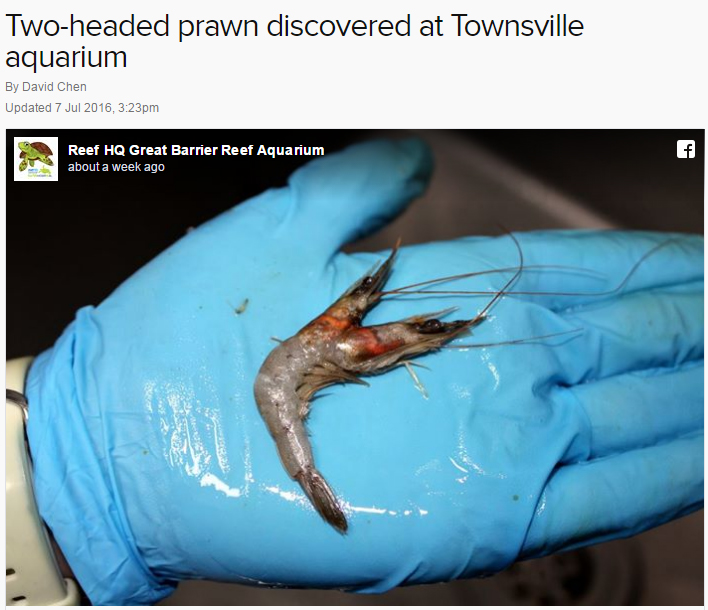
Two-headed prawn!!! Radiation? EDCs?

Read more here.

—
Yours sincerely,

Dr Richmond Loh DipProjMgt, BSc, BVMS, MPhil (Pathology), MANZCVS (Aquatics & Pathobiology), CertAqV, CMAVA, NATA Signatory.
Aquatic Veterinarian & Veterinary Pathologist
THE FISH VET, AUSTRALIA – PERTH | MELBOURNE | TOWNSVILLE

Mobile Aquatic Veterinary Medical & Diagnostic Services.

Listicle: When is it cost-effective to call a veterinarian to treat your fish?

In preparation for my conference presentations, I sent one of my students on an assignment.

He had to visit a local pet store, and collect information on fish medicines, namely:

  1. Regular retail prices
  2. What diseases they are used for, and
  3. Dose rates.

I then analysed the data and compared this with an average aquarium size of 300L and a pond size of 4000L. I arrived at the following conclusions:

  • Some drugs are extremely hazardous to users (e.g. trichlorfon is an endocrine disrupting chemical [see link]; formalin is carcinogenic; malachite green is so dangerous that it’s banned for use in food-fish). Do you want excess amounts of these drugs lying around where your children or pet/s may accidentally become exposed?
  • The most expensive medicines used to “self-treat” are bacterial (e.g. triple sulpha), flukes (e.g. praziquantel), and macroparasites (e.g. trichlorfon). If you have an aquarium, it might break even, provided fish respond. If you have a pond, it is actually cheaper to get a vet out.
  • Cost of “self-treatment” is based on having a correct diagnosis initially, and it is generally based on “luck” in choosing the correct drug (it might even be easier to win the lottery).
  • But, what if, your fish disease is caused by not one, but by many disease agents? In my experience, it’s quite common for multiple diseases to be present, and compounded by environmental factors. A single type of treatment would not suffice.
  • Cautionary notes on label may be inadequate. There are dangers of simultaneous, or sequential, random administration of drugs, without caution for multi-species tank (e.g. trichlorfon has cummulative effects; malachite green is harmful to fish like loaches; copper is toxic to clownfish…).
  • Label instructions do not account for water conditions. Treatments need to take water parameters into account (e.g. temperature affects lifecycle of parasites and this is vital for timing of repeat administration; general hardness affects efficacy of drugs like tetracycline is useless at rates on the label for hardwater and marine fishes because most of the drug will be chelated).
  • Label instructions may not account for disease agent. For example antibiotics should always be given as a course to avoid antibiotics resistance (some labels suggest to only treat once, when a minimum of 2-3 repeats is required to complete a course of antibiotics). In another example, time of application of repeats for parasiticides need to address egg or encysted stages.
  • Some drugs can cause more harm than good. Antibacterials like tetracycline, triple sulpha and methylene blue are hazardous to the biofilter, causing more harm.

CONCLUSION:

Treating fish by trial and error is false economy. The frustration and heartache that comes with mounting fish deaths is just not worth it.

Veterinary diagnostics and treatment examines the whole system, taking the needs of the patient, and the client into consideration when choosing the type/s of medicine/s to use.

Veterinary treatment is most cost-effective for:

  • large water volumes (>500 L),
  • valuable individual fish (expensive or rare fishes like koi, discus and marines that can cost >>$50 per animal),
  • high value fish populations (e.g. marines, discus, koi), and
  • when disease is caused by more than one agent.

Having said this, for some owners, you simply cannot put a price on pet fish. The majority of my clients consider their fish, part of their family, an heirloom, their life’s work, and their place of tranquility.

For collating this information, I’d like to give a huge thanks to Ming Jun LIM, President of the WAVMA Student Chapter, at Murdoch University, DVM-candidate 2018.

Follow me on: Facebook “Fin Page” – YouTube – Blog – Linkedin – Twitter

—
Yours sincerely,

Dr Richmond Loh

DipProjMgt, BSc, BVMS, MPh (Pathology), MANZCVS (Aquatics & Pathobiology), CertAqV, CMAVA, NATA Signatory.
Aquatic Veterinarian & Veterinary Pathologist
THE FISH VET, AUSTRALIA – PERTH | MELBOURNE | TOWNSVILLE

Mobile Aquatic Veterinary Medical & Diagnostic Services.
http://www.thefishvet.com.au
Ph: +61 (0)421 822 383
thefishvet_logo_medical-20130107.jpg
Skype: thefishvet

President WAVMA 2014

How to help your pond fish survive brutally cold winters?

PERTH has had one of its coldest winter nights, with air temperatures dropping to near freezing.

https://au.news.yahoo.com/thewest/wa/a/32042722/perth-and-south-west-shiver-through-coldest-night-of-the-year/

We need to prevent supercooling of our pond water to keep fish from stressing. To do this, we need to decrease the water flow rate to cut evaporative cooling, decrease aeration to reduce cooling by air, add salt to your pond at a rate of 1-5g/L, add vitamin C to their water, and reduce feeding to a minimum (and only during the warmer parts of the day – see also,

https://thefishvet.com/2011/06/23/how-often-should-i-feed-my-fishes/).

If you’re unsure about any of these, call us in to scope out your set-up.

—
Yours sincerely,

Dr Richmond Loh
DipProjMgt, BSc, BVMS, MPhil (Pathology), MANZCVS (Aquatics& Pathobiology), CertAqV, NATA Signatory.

Aquatic Veterinarian & Veterinary Pathologist.
PERTH | MELBOURNE | TOWNSVILLE
THE FISH VET – AUSTRALIA.

Aquatic Veterinary Medical & Diagnostic Services.

http://www.thefishvet.com.au

Ph: +61 421 822 383

Tumors in sea turtles might be due to pollution.

"A growing number of green sea turtles are being spotted on Australia’s Great Barrier Reef with fibropapillomatosis caused by a turtle-specific herpes virus. Turtles with the tumors — which are benign but can interfere with vision and render animals more vulnerable to infection — have also been found in Florida and Hawaii, and scientists suspect polluted water is to blame. Karina Jones of James Cook University in Townsville, Australia, is among those attempting to identify specific pollutants that cause the tumors."

Read more at – "Turtle herpes outbreak hints at Great Barrier Reef contamination"

Follow me on: Facebook "Fin Page" – YouTube – Blog – Linkedin – Twitter

—
Yours sincerely,

Dr Richmond Loh DipProjMgt, BSc, BVMS, MPh (Pathology), MANZCVS (Aquatics & Pathobiology), CertAqV, CMAVA, NATA Signatory.
Aquatic Veterinarian & Veterinary Pathologist
THE FISH VET, AUSTRALIA – PERTH | MELBOURNE | TOWNSVILLE

Mobile Aquatic Veterinary Medical & Diagnostic Services.
http://www.thefishvet.com.au
Ph: +61 (0)421 822 383
thefishvet_logo_medical-20130107.jpg
Skype: thefishvet

President WAVMA 2014