Wild Tropical ornamental fish and barramundi in the middle of temperate Victoria – in cooling ponds of Hazelwood power station.

Over ten years ago, I remember driving over two hours to get to this wild tropical fish Mecca in the middle of cold Victoria. We caught a selection of hybrid cichlids, and others have caught Oscars and plenty of other cichlids. These tropical fish had been released by fish hobbyists and have been able to survive the cold temperatures and have a self-sustaining population. Subsequently, these fish are considered feral and carried a pest status.

How is it possible? They’re thriving because this is a man-made lake, made to hold water to cool the power plant. So, I felt it was rather awkward to have to buy a fishing permit, to catch these fish. Nevertheless, we did, and were amazed at the different types of fishes we found.

This year, the state government took advantage of this tropical waters to stock with barramundi for the purpose of fishing. What an excellent idea!

Even in New Zealand, there’s a tropical freshwater prawn farm utilising the same idea – http://www.hukaprawnpark.co.nz/

But it sounds like it’s much too late. The Hazelwood power station is scheduled to shut down in the very near future. Bad timing? Was the $150,000 well spent for 5,000 barramundi?

Read more about "Victoria’s short-lived barramundi project, in cooling ponds of Hazelwood power station" at –
http://mobile.abc.net.au/news/2016-11-07/hazelwood-pondage-short-lived-barramundi/8000988

—
Yours sincerely,

Dr Richmond Loh
DipProjMgt, BSc, BVMS, MPhil (Pathology), MANZCVS (Aquatics& Pathobiology), CertAqV, NATA Signatory.

Aquatic Veterinarian & Veterinary Pathologist.
PERTH | MELBOURNE | SYDNEY | TOWNSVILLE
THE FISH VET – AUSTRALIA.

Aquatic Veterinary Medical & Diagnostic Services.
http://www.thefishvet.com.au
Ph: +61 421 822 383
Australian fur seal weighing 200kg wanders down Tasmanian street, squashes car

I must admit I’ve never seen this happen during my time in Tasmania.

http://www.abc.net.au/news/2016-12-26/australian-seal-found-sitting-on-car-in-suburban-launceston/8148086?pfmredir=sm

—
Yours sincerely,

Dr Richmond Loh
DipProjMgt, BSc, BVMS, MPhil (Pathology), MANZCVS (Aquatics& Pathobiology), CertAqV, NATA Signatory.

Aquatic Veterinarian & Veterinary Pathologist.
PERTH | MELBOURNE | SYDNEY | TOWNSVILLE
THE FISH VET – AUSTRALIA.

Aquatic Veterinary Medical & Diagnostic Services.
http://www.thefishvet.com.au
Ph: +61 421 822 383
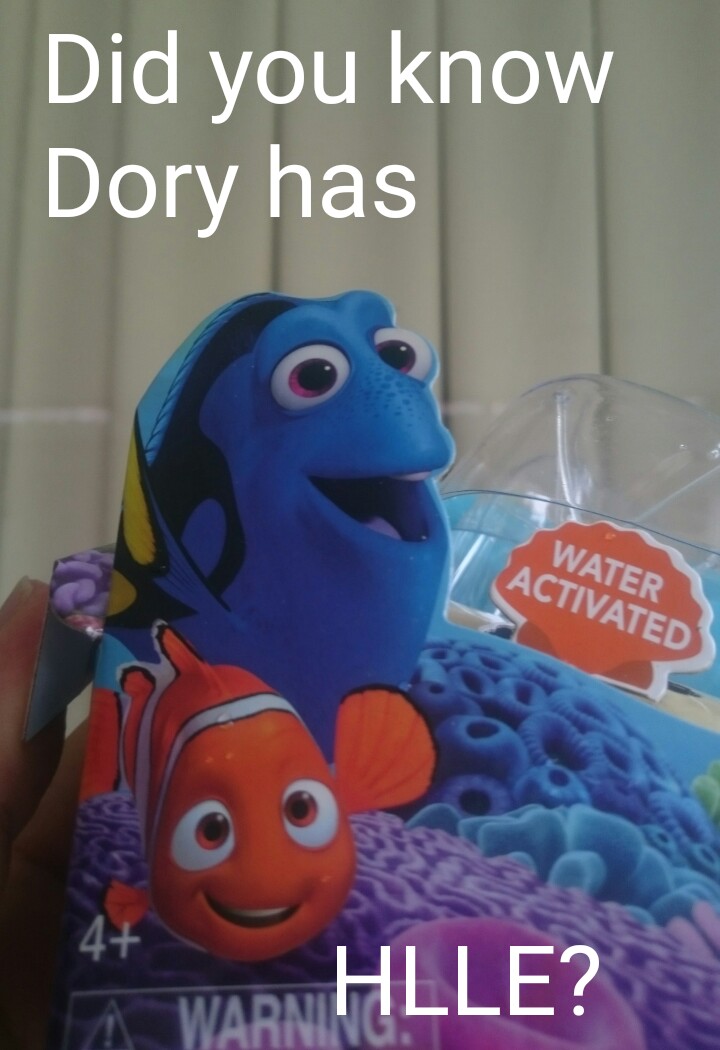
Is Dory sick?

Check out the spots in her face. These could be the beginnings of “head and lateral line erosion syndrome” (HLLE), if they’re forming pits. It seems to be confined to fish belonging to the groups: surgeonfish (like the blue tang) and butterfly fishes.

It’s still a syndrome because there’s been no definite causal agent identified. There are, however, many factors associated with the disease. Stress, poor water quality, improper diet, parasitic infestations and the use of charcoal in the filtration.

Read more about HLLE here –

https://thefishvet.com/2013/11/19/activated-charcoalcarbon-linked-to-head-and-lateral-line-erosion-syndrome-marine-equivalent-of-hole-in-the-head-disease/

In a recent publication, successful treatment incorporated topical application of a wound healing gel called Regranex which contains 0.01% becaplermin (recombinant platelet-derived growth-factor).

But you’ll be glad to know that these feckles are actually normal in healthy mature fish (thanks to the feedback from avid aquarists). Though, if they’re forming pits, definitely investigate whether it is HLLE.

And just for laughs, read about the movie mistakes in Finding Dory at this link. 

—
Yours sincerely,

Dr Richmond Loh
DipProjMgt, BSc, BVMS, MPhil (Pathology), MANZCVS (Aquatics& Pathobiology), CertAqV, NATA Signatory.

Aquatic Veterinarian & Veterinary Pathologist.
PERTH | MELBOURNE | SYDNEY | TOWNSVILLE
THE FISH VET – AUSTRALIA.

Aquatic Veterinary Medical & Diagnostic Services.

http://www.thefishvet.com.au

Ph: +61 421 822 383
Special fish joke for Christmas. 

Q: Why is it always Christmas in an aquarium? 
A: Because there are always baubles (bubbles)!

Merry Fishmas everyone and 

have a FINtastic new year! 

R <+>{


If you’re in need of more humour, watch

https://youtu.be/mWP7-VwdNJY

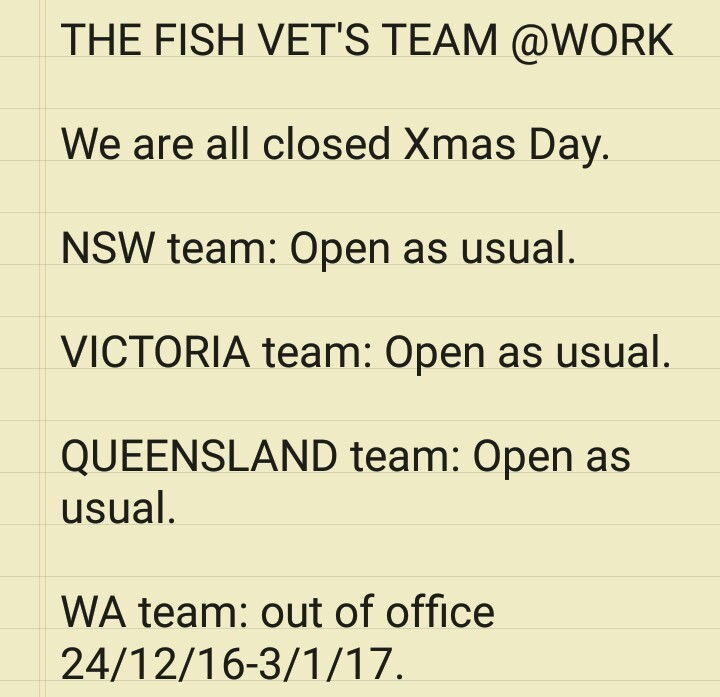
TheFishVet’s team work hours these holidays.

We are all closed Xmas Day.

NSW team: Business as usual.

VICTORIA team: Business as usual.

QUEENSLAND team: Business as usual.

WA team: out of office 24/12/16-3/1/17. Then business as usual.

Have a safe and joyous Christmas and a happy new year!

—
Yours sincerely,

Dr Richmond Loh
DipProjMgt, BSc, BVMS, MPhil (Pathology), MANZCVS (Aquatics& Pathobiology), CertAqV, NATA Signatory.

Aquatic Veterinarian & Veterinary Pathologist.
PERTH | MELBOURNE | SYDNEY | TOWNSVILLE
THE FISH VET – AUSTRALIA.

Aquatic Veterinary Medical & Diagnostic Services.

http://www.thefishvet.com.au

Ph: +61 421 822 383
Why “The Fish Vet”?

I’m commonly asked what is a fish vet, and what do I do. 

I’m a vet, for fish. Yes, a REAL Veterinarian. 

Anyway, I’m hoping our new YouTube channel can help with educating the other 95% of our population about fish veterinarians.

Learn more about aquatic yeterinary medicine. 

Subscribe to our YouTube channel 

http://tinyurl.com/thefishdoctor&nbsp;

The Fish Vet’s video clip translated into Spanish – How to sample fish blood.

Ola!

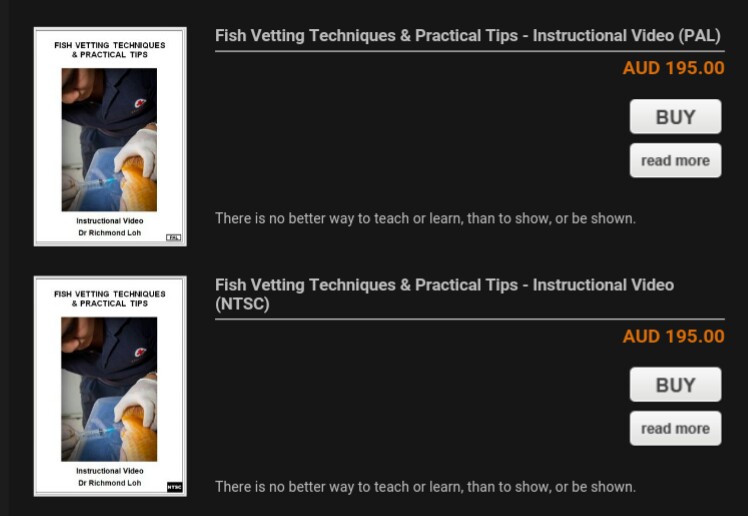
Check out one of my DVD clips (Fish Vetting Techniques and Practical Tips – Instructional Video) translated into Spanish.

This is how you take a blood sample from a fish (in Spanish).

https://m.facebook.com/story.php?story_fbid=1308724522513529&id=923828664336452

If you want to learn how to do a lot more fish vetting procedures, get your copy now from
http://thefishvet.com.au/shop/shopping.html

Available in two formats. English language only.

—
Yours sincerely,

Dr Richmond Loh
DipProjMgt, BSc, BVMS, MPhil (Pathology), MANZCVS (Aquatics& Pathobiology), CertAqV, NATA Signatory.

Aquatic Veterinarian & Veterinary Pathologist.
PERTH | MELBOURNE | SYDNEY | TOWNSVILLE
THE FISH VET – AUSTRALIA.

Aquatic Veterinary Medical & Diagnostic Services.
http://www.thefishvet.com.au
Ph: +61 421 822 383
Cyprinid herpesvirus 3 (KHV or CyHV3) and its evolutionary future as a biological control agent for carp in Australia – download the paper.

I had a read of the paper shared by Brad Bradley via Facebook – thank you.

The first paragraph is filled with assumptions about carp being a major cause of (rather than carp being a symptom of) aquatic ecosystem damage.

Here it also states that once KHV is released, there will be continued release of more devastating viruses, to kill fish that develop natural immunity.

But what I find most disconcerting is that it says, “the release of CyHV-3 undoubtedly represents a unique and exciting natural experiment…”

Would it be okay for me to say that I’m not in the least bit excited?

Read the paper, download the open-access paper here –

http://virologyj.biomedcentral.com/articles/10.1186/s12985-016-0666-4

—
Yours sincerely,

Dr Richmond Loh
DipProjMgt, BSc, BVMS, MPhil (Pathology), MANZCVS (Aquatics& Pathobiology), CertAqV, NATA Signatory.

Aquatic Veterinarian & Veterinary Pathologist.
PERTH | MELBOURNE | SYDNEY | TOWNSVILLE
THE FISH VET – AUSTRALIA.

Aquatic Veterinary Medical & Diagnostic Services.

http://www.thefishvet.com.au

Ph: +61 421 822 383