The Fish Vets gives some Fin Chat.

Join the Combined Fish Clubs of Victoria and attend The Fish Vets’ talk on:

On-site and off-site veterinary services: The advantages and disadvantages. 

Drs Richmond Loh and Alistair Brown will illustrate with case examples. 
When? 

Friday 27th Jan 2017.
Where? 

The address is 29 Grant Street. CLIFTON HILL just a block from the Clifton Hill station. (Melway 2 C K 2).

Job available – Manager of Shark Response Unit – Dept Fisheries WA.

Position number: 23309
Work type: Permanent – Full Time
Location: Fremantle, Western Australia, Australia.
Closing date: 2017-01-31 12:00pm AWST

The Department of Fisheries manages Western Australia’s fish, marine and the freshwater fisheries and the habitats on which they depend. We aspire to be recognised and respected by the WA community for our leadership in fisheries and aquatic resource management. The Department’s purpose is to deliver sustainable management and development of the State’s fisheries and aquatic resources by being responsive, resilient and results-focused.

There is currently one (1) Level 7 Manager Shark Response Unit position available for filling on a permanent full-time basis.

Position Profile:

Are you looking for an interesting, challenging and rewarding role in a progressive and encouraging workplace?

The role of the Manager Shark Response Unit includes; coordinating the Department of Fisheries planning and response to shark sightings and incidents, managing and coordinating the Department’s Shark Response Unit, leading the development of policies and strategies and representing the Department at key functions. The Manager will also work with other agencies to improve warning notifications, systems and responses and be responsible for engaging with the community, media and external stakeholders in relation to recommendations on specific shark hazard mitigation programs.

The Fremantle Fisheries branch is located near the iconic Fremantle Port 19km South West of Perth. Just a stone throw from the café strip and main CBD area you will never be in a hurry to head home after work, as some of Western Australia’s finest restaurants, cafes, bars and pubs are in close proximity and not to mention the famous Fremantle Markets. With excellent public transport facilities you can safely travel home on either the train or bus.

For FULL DETAILS, go to – http://tinyurl.com/zbt9qbf

Follow me on: Facebook "Fin Page" – YouTube – Blog – Linkedin – Twitter

—
Yours sincerely,

Dr Richmond Loh DipProjMgt, BSc, BVMS, MPhil (Pathology), MANZCVS (Aquatics & Pathobiology), CertAqV, CMAVA, NATA Signatory.
Aquatic Veterinarian & Veterinary Pathologist
THE FISH VET, AUSTRALIA – PERTH | SYDNEY | MELBOURNE | TOWNSVILLE | BRIBIE ISLAND

Mobile Aquatic Veterinary Medical & Diagnostic Services.

thefishvet_logo_medical-20130107.jpg

WAVMA’s 2017 Conference – Current Concepts in Aquaculture and Ornamental Fish Practice – call for papers

This conference will provide a framework for discussion and reflection on the role of veterinarians in continuing to foster the sustainable development of worldwide aquaculture and ornamental fish industries, with a special focus on development and options in the Eastern Europe region.

The event will be of relevance to veterinarians, veterinary technicians and students, as well as aquaculture policy makers (i.e. government officials, veterinary school personnel, national or regional veterinary professional associations) fish farmers/owners involved in commercial aquaculture and ornamental fish industries, non-veterinary aquatic animal health personnel, professionals involved in seafood safety control, and other aquatic animal health stakeholders.

Conference attendees will likely have diverse backgrounds of experience and expertise in aquatic animal medicine, so presentations may be broadly or specifically applicable to a wide range of topics that are relevant to the development of aquaculture in Eastern Europe, as well as in other parts of the world.

Objectives:

· To increase awareness on the importance of ensuring sustainable seafood production and food security through aquaculture in Romania and other neighbouring countries, consistent with a variety of regional and global initiatives and objectives;

· To emphasize important developments in global aquatic veterinary education and practice, and to encourage veterinarians and veterinary students to pursue new and developing options in aquatic veterinary medicine.

We are seeking oral and poster presentations which may include (but are not limited to) basic research, case reports and general ideas for clinical practice involving aquatic animals. Speakers are expected to provide at least 25 minute presentations to be entitled to free conference registration (includes lunches and banquet).

Poster presentations are welcome (up to 1 x 1 m in size).

Interested oral and poster presenters should submit a short biography, title of the presentation(s), authors’ names – indicating who will be the speaker by an asterisk, and type of presentation, to the Meetings Committee chair, at: cypcarpio@aol.com  by March 15, 2017.

—

Julius M. Tepper, DVM, CertAqV

Fellow, World Aquatic Veterinary Medical Assn.

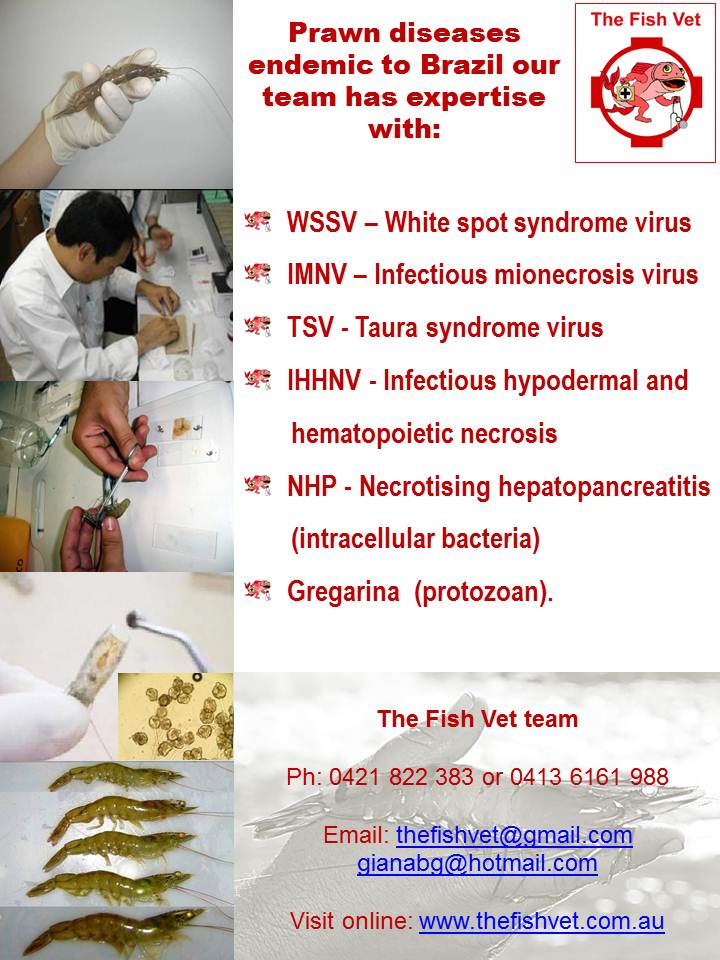
Why choose The Fish Vet for your prawn farm?

Considering the recent WSSV outbreak events in Australian prawn farms, it is vital to employ professionals with actual expertise on diseases exotic to Australia. Our dynamic team can help prevent diseases on your valuable prawn farm and hatchery.

Aquatic Animal Health specialist, Giana Gomes, has extensive experience with farmed prawns and has first-hand experience white spot outbreaks in Brazilian farms. After completing her veterinary degree, she worked as a veterinarian for Aquatec Ltd and Genearch Ltd, one of the largest shrimp hatchery and the first SPF hatchery in Brazil, respectively. Giana’s Master’s thesis was on prawn disease NHPB (necrotising hepatopancreatitis bacterium) which causes significant economic losses in Central and South America. In Australia, she has worked at the Australian Institute of Marine Science (AIMS) to establish histology techniques for tropical rock lobster larvae and the ornamental cleaner shrimp.

Giana’s expertise is illustrated in her presentation for the World Aquatic Veterinary Medical Association, “The most effective biosecurity actions you can take are monitoring and keeping a record of the health of your shrimp crops.” – FREE to watch at this link

Let’s not reinvent the wheel.

Together we can help you maximise your farm’s potential.

ENQUIRE NOW.

Follow me on: Facebook “Fin Page” – YouTube – Blog – Linkedin – Twitter

—
Yours sincerely,

Dr Richmond Loh DipProjMgt, BSc, BVMS, MPhil (Pathology), MANZCVS (Aquatics & Pathobiology), CertAqV, CMAVA, NATA Signatory.
Aquatic Veterinarian & Veterinary Pathologist

THE FISH VET, AUSTRALIA – PERTH | SYDNEY | MELBOURNE | TOWNSVILLE | BRIBIE ISLAND

Mobile Aquatic Veterinary Medical & Diagnostic Services.

thefishvet_logo_medical-20130107.jpg

Are you getting good advice and diagnostics, when you need it?

In a recent report by the OIE, on the Performance of [Government] Veterinary Services, they state: "It was highlighted that staff levels in some jurisdictions are not just stretched for emergencies but they are stretched now and these services are managing to cope because they are prioritising work and some work is not being carried out fully or at all. In several jurisdictions staff levels are seen as severely inadequate… concerns about increasing costs and delays in the laboratory services required for effective surveillance. There are some difficulties as well in providing veterinary cover in remote areas. Areas of reduced rural laboratory services occur in some jurisdictions… and may be stretched beyond their limits in case of animal disease emergencies." – source:

http://www.oie.int/fileadmin/Home/eng/Support_to_OIE_Members/docs/pdf/FinalReport_PVS_Australia.pdf

This will negatively impact your bottom-line.

You can support your state veterinary laboratories by using veterinarians who know how, and what to submit to the labs for testing, as part of your aquatic animal health management plan.

—
Yours sincerely,

Dr Richmond Loh

DipProjMgt, BSc, BVMS, MPhil (Pathology), MANZCVS (Aquatics & Pathobiology), CertAqV, CMAVA, NATA Signatory.
Aquatic Veterinarian & Veterinary Pathologist
THE FISH VET, AUSTRALIA

Mobile Aquatic Veterinary Medical & Diagnostic Services.

Update on the white spot syndrome viral disease in prawns – Queensland, Australia.

So far, reports state that five prawn farms have now been affected, and the disease has been found in native crustaceans in the Logan River.

In a recent press-release, it states that "no definitive source of prawn disease has been found.’

“We are still looking at a number of pathways that may have resulted in the white spot disease incursion in Queensland, including imported feed or probiotics, contaminated equipment, or even discarded uncooked prawns—or bits of prawns—that were purchased to eat.

“…fishers using infected imported prawns for bait is one possible pathway for this disease to get into our river system and onto prawn farms—and is why prawns imported for human consumption should never be used for bait.”

The Department of Agriculture and Water Resources is responsible for managing Australia’s biosecurity system which is in place to safeguard Australia’s agriculture, fisheries and forestry industries worth over $60 billion to our economy.

In a knee-jerk reaction, Australia now bans import of raw prawns from countries where WSSV is endemic. This is contrary to the pro-active approach in banning imported raw salmon and pork products. Is it a little too late?

While a lot of effort is going into finding out where and when the disease came into Australia, I’d expect considerable efforts are also going into surveying our native crustacean and polychaete populations (wild and farmed), to prove freedom from disease… otherwise, the ban on imported raw prawn products will be seen as an unfair trade-barrier.

Follow me on: Facebook "Fin Page" – YouTube – Blog – Linkedin – Twitter

—
Yours sincerely,

Dr Richmond Loh
DipProjMgt, BSc, BVMS, MPhil (Pathology), MANZCVS (Aquatics & Pathobiology), CertAqV, CMAVA, NATA Signatory.
Aquatic Veterinarian & Veterinary Pathologist
THE FISH VET, AUSTRALIA – PERTH | SYDNEY | MELBOURNE | TOWNSVILLE
Mobile Aquatic Veterinary Medical & Diagnostic Services.

W: http://www.thefishvet.com.au
Ph: +61 (0)421 822 383
Skype: thefishvet
President WAVMA 2014
Adjunct Lecturer Murdoch University
See advert on YouTube.
Looking for more books? Check out this site.

Fish joke for Monday-itis: What did the fish say to the farmer when caught by the tail?

Q: What did the fish say to the farmer when he was caught by the tail?

A: This is the end of me.

Have a FINtastic week! R <+>{

The Fish Vet – Sydney – availabilities

Just letting you know that our colleague in New South Wales will be unavailable from 24 January to 3rd February, 2017. Our colleague will be attending the Australia and New Zealand Zebrafish Husbandry Workshop.

So if you’re thinking of getting your fish checked, please book us in sooner rather than later.

Follow me on: Facebook “Fin Page” – YouTube – Blog – Linkedin – Twitter

—
Yours sincerely,

Dr Richmond Loh DipProjMgt, BSc, BVMS, MPhil (Pathology), MANZCVS (Aquatics & Pathobiology), CertAqV, CMAVA, NATA Signatory.
Aquatic Veterinarian & Veterinary Pathologist

THE FISH VET, AUSTRALIA – PERTH | SYDNEY | MELBOURNE | TOWNSVILLE

Mobile Aquatic Veterinary Medical & Diagnostic Services.

thefishvet_logo_medical-20130107.jpg

What’s your diagnosis? The problems with treating fish diseases are…

Quite often, if your fish presents with parasites, you can be almost certain, there may be other problems too.

Recently, I had a client losing fish from lice. This is easily enough to diagnose without special equipment. There are a variety of medicines you can use that’s suitable, but if you were to treat for lice alone, then you’re in for a shock.

Using my microscope, I was also able to diagnose two other parasitic diseases: Trichodina and gill fluke infestations. So treating for lice alone would still leave the fish owners with problems that would continue to kill more fish, if left undiagnosed.

Even if it were a simple single lice problem, treatments may fail for a variety of reasons: with drugs not working (e.g. incorrectly administered, wrong dose, poor water circulation, drug resistance, rapid drug degradation, etc), or drugs being harmful (e.g. drug interactions, effect on biofilter, species toxicity, etc.).

This is why I firmly believe that to have an effective cure, a site visit by myself or one of my veterinary colleagues is vital to save your fish. The clients are ever so happy that they had been referred to us, earlier rather than later, because they’d otherwise struggle and become frustrated with their losses.

The big question is, how much does it cost to get a veterinarian out? To put in economic perspective, clients typically lose somewhere between several hundred to thousands of dollars with ineffectual, randomly recommended treatments. Our fees typically range from $200-350, inclusive of treatment.

Don’t hesitate to call on The Fish Vet for any fish health and disease problems. Better still, call us to arrange for preventive health check-ups.

—
Yours sincerely,

Dr Richmond Loh
DipProjMgt, BSc, BVMS, MPhil (Pathology), MANZCVS (Aquatics& Pathobiology), CertAqV, NATA Signatory.

Aquatic Veterinarian & Veterinary Pathologist.
PERTH | MELBOURNE | SYDNEY | TOWNSVILLE | BRIBIE ISLAND.
THE FISH VET – AUSTRALIA.

Aquatic Veterinary Medical & Diagnostic Services.
http://www.thefishvet.com.au
Ph: +61 421 822 383