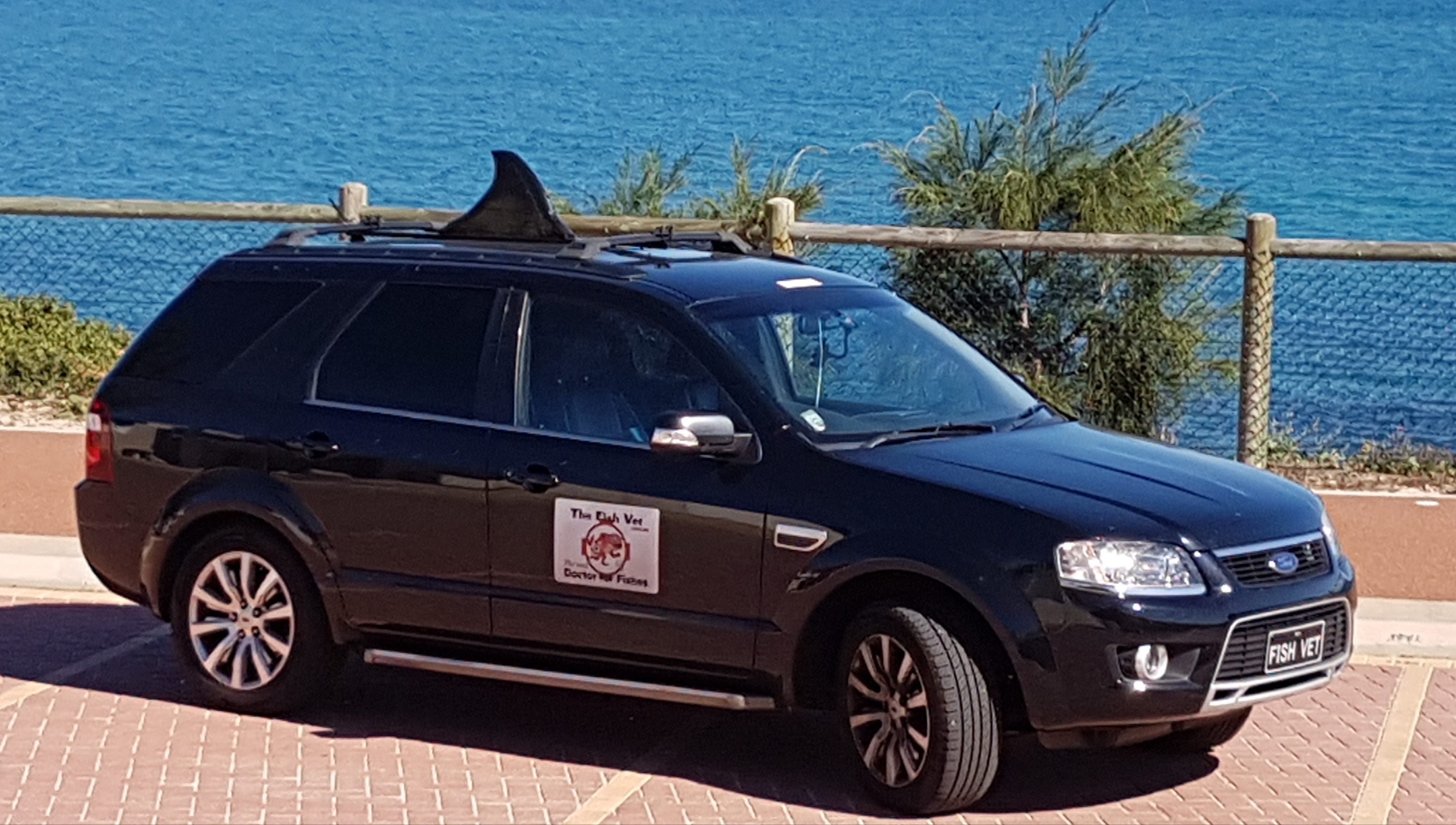
​Underwater diving that doesnt need scuba license – busselton jetty.

I did this in Cairns at the Great Barrier Reef for a change from real SCUBA amd snorkelling. Interesting. Just like the pearl divers. I still prefer snorkelling.

Check it out – https://www.facebook.com/9NewsPerth/videos/1432237030121786/

​Fish Vetting Essentials – the inspiration behind the MUST-HAVE book.

Still, 6 years after publishing my red book on fish health, I’m still getting online orders. How did this book come about?

As a new gradute veterinarian (in 2001), I started accumulating every useful (and legitimate) tidbits of information on fish medicine. Then as I prepared for my post-graduate examinations on aquatic animal health, I continued adding to this.


I’m passionate about helping improve the health of fishes. I wrote down the exact problems, and answers to questions for the exams, and for my work with fish, and shared it with other veterinarians at conferences. 

Before I knew it, more and more people asked for a copy of my little booklet. And the feedback completely blew me away.
One veterinarian thought they’d never be confident enough to see fish, but after reading it, they gained confidence and is now a fish veterinarian for life.

Fish VettingEssentials is a respected and inspiring source of up-to-date information.

As more and more success stories poured in, I was overwhelmed by the response.

Needless to say, this proved that ANYONE could use my formulas in this book for successfully diagnosing and treating fish diseases. 

I’ve been in the publishing world long enough to know I didn’t want to go the traditional publishing route, where the writer has limited control over the final product and no direct relationship with the reader.
So, in 2011, I decided to self-publish and share updates directly and exclusively from my website.
Think of it as ten years of blood, sweat and tears distilled down into one red book. Like taking all the information from the internet, filtering out all the myths and misinformation, down into a book.
In this book you’ll learn:
1. How to harness the power of the microscope.
2. How to interpret water quality test results.
3. How to predict disease issues before diseases happen. 
4. How to successfully treat diseased fish.
The “invisible disease” most aquarists don’t even know how to diagnose. Once you make this diagnosis, you will have unstoppable confidence to know what treatment, dose rate, and frequency to treat with.
The one book that transforms you from a novice, to an expert. 
You get it all in the form of a trusted red book.
This book is NOT for everyone.

Bad Things Will Happen

If you’re on the fence, let me offer a blunt prediction.
Here’s what will happen if you say “no” or “maybe later” to this offer.
You’ll misdiagnose fish diseases, you’ll give the incorrect treatment that will do no good, or worse, would kill the fish, you’ll give incorrect advice,….

That would be tragic.

Especially since you were just ONE CLICK away from getting the keys to the wisdom.
Don’t let that happen to you.
Don’t let your fish die, and you, haunted by regret.
In case you just skimmed through this post, here’s the deal:
Download your sample copy of Fish Vetting Essentials for Free at – http://thefishvet.com.au/ebook.html

Use our CONTACT FORM to place your order now (link).

How will KHV impact your koi health?

How will your pet koi fare? What can you do to reduce the likelihood of disease taking down your entire collection?

Recently, I moderated the WAVMA-hosted webinar on KHV. Learn moreat (free) – https://www.wavma.org/Webinars/b-1029-koi-herpesvirus-khv-as-a-potential-control-agent-for-australian-carp


Yours sincerely,

Dr Richmond Loh
DipProjMgt, BSc, BVMS, MPhil (Pathology), MANZCVS (Aquatics& Pathobiology), CertAqV, NATA Signatory.

Aquatic Veterinarian & Veterinary Pathologist.
PERTH | MELBOURNE | SYDNEY | TOWNSVILLE | BRIBIE ISLAND.
THE FISH VET – AUSTRALIA.

Aquatic Veterinary Medical & Diagnostic Services.
Web: http://www.thefishvet.com.au
Ph: +61 421 822 383
Mail: PO Box 5164, East Victoria Park, WA 6981, Australia.

​The Fish Vet “eels” your fish. 

To diagnose the condition, we can even prepare a cytology smear, and dye for you. 

We’re not as expensive as getting  it all wrong. Loan sharks not needed. We can save your sole because, we are Veterinary sturgeons. 
Sand dollars not accepted. Payment is by credit or COD.
So don’t be koi, drop us a line. 

Quarantine alert might have prevented white spot disease outbreak, review finds| The Guardian.

The risk could have been reduced if Biosecurity Queensland was made aware that federal authorities were investigating organised breaches of importation laws, under the codename Operation Cattai.”

https://www.theguardian.com/environment/2017/apr/14/quarantine-alert-might-have-prevented-white-spot-disease-outbreak-review-finds?CMP=share_btn_fb

Proven strategy to curing fish diseases – six steps.

The Fish keeping “industry” is full of myths. People are being advised to do all sorts of crazy things, most of which have no evidence behind them. Over the years, however, I have found a number of strategies that seem to be effective at curing fish diseases.
Here are 6 steps that actually work.
1. OBTAIN a correct diagnosis, often can’t tell what’s wrong just on clinical signs alone.  Need evidence, water results, microscopic examinations, laboratory testing, whatever it takes.

2. Don’t stop at the first diagnosis. There may be more than one thing wrong.

3. Choose the right medicine class to suit the diagnosis. 

4. Select the best method of administration.

5. Stick to plan, and keep your veterinarian informed with regular updates. 

6. Be able to change plans to suit unique situations.

DIAGNOSIS, it helps you know what to do.


DOWNLOAD the latest version of our Services Manual here – TFV-Services-&-Fees-2017 (postal address updated 23/2/2017).

​What’s your fish obsession score?

You know you’re obsessed with fish when…

#1. You own at least two aquariums, two ponds and an aquaponics system, and countless numbers of fishes.
#2. All large pots and planter boxes are fair game for turning into a pond.
#3. You stare intensely in every drain, river, pond or lake for fish. 
#4. You tell your friends with swimming pools, “You should really make it into a fish pond.”
#5. When you wife (or partner) says you cannot have anymore fish tanks.
#6. You own so many aquatic plush toys. 
#7. You can recite every line in Finding Nemo. 
#8. You must visit the public aquarium in any city you travel to. 
#9. You can stay staring at fish for hours on end.
#10. You never come home empty-handed after visiting the fish shop.
#11. You love marvelling at the variety of fishes at the fish market.
#12. The song played at your wedding  is “Unda da sea”, and “Kiss da girl” (from The Little Mermaid). 
#13. Your friends tag you on ever social media post that has to do with fish. 
#14. You spend all your free time reading about fishes.
#15. You know scientific names of several fish species. 
#16. You light up with energy when the conversation is about fish.
#17. You’re frequently having to debunk the myth of fish having a three-second memory. 
#18. You get a job working with fish.
#19. Your presents you’re given are always fish-themed.
#20. You get The Fish Vet out to check on your fish!

I’m afraid I’m guilty on all counts 😛

​Ever wondered what’s in fish medicines? Do they work?

There are many fish medicines available over the counter for pet fishes. I often get asked whether they work. Most commonly, I’m asked about Melafix and Pimafix. 


It’s challenging to answer sometimes. One major issue I have is that many products don’t show active ingredients on their label. Examples include Waterlife’s Octozin and Myxazin,  Tetra’s Lifeguard, and others. 
Some claim their remedy cures all ailments,”

With XXXX, there is no need for time-consuming guesswork when it comes to treating your freshwater fish. A unique, broad spectrum, non-antibiotic agent, XXXX treats the clinical signs of disease at their earliest stages in freshwater fish… attacks and destroys microorganisms that can cause disease in fish.”

Sometimes you can guess what sort/s of chemicals they contain, by their colour, smell and their claim of the range of pathogens they treat against. In terms of colour, treatments that impart a green colour to water may contain malachite green; blue may be methylene blue; tea-brown, tetracycline; and yellow, acriflavin. Then there are a great variety more that come in liquid, powder and tablet forms that do not stain the water.
As veterinarians, we are under oath to NOT promote, sell, prescribe, dispense, or use secret remedies or any other product for which we do not know the ingredients. We would not want to risk our veterinary registration to suggest such “secret” products.
The other problem is that, people are often using medicines without knowing what they’re treating for. So, if a medicine doesn’t work, it may be due to a lack of a proper diagnosis. For example, if someone’s fish has a parasitic infection, and they use an antibacterial drug, it’s surely not going to cure the fish. But to the person, they are determined that the deug doesn’t work, because the fish died.
Moreover, many people run the risk of being sold the wrong drug because of the opposites experience/s. People may be recommending you use this or that drug instead, because it has “worked for them” in the past. So, will it work for you? Your fish health problem is likely dissimilar, and using drugs without a proper diagnosis will surely end in failure.
Sometimes I’m asked what to treat with, without first performing diagnostics,“What’s your best guess?”

To which I reply, “I don’t guess.”

At The Fish Vet, we never guess. We diagnose and then treat – using medicines we know, and only those that we know will work in your specific case.