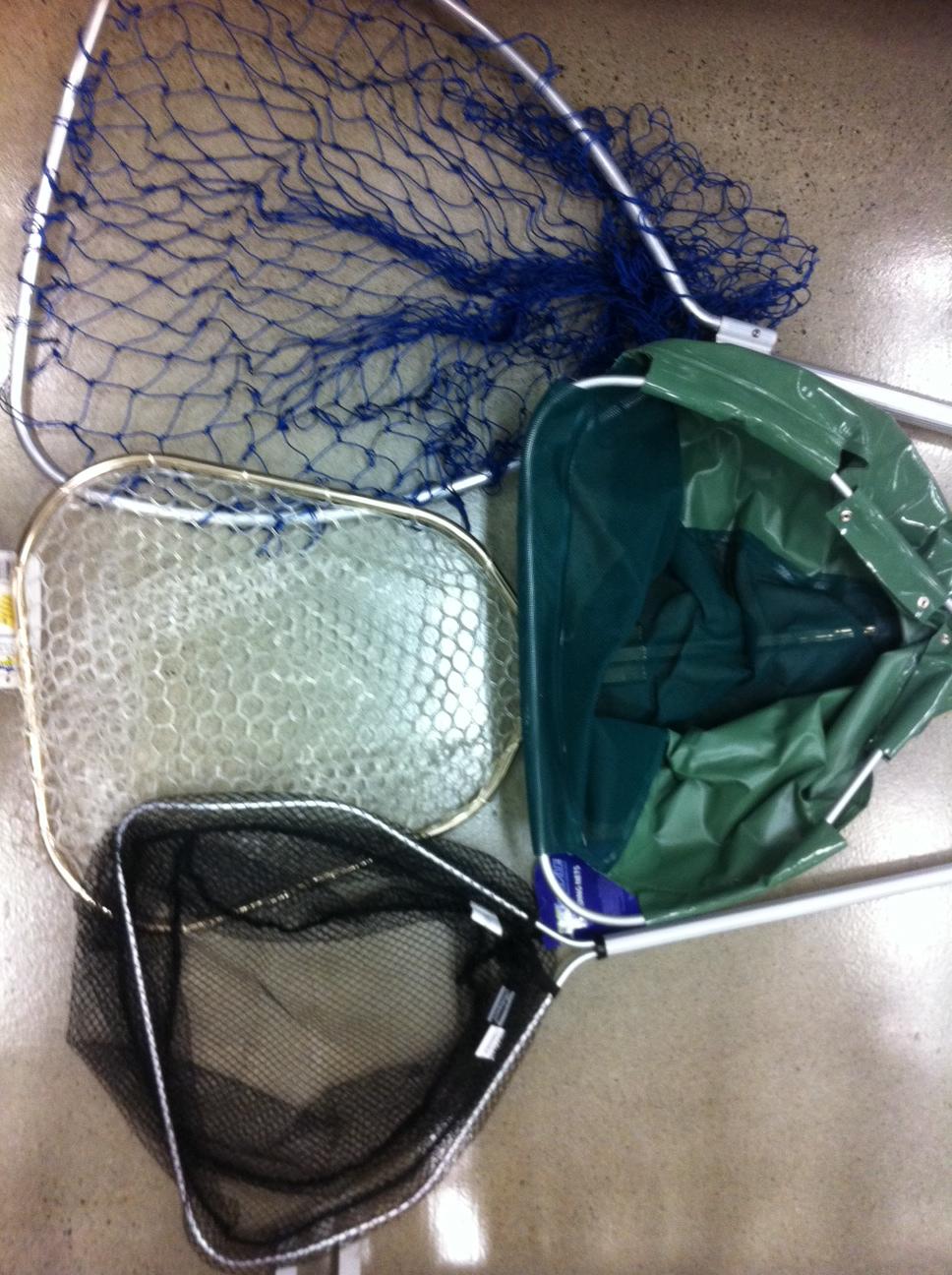
What is the best net to use?

What is the best net to use for fishes?

Pictured are several nets you can use and their physical properties are summarised.

The black net: small holes, soft flexible material, knotless.
The white net: medium-sized holes, soft flexible material, knotless.
The green net: fine holes, semi-flexible material, knotless.
The blue net: large holes, flexible material, knotted.

My preferred choice is a net would have a soft material to support the fish’s body, be knotless so that it will not scratch the fish and small holes to prevent fins and lips from getting caught. But those fish with spiny fins, the rubbery net or the fine sieve-like net may be preferable to prevent the fin spines from becoming tangled in the net.


Now on: TwitterBlogFacebookLinkedinFlickr


Yours sincerely,

Dr Richmond Loh
BSc BVMS MPhil (Vet Path) MANZCVSc (Aquatics & Pathobiology) DipPM CMAVAVeterinarian / Adjunct Lecturer Murdoch University / Secretary Aquatic Animal Health Chapter ANZCVS
The Fish Vet, Perth, Western Australia. Mobile Veterinary Service for fish and other aquatic creatures.
http://www.thefishvet.com.au
Ph: +61 (0)421 822 383

Vitamin K in fish nutrition

Aquaculture Nutrition Volume 17, Number 6 (December 2011)

Vitamin K in fish nutrition

Authors: C. KROSSØY 1, R. WAAGBØ 2, R. ØRNSRUD 2 Author Affiliations:

1: Department of Biology, University of Bergen, Bergen, Norway
2: National Institute of Nutrition and Seafood Research (NIFES), Bergen, Norway

Source: Aquaculture Nutrition, Volume 17, Number 6 (December 2011) Page Numbers: 585 – 594 Available Full Text:

Full Text: Subscription Required to view full text
Format: PDF
Size: unknown
Location: Publisher’s Site
Authentication: EBSCOhost EJS

Abstract: Vitamin K belongs to the lipid soluble vitamins, and occurs naturally as phylloquinone (vitamin K1) and menaquinone (vitamin K2). In addition, there is a synthetic provitamin, menadione (vitamin K3), primarily used as a vitamin K source in animal feed. Menadione is unstable during feed processing and storage and the dietary content may reach critically low levels. Recent publications also question the availability of menadione in feed for salmonids. Vitamin K plays vital roles in blood coagulation and bone mineralization in fish, but the suggested minimum requirement varies considerably depending on the vitamin K source used. Vitamin K deficiency is characterized by mortality, anaemia, increased blood clotting time and histopathological changes in liver and gills. However, one should assess both inherent and supplemented forms of vitamin K in feeds for exact determinations, as relevant novel feed ingredients of plant origin may be sufficient to meet the requirement for vitamin K. The current review gives an overview of the biochemical role of vitamin K, and discusses vitamin K requirement in fish in light of updated literature, with special emphasis on salmonids.

Citation: C. KROSSØY, R. WAAGBØ, R. ØRNSRUD . Vitamin K in fish nutrition. Aquaculture Nutrition, Volume 17, Number 6 (December 2011), pp. 585-594,

URL: http://ejournals.ebsco.com/direct.asp?ArticleID=4879AEBD3D321DCF386C

What is ‘dropsy’?

"Dropsy" is often used by hobbyists to mean bacterial septicaemia with consequent "bloating", protruding scales, etc. in freshwater fishes. This is true in some cases, but is not always true.

For me, as a veterinarian, "dropsy" is a non-specific sign of fluid build up within the fish due to failure of fluid balance. Not all fishes with bacterial infections end up with "dropsy" and not all conditions presenting as "dropsy" are due to bacterial infections.

This fluid build up may be due several reasons including the failure to keep water out, the failure to excrete fluid or the over-production of fluid. To simply things a little, the fish maintains its fluid in balance by properly functioning skin/mucus barrier, gills, kidneys and cardiovascular system. If there is damage to any of these systems (e.g. skin ulcers from fungal infections in barramundi, bacterial gill disease in guppy, kidney cysts in goldfish, ovarian cancers in koi), then fluid may build up in the fish.

Thus it is essential to get a proper diagnosis of the condition so that you know what to treat for.

Shark saves human

———- Forwarded message ———-
From: Dr. David Scarfe <DScarfe@avma.org>
Date: Thu, Sep 29, 2011 at 6:16 PM
Subject: AquaVetMed: Squalamine’s Antiviral Properties
To:

September 29, 2011

Sharks’ Virus Killer Could Cure Humans, Study Suggests


“Remarkable property” already effective against six types of viruses. Sharks aren’t just tough on the outside—a substance in their bodies can stop viruses in their tracks, a new study says.


A cholesterol-like compound found in dogfish sharks’ tissue has been shown to combat several viruses that cause hard-to-treat human diseases, such as dengue fever and hepatitis, a new study says. Called squalamine, the compound is already in human clinical trials for cancer and eye disorders, and several hundred people have been exposed without major side effects.


The new study revealed that squalamine can also disrupt a virus’s life cycle and prevent it from replicating in both tissue cultures and live animals. Though there are plenty of drugs to treat bacterial infections, there are few pharmaceuticals that are effective against viruses. Current antiviral drugs are highly specific—each targeting just one strain of a virus—but strains can easily mutate and become resistant to the medication.


“It’s a whole new approach to treatment of viral disease,” said study leader Michael Zasloff, of the Georgetown University Medical Center. “It’s very possible we could cure several diseases we [now] treat as chronic infections.”


“Eureka Moment” for Shark-based Antiviral Drug

Zasloff discovered squalamine in 1993 while searching for antibacterial agents in sharks, which are immune to some diseases, including all viruses. He found that squalamine—which “looked like nothing else that had ever been described or discovered”—inhibits the growth of blood vessels,  suggesting the molecule could potentially stop cancer cells from multiplying. Human research eventually led to Zasloff’s “eureka moment,” when he realized squalamine can also disable viruses, he said. “I could see [how it works against viruses] almost as if it were a moving picture,” he recalled.


Squalamine is a positively charged molecule, so when it enters a cell, the molecule immediately sticks “like Velcro” to the cell’s inner membranes, which have negative charges, Zasloff said. By doing so, squalamine “pops off” any positively charged proteins that were attached to the cell membrane—an action that does no harm to the cell, Zasloff noted. When a virus invades a cell, it expects those proteins to be present on the cell membrane. Without them, the virus can’t reproduce. “There is no other compound known to science that does this—this is a remarkable property,” Zasloff said. It’s also one that has apparently served sharks well for hundreds of millions of years—and possibly explains the creatures’ evolutionary success. The shark’s “antiviral defenses have been extraordinary,” Zasloff said. “It has adapted a very remarkable immune system and stayed with it.”


Squalamine Effective Against Human Viruses

In the study, squalamine thwarted infection of the dengue fever virus in human blood vessel cells and of hepatitis B and D in human liver cells—and with little harm to sharks. Shark tissue is no longer required to produce squalamine, which has been synthesized in the laboratory since 1995.

Zasloff and colleagues also discovered that squalamine inhibited yellow fever, eastern equine encephalitis virus, and murine cytomegalovirus in lab animals—in some cases curing the subjects, according to the study, published this week in the journal Proceedings of the National Academy of Sciences.


Current squalamine compounds can access only cells that have …


See the source (http://tinyurl.com/3ft4rgt) for the full story.


[The PNAS study is accessible from http://tinyurl.com/3swqcpt. ADS-Mod.]


___________________________

AquaVetMed e-News provides information to veterinary and veterinary-allied subscribers concerning aquatic animal medicine, health, welfare, public health and seafood safety, obtained from a variety of sources (largely AquaVetMed subscribers). While provided by the American Veterinary Medical Association’s, Aquatic Veterinary Medicine Committee and are for public distribution, they do not necessarily reflect the opinion of the AVMA or the veterinary profession. See the AVMA Terms of Use (http://tinyurl.com/29h2rf) for further information.


If e-News information is used elsewhere please acknowledge AquaVetMed as the source.  Encourage individuals to subscribe rather than distribute through list serves.


Messages may contain attachments that will have been scanned for known viruses.


Subscription and Contributions: Interested veterinarians and veterinary-allied professionals can subscribe, unsubscribe, or contribute pertinent news or information, by sending a message with “For AquaVetMed -” and the topic in the subject line, to dscarfe@avma.org.


Note: Undelivered e-mails will not be resent; Subscribers will be deleted from the list after repeated undelivered or bounced messages and will have to re-subscribe.


Visit our website: www.avma.org


________________________________


Now on: Twitter – Blog – Facebook – Linkedin – Flickr 

Yours sincerely,

Dr Richmond Loh
BSc BVMS MPhil (Vet Path) MANZCVSc (Aquatics & Pathobiology) DipPM CMAVA

Veterinarian / Adjunct Lecturer Murdoch University / Secretary Aquatic Animal Health Chapter ANZCVS
The Fish Vet, Perth, Western Australia. Mobile Veterinary Service for fish and other aquatic creatures.
http://www.thefishvet.com.au
Ph: +61 (0)421 822 383


A closer look at fish feeding – Part 7 – References used for posts on fish nutrition – by Jessie Poon

References

Cho, D. P. (1999). An Introduction to Nutrition and Feeding of Fish. Fish Nutrition Research Laboratory .

Craig, H. (2009). Understanding Fish Nutrition, Feeds, and Feeding. Virginia Tech .

Kesena, E. J., & Arimiche, N. A. (2010). Improving the quality of fish feed through Omega-3-Fatty acid inclusion in diet. Agriculture and Biology Journal of North America , 654-657.

Loh, R., & Landos, M. (2011). Fish Vetting Essentials. Richmond Loh Press, Perth, 73-77.

Lovell, T. (1998). Nutrition and feeding of fish. Aquaculture Series , 55-65.

Soyaqua. (2008). Retrieved 7 22, 2011, from Storage and Handling of Feeds for Fish and Shrimp: http://www.soyaqua.org/pdf2/asafeedhandstorepub.pdf

Soyaqua. (2008). Fish Nutrition, Feeds and Feeding. Retrieved 7 29, 2011, from Soy in Agriculture: http://www.soyaqua.org/asaimusbtech/lvhdcagemanual/fishnutrition.pdf

A closer look at fish feeding – Part 6a – The Price of Good Food – by Jessie Poon

Remember, the price of the food is directly related to the quality. Good quality foods should have a strong fishy fragrance, similar to the smell of the fish sauce that you get at the Vietnamese restaurants.

A closer look at fish feeding – Part 6 – Health and nutritional deficiencies – by Jessie Poon

Health and nutritional deficiencies

The biological definition of optimum health in fish is the absence of disease, physical stress, and the ability to maintain growth, reproduction and stable metabolism.
Reduced growth is the most common clinical sign of any deficiency, however, for each vitamin and mineral type, deficiencies may present in more specific ways. These are tabulated below (Craig, 2009).

Table 1: Vitamins deficiencies and their symptoms

Vitamin

Symptoms/ signs

Vitamin A

Eye/ vision problems (haemorrhagic eyes, eye lens deformation, eye lesions), oedema, haemorrhagic kidneys and skin.

Vitamin C

Anorexia, low disease resistance, slow wound healing, cartilage deformities, poor growth, scoliosis, haemorrhagic skin, liver, kidney, intestine and muscles.

Vitamin D

Scoliosis, tetany (white muscle), low bone ash, calcium, phosphorus.

Vitamin E

Nutritional myopathy, oedema, light skin colour, reduced reproductive activity, ceroid deposition, kidney and pancreas degeneration.

Vitamin K

Slow blood clotting, skin haemorrhages, anaemia

Vitamin B1 (thiamin)

Low haemoglobin, lethargy, poor appetite, skin haemorrhages.

Vitamin B2 (riboflavin)

Cataracts, cloudy eye lens, eye lesions, dark skin colouration, anaemia, fin erosion, anorexia.

Vitamin B3 (niacin)

Anorexia, oedema, lethargy, reduced co-ordination, skin lesions, loss of appetite, tetany.

Vitamin B5 (pantothenic acid)

Clubbed gills, eroded gill membranes, erratic swimming, liver necrosis.

Vitamin B6

Convulsions, rapid breathing/ gasping, erratic swimming, nerve disorders.

Vitamin B7 (biotin)

Muscle atrophy, gill degeneration, fatty liver, colon lesions, increased skin mucous.

Vitamin B12

Anaemia, poor appetite, low haemoglobin.

(Cho, 1999) (Soyaqua, 2008)

Table 2: Mineral deficiencies and their symptoms

Mineral

Symptoms/ Signs

Magnesium

Renal calcinosis, poor growth, lethargy.

Iodine

Hyperplasia of thyroid gland, goiter.

Zinc

Cataracts, slow growth, skin and fin erosion.

Copper

Deformed collagen and bone development

Iron

Anaemia, low haemoglobin.

(Cho, 1999) (Soyaqua, 2008)

Luckily for us, good quality fish foods suited to a variety of fish species are easily available at your local fish shop. The staff at Boronia Aquarium can help you choose the right kind of food to satisfy each and everyone of your fishes.

A closer look at fish feeding – Part 5 – Nutritional Components of Fish Food – by Jessie Poon

Nutritional Components

Nutritional components can be divided into 5 main categories: carbohydrates, proteins, fats, vitamins and minerals. Each provide fish with essential energy requirements and nutrients required for growth and everyday metabolism. Each constituent will be discussed below in more detail.

– Carbohydrates
Carbohydrates are often added as starches to fish feed formulations as binding and bulking agents, but are in actual fact not a major energy source for most fish. From 1 gram of carbohydrate, fish can only extract about 1.6 kcal, as opposed to mammals which can extract approximately 4 kcal (Craig, 2009). This is said to have arisen from the evolution of fish in aqueous systems in which carbohydrate sources were scarce, so their digestive and metabolic systems became more equipped to utilise proteins and fats for their energy needs (Lovell, 1998). Some fish however, such as warm water herbivores and omnivores are able to metabolise carbohydrates reasonably well.

– Proteins
Proteins in the diet are essential for body maintenance and muscle growth (Kesena & Arimiche, 2010) and are the primary, most efficient source of energy in fish. Proteins in fish feed are usually labelled as fish meal or shrimp meal. This component is generally the most expensive and so, some manufacturers substitute this with alternatives such as and soybean meal. Since protein is the major source of energy, it is important in assessing adequate energy needs. If a diet is deficient in energy content relative to protein content, a proportionate amount of dietary protein will be used for energy rather than tissue building. This is because energy needs for body maintenance and voluntary activity must be satisfied before energy and remaining protein is available for growth.

Amino acids are the building blocks of all proteins. Fish require twenty amino acids for growth, ten of which must be included in the diet as they cannot be synthesised within the body. These are known as essential amino acids.

Protein requirements generally are higher for small fry (baby fish), however as they grow larger, their protein requirements will usually decrease. Requirements will also vary with water temperature, water quality, genetic composition and feeding rates (Craig, 2009).

– Fats (lipids)
Lipids in fish feed provide a concentrated energy source whilst providing various other nutritional functions (Lovell, 1998). Lipids supply approximately twice the amount of energy as proteins and carbohydrates and some foods may contain up to 15% of fish diets (Craig, 2009). They also serve as a vehicle for the transportation of fat soluble vitamins (A, D, E and K) and play a crucial role in the structure and formation of cell membranes (Lovell, 1998). While warm-blooded animals have a major requirement for omega-6 fatty acids, most species of fish require omega-3 fatty acids and must be included in the diet (Cho, 1999). An explanation for this difference in fatty acid requirement is that the omega 3 structure allows a greater degree of unsaturation which is necessary to maintain flexibility and permeability characteristics at low temperatures such as in water (Lovell, 1998).

However, if a diet contains excess energy the fish may become full before they consume the necessary amounts of protein, vitamins and other nutrients for subsequent growth (Kesena & Arimiche, 2010). Excess energy, relative to protein content can cause excess amounts of visceral and body fat (Soyaqua, 2008). As such, it is recommended that fat content in ornamental fish foods do not exceed 10%.

Vitamins

Vitamins are organic micro-nutrients required in trace amounts and are essential for normal fish growth, health and general maintenance of metabolism (Cho, 1999). Most are not synthesised in the body and so must be included in the diet. Vitamins are divided into two categories: water soluble and fat soluble. Water-soluble vitamins include: the B- group vitamins, choline, inositol, folic acid, pantothenic acid, biotin and ascorbic acid (vitamin C). The fat-soluble vitamins include: the A vitamins, retinols (responsible for vision), the D group vitamins, E vitamins, the tocopherols and K vitamins (Craig, 2009). The requirements for most vitamins will depend upon the intake of other nutrients, size of the fish, species, life stage, growth rate and external environmental stresses (Soyaqua, Fish Nutrition, Feeds and Feeding, 2008).

– Minerals

Minerals are inorganic micro-nutrients necessary in the diet for normal body functions (Craig, 2009). In fish systems, minerals play pivotal roles in osmoregulation, intermediary metabolism, and are important in the formation of the skeleton and scales (Cho, 1999).

Minerals can be divided into two subgroups; those that are required in large quantities are termed major minerals and those that are required in small amounts are terms trace minerals (Lovell, 1998). Major minerals include calcium, sodium, chlorine, magnesium, potassium and phosphorous, while trace minerals include copper, chromium, iodine, iron, zinc and selenium (Craig, 2009). In the food product labelling, major minerals are often listed.

Fish are able to absorb dissolved minerals from the surrounding water across the gill membrane or through the digestive tract and skin. In fact, most of the calcium requirements of fish are extracted from the water (Lovell, 1998). This is why it is so important to maintain the water’s general hardness within their optimal ranges.
A closer look at fish feeding – Part 4 – Frequency and quantity of feed – by Jessie Poon

Frequency and quantity of feed

Fish should be fed small quantities 2-3 times daily as opposed to a single large feeding once a day. Smaller feedings allow for more efficient nutritional absorption and prevents excess food from polluting the system. At each feed, the fish should be given as much food as they can consume within 2-5 minutes. Within this 2-5 minute period, it is advised that you sprinkle a small amount of food over the surface and watch as the fish eat it, and then continue adding more food for the remaining time. This ensures all food is eaten and there is no excess left to pollute the tank. You know you have overfed when there is a large amount of food left at the bottom. Of course if you are target feeding bottom feeders, then this rule does not apply.
If you have a community tank you should also closely observe the fish at feeding time to ensure all fish are getting sufficient food. Some fish species are extremely fast feeders and will quickly consume food from the surface, leaving middle and bottom feeders with little to consume. If this is happening, then the types of food fed should be varied to cater for the slower feeders, or fish may have to be segregated to accommodate particular feeding habits.
It is also important to ensure that the particle size of the food is small enough to fit the gape of the fish’s mouth, but large enough so that it has something decent to munch on. Again you should observe the fish at feeding time as you will see the fish attempt to eat the granule, then leave it to sink to the bottom if it is too large.
Overall, feeding of fish is fairly self explanatory, however it requires some time and close observation to ensure it is done well.