I have to say that my shark hasn’t strayed and is still in my house… at least it was the last time I checked…
How tough is the abalone herpesvirus?
The Victorian and Tasmanian abalone industries took a big hit recently from a viral disease. Efforts are now in place to curb a recurrence. This paper adds knowledge to the biosecurity measures that all abalone farmers, commercial abalone divers and recreational abalone fishers should put in practice, especially when moving between sites and with the recreational abalone fishing season well under way.
| Aquaculture | |||||||||||||||||
| Volume 329, Number 2 (January 2012) | |||||||||||||||||
 |
Abalone herpes virus stability in sea water and susceptibility to chemical disinfectants | ||||||||||||||||
| Authors: | Serge Corbeil, Lynette M. Williams, Jemma Bergfeld, Mark St.J. Crane | ||||||||||||||||
| Author Affiliations: |
|
||||||||||||||||
| Source: | Aquaculture, Volume 329, Number 2 (January 2012) | ||||||||||||||||
| Page Numbers: | 20 – 26 | ||||||||||||||||
| Available Full Text: |
|
||||||||||||||||
| Abstract: | Experimental infection models using immersion and injection challenges were developed to investigate the effects of various physicochemical treatments on the abalone herpes virus (AbHV), an emerging virus causing viral ganglioneuritis in abalone in Australia. To determine stability at different temperatures, the virus was held at 4, 15, or 25°C for 1, 5, and 12days prior to immersion challenge of naïve abalone. Mortality curves indicated that when held for 1day in sea water at 4°C and 15°C the virus remained infectious and highly pathogenic. In addition, the virus retained partial infectivity after 5days held at 4°C. Histological examination of abalone tissues following viral exposure confirmed the presence of lesions typical of abalone viral ganglioneuritis in animals showing morbidity signs. An additional experiment was performed to determine the virucidal efficacy of three disinfectants (calcium hypochlorite, Buffodineand the non-ionic surfactant Impress). The disinfectants were used at various doses and durations to treat AbHV prior to injection and immersion challenges. Results showed that Buffodineand the non-ionic surfactant Impresswere effective at inactivating the virus with no detectable adverse effects on the abalone’s health. In addition, calcium hypochlorite showed a virucidal effect when used on lower titres of virus prior to immersion challenge. | ||||||||||||||||
| Citation: | Serge Corbeil, Lynette M. Williams, Jemma Bergfeld, Mark St.J. Crane . Abalone herpes virus stability in sea water and susceptibility to chemical disinfectants. Aquaculture, Volume 329, Number 2 (January 2012), pp. 20-26, | ||||||||||||||||
| URL: | http://ejournals.ebsco.com/direct.asp?ArticleID=45A2B7C79E5E35FC54D1 | ||||||||||||||||
In the big blue world.
Toxicities of commonly used aquarium remedies.
There are many remedies readily available through your local fish shop. But beware that not only can some of these be toxic to your fishes, but also to you. The paper below reveals that toxicity also varies between different types of fishes. Something to consider the next time you reach for a “multi-cure” because removing the disease by killing the host is not usually the best outcome.
|
Abstract
August 15, 2007, Vol. 231, No. 4, Pages 590-595
doi: 10.2460/javma.231.4.590
Tolerance of benzalkonium chloride, formalin, malachite green, and potassium permanganate in goldfish and zebrafishLuigi Intorre, DVM; Valentina Meucci, PhD; Domenica Di Bello, PhD; Gianfranca Monni, PhD; Giulio Soldani, MD; Carlo Pretti, PhD
Section of Pharmacology and Toxicology, Department of Veterinary Clinics, University of Pisa, 56124 Pisa, Italy. (Intorre, Meucci, Soldani); Department of Animal Pathology, University of Pisa, 56124 Pisa, Italy. (Di Bello, Monni, Pretti)
Address correspondence to Dr. Intorre.
Objective—To determine tolerance of goldfish and zebrafish to benzalkonium chloride, formalin, malachite green, and potassium permanganate. Design—Tolerance study. Animals—Adult goldfish (Carassius auratus) and zebrafish (Danio rerio). Procedures—Groups of fish (n = 10/group) were exposed to each disinfectant at the therapeutic dosage; at 0.25, 0.5, 3, and 5 times the concentration used for the therapeutic dosage; and at the concentration used for the therapeutic dosage but for 3 or 5 times the recommended exposure time. Results—In both species, exposure to malachite green at the therapeutic dosage resulted in toxic effects, including death. Exposure to formalin at the therapeutic dosage resulted in toxic effects in goldfish, but not zebrafish, and exposure to potassium permanganate resulted in toxic effects in zebrafish, but not goldfish. On the basis of the ratio of therapeutic dosage to median lethal dosage, in goldfish, formalin was more toxic than benzalkonium chloride, which was more toxic than malachite green, which was more toxic than potassium permanganate. In zebrafish, potassium permanganate was more toxic than formalin and benzalkonium chloride, which were approximately equally toxic and more toxic than mala-chite green. Extending treatment time increased the toxicity of potassium permanganate in zebrafish and the toxicity of formalin and malachite green in goldfish, but did not alter the toxicity of the other disinfectants. Conclusions and Clinical Relevance—Results indicated that there was no consistency between zebrafish and goldfish in their tolerance to disinfectants, and that therapeutic dosages reported in the literature for these disinfectants were not always safe. |
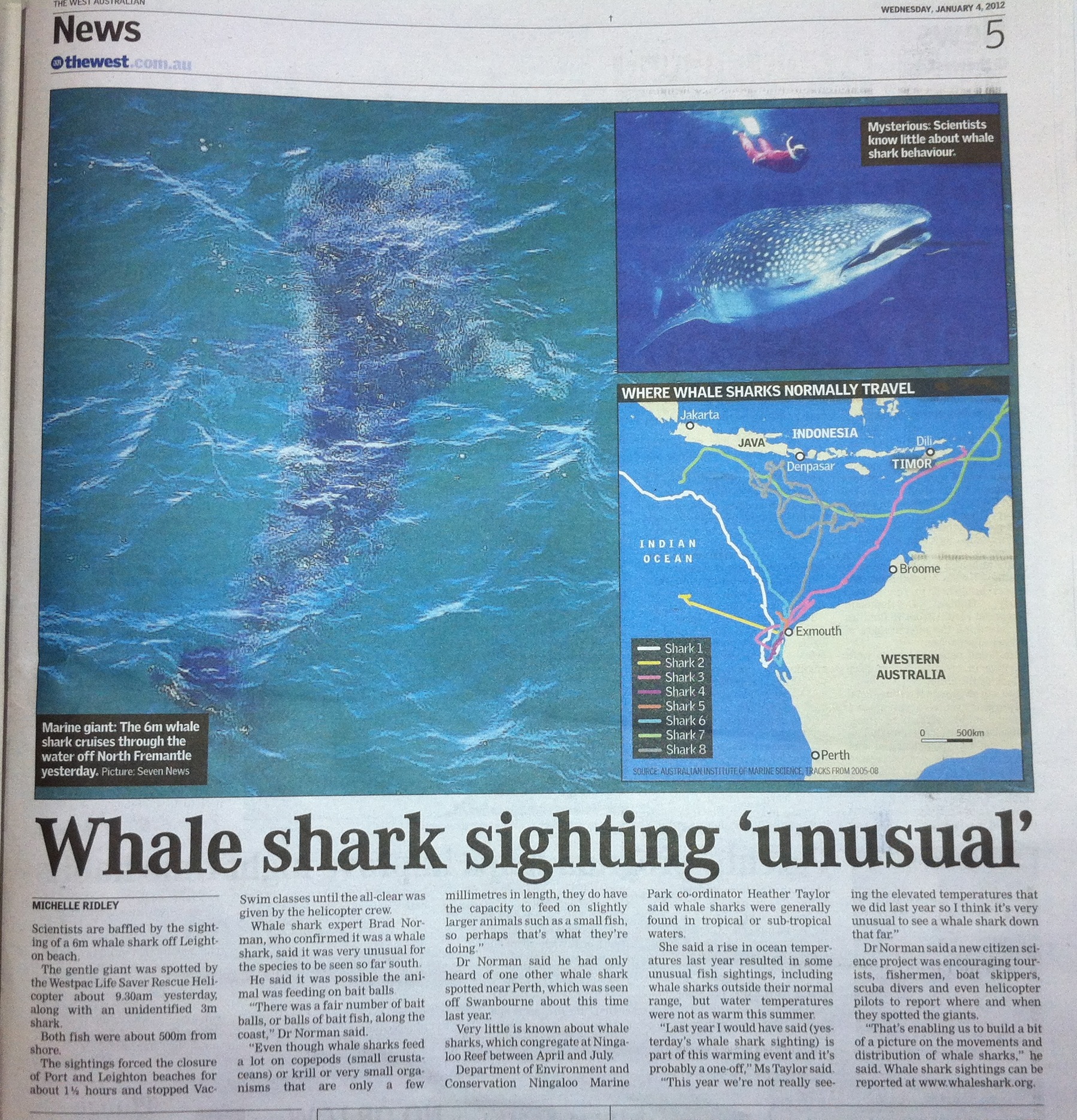
Whale shark unusually this far south.
Giant fish off Fremantle coast.. In today’s West Australian.
How much nitrate is safe for fish?
Contrary to popular belief, nitrate is not good for fishes. Nitrate is the end product of fish wastes and is most frequently removed by performing water changes or by plants. So, it is a good idea to have some aquatic plants in your aquarium and to carry out regular partial water changes and rinsing of your filters.
How much is safe for your fish? This article suggests a nitrate level of <250ppm is needed for turbot.
| Aquaculture | |||||||||||||||||
| Volume 329, Number 2 (January 2012) | |||||||||||||||||
| |
The chronic effect of nitrate on production performance and health status of juvenile turbot (Psetta maxima) | ||||||||||||||||
| Authors: | Chris G.J. van Bussel, Jan P. Schroeder, Sven Wuertz, Carsten Schulz | ||||||||||||||||
| Author Affiliations: |
|
||||||||||||||||
| Source: | Aquaculture, Volume 329, Number 2 (January 2012) | ||||||||||||||||
| Page Numbers: | 163 – 167 | ||||||||||||||||
| Available Full Text: |
|
||||||||||||||||
| Abstract: | The chronic effect of nitrate on the production performance and health of marine cultured fish species is still unknown. Thus, the aim of the present research was to evaluate the chronic effect of nitrate on production parameters and health status of turbot (Psetta maxima). Juvenile turbot were exposed to 0mg/L NO3–N (control C), 125mg/L NO3–N (low nitrate LN), 250mg/L NO3–N (medium nitrate MN) and 500mg/L NO3–N (high nitrate HN) for 6weeks in small-scaled recirculating aquaculture systems (RAS). After 42d, biomass yield, length, weight and specific growth rate (SGR) were significantly (p<0.05) lower for LN, MN and HN compared to C. Mortality, food conversion ratio (FCR), condition factor (CF) and splenic index (SI) did not differ significantly (p0.05) between C and LN but were significantly (p<0.05) higher in the MN and HN groups. Hepatosomatic index (HSI), total hemoglobin (Hb) and methemoglobin (MetHb) did not show significant differences (p0.05) between treatments. Thus, nitrate negatively influences the production performance of turbot, even at low concentrations and nitrate management is therefore a key-factor in turbot RAS production. | ||||||||||||||||
| Citation: | Chris G.J. van Bussel, Jan P. Schroeder, Sven Wuertz, Carsten Schulz . The chronic effect of nitrate on production performance and health status of juvenile turbot (Psetta maxima). Aquaculture, Volume 329, Number 2 (January 2012), pp. 163-167, <http://ejournals.ebsco.com/direct.asp?ArticleID=412791CE5E21268B02DA> | ||||||||||||||||
| URL: | http://ejournals.ebsco.com/direct.asp?ArticleID=412791CE5E21268B02DA | ||||||||||||||||
20 tonnes of dead fish – Norway
Forwarded from AquaVetMed
20 tonnes of dead fish wash up on Norway beaches- cause unknown…
January 3, 2012
Troms, Norway – The inhabitants of Troms could hardly believe their eyes on the morning of New Year’s Eve, a very large amount, an estimated 10 to 20 tons of dead herring washed up on the beach, writes Northern Lights. Tromsø city is the ninth largest urban area in Norway by population. The city is warmer than most other places located on the same latitude, due to the warming effect of the Gulf Stream which originates at the tip of Florida.
Various theories abound for the incident but no one knows for sure what’s happened in the popular hiking area in Nordreisa municipality. However, various theories have been tossed around, explains Jan-Petter Jorgensen (44), who stumbled upon the mass death in sight on the beach with his dog Molly. People say that something similar happened in the 80′s, and there is speculation among others on the river which flows into the ocean behind a promontory on the site, may have had something to do with it.
Maybe the fish have been caught in a deprived oxygen environment, and then died of fresh water? Jorgensen estimates each individual fish to be of 100-150 grams, and that the total might be about up to 20 tons. Now he’s worried about what might happen if no one comes and removing carcasses.
See the source (http://tinyurl.com/6q38h7l) for a rather impressive photograph of the incident.
Growing silver perch? Important reading in this blog.
I’ve just bought some silver perch for my backyard aquaponics project (I will outline my efforts at designing and construction in future posts). I got them in just before Christmas and all is going well.
One thing I noticed is that their behaviour is very much like sheep. They show a strong schooling behaviour and so where one or two go, the rest will not be far behind.
Like adolescent men at a buffet, these fish are guts when it comes to food! They just keep coming back and back to the surface for food.
I thought I should point backyard and full-time aquaculturists to this invaluable book on diseases of silver perch in case the sh!t hits the fan.
http://www.dpi.nsw.gov.au/__data/assets/pdf_file/0005/209309/Silver-Perch-Diseases-Manual.pdf
Happy fish keeping!
Richmond Loh
Who’s following The Fish Vet’s blog?
It’s quite neat that WordPress has provided a summary report of 2011’s activities on TheFishVet’s blog account.
We have almost every continent covered!
Thank you for the follow in 2011!
I look forward to sharing more with you in 2012 and beyond.

Yours sincerely,
Dr Richmond Loh
BSc BVMS MPhil (Vet Path) MANZCVS (Aquatics & Pathobiology) DipPM
Veterinarian / Adjunct Lecturer Murdoch University / Secretary Aquatic Animal Health Chapter ANZCVS
The Fish Vet, Perth, Western Australia. Mobile Veterinary Service for fish and other aquatic creatures.
http://www.thefishvet.com.au
Ph: +61 (0)421 822 383
http://www.thefishvet.com.au
Ph: +61 (0)421 822 383
What’s happening at WAVMA in 2012?
NB: WAVMA stands for World Aquatic Veterinary Medical Association, formerly AqVA [Aquatic Veterinary Association].
Dr Julius Tepper will be assuming the role of Past President, and Dr Dušan Palić will become the President. Dr Mohamed Faisal will be the President-Elect.
WAVMA’s web site had a significant overhaul in 2011. The new web page offers members a suite of options and privileges that will continue to grow and upgrade in 2012.
In 2011, WAVMA initiated the development of the Aquatic Veterinary General Practitioner Credentialing program. The program was spearheaded by our Credentialing Committee (Drs Faisal, Miller-Morgan, Palić -chair, Palmeiro, Scarfe, and Walster). Thanks to numerous members’ inputs and committee work, the program is set to be released in early 2012.
A WAVMA Fellowship Program is in the works, and Dr Faisal will be inviting nominees for WAVMA Fellows in early 2012 as well. The honour of Fellowship will be bestowed to outstanding WAVMA members who have contributed significantly to the development of aquatic veterinary medicine practice, art and science. Please consider nominating colleagues that you would like to recognise for their contributions to the field.
Other membership services will continue to grow in 2012. The Aquatic Vet News, members listserv are embedded in the new web site. The members database, and archive of listserv messages about members’ cases and questions are developing, and there is hope to offer access to an online store with WAVMA branded items soon. The executive board is exploring a cloud data storage option that would allow the members in good standing (renewed before April 1, 2012) unlimited personal computer files backup for a fraction of the cost of similar services. Another possible membership service that is being developed is the discounted book purchase program, which we hope to offer with support from several major publishers who offer titles in the areas of veterinary medicine and aquaculture.
WAVMA recently became an Affiliate Member of the World Small Animal Veterinary Association which will allows for promotion of the cause of aquatic veterinary medicine globally.
WAVMA is invite all members to help expand and grow the Association. Please, invite new members “Are you a WAVMA member?” Check out the member benefits online.