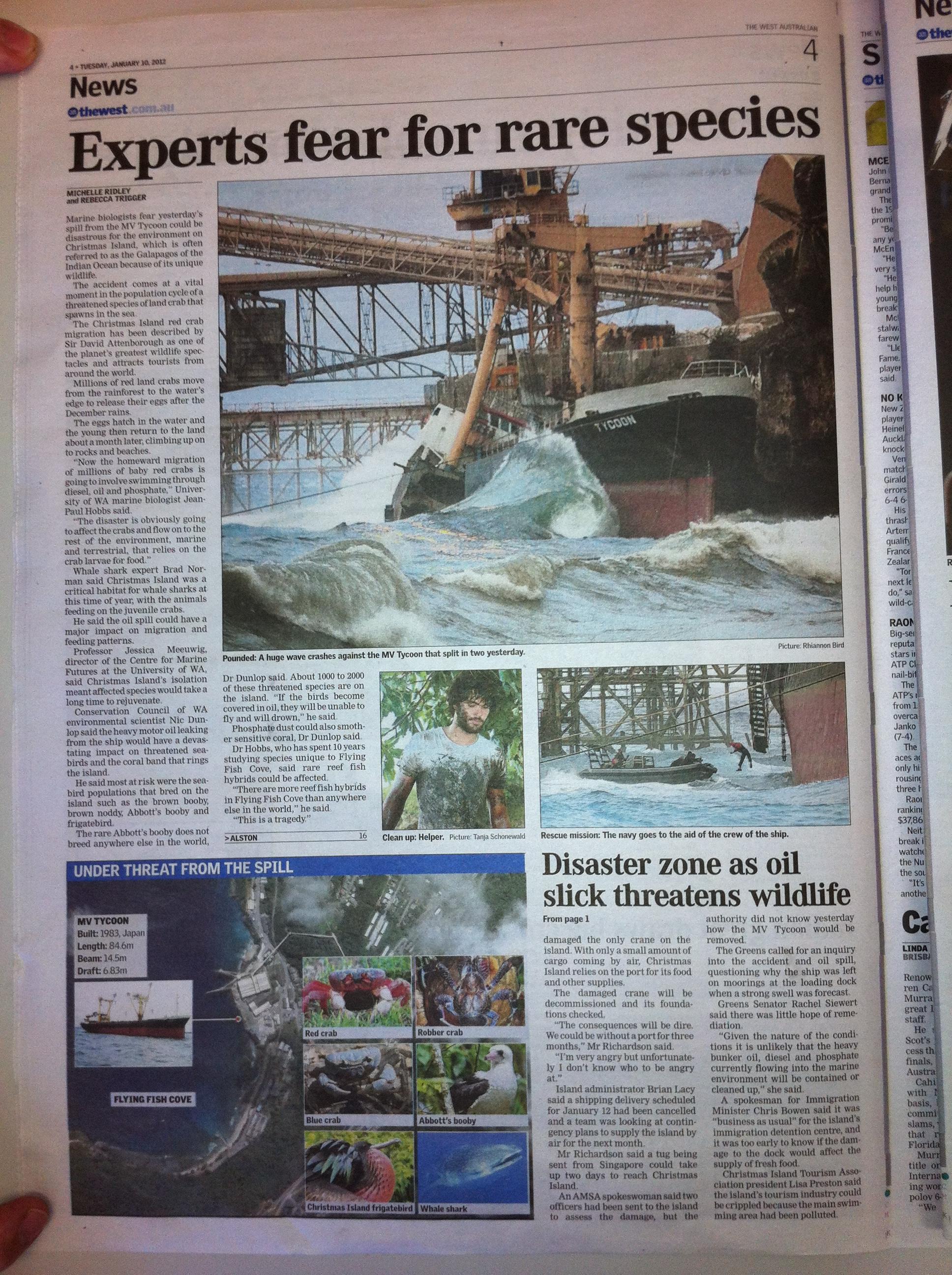
With wildlife as unique as Galapagos….
From today’s West Australian:
Dolphin’s amazing healing ability.
———- Forwarded message ———-
From: AquaVetMed
Date: Tue, Jan 10, 2012 at 1:53 AM
Subject: AquaVetMed: Science & Hollywood Combined to Describe Dolphins’ Ability to Heal
To:
From: AquaVetMed
Date: Tue, Jan 10, 2012 at 1:53 AM
Subject: AquaVetMed: Science & Hollywood Combined to Describe Dolphins’ Ability to Heal
To:
Researchers Study Dolphins’ Healing Ability
January 9, 2012
Atlanta, USA – For some reason, dolphins seem to bounce back from injuries much faster than humans do. Within weeks of a severe shark bite, researchers have documented badly-injured dolphins re-growing their missing tissue. A new film looks at one dolphin’s remarkable recovery, as researchers are trying to figure out just how they do it. “Dolphin Tale” tells the true story of the unlikely friendship between an 11-year-old boy and Winter, a badly injured dolphin rescued off the Florida coast.
As moving as the Hollywood storyline is, Winter’s real life story is even more compelling. She not only survived losing her tail in a trap, she’s now swimming again – a star at the Clearwater Aquarium – thanks to a prosthetic tail created just for her. There just seems to be a special connection between humans and dolphins. Even midweek at the national aquarium, rehearsal for the new dolphin show is packed.
Dr. Brent Whitaker is the head of biological programs at the National Aquarium. He says most people don’t know that dolphins possess the amazing ability to heal incredibly fast, even from wounds like shark bites. “It seems they look horrible one day, and the next day they as though they’re sealed up and they’re starting to heal well,” Whitaker said.
Researchers are trying to figure out just how they do it and what it could mean for us. The journey began about 10 years ago for Dr. Michael Zasloff with Georgetown University. He started documenting dolphin healing, including ….
See the source (http://tinyurl.com/68p4f85) for the full story and an interesting Fox News video clip.
___________________________
AquaVetMed e-News provides information to veterinary and veterinary-allied subscribers concerning aquatic animal medicine, health, welfare, public health and seafood safety, obtained from a variety of sources (largely AquaVetMed subscribers). While provided by the American Veterinary Medical Association’s, Aquatic Veterinary Medicine Committee and are for public distribution, they do not necessarily reflect the opinion of the AVMA or the veterinary profession. See the AVMA Terms of Use (http://tinyurl.com/29h2rf) for further information.
If e-News information is used elsewhere please acknowledge AquaVetMed as the source. Encourage individuals to subscribe rather than distribute through list serves.
Messages may contain attachments that will have been scanned for known viruses.
Subscription and Contributions: Interested veterinarians and veterinary-allied professionals can subscribe, unsubscribe, or contribute pertinent news or information, by sending a message with “For AquaVetMed -” and the topic in the subject line, to dscarfe@avma.org.
Note: Undelivered e-mails will not be resent; Subscribers will be deleted from the list after repeated undelivered or bounced messages and will have to re-subscribe.
Visit our website: www.avma.org
________________________________
—
Now on: Twitter – Blog – Facebook – Linkedin
—
Yours sincerely,
Dr Richmond Loh
BSc BVMS MPhil (Vet Path) MANZCVS (Aquatics & Pathobiology) DipPM
Veterinarian / Adjunct Lecturer Murdoch University / Secretary Aquatic Animal Health Chapter ANZCVS
The Fish Vet, Perth, Western Australia. Mobile Veterinary Service for fish and other aquatic creatures.
http://www.thefishvet.com.au
Ph: +61 (0)421 822 383
http://www.thefishvet.com.au
Ph: +61 (0)421 822 383
What do we get from doing research?
“Often what is common knowledge is not common practice,
and research which does not guide action is not worth doing.”
As scientists, we do a lot of research. But what for?
I thought I’d share this interesting excerpt about “research”.
Superficial research will always tell you things that you know. It rarely gets beneath the surface and the surface is there for anybody to see.
Also, it is easy to read the results of research and ‘recognise them’ as thing which you knew. However, few people would be able to predict the actual results in advance…
It is one thing to know the results of research, it is another to have sufficient information to act. Often what is common knowledge is not common practice, and research which does not guide action is not worth doing.
Taken from Customer Service Handbook, published by Centre for Professional Development.
No abs for Chinese New Year
Celebrations into the year of the golden dragon will do without live abalone imports from Tasmania for the New South Welshmen due to discovery of the infamous abalone herpesvirus in Tasmania. Read more on the link below.
CCTV for fish.
A great tool to fight crime is now a great tool to study fish behaviour.
| Aquacultural Engineering | |||||||||||||||||
| Volume 46, Number 1 (January 2012) | |||||||||||||||||
 |
A computer-vision system and methodology for the analysis of fish behavior | ||||||||||||||||
| Authors: | Vassilis M. Papadakis1,2, Ioannis E. Papadakis1,3, Fani Lamprianidou 1, Alexios Glaropoulos 1, Maroudio Kentouri 1 | ||||||||||||||||
| Author Affiliations: |
|
||||||||||||||||
| Source: | Aquacultural Engineering, Volume 46, Number 1 (January 2012) | ||||||||||||||||
| Page Numbers: | 53 – 59 | ||||||||||||||||
| Available Full Text: |
|
||||||||||||||||
| Abstract: | ? A low cost system was developed to quantitatively detect specific behavioral traits. ? Related activities were successfully detected. ? The system provides high accuracy measurements in time. ? Remote observation through web interface to eliminate behavioral alterations caused by human presence. ? Stocking density affects sea bream interaction with aquaculture net. | ||||||||||||||||
| Citation: | Vassilis M. Papadakis, Ioannis E. Papadakis, Fani Lamprianidou, Alexios Glaropoulos, Maroudio Kentouri . A computer-vision system and methodology for the analysis of fish behavior. Aquacultural Engineering, Volume 46, Number 1 (January 2012), pp. 53-59, | ||||||||||||||||
| URL: | http://ejournals.ebsco.com/direct.asp?ArticleID=46CE8351126808FC028B | ||||||||||||||||
Males will be males.. And never ask for directions!
The Same happens in these fish:
http://www.bbc.co.uk/news/uk-scotland-edinburgh-east-fife-11220559
What goes into making good fish food?
Did you know that a lot of science goes into producing fish food? In some of my older posts (written by Ms Jessie Poon), you can gauge that there are lots to think about. Some have better nutritional values than others. Some pollute the tank less. The article below talks about certain aspects of feed as it relates to feeding crayfish.
—
Now on: Twitter – Blog – Facebook – Linkedin
—
Yours sincerely,Dr Richmond Loh
BSc BVMS MPhil (Vet Path) MANZCVS (Aquatics & Pathobiology) DipPM
BSc BVMS MPhil (Vet Path) MANZCVS (Aquatics & Pathobiology) DipPM
Veterinarian / Adjunct Lecturer Murdoch University / Secretary Aquatic Animal Health Chapter ANZCVS
The Fish Vet, Perth, Western Australia. Mobile Veterinary Service for fish and other aquatic creatures.
http://www.thefishvet.com.au
Ph: +61 (0)421 822 383
http://www.thefishvet.com.au
Ph: +61 (0)421 822 383
Aquaculture Volume 325, Number 9 (January 2012) Manufacturing pellets with different binders: Effect on water stability and feeding response in juvenile Cherax albidus Authors: M.G. Volpe, E. Varricchio, E. Coccia, G. Santagata, M. Di Stasio, M. Malinconico, M. Paolucci Author Affiliations:
| no affiliations available |
Source: Aquaculture, Volume 325, Number 9 (January 2012) Page Numbers: 104 – 110 Available Full Text:
| Full Text: | Subscription Required to view full text |
| Format: | |
| Size: | Unknown |
| Location: | Publisher’s Site |
| Authentication: | Publisher’s Site |
Abstract: In this study, we used natural polysaccharides (pectin, alginate and chitosan) as binders to generate pellets for crayfish feeding. Pellets were produced by cold extrusion in order to preserve nutrients from degradation and reduce energy consumption. Thereafter, pellets were submitted to a coating procedure, with the aim of improving pellet stability in water. Pellet water stability was analyzed by monitoring the diameter of the released particles in water over progressive time intervals up to 24h, employing a Low Angle Laser Light Scattering Technique. Alginate containing pellets released particles with a smaller diameter than chitosan and pectin containing pellets, indicating that alginate containing pellets disaggregated more and therefore were less stable in water than the other pellet types. The effects of the different polysaccharide containing pellets were evaluated on crayfish feeding response employing juvenile Cherax albidus. The feeding experiment was carried out for 12weeks, at the end of which growth parameters and the activity of amylase, lipases and proteases in the gastric juice, hepatopancreas and intestine were recorded. Crayfish fed pectin containing pellets exhibited a significant weight gain. Digestive enzyme activities did not statistically show significant differences in the digestive tract except for amylase that was significantly higher in the intestine of animals fed pectin containing pellets. Our data indicate that pectin and chitosan pellets showed the best water stability performances, moreover pectin pellets brought about the highest body weight gain and affected the amylase profile in the intestine of juvenile Cherax albidus. Citation: M.G. Volpe, E. Varricchio, E. Coccia, G. Santagata, M. Di Stasio, M. Malinconico, M. Paolucci . Manufacturing pellets with different binders: Effect on water stability and feeding response in juvenile Cherax albidus. Aquaculture, Volume 325, Number 9 (January 2012), pp. 104-110, URL: http://ejournals.ebsco.com/direct.asp?ArticleID=4DC0A53FB285FB8A145B
What diseases can you catch from fish?
“With increasing numbers of pet and production fish operations, veterinarians will be expected to have the abilities and knowledge to diagnose and treat aquatic species and provide a standard of care commensurate with other commonly treated animal species. As their caseloads of aquatic species increase, veterinarians will come into contact with zoonotic diseases specific to aquatic species that have been of little concern when dealing with terrestrial animals. Certain pathogens pose a specific potential threat to veterinarians, pet owners, and producers working with finfish species. Although there is an extensive list of pathogens that are communicable to humans from aquatic species via consumption, pathogens can also be encountered during examination, handling, and treatment of aquatic species. It is important for veterinarians to be aware of the clinical signs that are associated with these specific zoonoses and ways to minimize risk of exposure to the causative organisms.”
Read full article here:
Aquatic zoonoses associated with food, bait, ornamental, and tropical fish
Benefits of being a member of the World Aquatic Veterinary Medical Association.
Membership allows you to access a wide range of resources including contact with leading aquatic veterinarians through the listserve, providing expert opinion on a case, diagnostic imagery and peer review, Publications such as the quarterly Aquatic Vet News keep you up to date with professional developments and issues within aquatic veterinary medicine. The image library can help in research or to jazz up those PowerPoint presentations! Whilst the aquatic vet WebCEPD provides live webinars, themed courses and presentations suitable for training staff, relicensure or personal professional development.
Check out WAVMA’s website: http://www.wavma.org/
Bacteria and ornamental fish
The warmer Summer weather means that it is the peak time of the year when bacterial infections and other diseases break out if the environmental conditions are suboptimal.
When disease hits, you will need to act quickly and upon the advice of your fish veterinarian.
This article is timely.
Bacteria and ornamental fish
Gregory A. Lewbart MS, VMD, Dipl.ACZM  , a
, a
| a | Department of Clinical Sciences, North Carolina State University, College of Veterinary Medicine, Raleigh, NC, USA |
Available online 31 May 2006.
Bacterial disease is the most common infectious problem of ornamental  fishes, and most bacterial infections are caused by gram-negative organisms. The majority ofbacterial fish pathogens are natural inhabitants of the aquatic environment, whether it be freshwater or marine. Extrinsic stressors, including shipping, crowding, poor water quality, and inadequate nutrition, may predispose an ornamental fish to bacterial disease. This article reviews the important bacterial pathogens of ornamental fish in a systematic manner, discusses the problems of over-the-counter antimicrobial compounds and antibiotic resistance, and reviews treatment and management options.
Key words: Bacteria; ornamental fish; pet fish; antibiotics\
View full article here: