Can we substitute fishmeal with plant proteins in fish feed?

The abstract below shows that fish protein may be substituted to some degree with plant proteins…..

But what effect will it have on their long-term nutritional needs?

Fish are generally marketed to consumers because they are a healthy choice and high in omega-3 fatty acids. Fish derive much of this from what they eat. So what effect will it have on the fatty acid content of the fish when it comes time to slaughter?

Perhaps we should turn to bread for our daily source of iodine, omega-3, fibre…..

Create Alert Add to Favorites Mark
Aquaculture
Volume 337, Number 1 (March 2012)
Replacing fishmeal with blends of alternative proteins on growth performance of rainbow trout (Oncorhynchus mykiss), and early or late stage juvenile Atlantic salmon (Salmo salar)
Authors: Gary S. Burr, William R. Wolters, Frederic T. Barrows, Ronald W. Hardy
Author Affiliations:
no affiliations available
Source: Aquaculture, Volume 337, Number 1 (March 2012)
Page Numbers: 110 – 116
Available Full Text:
Full Text: Subscription Required to view full text
Format: PDF
Size: Unknown
Location: Publisher’s Site
Authentication: Publisher’s Site
Abstract: The purpose of this study was to evaluate blends of alternate proteins as replacements for fishmeal in diets for rainbow trout (Oncorhynchus mykiss) and to use the results to develop and test alternate protein blends in diets for juvenile Atlantic salmon (Salmo salar). Nine experimental diets in which protein blends replaced 63%, 82% or 100% of fishmeal in the formulation (20, 10, and 0% fishmeal) were fed to rainbow trout (initial weight 19.5g) for 12weeks. Weight gains of trout fed diets containing the soy protein concentrate-based blend and the fishmeal control diet were similar, except at the 100% fishmeal replacement level, and significantly higher than that of trout fed diets containing the other blends. The soy protein blend and another based on wheat gluten meal were modified slightly and evaluated in early stage Atlantic salmon juveniles (initial weight 5.5g). Protein blends replaced 50%, 66% or 84% of fishmeal (30, 20 or 10% fishmeal). Weight gains of early stage juvenile salmon after 18weeks of feeding were significantly lower and feed conversion ratios higher when fed diets containing either blend compared to the fishmeal control diet, and gains decreased as level of fishmeal replacement increased. Blends were then modified further and tested in advance stage salmon juveniles (initial weight 31.5g). These blends were solely either all-plant protein-based or contained poultry by-product meal. Both blends were evaluated with or without addition of Spirulinaalgae meal. Alternate protein blends completely replaced fishmeal in experimental diets. After 12weeks of feeding, no differences in weight gain or feed conversion ratios were measured among groups fed experimental diets containing protein blends or the fishmeal control diet. Replacement of fishmeal with alternative protein blends in diets for early stage juvenile salmon is not recommended and the penalty in growth is severe. Fishmeal can be completely replaced in diets for late stage salmon over 30g without compromising fish performance or using land animal protein ingredients in feed formulations.
Citation: Gary S. Burr, William R. Wolters, Frederic T. Barrows, Ronald W. Hardy . Replacing fishmeal with blends of alternative proteins on growth performance of rainbow trout (Oncorhynchus mykiss), and early or late stage juvenile Atlantic salmon (Salmo salar). Aquaculture, Volume 337, Number 1 (March 2012), pp. 110-116,
URL: http://ejournals.ebsco.com/direct.asp?ArticleID=47808B9B64BB8CDDEC28

Four tiger sharks drawn to whale carcass – are sharks man-eaters?

Four sharks have been sighted off the coast of Yanchep and the beaches in the vicinity remains closed (http://www.watoday.com.au/wa-news/whale-carcass-attracts-sharks-to-metro-beaches-20120219-1tgvn.html).

This news article prompted me to think about the age old debate about whether sharks would eat humans. The prevailing socially acceptable answer out there is that they don’t. But are we underestimating their intelligence?

As a fish keeper and a veterinarian, I’ve read about, kept and observed numerous different fish species. One thing about their feeding habits is that they can learn to eat different foods. They can learn off their own species, and they can learn off other species. They can accept all types of live feeds, chopped up fresh meats and all sorts of dried foods. They will have a go and nibble and things to see if it’s edible. They will sample and eat things that they would never see in nature (e.g. cuttlefish and octopus to freshwater tropical ornamental fishes and boiled egg yolk to baby fish). So, why would a shark differ in their culinary behaviour?

So when a shark is given the opportunity to eat a human dressed like a seal, what do you think the shark’s next move would be?

Free referral service for your fish.

Did you know that The Fish Vet can help you no matter where you are in Australia?

I receive numerous calls and emails requesting for help with fish issues on a regular basis. Although I am not always able to help directly (due to geographic reasons), one of my network of colleagues may be able to.

Over the last ten years, I have been compiling a list of veterinarians with an interest in fish from around the country. These veterinarians usually have the necessary tools including a copy of Fish Vetting Essentials.

So, even if I can’t help you, I can direct someone to help you.

This is a free referral service that I’ve been providing for a number of years. So, just fill in your details on the client contact form (http://www.thefishvet.com.au/contact_us.html) with the nature of your issue and I can pass it on to my colleagues via email.

Please note that charges would apply from the advising veterinarian.

Yours sincerely,

Dr Richmond Loh
BSc BVMS MPhil MANZCVS (Aq & Pathol)
The Fish Vet, Perth, Western Australia.
Veterinary Medicine for fish.
http://www.thefishvet.com.au

Special koi net – part 2

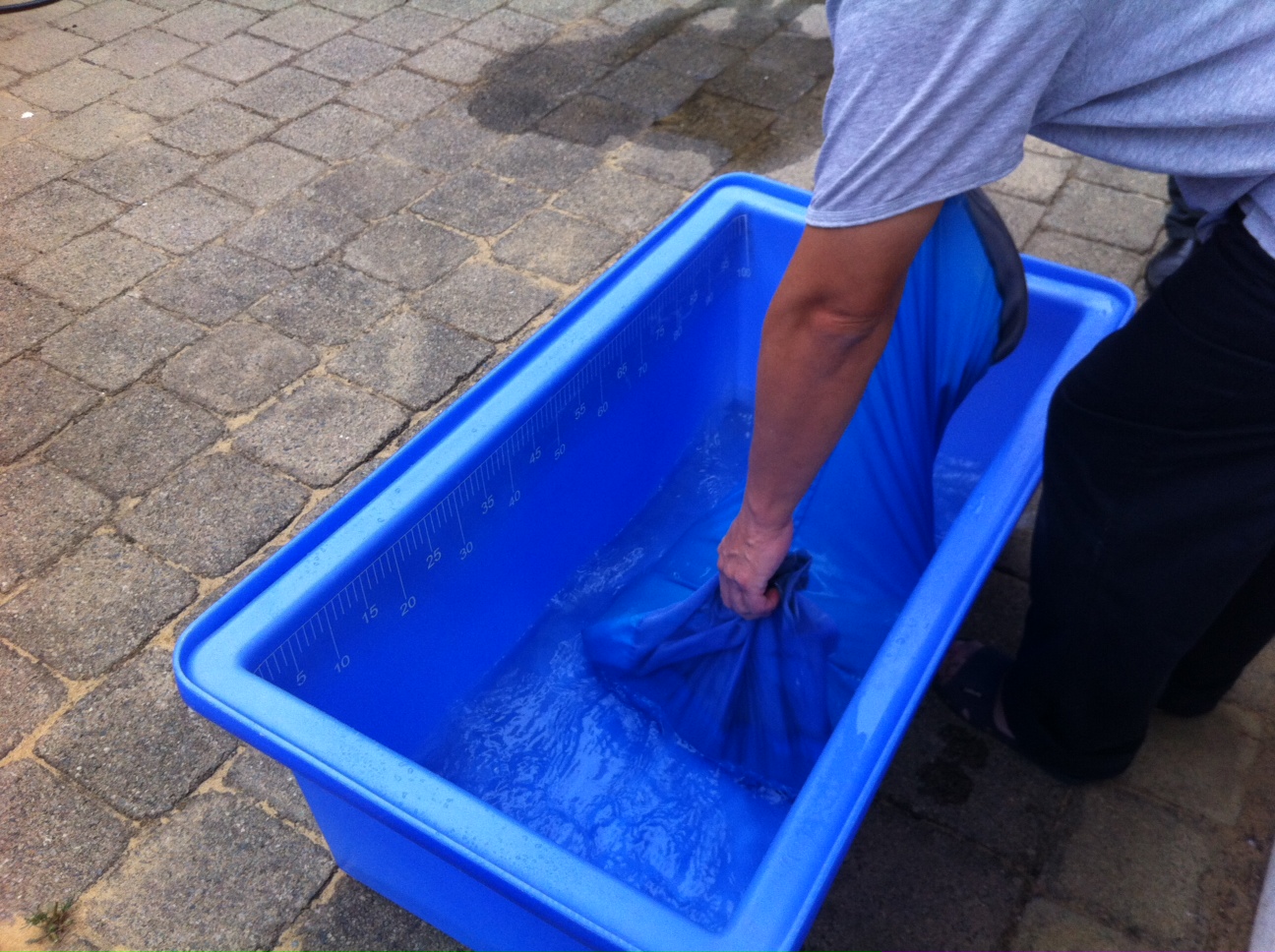
Another neat function of the special koi net that I didn’t mention in my previous post is that it can be used as a bucket!

Here my client scoops water from his pond into the tub.

Notice the tub has a special measuring tape on the inside wall so that we can easily measure the fish’s length without then being out of water. Clever!

What’s new in aquarium gadgets?

NEWS, REVIEWS AND OPINIONS ON THE LATEST FISHKEEPING GADGETS.

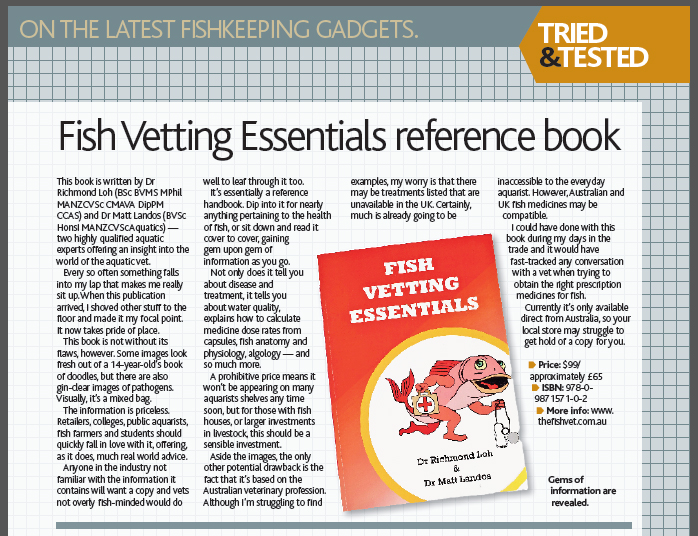
Check out what’s new – some pages from Practical Fish Keeping Magazine which can be downloaded from the link below, courtesy of Nathan Hill.

Practical Fish Keeping – New Gadgets

How to tell the difference in the sex of koi?

Telling the difference in the sex of koi fish can sometimes be difficult. It is easiest when they at sexual maturity and during spring/summer.

Female kois are more rotund because their bellies carry a full load of eggs. They have a shorter, wider head and the texture of their skin is smooth all over. The vent will be protruding.

Male kois are more streamlined and elongate. They have longer, narrower heads and the texture of their skin along their flanks and operculae (gill covers) are slightly rough to the touch. The vent of male fish will be sunken/concave.

During the breeding season, you may notice males chasing after females as they spawn.

Imagine absorbing your nutrients from your surroundings!

Fish are unique in their ability to absorb minerals not only from their diets but also from water!

Nutrition, Feeding, and Behavior of Fishnext term

Santosh P. Lall PhD Corresponding Author Contact Information, E-mail The Corresponding Author, Sean M. Tibbetts MSc

Institute for Marine Biosciences, National Research Council of Canada, 1411 Oxford Street, Halifax, Nova Scotia, Canada B3H 3Z1

Available online 31 March 2009.

Nutrition and feeding influence growth, reproduction, and health of previous termfishnext term and their response to physiologic and environmental stressors and pathogens. The basics of previous termfishnext term metabolism are similar to those of warm-blooded animals in that they involve food intake, digestion, absorption, and transport of nutrients to the various tissues. previous termFishnext term, however, being the most primitive form of vertebrates, possess some distinguishing features which will be discussed. Unlike warm-blooded animals, which are homoeothermic, previous termfishnext term are poikilothermic, so their body temperature and metabolic rate depends on the water temperature and this has practical implications for the nutrition, feeding and health of previous termfishnext term. Several behavioral responses have been linked to methods of feeding, feeding habits, frequency of feeding, mechanisms of food detection, and food preferences. previous termFish are also unique among vertebrates in their ability to absorb minerals not only from their diets but also from water through their gills and skin.

Keywords: previous termFish; Nutrition; Feeding; Behavior; Feeds; Diet

FRDC funds Dr Loh to attend Aquavet in the US.

The Aquavet Admissions Committee found that Dr Loh was too overqualified to attend Aquavet I and have selected him to participate in Aquavet II instead.

Dr Loh’s trip to the US later this year has been made possible through the –

People development program: 2011 Aquatic Animal Health Training Scheme is supported by funding from the FRDC
on behalf of the Australian Government”. This federal grant was won on a competitive basis.

Thank you to all those who have helped Dr Loh in the application process and by providing references and testimonials.

These can be viewed at – http://thefishvet.com.au/testimonials.html

Stuck for a Valentine’s gift? How about “gems” of information?

Check out Practical Fish Keeping’s review of Fish Vetting Essentials:

  • written by two highly qualified aquatic experts
  • dip into it for nearly everything
  • the information is priceless
  • real world advice
  • gems of information revealed
  • a sensible investment
  • it takes pride of place

To order your own copy, go to: http://www.thefishvet.com.au/shop/shopping.html