Do goldfish grow to the size of their tank?

I received a fairly lengthy question yesterday from the UK. To summarise the question, it was about whether goldfish only grow to the size of the tank (the full question/s follow this answer).
Growth in fish, like other organisms, are influenced by many factors including nutrition and hormonal influences. The one thing though, the people mean when they talk about talk about goldfish growing to the size of its tank is to do with their regulation of growth hormones. Goldfish are one that produce growth inhibitory hormones (e.g. somatostatin) and in nature, it’s their way of reducing intraspecific competition by suppressing growth of other goldfish. This is a particularly useful survival mechanism especially if you’re a “big fish in a small pond”! In a tank situation, and if partial water changes are not performed regularly, this hormone can build up and suppress the goldfish itself! And in this way, it is also a survival mechanism whereby it will not outgrow its pond!
Other fish do not produce such potent hormones and this is why they can outgrow the aquarium they live in. These fish tend to be “big fish in a big pond”. Their survival strategy is to get as big as they can to avoid being eaten by someone else. The barramundi and Murray cod are great examples of such fish.
Fish wastes are generally not ideal for fish to live in. They would have anti-nutritional effects and nitrates are known to suppress the immune system. If conditions are not optimal, fish will not thrive and will not grow.
—
Now on: Twitter – Blog – Facebook – Linkedin – YouTube

—
Yours sincerely,Dr Richmond Loh
BSc BVMS MPhil (Vet Path) MANZCVS (Aquatics & Pathobiology) DipPM

Veterinarian / Adjunct Lecturer Murdoch University / Secretary Aquatic Animal Health Chapter ANZCVS
The Fish Vet, Perth, Western Australia. Mobile Veterinary Service for fish and other aquatic creatures.
http://www.thefishvet.com.au
Ph: +61 (0)421 822 383
On 27/02/2012, at 18:54,
Dear Richmond Loh,
I came across your information on Koi-vet.com under the ‘Fish Vets Listing’ section and I was wondering if you could possibly help me.

I have recently been investigating and trying to find out the truth behind the issue of Goldfish growth, how it is affected through stunting and what it is in particular that causes stunting to begin with.

There are many rumours, opinions and myths floating around, which makes it hard to discern the facts from the fiction. I was wondering if you could help me with the understanding of this topic. Or know of any papers/research that could help point me in the right direction.

At the moment, the main things I come across when I speak to others, is that stunting is caused due to the fish being kept in small aquaria, poor water quality or under feeding.
While I can appreciate these are all valid points, how do these factors cause the growth to cease? Through looking around I have begun to see people say, that due to hormones a goldfish can continue to grow, regardless of it’s tank size, if it has good water quality. It makes me wonder, what hormones they are referring to and the biology behind this? Along with what counts as small aquaria? When is a tank, too small for a goldfish?

Another interesting rumour I’ve heard is that when a goldfish is stunted, it’s body stops growing, but it’s internal organs do not? Is this true?
I am also curious, at how a goldfish is affected, if it’s stunted at different sizes. For example is a goldfish stunted at 8 inches, much healthier than one stunted as a juvenile?

If you could provide any answers, or further help, I would be extremely grateful.

Thank you for your time,
May I wish you the best for the future,

Ms A. Taylor


Challenges when discussing fish welfare are…

Dr Loh will be presenting the topic of fish welfare to 3rd year veterinary students today at Murdoch University.

One of the challenges when discussing fish welfare is that there are 3 main definitions about what constitutes good animal welfare.

The first is a ‘nature-based’ definition where it requires fish to feel good experiences and be free from negative experiences like fear and pain.

The second is a functions-based definition where it requires fish to be in good health, meaning they grow well, are free from disease, reproduces, etc.

Then there is the ‘nature-based’ definition where fish are to be able to lead a natural life and express the full range of behaviours as they do in the wild.

These definitions are not always congruent with each other… These will be explained in the lecture today.

Scholarships available for Australian Fish Health Professionals.

I have been lucky enough to receive this scholarship which I will be using to attend Aquavet II mid this year (“Aquatic Animal Health Training Scheme”). Now you can also apply to receive a federal grant towards furthering yourself in the fish health sector.

See forwarded email below:

From: Jo-Anne Ruscoe [mailto:jo-anne.ruscoe@frdc.com.au]
Sent: Thursday, 23 February 2012 12:01 PM
Subject: People development awards / scholarships now open


FRDC development Awards

FRDC invites you to consider the following opportunities for professional development and also distribute this information to your members and colleagues – it would be great if you could have a think about suitable people and encourage them to apply.


Applications are now open for the following FRDC development Awards.


  • · Aquatic Animal Health Training Scheme
  • · International Travel Bursaries
  • · Visiting Expert Bursaries


Information on the Awards and how to apply can be found at http://www.frdc.com.au/communitypeople/scholarships

Applications close 23rd April 2012

The FRDC contact for the Awards is Jo-Anne Ruscoe

(02) 6285 0423 or email jo-anne.ruscoe@frdc.com.au


—
Now on: Twitter – Blog – Facebook – Linkedin – YouTube

—
Yours sincerely,

Dr Richmond Loh
BSc BVMS MPhil (Vet Path) MANZCVS (Aquatics & Pathobiology) DipPM

Veterinarian / Adjunct Lecturer Murdoch University / Secretary Aquatic Animal Health Chapter ANZCVS
The Fish Vet, Perth, Western Australia. Mobile Veterinary Service for fish and other aquatic creatures.
http://www.thefishvet.com.au
Ph: +61 (0)421 822 383

Amoebic gill disease in salmon- Scotland

AGD is playing havoc with the salmon in Scotland. This is considered a major disease of salmon when I was working as a veterinary fish pathologist in Tasmania and I believe it still is.

I read this article about the Scottish farm experience with interest.
http://www.thefishsite.com/fishnews/16527/agd-hard-to-control-says-marine-harvest

One of the major flaws in net pen aquaculture is that they are sited in the same location year in, year out. And as such, you would expect that pathogens would build up over time.

If we take a leaf out of traditional land farming of sheep for instance, the paddocks are cycled and allowed to crop or fallow. In this way, parasitic diseases such as intestinal worms can be managed more effectively.

I believe the future of net pen aquaculture would rely on having multiple leases where the sites are allowed to fallow or have alternative “crops” cultured.

Dr Richmond Loh
BSc BVMS MPhil MANZCVS (Aq & Pathol)
The Fish Vet, Perth, Western Australia.
Veterinary Medicine for fish.
http://www.thefishvet.com.au
Ph: +61 (0)421 822 383

Beware of chlorine

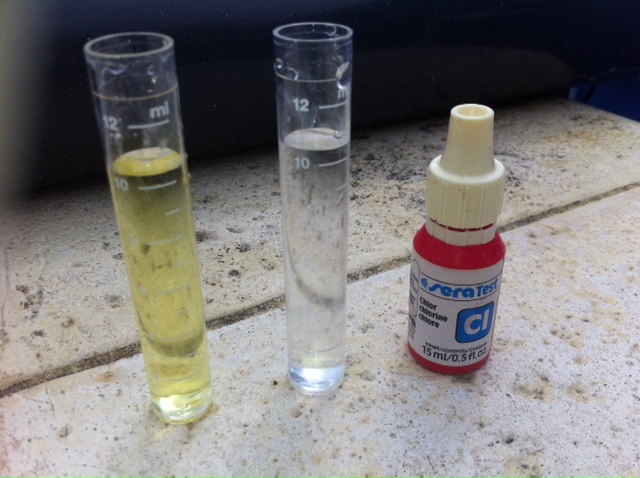
Beware of chlorine when making large water changes. I’ve used a test kit to demonstrate to the client that although you cannot smell the chlorine like when you are at the pools, chlorine levels harmful to your fish (and biofilter) exists in tap water (note the bright yellow coloured reaction in the vial on the left). The vial on the right contains dechlorinated water shows no colour change.

Yours sincerely,

Dr Richmond Loh
BSc BVMS MPhil MANZCVS (Aq & Pathol)
The Fish Vet, Perth, Western Australia.
Veterinary Medicine for fish.
http://www.thefishvet.com.au
Ph: +61 (0)421 822 383

Thank you for liking The Fish Vet’s Fan Page.

Thank you everyone for liking the page. We’ve now over 90 LIKES!

The new site address is – http://www.facebook.com/thefishvetdrloh

Formalin knocks out oxygen.

Did you know that formalin knocks oxygen out of the water? This means that if you’re treating fishes that already have gill disease, it would exacerbate the condition. Always get a definitive diagnosis before reaching for the “cure all” treatment.

And For those needing to treat their fishes with formalin, now is an ideal time to do so because of the cooler weather. Cooler waters tend to carry more oxygen than when it is warm.

Like The Fish Vet’s fb page?

Favour if you can please.
Can as many people as possible please LIKE my Facebook Fan Page (http://www.facebook.com/pages/The-Fish-Vet/188036301245327)?
This is so I can get a shortened web address for the page.
Thank you kindly!
—

Now on: Twitter – Blog – Facebook – Linkedin – YouTube

—
Yours sincerely,

Dr Richmond Loh
BSc BVMS MPhil (Vet Path) MANZCVS (Aquatics & Pathobiology) DipPM

Veterinarian / Adjunct Lecturer Murdoch University / Secretary Aquatic Animal Health Chapter ANZCVS
The Fish Vet, Perth, Western Australia. Mobile Veterinary Service for fish and other aquatic creatures.
http://www.thefishvet.com.au
Ph: +61 (0)421 822 383