What car dies a fish drive?
A tank!
All about Fish Vetting – Dr Richmond Loh
What car dies a fish drive?
A tank!
What to do when you suspect your fish is sick? Do you instantly reach for a “multi-cure”? Does a “multi-cure” exist? Why isn’t there a “multi cure” for all animals and for humans? One of my colleagues likens “multi-cure” to Chinese medicine. Does it really work and does it really cure all ailments?
More often than not, as you seek advice from the net or if you call around different shops, you will find an abundance of conflicting information about what your fish is sick with and what to treat for. How do you discern? One of my colleagues says that their best advice would be to unplug your computer from the wall! He really dislikes “doctor Google”.
Without testing the water and without examining your fish, it would be impossible to tell. Many fish diseases are caused by bugs that are so small that you’d need a microscope to detect. So, anyone who can tell you what is wrong with your fish without having the necessary information and tools would be a genius, or is telling you fiction.
My advice would be…
Increase salinity for freshwater fish by adding sodium chloride (rock salt, sea salt or aquarium salt) at 5g/L to reduce osmoregulatory stress (reduce salinity by 5ppt in marine fish by diluting seawater with freshwater).
For emergency oxygenation, use potassium permanganate at 2ppm or 3% peroxide at 0.25ml/L. This will also act as a mild disinfectant.
Add vitamin C to the water at 10mg/L to helps improve immune system and wound healing.
Then, call a fish veterinarian to investigate the reason why your fish is sick. With a proper diagnosis, you will know whether other fish are in danger of being infected and know what to treat you fish, tank or pond with.
Previously we discussed that night time seems to be the best time to treat fish diseases. Is it always the case?
Certain medications (e.g. formalin) may displace oxygen from the water. In a planted aquatic system, oxygen levels should be at its peak during the day. So, when you’re treating for respiratory conditions in fish, you would choose a time of the day where dissolved oxygen would be at its highest. This time would be around noon.
Another reason for choosing to treat during the day is when you’re using new drugs in a new species. During the day, you have all the light available in order to observe the fish and how they’re reacting to the drug. So, if there are any adverse reactions, you can act on things quickly.
That’s just a snap shot on time as factor that influences management options.
This is not really a fish related post, but is very important as it might affect you or the people around you. Yesterday I attended a brief presentation on suicide prevention amongst veterinarians. The stats in the first few slides are astounding. There are some pertinent points about how the veterinary profession could shift to create a better working environment. The problem is universal and centres on long working hours for low pay.
Did you know that veterinarians and architects are the lowest paid professions? Combine this with a hefty tuition fee, veterinarians may find themselves to be in grave financial stress. Check this out for a scenario; a full-fee paying student will pay AUD$45,000/yr for 6 years before graduating. The Australian Veterinary Association is only now campaigning for a minimum veterinary graduate wage of AUD$50,000/yr.
There are also some generic pointers that would be applicable to everyone to build resilience into your set of life skills and help you live life to the full. Below are some points taken from two of the slides from the presentation –
Happiness is best brought about by five things:
For well being in society or Individuals:
Are we all right – suicide prevention
The presentation was provided courtesy of
Dr Brian Mc Erlean MVB MRCVS
Australian Veterinary Association Community Coordinator WA
One Life Suicide Prevention Strategy
Mob: +61 (0)4 3356 1922
nervoustransmitter@bigpond.com
www.onelifewa.com.au
“People Making Time for People”
The Second Edition of Invertebrate Medicine was released in December, 2011. It has been substantially expanded from the first edition to reflect the tremendous growth of the pertinent literature and work that is being accomplished in the fields of invertebrate animal medicine, disease investigation, conservation, husbandry, and animal welfare. In 2012 it is being recognized with a Text and Academic Authors Association TEXTY award for excellence in the Life Sciences Category.
With the increased merging of animal and human medicine (“one health” or “one medicine”), the growing importance of invertebrates in biomedical research, and the many ongoing efforts to preserve habitat, protect at risk species, and learn more about how invertebrates help define and connect ecosystems, this new edition is both warranted and timely.
Six new chapters (Reef Systems, Butterfly Houses, Honeybees, Conservation and Preservation, Welfare, and Sources of Supplies) have debuted and three first edition appendices (Neoplasia, Euthanasia, and Reportable Diseases) have been expanded into full chapters. The Laws and Regulations Chapter has been broadened, with the addition of a new author, to include more international information.
Excerpt copied and pasted from: http://www.greglewbart.com/invertebrate_medicine__2nd_edition_108775.htm
Many the scaleless fishes have numerous large eosinophilic cells in their epithelium called “club cells”. In the old days, they were often labelled as “fright cells”. The reason for this name is that it was thought that when fish are stressed or being attacked, these cells are activated to release chemicals that will warn their conspecifics of danger and to avoid the area. “Recent studies demonstrated that predation has no effect on club cell investment. Rather, club cells have an immune function and cell production may be stimulated by skin-penetrating pathogens and parasites.” Check out this article for more detailed information.
| Journal of Fish Diseases | |||||||||||||||||
| Volume 35, Number 4 (April 2012) | |||||||||||||||||
 |
Do fathead minnows, Pimephales promelasRafinesque, alter their club cell investment in responses to variable risk of infection from Saprolegnia? | ||||||||||||||||
| Authors: | R J Pollock 1, M S Pollock 1, M C O Ferrari1,2, S G W Kaminskyj 1, D P Chivers 1 | ||||||||||||||||
| Author Affiliations: |
|
||||||||||||||||
| Source: | Journal of Fish Diseases, Volume 35, Number 4 (April 2012) | ||||||||||||||||
| Page Numbers: | 249 – 254 | ||||||||||||||||
| Available Full Text: |
|
||||||||||||||||
| Abstract: | Fish in the Superorder Ostariophysi possess large epidermal club cells that release chemical cues warning nearby conspecifics of danger. Despite the long-held assumption that such club cells evolved under the selective force of predation, recent studies demonstrated that predation has no effect on club cell investment. Rather, club cells have an immune function and cell production may be stimulated by skin-penetrating pathogens and parasites. The current work investigates whether fathead minnows, Pimephales promelas, alter their club cell characteristics based on variation in infection risk. In a 2 × 3 design, we exposed minnows to infective cysts of two oomycete species (Saprolegnia feraxand S. parasitica) at three different concentrations (2, 20 or 200 cysts L-1). Club cell characteristics (number and size) were quantified 12 days after exposure. Saprolegnia parasiticais thought to be more pathogenic than S. ferax, hence we predicted greater club cell investment and a larger turnover rate of cells by minnows exposed to S. parasiticathan S. ferax.We also predicted that minnows exposed to higher numbers of cysts should invest more in club cells and have a higher turnover rate of cells. We found no difference in club cell density or size between fish exposed to the two Saprolegniaspecies; however, fish exposed to high concentrations of pathogens had smaller club cells than those exposed to low concentrations, indicating a higher rate of turnover of cells in the epidermis. | ||||||||||||||||
| Citation: | R J Pollock, M S Pollock, M C O Ferrari, S G W Kaminskyj, D P Chivers . Do fathead minnows, Pimephales promelasRafinesque, alter their club cell investment in responses to variable risk of infection from Saprolegnia?. Journal of Fish Diseases, Volume 35, Number 4 (April 2012), pp. 249-254, <http://ejournals.ebsco.com/direct.asp?ArticleID=476E9906787317EDC908> | ||||||||||||||||
| URL: | http://ejournals.ebsco.com/direct.asp?ArticleID=476E9906787317EDC908 | ||||||||||||||||
If you’ve liked the information I’ve been providing so far, you may wish to "hook" up with The Fish Vet on other social media networks:
Facebook – http://facebook.com/thefishvetdrloh – LIKE IT!
YouTube: http://www.youtube.com/user/TheFishVetDrLoh
Blog – https://thefishvet.wordpress.com/
Twitter – http://twitter.com/thefishvet
Linkedin – http://au.linkedin.com/pub/dir/Richmond/Loh
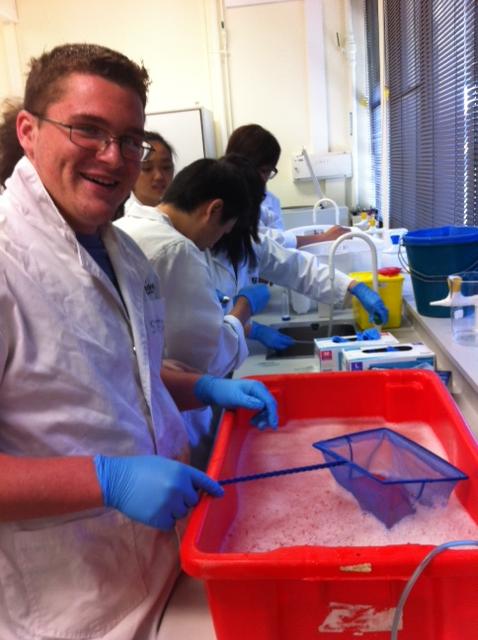
Here Stephan anaesthetises a silver perch.
He will get $1 off the price of Fish Vetting Essentials for every LIKE he can get for my Facebook fan page.
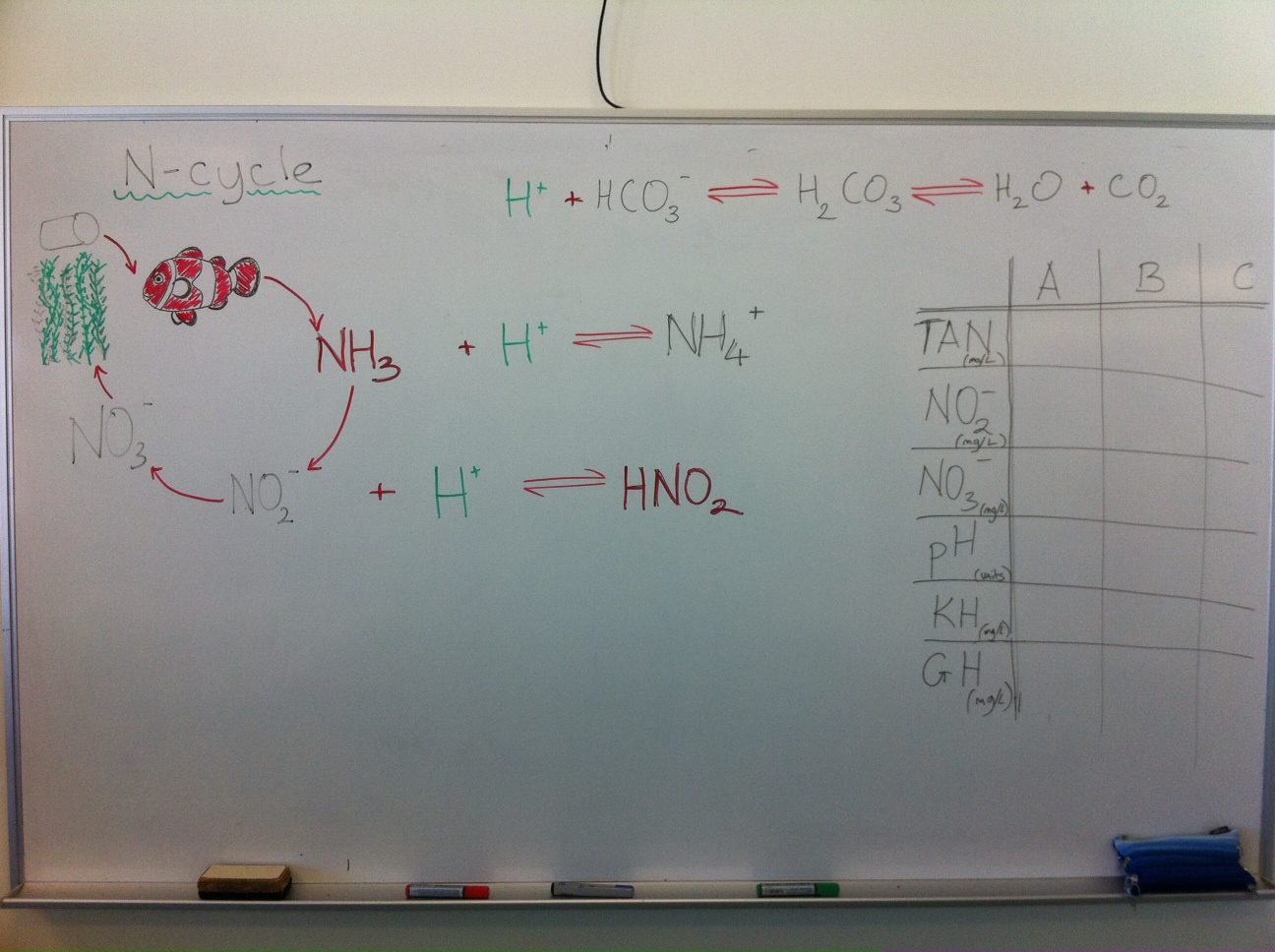
This time I’ve drawn a better fish picture! Yes, a ‘Nemo’ fish!
The short answer is YES, there is a better time to treat.
If you’re talking about white spot disease, their biology dictates that most of the mature trophonts exit the host and the theronts excyst during darkness. The theory behind this behavior is so that when fish are at rest and near the bottom, the parasite would have the best chance at locating a host. Most medications are not effective against the encysted stages of Ichthyophthyrius/Cryptocaryon, but are effective on the motile phases. So, since bugs tend to be released from their cysts during the night, then the most appropriate time to treat would be just at sunset or just prior to lights out. This would mean that the medication is at its highest concentration in the water when the majority of the parasite are at their susceptible phase.
If you’re talking about using medications such at organophosphorus compounds (e.g. trichloron or fenthion), the organophosphorus compounds tend to be broken down more quickly at alkaline pH (high pH). In a planted tank/pond situation, there are diurnal variations in the pH due in most part to a net carbon dioxide use and release. This in turn will affect the pH. Because of the net carbon dioxide being generated during the night, the water would become more acidic. The reverse is true. When photosynthesis is at its peak, the water’s pH will be high. So, having said this, the best time of the day to use OPs is at night.
In addition to this, many chemicals can be broken down by the sun’s UV rays. And this is one of the reasons why UV lights should be turned off when treating aquaria/ponds. So, a night treatment may be better.
These three examples have suggested that night time is the best time to treat. So when might you use medicines during the day?