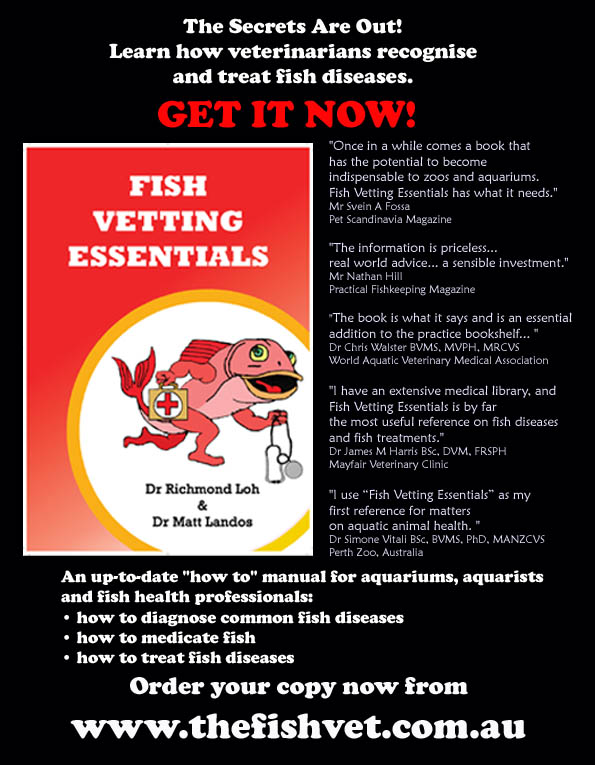
Check out the advertisement for the Fish Vetting Essentials book that appears in this month’s Pet Industry News magazine! And just in time too for Interzoo in Germany (17 – 20.05.2012).
All about Fish Vetting – Dr Richmond Loh
Check out the advertisement for the Fish Vetting Essentials book that appears in this month’s Pet Industry News magazine! And just in time too for Interzoo in Germany (17 – 20.05.2012).
One of my friends alerted me to a new product available –
What are your thoughts?
My thoughts…
too small, no heater and not sure if there is sufficient filtration for fish. Not bad if it is to be used as a vase or a rubbish bin.
I was teaching again at Murdoch University yesterday and thought I’d share this idea with you.
Whenever I teach a group of students, I always ask the participants, “How many people have kept fish in their life?”
Usually, 1/3 of the class would show their hands.
My next question would be, “Of those who have kept fish before, how many no longer keep fish?”
Two thirds of the respondents would show their hands.
Do you know why these people give up? The resounding answer is, “Because they died.” And their experience is that deaths would occur in the first few weeks of fishkeeping.
A lot of people are amazed when I tell them that the lifespan of a goldfish could be 15-20 years or more, but unfortunately, the average lifespan of a goldfish in captivity could be as low as less than one month! Why is this so?
The most common problem is new tank syndrome. It is a real invisible killer of fish and the hobby. Fish keepers must familiarise themselves with this ahead of anything else when they do their research. And this is always my emphasis whenever I teach about fish health. This condition can also affect established tanks!
I have deviated from my point…
So, in a class of 100 veterinary students, 33 would have kept fish before and of these, we would lose 22 of these from the hobby. The ornamental fish industry would do much better if everyone worked together to educate new hobbyists about fish keeping. Just imagine, our industry could be at least three times the size it is now!
How can we do this?
Every fish store and pet shop should have leaflets to hand to new hobbyists so that their customers may learn about the nitrogen cycle and that shops should request the new owners to test their water regularly in the start-up phase, or to request them to bring their water in for testing.
If you’re in Melbourne and need to seek veterinary advice for your fish, book an appointment to see Dr Loh for this Saturday.
Phone 03 9762 2044
Check out the competition to win a copy of “Fish Vetting Essentials” on the Veterinary Practice News Facebook page.http://www.facebook.com/VeterinaryPracticeNews
Like it on FaceBook!
—
Follow me on: Twitter – Blog – Facebook – Linkedin – YouTube —
Yours sincerely,
Dr Richmond Loh
BSc BVMS MPhil (Vet Path) MANZCVS (Aquatics & Pathobiology) DipPMVeterinarian / Adjunct Lecturer Murdoch University / Secretary Aquatic Animal Health Chapter ANZCVS
The Fish Vet, Perth, Western Australia. Mobile Veterinary Service for fish and other aquatic creatures.
http://www.thefishvet.com.au
Ph: +61 (0)421 822 383
My pair of clown fish didn’t greet me with their playful swim this morning when I came to feed them. What happened? Where were they hiding?
They were found at the bottom of their tank. The bodies of the pair lay rigid, both had their operculae (gill covers) flared open and their gills bleached of their normal red colouration. What could cause not one, but both fish in the tank to die in this manner? I thought about the flared gills and what it could mean.
An infectious disease such as gill parasites? Very unlikely since there have been no new introductions since the tank was setup over a year ago, no live aquatic feeds are given and the seawater is made artificially.
How about water quality issues such as hypoxia and carbon dioxide toxicity? Fish that die from such reasons will usually find it difficult to breathe and may die with their mouths gaping and operculae flared. But the tank has such low stocking density and the pumps are all working fine.
How about nitrite toxicity? Could the biofilter have crashed and now caused the nitrite levels to spike? Nitrite causes methaemoglobin formation, making it difficult for the blood to carry oxygen around the body. Perhaps this is why the fish were found with operculae flared. But the filter has never stopped working, the fish are not overfed, there is a very low stocking density and there was not the tell-tale signs of chocolate brown gills.
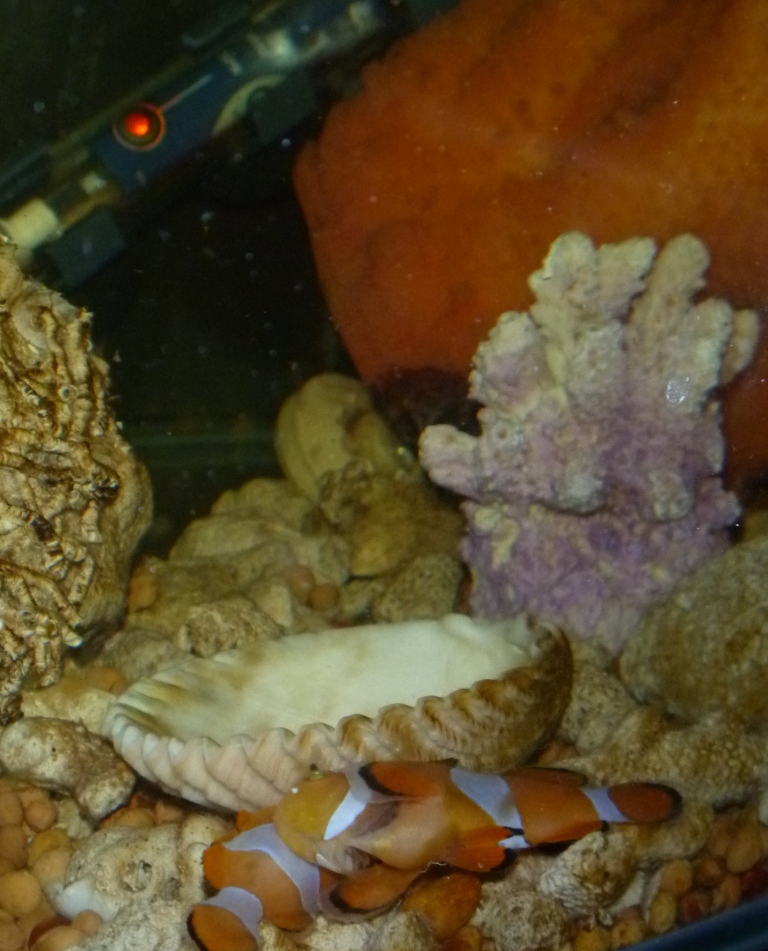
As I dipped a jar to collect the water, I noticed the water was exceptionally warm. The water temperature was 36 degrees celsius (this is 10 degrees higher than what is acceptable)! I notice that even at this high temperature, the heater was still in the “ON” position (see picture below, the lit orange light indicates the heater is still on and heating the water). A faulty heater thermostat has caused the demise of Nemo 1 and Nemo 2 😦
High water temperatures will decrease the dissolved oxygen. This, coupled with hyperthermia (having water temperatures above their physiological tolerance) would explain today’s tragic loss.
I will definitely choose a different brand of aquarium heater to prevent this from happening again.
A federal court judge has ordered the Food and Drug Administration to take action on its own 35-year-old rule that would stop farmers from mixing popular antibiotics into animal feed, a practice which is widely believed to have led to a surge in dangerous, drug-resistant bacteria. ..
What do you call the popular fish?
A star fish!
Skretting Australasian Aquaculture 2012; 6-10 May 2012; Melbourne, Victoria Australia:
The 2012
international conference is hosted by
Asian Pacific Chapter of the World Aquaculture Society and the Australian National Aquaculture Council. The naming rights sponsor is Skretting, while the sponsors are Australia’s Fisheries Research and
Development Corporation and Melbourne Australia.
The theme for this year’s meeting is “The Next Ten Years” and in the words of the organizers “Whether it be genetic improvement of farmed species, advances in health management, increased production efficiency, or higher product quality for consumers – the aquaculture industry continues to develop innovative and sustainable practices” the theme is apropos. The conference per se will be held at the Melbourne Convention and Exhibition Centre, with several conference hotels close nearby. For additional information refer to the conference website.
Can you see the haptors and four eye spots of this bug? Can you see the outline of the bug?

What is it?
Dactylogyrus sp. (aka gill fluke).