Bob Croucher with a copy of Fish Vetting Essentials at Interzoo 2012, Germany, for the pet supply trade show.
For only AUD$99 (plus postage and handling), get your very own copy now at
http://thefishvet.com.au/shop/shopping.html
All about Fish Vetting – Dr Richmond Loh
Bob Croucher with a copy of Fish Vetting Essentials at Interzoo 2012, Germany, for the pet supply trade show.
For only AUD$99 (plus postage and handling), get your very own copy now at
http://thefishvet.com.au/shop/shopping.html
| Aquaculture International: Journal of the European Aquaculture Society | |||||||||||||||||
| Volume 20, Number 3 (June 2012) | |||||||||||||||||
 |
Scoring of the extent and intensity of carp (Cyprinus carpio) skin changes made by cormorants (Phalacrocorax carbo sinensis): relationship between morphometric and histological indices | ||||||||||||||||
| Authors: | Stefan Skoric 1, Božidar Raškovic 2, Vesna Poleksic 2, Zoran Gacic 1, Mirjana Lenhardt 1 | ||||||||||||||||
| Author Affiliations: |
|
||||||||||||||||
| Source: | Aquaculture International: Journal of the European Aquaculture Society, Volume 20, Number 3 (June 2012) | ||||||||||||||||
| Page Numbers: | 525 – 535 | ||||||||||||||||
| Available Full Text: |
|
||||||||||||||||
| Abstract: |
Abstract
Cormorants cause damage to fish in aquaculture not only by consuming large number of fish but also by wounding them. Quantification of the actual damage in fish induced by wounding is important for reliable estimations of the overall loss in aquaculture caused by cormorants. In this study, specimens of mirror and scaly carp (Cyprinus carpio L.) injured by attacks of great cormorant (Phalacrocorax carbo L.) were collected from the “Ecka” fish farm in Serbia. Surfaces of superficial and open subepithelial wounds (expressed as a percent of the total body surface), estimated by computer-assisted image analysis, had mean values 10.66 ± 1.86 and 0.85 ± 0.90, respectively. Histological evaluation of wounds was performed by two scoring systems: system proposed by Bernet et al. (J Fish Dis 22:25–34, 1999) and modified system described by Wahli et al. (Aquaculture 225:371–386, 2003). The most frequent histopathological changes were disturbed epidermal structure and surface cell morphology and increased number of club cells (on more than 75% of specimens); increased number of melanocytes and their distribution in different layers in dermis; and enlarged hypodermis (more than 80% of samples) and myolysis (50% of samples). Comparison of wounds’ surfaces (surface of superficial injures) and histopathological changes, estimated by two scoring systems, revealed significant positive correlation. Bernet’s scoring system showed higher correlation coefficients, when compared with the modified Wahli’s scoring system.
|
||||||||||||||||
| Citation: | Stefan Skoric, Božidar Raškovic, Vesna Poleksic, Zoran Gacic, Mirjana Lenhardt . Scoring of the extent and intensity of carp (Cyprinus carpio) skin changes made by cormorants (Phalacrocorax carbo sinensis): relationship between morphometric and histological indices. Aquaculture International: Journal of the European Aquaculture Society, Volume 20, Number 3 (June 2012), pp. 525-535, <http://ejournals.ebsco.com/direct.asp?ArticleID=44239164CD6023F39F03> | ||||||||||||||||
| URL: | http://ejournals.ebsco.com/direct.asp?ArticleID=44239164CD6023F39F03 | ||||||||||||||||
Congratulations to Dr Richmond Loh who, through a competitive basis, was awarded the George Alexander Foundation International Fellowship 2012, which is administered through the International Specialised Skills Institute.
The aim of this Fellowship is to promote the acquisition of higher-level skills and an appreciation of international best practice in several areas.
Dr Loh has been selected because of his passion and it is genuine recognition of the significant contribution he has already made and will be making in the years to come.
Letters supporting his application are available via the links below:
Letter of Support – Agrifood Industry Skills Council
Letter of Support – Australian & NZ College of Veterinary Scientists (ANZCVS)
“The turtles responsible for the infections predominantly have shell lengths of less than 4 inches and were likely purchased from street vendors….. Nineteen people have been hospitalized….”
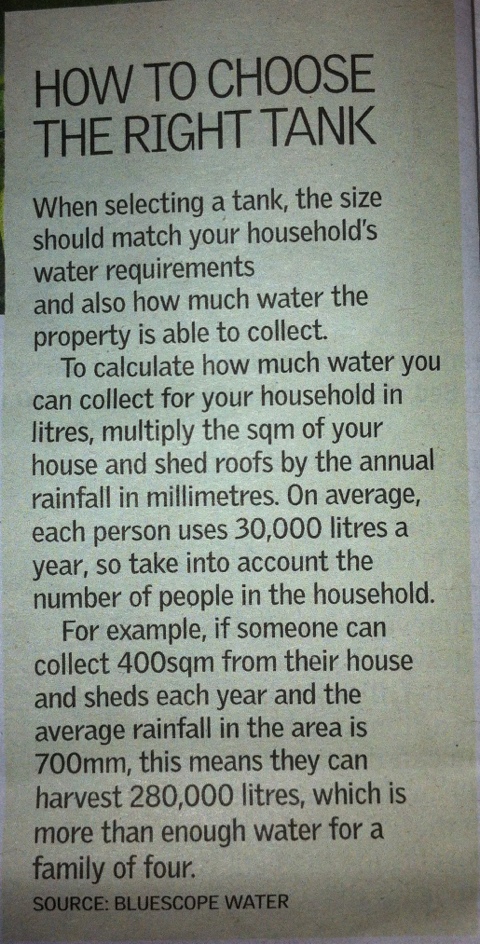
Now is the perfect time to invest in rainwater tanks. But what size should you get? I found this nifty section about choosing the right size to fit your needs in today’s West Australian lift out.
I wonder if we’re near the end of genetic selection for improved production in the traditional crops and livestock. How much more milk can a cow give? How much more meat can a chicken produce in a short time frame?
This author says that only 10% of the world’s aquaculture farmers invest in genetic selection. Imagine what potential there is for this industry to boom if we were to select for stock fitter for farming.
| Aquaculture | |||||||||||||||||
| Volume 349, Number 9 (May 2012) | |||||||||||||||||
| |
Genetic improvement for the development of efficient global aquaculture: A personal opinion review | ||||||||||||||||
| Authors: | Trygve Gjedrem | ||||||||||||||||
| Author Affiliations: |
|
||||||||||||||||
| Source: | Aquaculture, Volume 349, Number 9 (May 2012) | ||||||||||||||||
| Page Numbers: | 12 – 22 | ||||||||||||||||
| Available Full Text: |
|
||||||||||||||||
| Abstract: | It has been exciting to follow the rapid development of aquaculture production in Norway, and internationally, since 1971. As an animal breeder I am particularly impressed with the genetic gain obtained for growth rate, and also for disease resistance in several aquatic species, which is five to six times higher than what has been achieved in terrestrial farm animals. This is illustrated in five selected projects I have been involved in. The sad story is, however, that only less than 10% of the world’s aquaculture production is based on genetically improved stocks. The big challenge for the future is to develop more selective breeding programs for existing and new emerging aquaculture species in order to increase the production of this nutritious food source and to improve the efficiency of the use of feed, water, land and labor resources. | ||||||||||||||||
| Citation: | Trygve Gjedrem . Genetic improvement for the development of efficient global aquaculture: A personal opinion review. Aquaculture, Volume 349, Number 9 (May 2012), pp. 12-22, <http://ejournals.ebsco.com/direct.asp?ArticleID=432F8DCB9C444BE02064> | ||||||||||||||||
| URL: | http://ejournals.ebsco.com/direct.asp?ArticleID=432F8DCB9C444BE02064 | ||||||||||||||||
In some cases, antibiotics are used to fend off bacterial infections causing massive deaths of larval shellfish in the hatchery. There has been a lot of work put into investigating alternative means of avoiding over-use of antibiotics. So, just like having yoghurt for gut health, considerable work has been put into probiotics for aquaculture applications.
| Aquaculture | |||||||||||||||||
| Volume 349, Number 9 (May 2012) | |||||||||||||||||
| |
Protective effect of four potential probiotics against pathogen-challenge of the larvae of three bivalves: Pacific oyster (Crassostrea gigas), flat oyster (Ostrea edulis) and scallop (Pecten maximus) | ||||||||||||||||
| Authors: | Aditya Kesarcodi-Watson, Philippe Miner, Jean-Louis Nicolas, Rene Robert | ||||||||||||||||
| Author Affiliations: |
|
||||||||||||||||
| Source: | Aquaculture, Volume 349, Number 9 (May 2012) | ||||||||||||||||
| Page Numbers: | 29 – 34 | ||||||||||||||||
| Available Full Text: |
|
||||||||||||||||
| Abstract: | Mollusc aquaculture is an important commodity for France with Pacific oysters, flat oysters and the great scallop being the three main species. Pacific oyster larvae production is currently successful, however larval production of flat oyster and scallops regularly face problems remedied by antibiotics. Using a bioassay technique, four potential probiotic strains (Alteromonas macleodii0444, Neptunomonassp. 0536, Phaeobacter gallaeciensis, Pseudoaltermonassp. D41) were tested upon the larvae of the three mollusc species when challenged with pathogens. Pacific oysters and flat oysters were challenged individually with the pathogens Vibrio coralliilyticusand V. pectenicida, while scallops were challenged with V. coralliilyticusand V. splendidus. Survival of the larvae was measured in challenged larvae given the probiotics and those without probiotic. In scallop larvae, protection against V. coralliilyticusand V. splendiduswas provided by prior administration of P. gallaeciensis(29% and 53% better than the respective pathogen controls), A. macleodii0444 (30%, 36%) and Neptunomonassp. 0536 (36%, 55%). Significant protection with Pseudoalteromonassp. D41 was only provided against V. splendidus(35%). In flat oyster larvae, protection against V. coralliilyticusand V. pectenicidawas provided by P. gallaeciensis. (73%, 69%) and A. macleodii0444 (45%, 53%). Neptunomonassp. 0536 provided significant protection only against V. pectenicida(48% higher). Use of Pseudoalteromonassp. D41 did not offer significant protection for flat oyster larvae against either pathogen. Experiments with Pacific oysters suggested that Pseudoalteromonassp. D41 and P. gallaeciensiscould be effective against challenge by V. coralliilyticus(50% and 40% improved survival respectively) but not against V. pectenicida. The results indicate that P. gallaeciensis, A. macleodii0444, Neptunomonassp. 0536 and Pseudoalteromonassp. D41 could be useful in mollusc larviculture. | ||||||||||||||||
| Citation: | Aditya Kesarcodi-Watson, Philippe Miner, Jean-Louis Nicolas, Rene Robert . Protective effect of four potential probiotics against pathogen-challenge of the larvae of three bivalves: Pacific oyster (Crassostrea gigas), flat oyster (Ostrea edulis) and scallop (Pecten maximus). Aquaculture, Volume 349, Number 9 (May 2012), pp. 29-34, <http://ejournals.ebsco.com/direct.asp?ArticleID=461D8BE0FEC9BE894B9D> | ||||||||||||||||
| URL: | http://ejournals.ebsco.com/direct.asp?ArticleID=461D8BE0FEC9BE894B9D | ||||||||||||||||
Do you have a water-saving dunny and can’t seem to get sufficient water to come into contact with the toilet freshener? We recently installed a new toilet and then I was faced with this issue. Then I discovered those gel discs that you can position anywhere on the bowl.
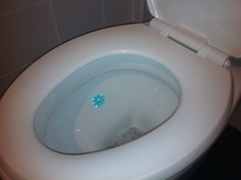
That’s a pretty clever invention!