How much fish does it take to make salmon?

The calcs come to 1.2 kg of “trash fish” to make 1 kg of salmon.

www.bcsalmonfacts.ca/forum#!/c87f319a08


Yours sincerely,

Dr Richmond Loh
BSc BVMS MPhil MANZCVS (Aq & Pathol)
The Fish Vet, Perth, Western Australia.
Veterinary Medicine for fish.
http://www.thefishvet.com.au
Ph: +61 (0)421 822 383

Giant eyeball washes up on beach in Florida | News.com.au

Does it belong to a fish? Whale? Cephalopod?

http://mobile.news.com.au/world/giant-eyeball-wahses-up-on-beach-in-florida/story-fndir2ev-1226494765438

BBC – Earth News – Polar bear’s epic nine day swim in search of sea ice.

More evidence for, and consequences of global warming?

http://news.bbc.co.uk/earth/hi/earth_news/newsid_9369000/9369317.stm

Manna from heaven – Typhoon Bolaven rains fish on Russian beach.

How wonderful would it be to have free seafood, delivered to your door step?

http://mobile.news.com.au/travel/news/typhoon-bolaven-rains-fish-on-russian-beach/story-e6frfq80-1226480708634

Can you keep fish completely submerged?

The short is, probably not… their entire lives.

Most fish can carry out their entire respiration by way of gills, however, some fish that are adapted to poorly oxygenated waters such as the catfish and labyrinth fishes (e.g. Siamese fighters, gouramis), require access to the water surface to breathe. Otherwise, they will most certainly drown! Yes, fish can drown!

On the other hand, the proper functioning of the swimbladder of physostomes requires gulping air to fill it. And this process is also vital in the fry swim up phase during early development.

But what about adult salmon? Why the reason for such research? Some people view aquaculture pens as visual pollution. Also, some farm sites are too rough for surface farms. And so, underwater net pen designs maybe necessary.

Read more in the abstract of the article below as it relates to salmonids:

;

Aquacultural Engineering
Volume 51, Number 11 (November 2012)
Atlantic salmon (Salmo salarL.) in a submerged sea-cage adapt rapidly to re-fill their swim bladders in an underwater air filled dome
Authors: Øyvind J. Korsøen1,2, Jan Erik Fosseidengen 1, Tore S. Kristiansen 1, Frode Oppedal 1, Samantha Bui 3, Tim Dempster 3
Author Affiliations:
1: Institute of Marine Research, NO-5984 Matredal, Norway
2: Centre for Research-based Innovation in Aquaculture Technology (CREATE), SINTEF Fisheries and Aquaculture, 7465 Trondheim, Norway
3: Sustainable Aquaculture Laboratory – Temperate and Tropical (SALTT), Department of Zoology, University of Melbourne, Victoria 3010, Australia
Source: Aquacultural Engineering, Volume 51, Number 11 (November 2012)
Page Numbers: 1 – 6
Available Full Text:
Full Text: Subscription Required to view full text
Format: PDF
Size: Unknown
Location: Publisher’s Site
Authentication: Publisher’s Site
Abstract: ? Submergence of salmon is unfeasible as swimbladder gas leakage reduces growth. ? A submerged air filled dome was tested to see if salmon can refill their swimbladder. ? Salmon rapidly and repeatedly swallowed air from the underwater dome. ? The results demonstrate that salmon can adapt to use underwater air domes.
Citation: Øyvind J. Korsøen, Jan Erik Fosseidengen, Tore S. Kristiansen, Frode Oppedal, Samantha Bui, Tim Dempster . Atlantic salmon (Salmo salarL.) in a submerged sea-cage adapt rapidly to re-fill their swim bladders in an underwater air filled dome. Aquacultural Engineering, Volume 51, Number 11 (November 2012), pp. 1-6, ;
URL: http://ejournals.ebsco.com/direct.asp?ArticleID=452ABCD5BFD3551C8190

What’s the best antibiotic to treat sick fish with?

Those antibiotics commonly available at fish shops include tetracycline and triple sulfa. Illegally, nitro furans and kanamycin are sometimes purchased/imported.

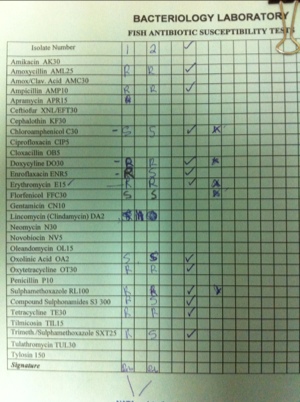
Before we dive right into the answer on which is the best antibiotic to use to treat such fish, have a look at this picture.

In this diagram is a table of the antibiotic sensitivities of a said fish/aquatic bacteria. ‘S’ stands for sensitive and in theory, it should be effective. ‘R’ stands for resistant and in theory, will have negligible effect on the pathogen.

Whenever I choose to test fish with antibiotics, it’s a good idea to run cultures and an antibiotic sensitivity panel to determine:
1. What bacteria you have?
2. Is it a primary pathogen or secondary invader?
3. Which antibiotic would have the greatest effect if necessary?
20121003-074712.jpg

In this picture, you may notice that not all antibiotics will work every time. It’ll depend on the bacteria and on the strain. It may also depend on what you’ve used in the past. Consider evidenced based medicine, rather than a ‘quick fix’ recommended by a friend.

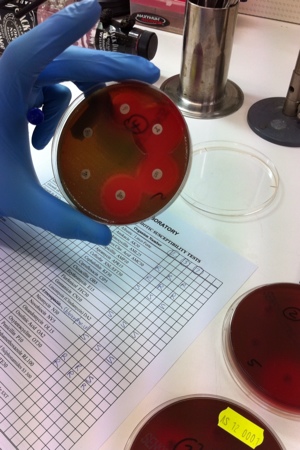
In another picture, the antibiotic sensitivity panel is not looking as bad. The discs are antibiotic impregnated cards and the space seen around them (areas of inhibited bacterial growth) is measured and compared with the standards to check if they are effective.
20121003-095012.jpg

How do you accurately and safely measure out a volume of solution from a large bottle?

Some chemicals are rather toxic in pure form (e.g. formalin, trichlorphon) and the less pouring you do, the better to avoid spills. This method I’m showing is a good way to measure out a volume of solution without having to pour or tip the bottle.

Is salmon’s readiness for sea an indicator of how they’ll perform?

When I was working in Tasmania, every year around spring time, fish farmers will be gearing up to move their fish from the freshwater ponds to the sea. How do you know when they’re ready? Visually, they will start to lose their parr marks, turning a wholly more silver colour.

When this happens, a random sample of fish are placed in seawater ponds for a seawater ‘challenge’ trial. These fish are then taken to the lab and we would take blood samples from salmon to check whether they were ready to go to sea. We would test their blood for any elevations in serum sodium or chloride levels. If they are able maintain these parameters within their normal reference ranges, then it means that the fish are ready to be trucked to sea cages. If not, then the fish are held back till they are ready.

But this paper states that even if fish are ready, they’re not all necessarily going to do well. Read the paper below to find out more.


Create Alert Add to Favorites Mark
Aquaculture
Volume 363, Number 8 (September 2012)
Gill Na+,K+-ATPase of Atlantic salmon smolts in freshwater is not a predictor of long-term growth in seawater
Authors: Gayle B. Zydlewski, Joseph Zydlewski
Author Affiliations:
no affiliations available
Source: Aquaculture, Volume 363, Number 8 (September 2012)
Page Numbers: 121 – 126
Available Full Text:
Full Text: Subscription Required to view full text
Format: PDF
Size: Unknown
Location: Publisher’s Site
Authentication: Publisher’s Site
Abstract: Gill Na+,K+-ATPase activity is a widely used measure of osmoregulatory preparedness in salmonid smolts. The degree to which this measure may predict long term performance is uncertain. In order to assess the relationship of this enzyme to long term growth and ion homeostasis, a cohort of Atlantic salmon hatchery smolts was used in a controlled environment with no salinity perturbations. In May 2006, gill Na+,K+-ATPase activity from 940 individually PIT tagged, Penobscot River smolts (USFWS, Green Lake National Fish Hatchery, Maine, United States) was measured immediately prior to isothermal transfer from freshwater to 32ppt seawater. From the observed range of activities, individuals were classified as having “low”, “middle”, or “high” enzyme activity levels. Individual size (fork length and mass) was recorded on days 0, 1, 3, and 14 and monthly for four months. Growth rates over four time periods were calculated for individual fish maintained until the end of the experiment. Gill Na+,K+-ATPase activities were also measured from a subset of sampled fish. All groups effectively osmoregulated as evidenced by minor perturbations in plasma osmolyte levels. Apart from initial weight loss on transfer, fish grew throughout the experiment, however, there were no differences (fish size, growth rate, and gill Na+,K+-ATPase activity in seawater) among groups with initially different gill Na+,K+-ATPase activities (prior to seawater entry). While gill Na+,K+-ATPase activity may be predictive of performance during the acute phase of acclimation (first few days), typical variation in this enzyme, expressed in freshwater at the peak of smolting, does not appear to be predictive of long-term growth in seawater.
Citation: Gayle B. Zydlewski, Joseph Zydlewski . Gill Na+,K+-ATPase of Atlantic salmon smolts in freshwater is not a predictor of long-term growth in seawater. Aquaculture, Volume 363, Number 8 (September 2012), pp. 121-126, <http://ejournals.ebsco.com/direct.asp?ArticleID=4E8696AA9BDF92F34569&gt;
URL: http://ejournals.ebsco.com/direct.asp?ArticleID=4E8696AA9BDF92F34569

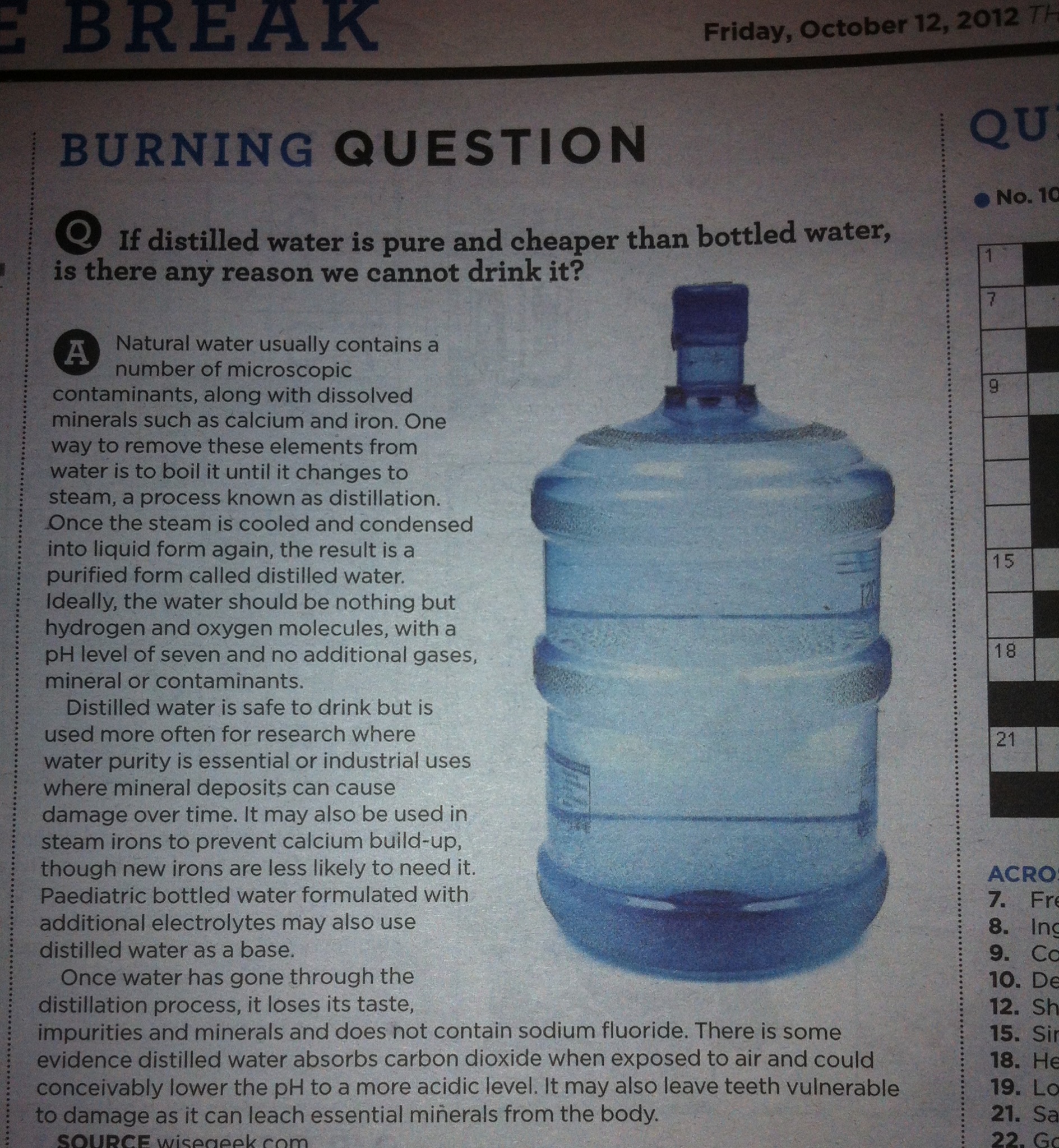
Something about water. Distilled vs bottled.

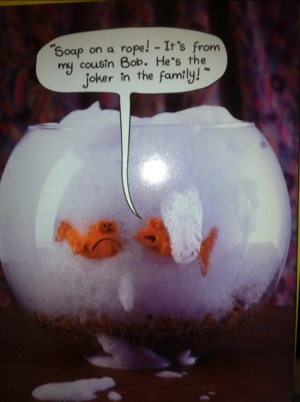
Reminds me of the part in Deuce Bigalow where he poured bottled water into his aquarium and drank funky water from his tap.