Some chemicals are rather toxic in pure form (e.g. formalin, trichlorphon) and the less pouring you do, the better to avoid spills. This method I’m showing is a good way to measure out a volume of solution without having to pour or tip the bottle.
Is salmon’s readiness for sea an indicator of how they’ll perform?
When I was working in Tasmania, every year around spring time, fish farmers will be gearing up to move their fish from the freshwater ponds to the sea. How do you know when they’re ready? Visually, they will start to lose their parr marks, turning a wholly more silver colour.
When this happens, a random sample of fish are placed in seawater ponds for a seawater ‘challenge’ trial. These fish are then taken to the lab and we would take blood samples from salmon to check whether they were ready to go to sea. We would test their blood for any elevations in serum sodium or chloride levels. If they are able maintain these parameters within their normal reference ranges, then it means that the fish are ready to be trucked to sea cages. If not, then the fish are held back till they are ready.
But this paper states that even if fish are ready, they’re not all necessarily going to do well. Read the paper below to find out more.
| Create Alert Add to Favorites Mark | |||||||||||||||||
| Aquaculture | |||||||||||||||||
| Volume 363, Number 8 (September 2012) | |||||||||||||||||
 |
Gill Na+,K+-ATPase of Atlantic salmon smolts in freshwater is not a predictor of long-term growth in seawater | ||||||||||||||||
| Authors: | Gayle B. Zydlewski, Joseph Zydlewski | ||||||||||||||||
| Author Affiliations: |
|
||||||||||||||||
| Source: | Aquaculture, Volume 363, Number 8 (September 2012) | ||||||||||||||||
| Page Numbers: | 121 – 126 | ||||||||||||||||
| Available Full Text: |
|
||||||||||||||||
| Abstract: | Gill Na+,K+-ATPase activity is a widely used measure of osmoregulatory preparedness in salmonid smolts. The degree to which this measure may predict long term performance is uncertain. In order to assess the relationship of this enzyme to long term growth and ion homeostasis, a cohort of Atlantic salmon hatchery smolts was used in a controlled environment with no salinity perturbations. In May 2006, gill Na+,K+-ATPase activity from 940 individually PIT tagged, Penobscot River smolts (USFWS, Green Lake National Fish Hatchery, Maine, United States) was measured immediately prior to isothermal transfer from freshwater to 32ppt seawater. From the observed range of activities, individuals were classified as having “low”, “middle”, or “high” enzyme activity levels. Individual size (fork length and mass) was recorded on days 0, 1, 3, and 14 and monthly for four months. Growth rates over four time periods were calculated for individual fish maintained until the end of the experiment. Gill Na+,K+-ATPase activities were also measured from a subset of sampled fish. All groups effectively osmoregulated as evidenced by minor perturbations in plasma osmolyte levels. Apart from initial weight loss on transfer, fish grew throughout the experiment, however, there were no differences (fish size, growth rate, and gill Na+,K+-ATPase activity in seawater) among groups with initially different gill Na+,K+-ATPase activities (prior to seawater entry). While gill Na+,K+-ATPase activity may be predictive of performance during the acute phase of acclimation (first few days), typical variation in this enzyme, expressed in freshwater at the peak of smolting, does not appear to be predictive of long-term growth in seawater. | ||||||||||||||||
| Citation: | Gayle B. Zydlewski, Joseph Zydlewski . Gill Na+,K+-ATPase of Atlantic salmon smolts in freshwater is not a predictor of long-term growth in seawater. Aquaculture, Volume 363, Number 8 (September 2012), pp. 121-126, <http://ejournals.ebsco.com/direct.asp?ArticleID=4E8696AA9BDF92F34569> | ||||||||||||||||
| URL: | http://ejournals.ebsco.com/direct.asp?ArticleID=4E8696AA9BDF92F34569 | ||||||||||||||||
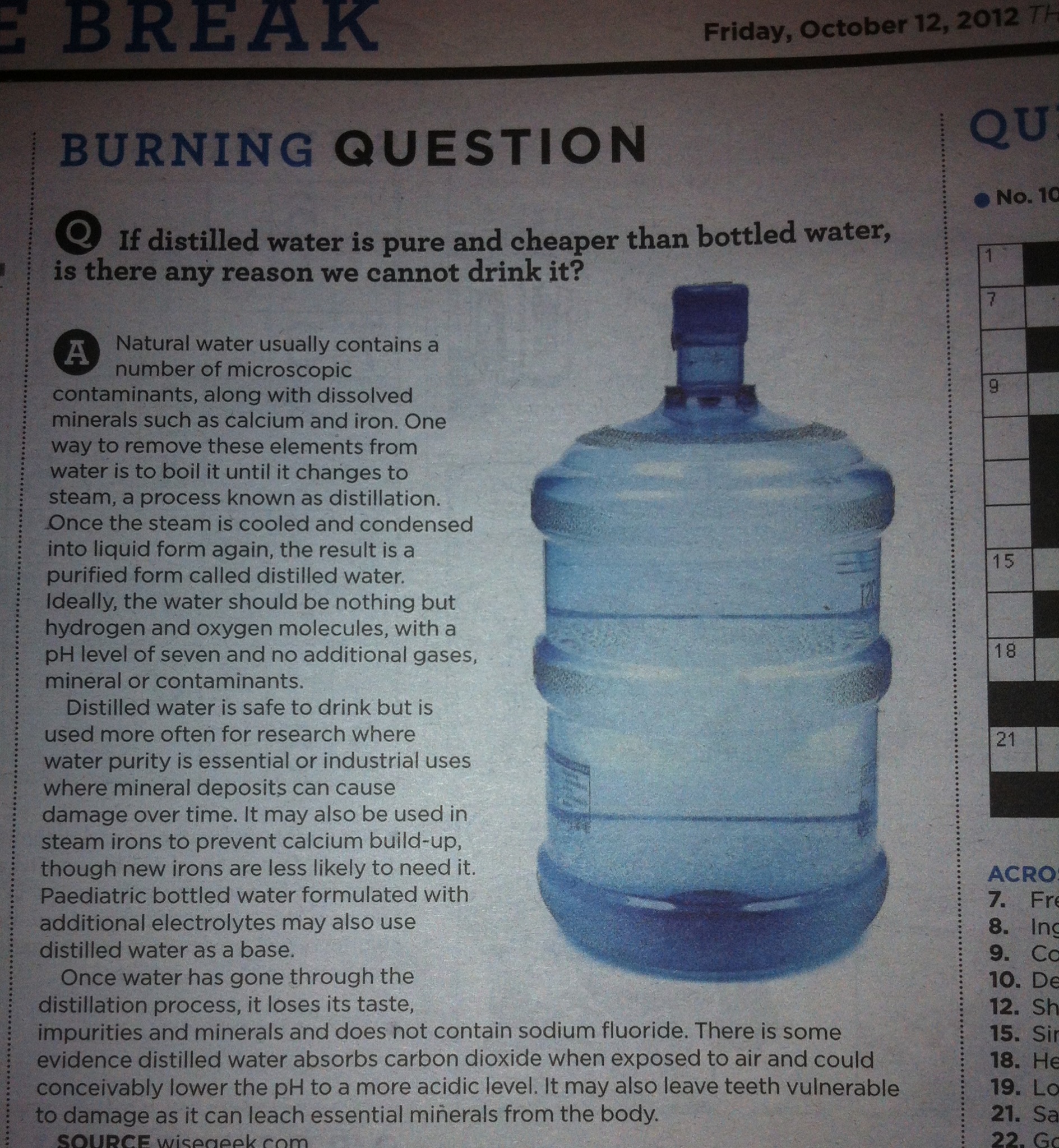
Something about water. Distilled vs bottled.
Reminds me of the part in Deuce Bigalow where he poured bottled water into his aquarium and drank funky water from his tap.
How do you determine the PCV of fish blood?
The packed cell volume (PCV) of fish blood is an important indicator of fish health. It’s also sometimes called haematocrit/hematocrit. For some background on fish haematology, see also previous posts using this link – https://thefishvet.com/?s=haematology
How do you test for it? Check out my latest youtube clip here – http://youtu.be/ig0u4LuOlRA
I know it’s only a fish… but…
I get this a lot from clients with pet ornamental fish. I must admit that I’d be the last person they need to explain to. It’s very normal to become attached to pet fishes. Each one is unique and each one could mean a lot more to their owner than some would think.
Do you know someone with a favourite grotty T-shirt? Their favourite pair of undies? Why do people get so attached to inanimate objects and query why people become so attached to their fish? This simply cannot be explained.
So, any fish, big or small, from oscars to guppies, Dr Loh, The Fish Vet can help.
How do you treat buoyancy disorder in a fish?
From time to time, some fish may develop swim bladder problems and these tend to manifest as buoyancy disorders – either the fish is floating to the top (positively buoyant), or sinking to the bottom (negatively buoyant). Fish in their natural healthy state should be relatively neutrally buoyant, or only just slightly negatively buoyant.
How to fix this condition using mechanical/pneumatic methods on fish?
Fish should be sedated and the smallest gauge needle used. Best response is seen if fish is attended to within 24 hours of first showing signs of swim bladder disease.
In fish that are laterally compressed, a bright light shining from the other side may make a silhouette apparent. In thicker bodied fish, ultrasound may be necessary to help guide your needle to the right location. Once in the swim bladder lumen, the syringe can be used to inflate or deflate the sac depending on what’s needed.
It is also worthwhile to point out that buoyancy disorders are not always a
benign condition. It may be due to several things including the more common conditions such as mycobacteriosis and septicaemia. So these should be diagnosed as soon as possible and the right course of treatment chosen.
iki Jime Fish
Good site on humane euthanasia of fish, shared by Dr Sandy Ypelaan on Facebook: http://www.ikijime.com/index.php
Singapore to Open World’s Largest Oceanarium at Resorts World Sentosa : TravelersToday
Benefits versus risks of eating fish.
From: “Dr. David Scarfe”
Date: 9 October 2012 17:53:53 AWST
Subject: AquaVetMed: FAO/WHO Report – Risks and Benefits of Fish Consumption
October 9, 2012
Food and Agriculture Organization of the United States/World Health Organization – Expert Consultation on the Risks and Benefits of Fish Consumption Report
Rome, Italy – Based on a request and recommendation from the FAO/WHO Food Standards Programme, Codex Alimentarius Commission, and the Codex Committee on Food Additives and Contaminants, a Joint FAO/WHO Expert Consultation on the Risks and Benefits of Fish Consumption (primarily focused on health risks associated with methylmercury and dioxins and dioxin-like PCBs in fish), was convened in January 2010 in Rome to provide scientific advice on how to consider the risks and benefits of fish consumption. The Consultation recommended a series of steps, such as the need to emphasize the neurodevelopment benefits to offspring from fish consumption by women of childbearing age, and the neurodevelopment risks to offspring of such women not consuming fish.
Conclusions
· Consumption of fish provides energy, protein and a range of essential nutrients.
· Eating fish is part of the cultural traditions of many peoples. In some populations, fish is a major source of food and essential nutrients.
· Among the general adult population, consumption of fish, particularly fatty fish, lowers the risk of coronary heart disease mortality. There is an absence of probable or convincing evidence of coronary heart disease risks of methylmercury. Potential cancer risks of dioxins are well below established coronary heart disease benefits.
· Among women of childbearing age, pregnant women and nursing mothers, considering benefits of docosahexaenoic acid (DHA) versus risks of methylmercury, fish consumption lowers the risk of suboptimal neurodevelopment in their offspring compared with not eating fish in most circumstances evaluated.
· At levels of maternal dioxin exposure (from fish and other dietary sources) that do not exceed the provisional tolerable monthly intake (PTMI), neurodevelopmental risk is negligible. At levels of maternal dioxin exposure (from fish and other dietary sources) that exceed the PTMI, neurodevelopmental risk may no longer be negligible.
· Among infants, young children and adolescents, evidence is insufficient to derive a quantitative framework of health risks and benefits. However, healthy dietary patterns that include fish consumption and are established early in life influence dietary habits and health during adult life.
Recommendations
To minimize risks in target populations, the Expert Consultation recommends that Member States should:
· Acknowledge fish as an important food source of energy, protein and a range of essential nutrients and fish consumption as part of the cultural traditions of many peoples;
· Emphasize the benefits of fish consumption on reducing coronary heart disease mortality (and the risks of mortality from coronary heart disease associated with not eating fish) for the general adult population;
· Emphasize the net neurodevelopmental benefits to offspring of fish consumption by women of childbearing age, particularly pregnant women and nursing mothers, and the neurodevelopmental risks of not consuming fish to offspring of such women;
· Develop, maintain and improve existing databases on specific nutrients and contaminants, particularly methylmercury and dioxins, in fish consumed in their region;
· Develop and evaluate risk management and communication strategies that both minimize risks and maximize benefits from eating fish.
The further information on the Consultation and the full report can be downloaded from http://tinyurl.com/99ouxol.
___________________________
AquaVetMed e-News provides information to veterinary and veterinary-allied subscribers concerning aquatic animal medicine, health, welfare, public health and seafood safety, obtained from a variety of sources (largely AquaVetMed subscribers). While provided by the American Veterinary Medical Association’s, Aquatic Veterinary Medicine Committee and are for public distribution, they do not necessarily reflect the opinion of the AVMA or the veterinary profession. See the AVMA Terms of Use (http://tinyurl.com/29h2rf) for further information.
If e-News information is used elsewhere please acknowledge AquaVetMed as the source. Encourage individuals to subscribe rather than distribute through list serves.
Messages may contain attachments that will have been scanned for known viruses.
Subscription and Contributions: Interested veterinarians and veterinary-allied professionals can subscribe, unsubscribe, or contribute pertinent news or information, by sending a message with “For AquaVetMed -” and the topic in the subject line, to dscarfe@avma.org.
Note: Undelivered e-mails will not be resent; Subscribers will be deleted from the list after repeated undelivered or bounced messages and will have to re-subscribe.
Visit our website: http://www.avma.org
________________________________
Exposure to air is stressful to oysters.
Air exposure and mechanical agitation are commonly used methods for decreasing shell biofouling in the shellfish industry. However, these techniques cause significant stress to the bivalves. Could these anthropomorphic measures have contributed to the major decline of the Australian pearl oyster industry (see tech notes on Oyster Oedema Disease)? Some food for thought.
| Aquaculture | |||||||||||||||||
| Volume 363, Number 8 (September 2012) | |||||||||||||||||
|
Changes in the transcriptional expression of oxidative stress response genes in Akoya pearl oysters (Pinctada fucata) exposed to air and mechanical agitation | ||||||||||||||||
| Authors: | Rhiannon P. Kuchel, Sham Nair, David A. Raftos | ||||||||||||||||
| Author Affiliations: |
|
||||||||||||||||
| Source: | Aquaculture, Volume 363, Number 8 (September 2012) | ||||||||||||||||
| Page Numbers: | 33 – 38 | ||||||||||||||||
| Available Full Text: |
|
||||||||||||||||
| Abstract: | The Akoya pearl oyster is an economically important species farmed throughout Japan and China, and on a small scale in Australia. Recent proliferation of Akoya viral disease (AVD) has dramatically reduced both wild and farmed populations in Asia. It is thought that AVD is exacerbated by anthropogenic pressures associated with over-crowding and stress caused by fluctuations in the environment, as well as by husbandry and handling. To test the effects of these stressors, the differential expression of genes encoding three antioxidant enzymes (peroxiredoxin, PRx; glutathione-S-transferase, GST; glutathione peroxidase, GPx) and the generic stress biomarker heat shock protein 70 (HSP-70) was investigated using quantitative real-time PCR on mRNA extracted from gill tissues of Pinctada fucatathat had been exposed to either mechanical agitation (MA, a combination of air exposure and shaking) or air alone for 1h and 6h. We observed a significant decline (up to 50%; p<0.05) in the expression of both GST and PRx 60min after oysters were exposed to air and MA. GPx transcription declined significantly 60min after exposure to MA. Hierarchical cluster analysis and multidimensional scaling (MDS) demonstrated that, even though no significant differences were identified in the expression of these genes 6h after exposure to stress, there was still a clear differentiation between controls and the two stress treatments. After 6h, the MDS analysis showed that antioxidant enzyme expression was intermediate between the 60min time point and the non-stressed controls. The MDS plot also demonstrated that there was no clear distinction between exposure to air and MA, suggesting that air exposure (which was a component of both treatments) is the main causative agent of transcriptional stress responses. HSP-70 expression also declined when oysters were exposed to both stressors, but these decreases were not statistically significant. Overall, the data suggest that the antioxidant systems of oysters are affected by exposure to air. This contributes to a growing understanding of short-term stress responses in bivalve molluscs and their potential effects on cellular homeostasis. | ||||||||||||||||
| Citation: | Rhiannon P. Kuchel, Sham Nair, David A. Raftos . Changes in the transcriptional expression of oxidative stress response genes in Akoya pearl oysters (Pinctada fucata) exposed to air and mechanical agitation. Aquaculture, Volume 363, Number 8 (September 2012), pp. 33-38, <http://ejournals.ebsco.com/direct.asp?ArticleID=4BA7B78B31C5AA067019> | ||||||||||||||||
| URL: | http://ejournals.ebsco.com/direct.asp?ArticleID=4BA7B78B31C5AA067019 | ||||||||||||||||