Fish flesh that melts!

The Kudoa parasite can cause liquefactive necrosis of the host fish’s flesh when the host dies. It was always joked that this is the reason why some fish are deep fried direct from the freezer to avoid this ‘melting moment’!

Read more about this interesting fish flesh parasite at the following link:

www.thefishsite.com/articles/1481/kudoa-parasites-in-fish


Yours sincerely,

Dr Richmond Loh
BSc BVMS MPhil MANZCVS (Aq & Pathol)
The Fish Vet, Perth, Western Australia.
Veterinary Medicine for fish.
http://www.thefishvet.com.au
Ph: +61 (0)421 822 383

What impact does abalone domestication have on the genetic variability within and amongst populations?

Abalone are commercially fished from the sea by professional divers and recreational fishers collect them during the open season near the shore. Due to the demand for this delicacy, farming of abalone is now commonplace. Traditionally, farming has been on land and water from the sea is used to supply the tanks. In some places, ranching of abalone is gradually being introduced. Ranching involves breeding and raising abalone to a certain size, and then placing them on leased reefs in the wild to grow out, for harvesting when they are ready (imagine, free-ranging abalone!).

After the very real abalone die-offs as a result of abalone viral ganglioneuritis (AVG is caused by a herpesvirus), there has been increased vigilance in movement of livestock and in health checks.

There has been plenty of political battles between the various stakeholders (recreational fishers, live restaurant trade, commercial divers, traditional farmers and ranchers). Each with an economic stake in this oppose each others’ activities as they are seen to jeopardise the health and safety of the abalone resource. Add to this, the dimension of altering the genetic structure of the population.

A risk analysis was recently conducted, regarding the probability of disease spread which was funded by the FRDC. We have yet to hear the conclusions.

This article concentrates on the genetic aspect and it’s worth a read especially if you’re into breeding fish for wild stock enhancement.

According to this article, abalone domestication has no impact on the genetic variability within and amongst populations.

Aquaculture
Volume 357, Number 3 (August 2012)
A population genetic analysis of abalone domestication events in South Africa: Implications for the management of the abalone resource
Authors: Clint Rhode, Juli-ann Hepple, Suzaan Jansen, Tanja Davis, Jessica Vervalle, Aletta Elizabeth Bester-van der Merwe, Rouvay Roodt-Wilding
Author Affiliations:
no affiliations available
Source: Aquaculture, Volume 357, Number 3 (August 2012)
Page Numbers: 235 – 242
Available Full Text:
Full Text: Subscription Required to view full text
Format: PDF
Size: Unknown
Location: Publisher’s Site
Authentication: Publisher’s Site
Abstract: Abalone culture is South Africa’s largest aquaculture sector in terms of revenue. Nonetheless, the industry is in its formative years and much scope remains for refinement and regulation of production practices. It is important to manage genetic diversity in terms of the particular breeding objectives pursued by respective facilities: selective breeding vs. ranching; whilst conserving the genetic integrity of wild populations remains a national imperative. The present study found no significant decrease in genetic diversity between wild and cultured populations as based on heterozygosity and allelic content of genomic- and EST-microsatellite loci. However, estimates for pairwise genotypic differentiation, Fst, AMOVA and Factorial correspondence analysis suggest the genetic heterogeneity of cultured populations and their significant differentiation from the wild progenitor populations. As expected, the cultured population showed reduced effective population sizes, but relatedness remained low. It is postulated that both neutral and selective evolutionary forces are responsible for the observed patterns of genetic variability within and amongst populations. The implications of the results are discussed in terms of broad managerial objectives for the South African abalone and continued monitoring is advised.
Citation: Clint Rhode, Juli-ann Hepple, Suzaan Jansen, Tanja Davis, Jessica Vervalle, Aletta Elizabeth Bester-van der Merwe, Rouvay Roodt-Wilding . A population genetic analysis of abalone domestication events in South Africa: Implications for the management of the abalone resource. Aquaculture, Volume 357, Number 3 (August 2012), pp. 235-242, ;
URL: http://ejournals.ebsco.com/direct.asp?ArticleID=4C24A0722428D6D8BA24


Follow me on: Facebook “Fin Page” – YouTube – Blog – Linkedin – Twitter 

Yours sincerely,

Dr Richmond Loh

BSc, BVMS, MPhil (Vet Path), MANZCVS (Aquatics), MANZCVS (Pathobiology), DipPM.
Veterinarian | Adjunct Senior Lecturer Murdoch University | WAVMA Communications Committee Member |
Secretary Aquatic Animal Health Chapter – Australian and New Zealand College of Veterinary Scientists (ANZCVS)
The Fish Vet, Perth, Western Australia, AUSTRALIA. Mobile Veterinary Service for fish and other aquatic creatures.
http://www.thefishvet.com.au
Ph: +61 (0)421 822 383

Effectiveness of electrical stunning and chilling in ice water of farmed fish.

This method has been in use for quite a while and effectively in the poultry industry. Work is being done to show its effectiveness for humane slaughter of fishes. This might also be the way to go for invertebrates such as the crab and lobster.


Aquaculture
Volume 365, Number 18 (October 2012)
Assessing effectiveness of electrical stunning and chilling in ice water of farmed yellowtail kingfish, common sole and pike-perch
Authors: P. Llonch, E. Lambooij, H.G.M. Reimert, J.W. van de Vis
Author Affiliations:
no affiliations available
Source: Aquaculture, Volume 365, Number 18 (October 2012)
Page Numbers: 143 – 149
Available Full Text:
Full Text: Subscription Required to view full text
Format: PDF
Size: Unknown
Location: Publisher’s Site
Authentication: Publisher’s Site
Abstract: Animals should be rendered unconscious before slaughter in order to avoid suffering or pain. The objective of this study was to evaluate an electrical stunning after dewatering to induce instantaneous unconsciousness and insensibility in yellowtail kingfish (Seriola lalandi), common sole (Solea solea) and pike-perch (Stizostedion lucioperca). To kill without recovery, the current was applied for 5s, followed by chilling in ice water for 10min. Loss of consciousness and sensibility were assessed by neural (EEG), physiological (ECG) and behavioural parameters. An epileptiform insult was observed in all yellowtail kingfish (n=27), common sole (n=25) and pike-perch (n=25) after administering a current of 0.54±0.12 Arms(124V dc and 11 Vrmsac; 100Hz), 0.65±0.23 Arms(98V dc and 8.4 Vrmsac; 100Hz) and 0.75±0.24 Arms(144V dc and 13 Vrmsac; 100Hz) during 1s through the head of individual fish, respectively.
Citation: P. Llonch, E. Lambooij, H.G.M. Reimert, J.W. van de Vis . Assessing effectiveness of electrical stunning and chilling in ice water of farmed yellowtail kingfish, common sole and pike-perch. Aquaculture, Volume 365, Number 18 (October 2012), pp. 143-149, <http://ejournals.ebsco.com/direct.asp?ArticleID=450883FD825B209A5FB5&gt;
URL: http://ejournals.ebsco.com/direct.asp?ArticleID=450883FD825B209A5FB5

How much fish does it take to make salmon?

The calcs come to 1.2 kg of “trash fish” to make 1 kg of salmon.

www.bcsalmonfacts.ca/forum#!/c87f319a08


Yours sincerely,

Dr Richmond Loh
BSc BVMS MPhil MANZCVS (Aq & Pathol)
The Fish Vet, Perth, Western Australia.
Veterinary Medicine for fish.
http://www.thefishvet.com.au
Ph: +61 (0)421 822 383

Giant eyeball washes up on beach in Florida | News.com.au

Does it belong to a fish? Whale? Cephalopod?

http://mobile.news.com.au/world/giant-eyeball-wahses-up-on-beach-in-florida/story-fndir2ev-1226494765438

BBC – Earth News – Polar bear’s epic nine day swim in search of sea ice.

More evidence for, and consequences of global warming?

http://news.bbc.co.uk/earth/hi/earth_news/newsid_9369000/9369317.stm

Manna from heaven – Typhoon Bolaven rains fish on Russian beach.

How wonderful would it be to have free seafood, delivered to your door step?

http://mobile.news.com.au/travel/news/typhoon-bolaven-rains-fish-on-russian-beach/story-e6frfq80-1226480708634

Can you keep fish completely submerged?

The short is, probably not… their entire lives.

Most fish can carry out their entire respiration by way of gills, however, some fish that are adapted to poorly oxygenated waters such as the catfish and labyrinth fishes (e.g. Siamese fighters, gouramis), require access to the water surface to breathe. Otherwise, they will most certainly drown! Yes, fish can drown!

On the other hand, the proper functioning of the swimbladder of physostomes requires gulping air to fill it. And this process is also vital in the fry swim up phase during early development.

But what about adult salmon? Why the reason for such research? Some people view aquaculture pens as visual pollution. Also, some farm sites are too rough for surface farms. And so, underwater net pen designs maybe necessary.

Read more in the abstract of the article below as it relates to salmonids:

;

Aquacultural Engineering
Volume 51, Number 11 (November 2012)
Atlantic salmon (Salmo salarL.) in a submerged sea-cage adapt rapidly to re-fill their swim bladders in an underwater air filled dome
Authors: Øyvind J. Korsøen1,2, Jan Erik Fosseidengen 1, Tore S. Kristiansen 1, Frode Oppedal 1, Samantha Bui 3, Tim Dempster 3
Author Affiliations:
1: Institute of Marine Research, NO-5984 Matredal, Norway
2: Centre for Research-based Innovation in Aquaculture Technology (CREATE), SINTEF Fisheries and Aquaculture, 7465 Trondheim, Norway
3: Sustainable Aquaculture Laboratory – Temperate and Tropical (SALTT), Department of Zoology, University of Melbourne, Victoria 3010, Australia
Source: Aquacultural Engineering, Volume 51, Number 11 (November 2012)
Page Numbers: 1 – 6
Available Full Text:
Full Text: Subscription Required to view full text
Format: PDF
Size: Unknown
Location: Publisher’s Site
Authentication: Publisher’s Site
Abstract: ? Submergence of salmon is unfeasible as swimbladder gas leakage reduces growth. ? A submerged air filled dome was tested to see if salmon can refill their swimbladder. ? Salmon rapidly and repeatedly swallowed air from the underwater dome. ? The results demonstrate that salmon can adapt to use underwater air domes.
Citation: Øyvind J. Korsøen, Jan Erik Fosseidengen, Tore S. Kristiansen, Frode Oppedal, Samantha Bui, Tim Dempster . Atlantic salmon (Salmo salarL.) in a submerged sea-cage adapt rapidly to re-fill their swim bladders in an underwater air filled dome. Aquacultural Engineering, Volume 51, Number 11 (November 2012), pp. 1-6, ;
URL: http://ejournals.ebsco.com/direct.asp?ArticleID=452ABCD5BFD3551C8190

What’s the best antibiotic to treat sick fish with?

Those antibiotics commonly available at fish shops include tetracycline and triple sulfa. Illegally, nitro furans and kanamycin are sometimes purchased/imported.

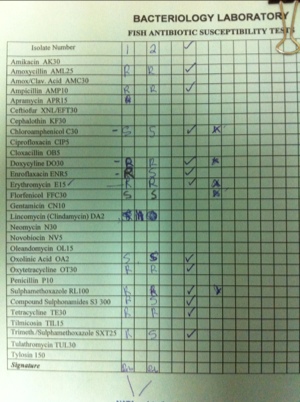
Before we dive right into the answer on which is the best antibiotic to use to treat such fish, have a look at this picture.

In this diagram is a table of the antibiotic sensitivities of a said fish/aquatic bacteria. ‘S’ stands for sensitive and in theory, it should be effective. ‘R’ stands for resistant and in theory, will have negligible effect on the pathogen.

Whenever I choose to test fish with antibiotics, it’s a good idea to run cultures and an antibiotic sensitivity panel to determine:
1. What bacteria you have?
2. Is it a primary pathogen or secondary invader?
3. Which antibiotic would have the greatest effect if necessary?

20121003-074712.jpg

In this picture, you may notice that not all antibiotics will work every time. It’ll depend on the bacteria and on the strain. It may also depend on what you’ve used in the past. Consider evidenced based medicine, rather than a ‘quick fix’ recommended by a friend.

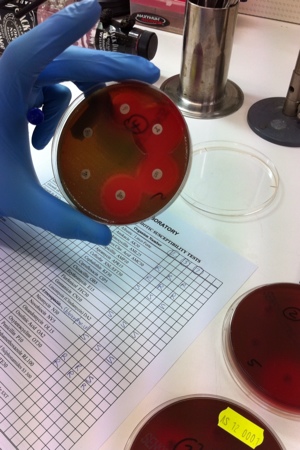
In another picture, the antibiotic sensitivity panel is not looking as bad. The discs are antibiotic impregnated cards and the space seen around them (areas of inhibited bacterial growth) is measured and compared with the standards to check if they are effective.

20121003-095012.jpg