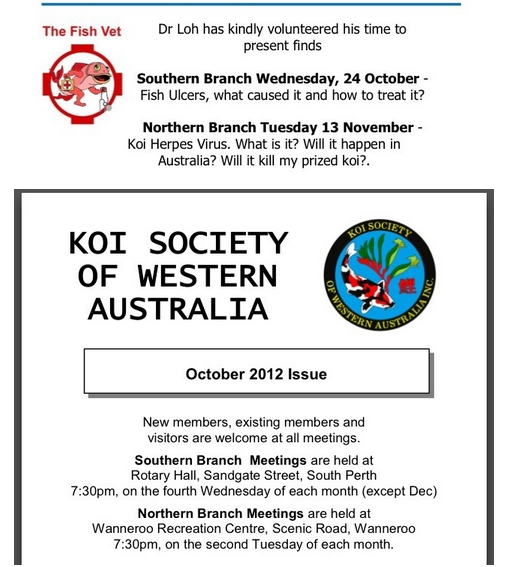
What are the causes if ulcers/red spots in koi fish? How to diagnose the cause of the fish disease? What treatments are available? Do I need antibiotics? The answers to these questions and more will be discussed with plenty of pictures to illustrate and a short video clip will be shown at tonight’s Koi Society of WA’s meeting. We hope to see you there. Details of the venue and time are in the picture below.
Gas project considers commercial fishers.
Fisheries Minister Norman Moore has welcomed negotiations between the State’s peak commercial fishing body and resources company Chevron Australia, to set up a mechanism for compensating commercial fishers potentially affected by the new Wheatstone Project.
For details, please follow the link below to see the media release issued by Minister Moore this morning:
No “fluke” about this diagnosis.
Check out what’s down the scope this time as Dr Richmond Loh, The Fish Vet, coaches a couple of students from Murdoch University on what to look out for and any interesting bits that go with the diagnosis.
Dr Loh offers diagnostic pathology testing of aquatic animals (including histology, cytology, haematology and bacteriology) to fish farmers and for pet owners the like.
;
—
Follow me on: Facebook “Fin Page” – YouTube – Blog – Linkedin – Twitter
—
Yours sincerely,
Dr Richmond Loh
BSc, BVMS, MPhil (Vet Path), MANZCVS (Aquatics), MANZCVS (Pathobiology), DipPM.
Veterinarian | Adjunct Senior Lecturer Murdoch University | WAVMA Communications Committee Member |
Secretary Aquatic Animal Health Chapter – Australian and New Zealand College of Veterinary Scientists (ANZCVS)
The Fish Vet, Perth, Western Australia, AUSTRALIA. Mobile Veterinary Service for fish and other aquatic creatures.
http://www.thefishvet.com.au
Ph: +61 (0)421 822 383
http://www.thefishvet.com.au
Ph: +61 (0)421 822 383
Free lecture on fish welfare.
Free webinar on all you wanted to know about fish welfare can be found on my latest youtube video.
Just follow this link:
Will BHP’s plans to explore for oil just five kilometres from Western Australia’s Ningaloo Reef affect the health of marine life in the region?
See link for the full article:
http://aquatichealth.net/node/62537
—
Yours sincerely,
Dr Richmond Loh
BSc BVMS MPhil MANZCVS (Aq & Pathol)
The Fish Vet, Perth, Western Australia.
Veterinary Medicine for fish.
http://www.thefishvet.com.au
Ph: +61 (0)421 822 383
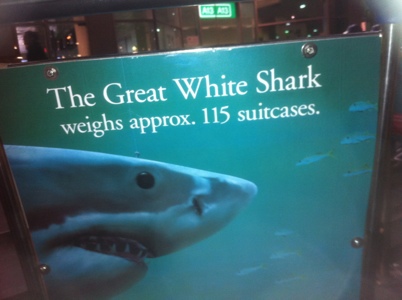
Fish-e Trivia for Monday-itis.
Optimal stocking density of carp in rice paddies is 6000/ha.
| Aquaculture International: Journal of the European Aquaculture Society | |||||||||||||||||
| Volume 20, Number 5 (October 2012) | |||||||||||||||||
 |
Factors affecting fish yield and profit in fish pen culture in flooded ricefields | ||||||||||||||||
| Authors: | Nam Cao Quoc 1, Nico Vromant 2, Duong Le Thanh 1, Frans Ollevier 3 | ||||||||||||||||
| Author Affiliations: |
|
||||||||||||||||
| Source: | Aquaculture International: Journal of the European Aquaculture Society, Volume 20, Number 5 (October 2012) | ||||||||||||||||
| Page Numbers: | 827 – 845 | ||||||||||||||||
| Available Full Text: |
|
||||||||||||||||
| Abstract: |
Abstract
In recent years, a rotational system consisting of two rice crops followed by a fish pen culture during the monsoon flood period was adopted in parts of the flood-prone region of the Mekong Delta. In this paper, we use the survey data from 51 fish pen farmers at Co Do and Vinh Thanh district, Can Tho City, to investigate the factors affecting fish yield and profit in such fish pen culture system. The net yield of all stocked fish varies from 377 to 3,782 kg/ha/crop while the return above variable costs varies from -5.3 to 9.8 million VND/ha/crop. Low fish price at harvest and the difficulty to sell below market sized fish at a period of oversupply are the main problems for fish pen culture. Fish net yield significantly increases with stocking density and is linked with specific polycultures. Common carp and bighead carp perform best in fish pen culture, both in production and profit considerations. Harvest body mass of common carp is mainly limited by increasing common carp stocking density. Therefore, a stocking density of common carp of about 6,000 fish/ha is recommended to obtain the optimum combination of reasonable body masses, and a good price, as well as a high return above fingerling costs.
|
||||||||||||||||
| Citation: | Nam Cao Quoc, Nico Vromant, Duong Le Thanh, Frans Ollevier . Factors affecting fish yield and profit in fish pen culture in flooded ricefields. Aquaculture International: Journal of the European Aquaculture Society, Volume 20, Number 5 (October 2012), pp. 827-845, <http://ejournals.ebsco.com/direct.asp?ArticleID=443AB7B63ED5FB6A814A> | ||||||||||||||||
| URL: | http://ejournals.ebsco.com/direct.asp?ArticleID=443AB7B63ED5FB6A814A | ||||||||||||||||
—
Follow me on: Facebook “Fin Page” – YouTube – Blog – Linkedin – Twitter
—
Yours sincerely,
Dr Richmond Loh
BSc, BVMS, MPhil (Vet Path), MANZCVS (Aquatics), MANZCVS (Pathobiology), DipPM.
Veterinarian | Adjunct Senior Lecturer Murdoch University | WAVMA Communications Committee Member |
Secretary Aquatic Animal Health Chapter – Australian and New Zealand College of Veterinary Scientists (ANZCVS)
The Fish Vet, Perth, Western Australia, AUSTRALIA. Mobile Veterinary Service for fish and other aquatic creatures.
http://www.thefishvet.com.au
Ph: +61 (0)421 822 383
http://www.thefishvet.com.au
Ph: +61 (0)421 822 383
Are We Still Evolving? – immortality.
I watched this show today and one of the scientists said she discovered the secret to anti-ageing when studying Tetrahymena (this, in the fish world, we know as a parasite of fishes). These protozoa are capable of continually dividing/multiplying without limit because they are able to repair and maintain the length of their telomeres (at the ends of their DNA) with telomerase.
Studies have shown that lobsters also have strong telomerase activity, and so, they never age at a cellular level. Theoretically then, they can live for eternity!
In humans, decreasing stress levels can help with extending the telomere length.
Maybe Tetrahymena and lobsters are just cool and calm critters.
How do you make seawater?
Did you know you can make artificial seawater so you can conveniently keep a tropical seawater tank to house your own set of Nemo’s?
Check out a very simple video I’ve uploaded to my YouTube channel –
Amoebic gill disease (AGD), the long-term solution.
Looks like genetic selection is the way to forge ahead as a way to avoid the costly freshwater baths and production losses (reduced appetite, poor feed conversion, poor growth rates, mortalities, etc.). Good one!
| Aquaculture | |||||||||||||||||
| Volume 365, Number 18 (October 2012) | |||||||||||||||||
|
Genetic variation in parasite resistance of Atlantic salmon to amoebic gill disease over multiple infections | ||||||||||||||||
| Authors: | Peter D. Kube, Richard S. Taylor, Nicholas G. Elliott | ||||||||||||||||
| Author Affiliations: |
|
||||||||||||||||
| Source: | Aquaculture, Volume 365, Number 18 (October 2012) | ||||||||||||||||
| Page Numbers: | 165 – 172 | ||||||||||||||||
| Available Full Text: |
|
||||||||||||||||
| Abstract: | Genetic selection is being developed as a management tool for the control of amoebic gill disease (AGD) in Atlantic salmon. AGD is caused by an external gill parasite and is an animal health issue that results in significant economic loss to the Tasmanian salmon industry. This paper presents genetic parameters for AGD resistance, describes patterns of genetic variation over multiple infection cycles, and discusses the development of a selective breeding program to exploit this variation. | ||||||||||||||||
| Citation: | Peter D. Kube, Richard S. Taylor, Nicholas G. Elliott . Genetic variation in parasite resistance of Atlantic salmon to amoebic gill disease over multiple infections. Aquaculture, Volume 365, Number 18 (October 2012), pp. 165-172, <http://ejournals.ebsco.com/direct.asp?ArticleID=400DB0C52F19EFF6B346> | ||||||||||||||||
| URL: | http://ejournals.ebsco.com/direct.asp?ArticleID=400DB0C52F19EFF6B346 | ||||||||||||||||
—
Follow me on: Facebook “Fin Page” – YouTube – Blog – Linkedin – Twitter
—
Yours sincerely,
Dr Richmond Loh
BSc, BVMS, MPhil (Vet Path), MANZCVS (Aquatics), MANZCVS (Pathobiology), DipPM.
Veterinarian | Adjunct Senior Lecturer Murdoch University | WAVMA Communications Committee Member |
Secretary Aquatic Animal Health Chapter – Australian and New Zealand College of Veterinary Scientists (ANZCVS)
The Fish Vet, Perth, Western Australia, AUSTRALIA. Mobile Veterinary Service for fish and other aquatic creatures.
http://www.thefishvet.com.au
Ph: +61 (0)421 822 383
http://www.thefishvet.com.au
Ph: +61 (0)421 822 383