The simplest and cheapest kind of aquaponics.

You don’t need a lot of materials, money, space and time to set up your own aquaponics. If you have a pond, you can start one right away! I consider the floating planters a form of aquaponics and it resembles the commercially used deep water culture (also called raft systems). Start growing your own vegetables or flowery plants to spruce up your pond. Having a planted pond has many advantages and having them in floating baskets will avoid a lot of the pitfalls as is explained in this video.

http://youtu.be/xa3bVvTDVxo

So, I hope that after watching this video, I hope to see everyone with these in their fish ponds.

wild-caught shrimp fed one large meal of artificial diet and immediately frozen make better feed for seahorse broodstock.

Journal of the World Aquaculture Society
  Volume 43, Number 6 (December 2012)
     Growth, Reproductive Performances, and Brood Quality of Long Snout Seahorse, Hippocampus guttulatus, Fed Enriched Shrimp Diets
   Authors: Jorge Palma 1, José P. Andrade 1, Dominique P. Bureau 2
   Author Affiliations:
 1: CCMAR, Universidade do Algarve, FCT, Edificio 7, Campus de Gambelas, Faro 8005-139, Portugal
 2: UG/OMNR Fish Nutrition Research Laboratory, Department of Animal and Poultry Science, University of Guelph, Guelph, Ontario N1G 2W1, Canada
   Source: Journal of the World Aquaculture Society, Volume 43, Number 6 (December 2012)
   Page Numbers: 802 – 813
   Available Full Text:
Full Text: Subscription Required to view full text
Format: PDF
Size: unknown
Location: Publisher’s Site
Authentication: EBSCOhost EJS
   Abstract: This investigation examined the effect of using enriched shrimp (Atlantic ditch shrimp, Palaemonetes varians) diets on growth of long snout seahorse, Hippocampus guttulatus, and its effect on the reproduction rate and brood quality. Three diets were (1) natural wild-caught shrimp (natural shrimp diet-control diet), (2) wild-caught shrimp fed an artificial feed for 10 d (enriched shrimp diet), and (3) wild-caught shrimp fed one large meal of artificial diet and immediately frozen (ingested artificial feed shrimp diet). These diets were fed to seahorses during a 12-wk growth trial. At the end, significant differences on the final wet weight were found between seahorses fed the three different treatments (P< 0.009). Seahorses fed ingested artificial feed shrimp diet had more broods (9), generated more juveniles per brood (299 ± 87), and significantly bigger juveniles (12.4 ± 1 mm) than seahorses fed natural shrimp diet and enriched shrimp diet. Significant differences in the morphometry of juveniles hatched from parents fed the three different dietary treatments (Wilk’s ? = 0.2, F(6,460)= 47.41, P< 0.0001) were also found. Results indicate that the combined use of a natural diet (shrimp) and an artificial diet benefit growth and feed utilization by seahorses and have a direct impact on the reproductive rate and brood quality of H. guttulatus.
   Citation: Jorge Palma, José P. Andrade, Dominique P. Bureau . Growth, Reproductive Performances, and Brood Quality of Long Snout Seahorse, Hippocampus guttulatus, Fed Enriched Shrimp Diets. Journal of the World Aquaculture Society, Volume 43, Number 6 (December 2012), pp. 802-813, <http://ejournals.ebsco.com/direct.asp?ArticleID=482BB169715B46FEB51E&gt;
   URL: http://ejournals.ebsco.com/direct.asp?ArticleID=482BB169715B46FEB51E

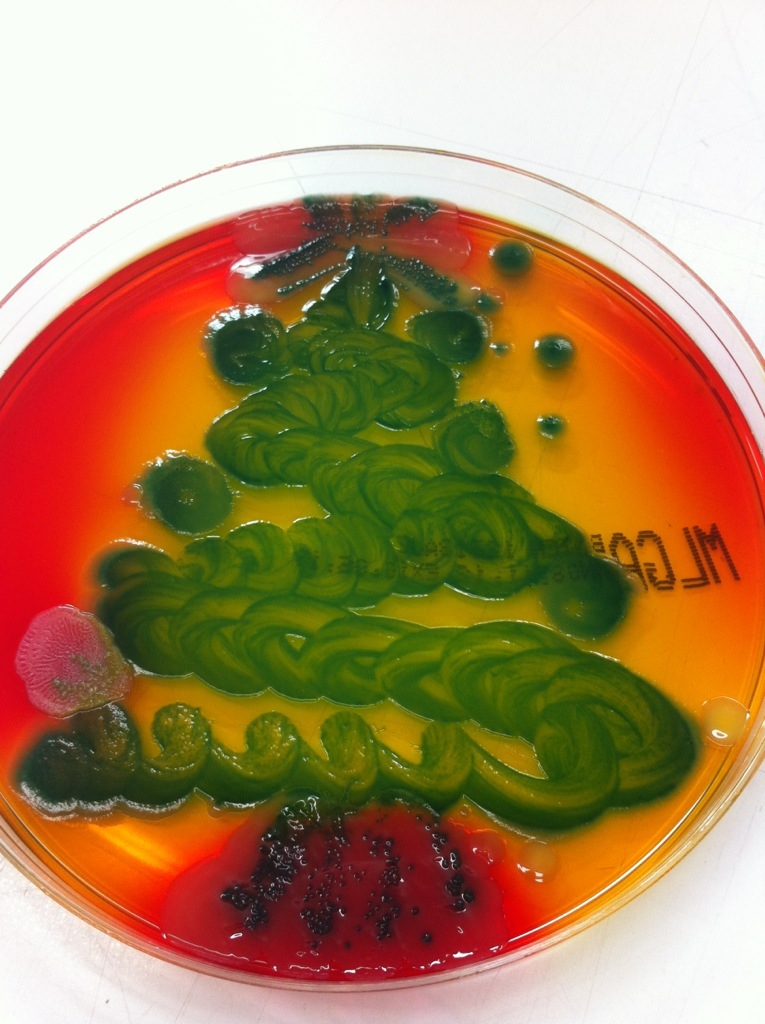
Growing my own Christmas Tree with bacteria.

I saw a fungus tree on FB and so I asked my bacteriologist friend, Sam Hair, if he could make me a bacteria tree.

Pictured is a bacteria tree on chromogenic agar plate. The green foliage is E. coli, the pink baubles are Pseudomonas aeruginosa, and the star and tree trunk are Enterobacter cloacae. But with the E. coli being motile, it has invaded the star, trunk and balls. I’ve uploaded a time lapse video to show you the making of our bacterial Christmas tree – http://youtu.be/s3LH9H_WQRQ.

I’d like to take this opportunity to thank you for following and for sharing, and wish you a very merry Christmas and a happy new year!

Stay tuned for more great stuff.Sign Out

20121224-123257.jpg

Crayfish Harbor Fungus That’s Wiping Out Amphibians

———- Forwarded message ———-
From: Dr. David Scarfe <DScarfe@avma.org>
Date: Wed, Dec 19, 2012 at 2:55 AM
Subject: AquaVetMed: Possible Reservoir for Chytrid Fungus
To: 

December 18, 2012

Crayfish Harbor Fungus That’s Wiping Out Amphibians


National Geographic News – Freshwater crustaceans could be the key to understanding how the chytrid fungus persists in the ecosystem long after the last amphibian is gone. Scientists have found a new culprit in spreading the disease that’s been driving the world’s frogs to the brink of extinction: crayfish.


In the last few decades, the disease caused by the chytrid fungus has been a disaster for frogs and other amphibians. More than 300 species are nearly extinct because of it. Many probably have gone extinct, but it can be difficult to know for sure when a tiny, rare species disappears from the face of the Earth.  “This pathogen is bad news. It’s worse news than any other pathogen in the history of life on Earth as far as we know it,” says Vance Vredenburg, a conservation biologist at San Francisco State University who studies frogs but did not work on the new study.


The chytrid fungus was only discovered in the late 1990s. Since then, scientists have been scrambling to figure out how it spreads and how it works. One of the biggest mysteries is how chytrid can persist in a frogless pond. Researchers saw it happen many times and were perplexed: If all of a pond’s amphibians were wiped out, and a few frogs or salamanders came back and recolonized the pond, they would also die—even though there were no amphibians in the pond to harbor the disease.


One possible reason is that chytrid infects other animals. For a study published today in Proceedings of the National Academy of Sciences, Taegan McMahon, a graduate student in ecology at the University of South Florida in Tampa, looked at some possible suspects and focused on crayfish, those lobster-like crustaceans living in freshwater. They seemed like a good possibility because they’re widespread and because their bodies have a lot of keratin, a protein the fungus attacks. In the lab, McMahon exposed crayfish to the disease and  … … .


See the source (http://tinyurl.com/cbrj8sq) for the full story and much more.


[The article published in PNAS is accessible at http://tinyurl.com/d8nkd9d.  ADS-Mod.]


___________________________

AquaVetMed e-News provides information to veterinary and veterinary-allied subscribers concerning aquatic animal medicine, health, welfare, public health and seafood safety, obtained from a variety of sources (largely AquaVetMed subscribers). While provided by the American Veterinary Medical Association’s, Aquatic Veterinary Medicine Committee and are for public distribution, they do not necessarily reflect the opinion of the AVMA or the veterinary profession. See the AVMA Terms of Use (http://tinyurl.com/29h2rf) for further information.


If e-News information is used elsewhere please acknowledge AquaVetMed as the source.  Encourage individuals to subscribe rather than distribute through list serves.


Messages may contain attachments that will have been scanned for known viruses.


Subscription and Contributions: Interested veterinarians and veterinary-allied professionals can subscribe, unsubscribe, or contribute pertinent news or information,  by sending a message with “For AquaVetMed -” and the topic in the subject line, to dscarfe@avma.org.  


Note: Undelivered e-mails will not be resent; Subscribers will be deleted from the list after repeated undelivered or bounced messages and will have to re-subscribe.


Visit our website: www.avma.org


________________________________


Fish polyculture may increase the maximum standing crop of a pond by utilising a wider range of available food and ecological niches, and hence a higher yield.

Journal of the World Aquaculture Society
  Volume 43, Number 6 (December 2012)
     Comparative Analysis of Different Fish Polyculture Systems
   Authors: Leonardo J. G. Barcellos 1, Rosmari M. Quevedo 1, Luiz Carlos Kreutz 1, Filipe Ritter 1, Adalberto Pandolfo 1, Marcelo Hemkemeier 1, Luciane Colla 1, Leonardo B. Silva 2, Gessi Koakoski 3, João G. S. da Rosa 3
   Author Affiliations:
 1: Universidade de Passo Fundo (UPF), Curso de Medicina Veterinária, Campus I, Bairro São José, Caixa Postal 611, CEP 99001-970, Passo Fundo, RS–Brazil
 2: Universidade Luterana do Brasil (ULBRA), Curso de Medicina Veterinária, Sede Campus Canoas, Av. Farroupilha 8001, CEP 92425-900, Canoas, RS–Brazil
 3: Programa de Pós-Graduação em Farmacologia, Universidade Federal de Santa Maria–UFSM, Santa Maria, RS, Brazil
   Source: Journal of the World Aquaculture Society, Volume 43, Number 6 (December 2012)
   Page Numbers: 778 – 789
   Available Full Text:
Full Text: Subscription Required to view full text
Format: PDF
Size: unknown
Location: Publisher’s Site
Authentication: EBSCOhost EJS
   Abstract: Fish polyculture may increase the maximum standing crop of a pond by utilizing a wider range of available food and ecological niches. To identify a better polyculture system for the fish production practiced in southern South America, a 167-d experiment was conducted in 16 earthen ponds (250 m2). The control group contained a traditional combination of carps: 35% common carp (CC), 35% grass carp, 15% silver carp (SC), and 15% bighead carp (BC). The T25%, T50%, and T75% groups consisted of ponds in which CC was replaced by jundiá (JN), and SC and BC were replaced by Nile tilapia at substitution rates of 25%, 50%, and 75%, respectively. The yields of the T25%, T50%, and T75% groups were higher than those of the control group. The effluents generated in the control and T25% groups had lower total phosphorus levels than those generated in the other groups. Considering that all the substituted groups demonstrated better growth performance than the control group and that the T25% group was also better in terms of effluent quality and economic performance, we concluded that fish polyculture in South America would be optimized using a species ratio tested in T25% groups.
   Citation: Leonardo J. G. Barcellos, Rosmari M. Quevedo, Luiz Carlos Kreutz, Filipe Ritter, Adalberto Pandolfo, Marcelo Hemkemeier, Luciane Colla, Leonardo B. Silva, Gessi Koakoski, João G. S. da Rosa . Comparative Analysis of Different Fish Polyculture Systems. Journal of the World Aquaculture Society, Volume 43, Number 6 (December 2012), pp. 778-789, <http://ejournals.ebsco.com/direct.asp?ArticleID=43FF9F7438B85E8DAEE7&gt;
   URL: http://ejournals.ebsco.com/direct.asp?ArticleID=43FF9F7438B85E8DAEE7

Check out what the Aquatic Animal Health Chapter of the Australian and New Zealand College of Veterinary Scientists have been up to.

See page 6 of the newsletter.

———- Forwarded message ———-

From: ANZCVS
Date: Fri, Dec 21, 2012 at 8:31 AM
Subject: December College Courier
To: thefishvet@gmail.com

From: ANZCVS <ANZCVS_36dd5738-4901-421b-b54e-96ca5bda9ea1@mailsprout.com.au>
Date: Fri, Dec 21, 2012 at 8:31 AM
Subject: December College Courier

December College Courier

Dear DR LOH,

The December College Courier is now available to download – please click here to download your copy now.

==============2012_Dec_Courier_ANZCVS=================

Elaine Lowe
College Manager
Australian and New Zealand College of Veterinary Scientists
Building 3
Garden City Office Park
2404 Logan Road
EIGHT MILE PLAINS QLD 4113
Telephone: 07 3423 2016
Fax: 07 3423 2977
Web http://www.acvsc.org.au