Fantastic coloured pictures of the numerous types of worms.
http://www.chucksaddiction.com/hitchworms.html
2013 FRDC Australasian Scientific Conference on Aquatic Animal Health.
As per preliminary announcement, the 2013 FRDC Australasian Scientific Conference on Aquatic Animal Health will be held in Cairns at The Pullman Reef Hotel, on 9-12 July 2013.
The scientific program will be held over 4 days to accommodate the increasing interest in the conference both domestically and from overseas. There will be a short happy hour at the end of each day to facilitate networking opportunities, and the conference dinner will be held on the last day of the conference.
As announced previously the two international expert presenters at the conference are:
Prof Hugh Ferguson
Head of the Department of Pathobiology, Director of the Marine Medicine programme, Professor of Pathology, School of Veterinary Medicine, St George’s University, Grenada, West Indies.
Prof Don Lightner
Aquaculture Pathology Laboratory, Department of Veterinary Science and Microbiology, University of Arizona, OIE Reference
Laboratory for Crustacean Diseases.
A conference website is being developed for conference registration and abstract submission.
Details will be announced soon.
For more information, please contact
Joanne Slater
FRDC Aquatic Animal Health Subprogram Coordinator
C/o CSIRO Animal, Food and Health Sciences
Australian Animal Health Laboratory
PO Box 24 Geelong VIC 3220
Phone: 03 5227 5427
Fax: 03 5227 5555
Email: joanne.slater@csiro.au
Man steals an aquarium fish to win a fishing tournament.
93% of astronaut’s urine and perspiration is recycled into drinking water.
But in aquaria, 100% of fish wastes would remain in the tank they live in. This is why it’s important to have adequate filtration and water changes.

Aquatic Animal Health Technical workshop – March 20-22nd 2013, Glenelg, South Australia.
The Third FRDC Aquatic Animal Health Technical Forum – Skills training workshop to be held in Glenelg, South Australia on the 20th to 22nd March 2013.
The workshop can accommodate a maximum of 25 participants.
Please register your attendance to Lynette M Williams by Friday 8thFebruary 2013
The funding provided by the FRDC project will subsidise some of the travel/accommodation costs per participant.
For more information, click on the document links below
General Information 2013 Workshop MC rev.docx
Final Report print version.pdf
or please contact
Lynette M Williams
Senior Technical Officer,
Fish Disease Laboratory,
CSIRO, Livestock Industries
PO Bag 24,
GEELONG, Vic, 3220
Voicemail 03 52275442
Lynette.Williams@csiro.au
—
Yours sincerely,
Dr Richmond Loh
BSc BVMS MPhil MANZCVS (Aq & Pathol)
The Fish Vet, Perth, Western Australia.
Veterinary Medicine for fish.
http://www.thefishvet.com.au
Ph: +61 (0)421 822 383
Ever thought of using a sperm bank for fish?
| Aquaculture Research | |||||||||||||||||
| Volume 44, Number 1 (December 2012) | |||||||||||||||||
 |
Dry shipper cryopreservation of seven-band grouper (Epinephelus septemfasciatusThunberg) spermatozoa | ||||||||||||||||
| Authors: | Ivan Chong Chu Koh, Daisuke Tanaka, Takayoshi Itagane, Masaharu Tsuji, Yasushi Tsuchihashi, Hiromi Ohta | ||||||||||||||||
| Author Affiliations: |
|
||||||||||||||||
| Source: | Aquaculture Research, Volume 44, Number 1 (December 2012) | ||||||||||||||||
| Page Numbers: | 59 – 66 | ||||||||||||||||
| Available Full Text: |
|
||||||||||||||||
| Abstract: | This study examined the usage of a dry shipper for cryopreservation of Epinephelus septemfasciatus (Thunberg) spermatozoa. Milt was diluted 1:49 with 5% dimethyl sulfoxide plus 95% foetal bovine serum for cryopreservation. Computer-assisted sperm analysis was used to analyse sperm motility, while fertilization and hatching trials were conducted to gauge the applicability of the cryopreservation method for aquaculture. We showed that cooling rates of the dry shipper were stable for 14 days and could be manipulated by the use of different sized freezing straws and use of a simple polystyrene foam container (5 × 5 × 12 cm and 1 cm thickness on all sides with the upper layer exposed). Dry shipper cryopreserved spermatozoa had significantly lower post-thaw per cent motility and velocity than fresh sperm, but linearity of movement was unchanged. Fertilization and hatching rates were not significantly different at all tested sperm to egg ratios (3000:1–243000:1). The results indicated that 0.33 mL of milt when cryopreserved was sufficient to fertilize up to 450 g of oocytes. Application of this technology will help improve seed production in aquaculture and further develop breeding and genetics studies. | ||||||||||||||||
| Citation: | Ivan Chong Chu Koh, Daisuke Tanaka, Takayoshi Itagane, Masaharu Tsuji, Yasushi Tsuchihashi, Hiromi Ohta . Dry shipper cryopreservation of seven-band grouper (Epinephelus septemfasciatusThunberg) spermatozoa. Aquaculture Research, Volume 44, Number 1 (December 2012), pp. 59-66, <http://ejournals.ebsco.com/direct.asp?ArticleID=4F418BF0CF048CE73FDC> | ||||||||||||||||
| URL: | http://ejournals.ebsco.com/direct.asp?ArticleID=4F418BF0CF048CE73FDC | ||||||||||||||||
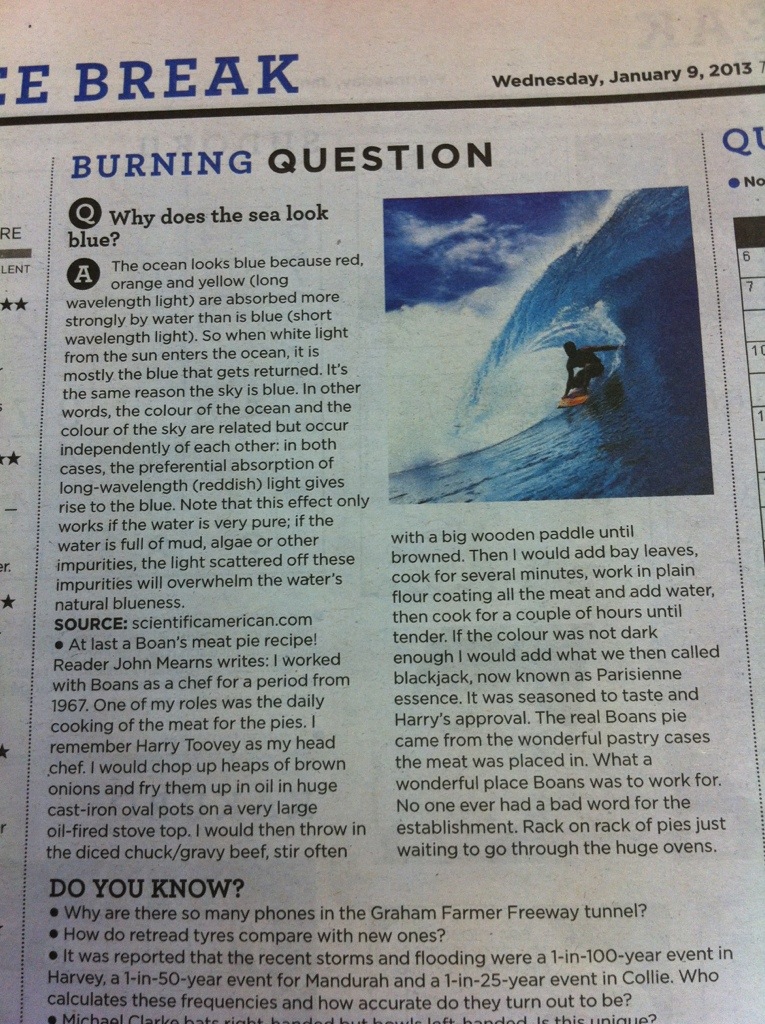
Why is the ocean blue?
From today’s papers.
Fish-killer plants!
Sounds like the underwater version of “Little Shop of Horrors” movie.
Now that I’ve your attention, I’d like to draw your attention to this article. There may come time when it might be necessary to remove fish from water bodies. Examples include the removal of invasive exotic fish species from a lake or pond. Old methods involve pumping out the pond and leaving it to dry. This is a long and expensive process, and in the meantime when the pond is left to dry, other aquatic organisms ranging from invertebrates to macrovertebrates such as birds, etc. will be displaced from their homes.
This is why research in this area of looking for toxins that specifically target fish, while leaving other organisms safe from harm is a necessary evil.
| Journal of Applied Aquaculture | |||||||||||||||||
| Volume 24, Number 4 (December 2012) | |||||||||||||||||
| |
Median Lethal Concentration (LC50) of Piscicidal Plants and Their Utilization in Aquaculture | ||||||||||||||||
| Authors: | S.N. Ramanujam 1, R. Dominic 1 | ||||||||||||||||
| Author Affiliations: |
|
||||||||||||||||
| Source: | Journal of Applied Aquaculture, Volume 24, Number 4 (December 2012) | ||||||||||||||||
| Page Numbers: | 326 – 333 | ||||||||||||||||
| Available Full Text: |
|
||||||||||||||||
| Abstract: | Aqueous and ethanol extracts of Acacia pennata(bark), Catunaregam uliginosa(fruit), Diospyros lenceofolia(fruit), and Sapindus mukorossi(fruit) were evaluated as piscicides on the freshwater fish Danio dangila, Danio rerio, and Puntius shalynius,and the air-breathing Heteropneustes fossilis. Catunaregam uliginosa(fruit) possessed relatively higher piscicidal potency followed by Sapindus mukorossi(fruit), Acacia pennata(bark), and lastly Diospyros lanceofolia(fruit). Catunaregam uliginosacan thus be used for eradicating unwanted wild fishes in a short time span at low concentrations so that the health of aquatic environment is maintained. | ||||||||||||||||
| Citation: | S.N. Ramanujam, R. Dominic . Median Lethal Concentration (LC50) of Piscicidal Plants and Their Utilization in Aquaculture. Journal of Applied Aquaculture, Volume 24, Number 4 (December 2012), pp. 326-333, <http://ejournals.ebsco.com/direct.asp?ArticleID=47FC9128559540E91AAF> | ||||||||||||||||
| URL: | http://ejournals.ebsco.com/direct.asp?ArticleID=47FC9128559540E91AAF | ||||||||||||||||
Trial of a proposed new system for managing the biosecurity risks of Imported ornamental fish (BIOSECURITY ADVICE 2012/23).
This Biosecurity Advice informs stakeholders of a trial of proposed changes to Australia’s system for managing biosecurity risks associated with imported ornamental fish. The proposed changes aim to better manage the biosecurity risks by shifting the emphasis of risk management off-shore. The changes would negate the need for the current system of post-arrival quarantine detention of fish. The proposed changes include an on-arrival fish health surveillance program that would continuously monitor the effectiveness of overseas authorities in ensuring the health of ornamental fish exported to Australia. The department is planning to trial the surveillance system to test its operational feasibility.
Ornamental fish import permit holders willing to participate in the trial are asked to contact Animal Biosecurity.
Under the proposed system;
• all shipments of freshwater and marine ornamental fish would continue to be inspected on arrival,
• bags of fish showing significant mortality or morbidity would be sampled during on-arrival inspection and the remaining fish destroyed or re-exported,
• some bags would be selected randomly during on-arrival inspection for sampling and the remaining fish in the consignment released,
• fish samples would be sent to participating laboratories for a general health assessment and testing for specific disease agents of quarantine concern, and
• the information obtained would be analysed and appropriate action taken to manage any biosecurity disease risk at the source.
Read more here – http://www.daff.gov.au/__data/assets/pdf_file/0004/2222167/BA-2012-23-Finsfish-trial.pdf
Don’t miss other gems of knowledge on TheFishVet’s Facebook ‘FIN’ page.
Why not ‘hook up’ with Dr Loh on his FB fanpage for pictorial updates as well.
See http://www.facebook.com/thefishvetdrloh
Don’t miss out on other gems of knowledge such as this latest post –
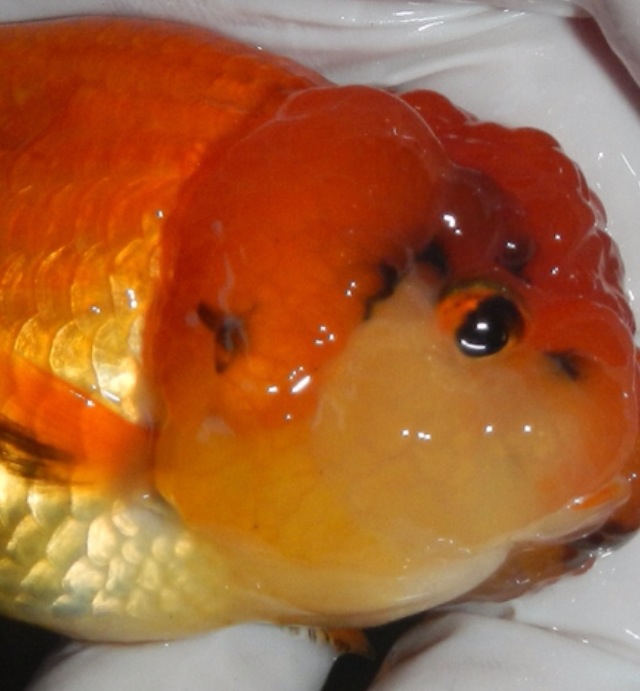
Chronic inflammatory lesions tend to have melanin deposits as is shown here with the multifocal black skin pigmentation. This fish is healing from previous skin ulcers attributed to gyrodactylosis (skin flukes). Note that the epidermal proliferation around the head is normal for this breed (ranchu). It is called a ‘wen’ or ‘hood’. Sometimes the ‘wen’ can grow so much that it’ll grow over the eyes causing obstruction to sight and will need to be surgically trimmed.