Solution for kamikaze tuna.

Tank wall collision is one of the major causes of mortality during the early-stage rearing of Pacific bluefin tuna. This paper details changing the water flow rate as a preventive measure.

I wonder if an air-bag would work… But seriously, have a ring of air around the tank sides.


Aquaculture International: Journal of the European Aquaculture Society
  Volume 21, Number 1 (February 2013)
     Critical swimming speed and maximum sustainable swimming speed of juvenile Pacific bluefin tuna, Thunnus orientalis
   Authors: F. S. Sabate 1, Y. Nakagawa 1, T. Nasu 1, W. Sakamoto 1, S. Miyashita 1
   Author Affiliations:
 1: Fisheries LaboratoryKinki UniversitySakata 1-5Shirahama, Wakayama649-2211Japan
   Source: Aquaculture International: Journal of the European Aquaculture Society, Volume 21, Number 1 (February 2013)
   Page Numbers: 177 – 181
   Available Full Text:
Full Text: Subscription Required to view full text
Format: PDF
Size: unknown
Location: Publisher’s Site
Authentication: EBSCOhost EJS
   Abstract: Tank wall collision is one of the major causes of mortality during the early-stage rearing of Pacific bluefin tuna, Thunnus orientalis(PBT). Therefore, to design a rearing environment that meets the needs of juvenile PBT, it is important to gather information about their swimming capabilities. We conducted experiments to examine the relative critical swimming speed (RCSS) and maximum sustainable swimming speed (MSSS) of early-stage PBT. The fish were kept in 3-tonne tanks and fed on artificial pellets every 2 h from dusk to dawn. We conducted two sets of experiments to measure swimming speed; the fish were introduced one at a time into a water funnel, and the water current velocity was gradually increased over time to estimate RCSS, or the water current was kept at a constant velocity to estimate MSSS. We measured the RCSS of 72 PBT juveniles (24–29 days after hatching (DAH); standard length (SL), 15.0 ± 2.3 mm) and the MSSS of 32 PBT juveniles (28–37 DAH; SL, 20.0 ± 5.1 mm) in the laboratory. The RCSS ranged from 4.7 to 20.3 SL/s (average, 12.4 ± 3.3 SL/s), and the MSSS was estimated to be approximately 4 SL/s. We speculate that introducing a water current in the rearing tank of no more than 4 SL/s could positively affect the survival of juvenile PBT.Tank wall collision is one of the major causes of mortality during the early-stage rearing of Pacific bluefin tuna, Thunnus orientalis(PBT). Therefore, to design a rearing environment that meets the needs of juvenile PBT, it is important to gather information about their swimming capabilities. We conducted experiments to examine the relative critical swimming speed (RCSS) and maximum sustainable swimming speed (MSSS) of early-stage PBT. The fish were kept in 3-tonne tanks and fed on artificial pellets every 2 h from dusk to dawn. We conducted two sets of experiments to measure swimming speed; the fish were introduced one at a time into a water funnel, and the water current velocity was gradually increased over time to estimate RCSS, or the water current was kept at a constant velocity to estimate MSSS. We measured the RCSS of 72 PBT juveniles (24–29 days after hatching (DAH); standard length (SL), 15.0 ± 2.3 mm) and the MSSS of 32 PBT juveniles (28–37 DAH; SL, 20.0 ± 5.1 mm) in the laboratory. The RCSS ranged from 4.7 to 20.3 SL/s (average, 12.4 ± 3.3 SL/s), and the MSSS was estimated to be approximately 4 SL/s. We speculate that introducing a water current in the rearing tank of no more than 4 SL/s could positively affect the survival of juvenile PBT.
   Citation: F. S. Sabate, Y. Nakagawa, T. Nasu, W. Sakamoto, S. Miyashita . Critical swimming speed and maximum sustainable swimming speed of juvenile Pacific bluefin tuna, Thunnus orientalis. Aquaculture International: Journal of the European Aquaculture Society, Volume 21, Number 1 (February 2013), pp. 177-181, <http://ejournals.ebsco.com/direct.asp?ArticleID=45D686120F3F3CD3180A&gt;
   URL: http://ejournals.ebsco.com/direct.asp?ArticleID=45D686120F3F3CD3180A

Where can you get advanced fish vet training?

It’s not been an easy road to acquire specialised knowledge, skills and training as described by a colleague, even in the US. So, they have compiled a list of training providers and their courses on their blog.

Check it out here:

http://avsnca.com/aquatic-veterinary-medicine-resources/comment-page-1/

There will also be a couple of courses being run in Australia this year; in July (https://thefishvet.com/2013/01/11/2013-frdc-australasian-scientific-conference-on-aquatic-animal-health/)
and another in August (https://thefishvet.com/2012/12/28/the-24th-international-conference-of-the-world-association-for-the-advancement-of-veterinary-parasitology-will-be-in-perth-australia/).

Also, join WAVMA to network with other fish vets.

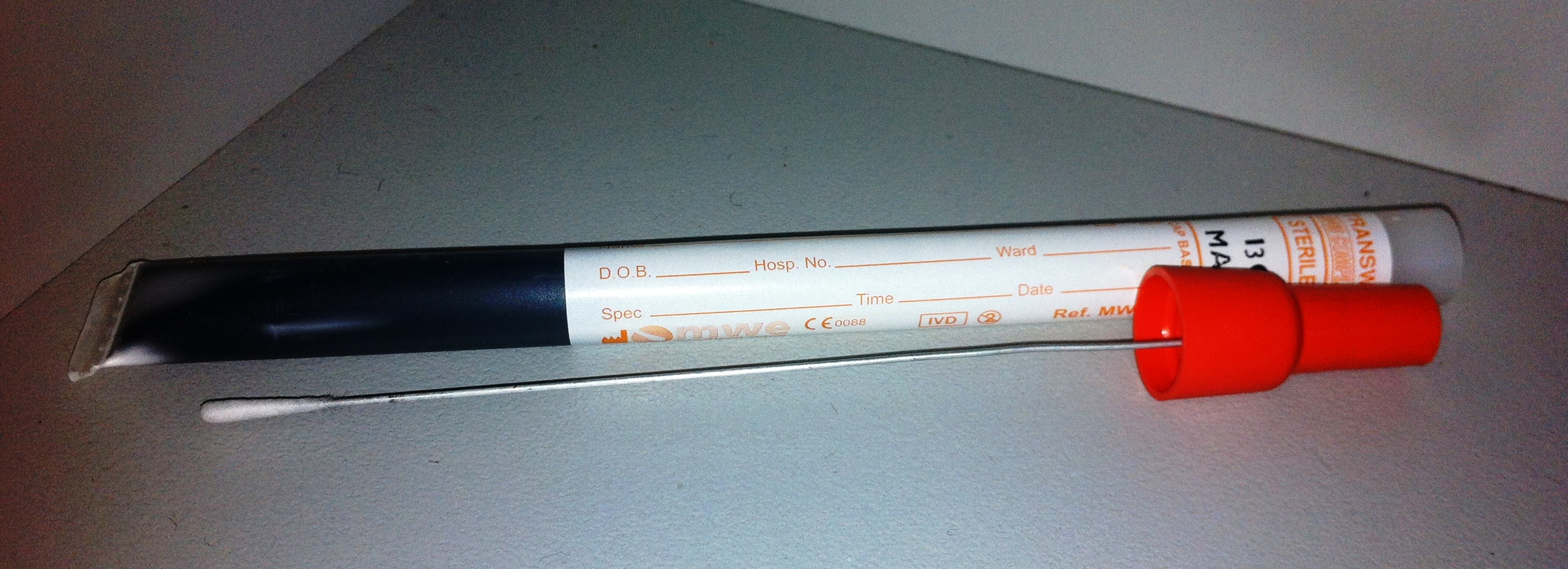
Bacterial transport swabs for small fish.

Why culture for bacteria? The answer can be found in a previous post (
https://thefishvet.com/2012/10/13/whats-the-best-antibiotic-to-treat-sick-fish-with/).

But do you ever have trouble trying to take an aseptic sample from the kidney of a tiny fish and find that the giant cotton wool swab ends up swabbing everything, but the kidney?

Ensuring that you take a targeted sample will ensure that whatever the bacteriology laboratory isolates, itis likely to be significant, rather than mere environmental contaminant.

Also, my fish bacteriologist colleague says that aquatic bacteria survive better in Amies transport media that contains charcoal.

This swab pictured is the ideal design for fish vetting and it’s what I carry in my kit at all times.

Amies Bacterial Transport Swab

These bacterial transport swabs with small tips are perfect for aseptically sampling from small fish organs. The charcoal media guarantees longevity of the bugs so they can reach the lab alive.


Enquire with TheFishVet regarding supply of these Transwabs for your veterinary clinic or laboratory.


Yours sincerely,

Dr Richmond Loh
BSc BVMS MPhil MANZCVS (Aq & Pathol)
The Fish Vet, Perth, Western Australia.
Veterinary Medicine for fish.
W: http://www.thefishvet.com.au
E: thefishvet
P: +61 (0)421 822 383

National veterinary registration is now recognised in Victoria and Tasmania.

Veterinary surgeons (including specialists) who currently hold primary registration and reside permanently in another Australian State or Territory are entitled to practise as a veterinary surgeon in Tasmania (since 16 Dec 2012) and Victoria (since 1 Jan 2011), on a part-time/casual/locum basis without having to register with the Veterinary Board in the respective states.
Each state and territory in Australia has separate legislation covering veterinary practise which is regulated under the relevant state or territory Veterinary Registration Board (VSB).

Why is there a move towards national registration? The answers are sourced from http://www.daff.gov.au/animal-plant-health/animal/system/vets

Separate regulatory systems in each state and territory hinder the mobility of veterinarians within Australia, hinder interstate competitiveness, and inconvenience clients with interstate or national interests as well as those requiring particular veterinary expertise only available outside their own state or territory.

There is now ready movement of Australians and animals from state to state. Public policy has embraced the concepts of open markets, competition policy and mutual recognition by state and territory systems of qualifications and operations by other states and territories.

National recognition of veterinary registration has assumed increasing importance in the last decade with the growing need to remove obstacles to the delivery of cross-border veterinary services. In addition, one of the objectives of National Competition Policy is to allow greater competition within the veterinary services market. As production animal enterprises consolidate or specialise and performance animals travel to compete nationally, reforms which enable the integrated delivery of veterinary services on an Australia wide basis are vital to the profession meeting existing and future market demand for veterinary services.

Current arrangements no longer provide the most appropriate and efficient mechanism for regulation of modern veterinary practice, and do not accommodate ongoing technological advances and changes within the profession.

What does this mean for you? Well, this means that difficult to find expertise such as fish veterinarians can now be more readily accessible. Under the current regulations, Dr Loh’s services are not just available in WA, but also in Victoria and Tasmania. So, if you’d like to fly Dr Loh across the continent, it’s very possible.

How much blood do you need for lab testing?

I had a flurry of questions about the blood testing. The most common one was, what is the minimum amount of blood we need in order to run a full biochemistry panel?

The minimum amount of blood we need is 0.5mL. Blood collection tubes come in all sizes and I’ve included a picture of the common sizes used (from left to right, 10mL, 5mL, 2mL and 1mL). The amount of anticoagulant to blood ratio shouldn’t be too much of a problem if running a biochemistry panel. It is only an issue if you’re wanting haematology since excess anticoagulant can rupture your cells, and too little will lead to a clotted blood sample. Of course there are a heap of other complications, but I’d best leave that to a specialist clinical pathologist to answer.

20130130-123005.jpg

How to collect blood from the tail vein of a fish.

Collecting fish blood for testing can generate information on the health of the animals including states of inflammation (e.g. bacterial infection), viral infection, their immunocompetence and more.

Collecting blood from a fish can be likened to collecting it from the tail vein of cattle. I’ve uploaded a video (http://youtu.be/MPoqU6721_Q) demonstrating with an anaesthetised koi fish. In dorsolaterally compressed fishes, and if the needle is not of sufficient length, the needle may be inserted diagonally. Landmarks: midline, spinal column & level with the lateral line.

For reasons why we collect blood in fishes, check out more information on my blog – https://thefishvet.com/?s=haematologyImage

Sex video of deep-sea squid.

http://smithsonianscience.org/2013/01/first-detailed-sex-video-of-deep-sea-squid-penetrates-long-standing-mysteries-as-to-how-these-animals-mate/

Shrimp Pathology Short Course will be conducted from June 3-14th, 2013.

This course is taught byDr. Donald Lightner and his colleagues from the Aquaculture Pathology Laboratory at the University of Arizona.  This intensive course consists of comprehensive lectures and practical laboratory training that is focused on current methods used to diagnose, prevent, and treat the principal diseases of cultured penaeid shrimp. This program also provides an excellent opportunity for participants to meet and interact with others involved in shrimp disease research and management.

More information available at
http://microvet.arizona.edu/research/aquapath/index.htm

For additional information regarding the course, please contact:Donald V. Lightner, Professor, or Rita Redman – Short Course coordinator
Department of Veterinary Science and Microbiology
The University of Arizona, Building 90, Room 102
1117 E. Lowell St.
Tucson, Arizona 85721, USA.
FAX: (520) 621-4899
Tel:  (520) 621-4438
E-mail: dvl@email.arizona.eduritar@email.arizona.edu


This information brought to my attention from WAVMA’s email list-serve.