Australian freshwater turtles as a potential aquaculture species.

SEQ Fish has just completed an RIRDC funded project to assess the viability of a new industry in Australia based on breeding and growing Australian native freshwater turtle for human consumption. The results suggest that Emydura macquarii (signata), the Brisbane River Short Necked turtle, is the most likely candidate for aquaculture systems due to its fecundity, growth rate and hardiness.

Learn more about the project in the newsletter excerpt by clicking on the link below:

Turtle AqCx

Hundreds of different pharmaceuticals are able to slip past conventional wastewater treatment plants and into our waterways; exerting ecological effects.

The original catchy title was “Drugged Fish Lose Their Inhibitions, Get the Munchies” by Emily Underwood.

After swimming in water laced with a common antianxiety medication, the red-finned fish lose their inhibitions and gobble up prey at a much faster rate, according to a new study presented here today at the annual meeting of the American Association for the Advancement of Science (publisher of ScienceNOW). The animals act strangely even after being exposed to low concentrations of the medication found in rivers worldwide, suggesting that the drug and others like it could affect fish behavior and ecology even in small doses.


Read more at this link.

Shared by Nicole Spooner, AquaVet Classmate.

Fish joke for Monday-itis: Smarts.

Shared by Toni Erkinharju via Facebook

RECIPE FOR HOW TO GET REALLY SMART

A customer at Stingray Fishmongers marveled at the owner’s quick wit and intelligence.

‘Tell me, Simon, what makes you so smart?’

‘I wouldn’t share my secret with just anyone, ‘Simon replies, lowering his voice so the other shoppers won’t hear.’ But since you’re a good and faithful customer, I’ll let you in on it. Fish heads. You eat enough of them, you’ll be positively brilliant.’

‘You sell them here?’ the customer asks.

‘Only $4 apiece’, says Simon.

The customer buys three. A week later, he’s back in the store complaining that the fish heads were disgusting and he isn’t any smarter.

‘You didn’t eat enough, ‘says Simon. The customer goes home with 20 more fish heads. Two weeks later, he’s back and this time he’s really angry.

‘Hey, Simon, ‘he complains, ‘you’re selling me fish heads for $4 a piece when I can buy the whole fish for $2. you’re ripping me off!’

‘You see?’ says Simon, ‘you’re smarter already.’

A great natural way to help combat external parasites using mussels.

I always thought that this could be a good idea and someone’s actually done the ground work to find evidence that it works!

(I’ve been finding that this has been a recurring theme with all my inventions too!).

I wonder if it can work with other parasites such as flukes, Cryptocaryon and others.

Great work to the primary investigators and the team behind them!

Journal of Fish Diseases
  Volume 36, Number 3 (March 2013)
     Filtration of sea louse, Lepeophtheirus salmonis, copepodids by the blue mussel, Mytilus edulis, and the Atlantic sea scallop, Placopecten magellanicus, under different flow, light and copepodid-density regimes
   Authors: A Bartsch, S M C Robinson, M Liutkus, K P Ang, J Webb, C M Pearce
   Author Affiliations:
no affiliations available
   Source: Journal of Fish Diseases, Volume 36, Number 3 (March 2013)
   Page Numbers: 361 – 370
   Available Full Text:
Full Text: Subscription Required to view full text
Format: PDF
Size: unknown
Location: Publisher’s Site
Authentication: EBSCOhost EJS
   Abstract: Population management of Lepeophtheirus salmonisin Canada currently relies on chemotherapeutants to remove attached stages of the ectoparasite. However, some populations of L. salmonisare developing resistance to chemotherapeutants making alternate management measures necessary. This article explores the ability of filter-feeding shellfish [i.e. blue mussels (Mytilus edulis) and Atlantic sea scallops (Placopecten magellanicus)] to consume the copepodid stages of L. salmonisin the laboratory under static and flowing water conditions, with variable copepodid densities, and with the aid of a light attractant. Mytilus edulisconsumed copepodids under both static and flowing water conditions, and the proportion of individuals ingested was similar at low and high copepodid densities, suggesting that M. eduliswas not saturated at the concentrations tested. Also, M. edulisconsumed more copepodids when a light attractant was present, suggesting that lights may be useful to concentrate widely dispersed copepodids around cultured shellfish in the field. Finally, P. magellanicusconsumed the same number of copepodids as an equivalent total wet weight of M. edulis. During each of the four separate experiments, shellfish consumed between 18 and 38% of the copepodids presented perhour, suggesting that both species are well suited for low level removal of copepodids over time.
   Citation: A Bartsch, S M C Robinson, M Liutkus, K P Ang, J Webb, C M Pearce . Filtration of sea louse, Lepeophtheirus salmonis, copepodids by the blue mussel, Mytilus edulis, and the Atlantic sea scallop, Placopecten magellanicus, under different flow, light and copepodid-density regimes. Journal of Fish Diseases, Volume 36, Number 3 (March 2013), pp. 361-370, <http://ejournals.ebsco.com/direct.asp?ArticleID=42ABA5C9A1273865C962&gt;
   URL: http://ejournals.ebsco.com/direct.asp?ArticleID=42ABA5C9A1273865C962

The Nitrogen Cycle and Biofiltration for the Practicing Veterinarian.

FYI.

———- Forwarded message ———-
From: Dr. David Scarfe <DScarfe@avma.org>

B-1001: The Nitrogen Cycle and Biofiltration for the Practicing Veterinarian

Brought to you by WAVMA & The Aquarium Vet


Join us for a Webinar on Wednesday, March 13, 2013 (8:00 pm / 20:00 GMT/UTC)

(be sure to check www.timeanddate.com/worldclock/converter.html for your local time)

1.5 hours of WAVMA veterinary Continuing Education & Professional Development credit


Presenter: Rob Jones BVSc(Hons), MACVSc(Aq), MAqua – The Aquarium Vet

Learning Objectives: In this webinar we will discusses the clinical signs and pathophysiology of one of the most common causes for the death of fish – ammonia toxicity and to a lesser extent nitrite toxicity. Understanding the nitrogen cycle is essential for any type of fish keeping.

We will look at biofilters and the steps in the conversion of ammonia to nitrite and then to nitrate, as well as the toxicity of the various stages in the cycle. Biofiltration is one of the most critical components of any closed system. What is a biofilter and how to establish and successfully maintain one will be discussed, along with conditions that may affect or destroy biofilters. An examination of the process of denitrification will complete the webinar.

REGISTRATION

B-1001: The Nitrogen Cycle and Biofiltration for the Practicing Veterinarian


WAVMA Members – AU$ 15.00

WAVMA Non-Members – AU$ 25.00

All Students – AU$ 5.00


WAVMA Membership – www.wavma.org/Become-a-member

To register – click  (or http://www.theaquariumvet.com.au/pages/view/online_course)

     Be sure to scroll down and select the correct webinar


After making the payment you will receive an e-mail with instructions on how to join the live webinar.


PLEASE NOTE: Registrants unable to attend the live webinar will be provided access to a recording on the WAVMA WebCEPD website. Instructions for obtaining veterinary CEPD credit will be available after participating in the live or recorded webinar.

System Requirements
PC-based attendees
Required: Windows® 7, Vista, XP or 2003 Server

Mac®-based attendees
Required: Mac OS® X 10.6 or newer

Mobile attendees
Required: iPhone®, iPad®, Android™ phone or Android tablet


Follow me on: Facebook “Fin Page” – YouTube  – Blog – Linkedin – Twitter


Yours sincerely,

Dr Richmond Loh
BSc, BVMS, MPhil (Vet Path), MANZCVS (Aquatics), MANZCVS (Pathobiology), DipPM.
Veterinarian | Adjunct Senior Lecturer Murdoch University | WAVMA President-Elect |
Secretary Aquatic Animal Health Chapter – Australian and New Zealand College of Veterinary Scientists (ANZCVS)
The Fish Vet, Perth, Western Australia, AUSTRALIA.

Mobile Veterinary Medical & Diagnostic Services for fish and other aquatic creatures.
http://www.thefishvet.com.au
Ph: +61 (0)421 822 383

Marine Vibrios, environmental cues regulate their growth and distribution.

This article was sourced from http://oceanacidification.wordpress.com/2013/02/12/ecological-aspects-of-marine-vibrio-bacteria-exploring-relationships-to-other-organisms-and-a-changing-environment/

Ecological aspects of marine Vibrio bacteria – exploring relationships to other organisms and a changing environment
Posted by Lina Hansson

Heterotrophic bacteria of the genus Vibrio are indigenous in the marine environment although environmental cues regulate their growth and distribution. The attention brought to this genus is due to its many species/strains that are pathogenic to humans and other organisms. Vibrio abundances are strongly coupled to water temperature and salinity but abundance dynamics occur even where these hydrographical parameters are stable. In this thesis, I have studied Vibrio dynamics in relation to other organisms such as phytoplankton (papers I, II and III) and a bivalve host-organism (paper IV) in a changing environment where increasing temperature (paper III) and ocean acidification (paper IV) may influence survival and proliferation of these bacteria. In particular paper I showed that in a tropical coastal area, where the water temperature and salinity were stable across seasons, abundances of Vibrio were tightly coupled to phytoplankton biomass and community composition. A diatom bloom during December seemed to support high numbers of vibrios in waters with otherwise low levels of dissolved organic carbon. Paper II further supports that some phytoplankton can favor Vibrio growth while others seem to have a negative influence on Vibrio abundances. For instance, Skeletonema tropicum, a common diatom in Indian coastal waters, easily eradicated Vibrio parahaemolyticus from sea water in our experiments. In temperate marine areas culturable Vibrio predominantly occurs in the water column during the warmer months. Sediments are suggested to be potential reservoirs when conditions in the water-column are harsh. Accordingly, in paper III we showed that cold-water sediments from geographically separate areas in a boreal region of Scandinavia all contained relative high abundances of total Vibrio spp. and that all sediments also included culturable Vibrio. In agreement with paper I, the fresh input of organic material from phytoplankton blooms, for which chlorophyll a was used as a proxy, seemed to positively influence Vibrio abundances also in the sediments (paper III). Therefore, the pelagic-benthic coupling which can supply the sediments with biomass from the primary production could influence the abundance of Vibrio spp. Increasing temperature had variable influence on sediment-associated Vibrio abundance, with a significant increase in abundances in sediments originating from one area when the temperature reached over 21°C and a generally negative influence of increasing temperature on abundances in sediments originating from another area (paper III). This suggests that the sediments contained different Vibrio communities with varying temperature tolerance traits. Rising levels of carbon dioxide in the atmosphere does not only lead to higher water temperature through the green house effect, but also to acidification of the oceans. Paper IV illustrated how a common bivalve pathogen, Vibrio tubiashii, can be favored in the interaction with a calcifying bivalve host, Mytilus edulis, when this host-pathogen combination was exposed to levels of ocean acidification projected to occur by the end of the 21st century. Thus, global environmental changes may enhance the probability of Vibrio infections in higher organisms.

Asplund M. E., 2013. Ecological aspects of marine Vibrio bacteria – Exploring relationships to other organisms and a changing environment. PhD thesis, University of Gothenburg. Thesis.

New Wastewater Treatment Removes Drug Residues.

There are many drugs and chemicals that enter our waterways that can exert effects on aquatic life even at levels beyond detectable limits by even the most sophisticated of equipment. Immunosuppression, behavioural changes and endocrine disruption are some effects in aquatic animal life that have been reported in the literature due to residues from agrichemicals and human medications. Even algal growth can be affected! There is still a lot of controversy around these findings due to the complexity of the pathogenesis, however, the is evidence out there. There’s no denying this in Sweden, already work is underway to curb such effects by way of advanced techniques for wastewater treatment.

Read more below…

———- Forwarded message ———-
From: Dr. David Scarfe <DScarfe@avma.org>
Date: Mon, Mar 4, 2013 at 12:52 AM
Subject: AquaVetMed e-News: New Wastewater Treatment Removes Drug Residues
To:

March 2, 2013

New Wastewater Treatment Technique Protects Fish from Antidepressants

Sweden – Researchers at KTH Royal Institute of Technology in Stockholm have developed a new technique to prevent pharmaceutical residues from entering waterways and harming wildlife. The new water treatment technology – called membrane distillation – separates drug residues from sewage with the help of district heating, says Andrew Martin, a professor at KTH’s Institute of Energy Technology who worked on the development project with IVL and Scarab Development AB.

Martin says that water vapor passes through a thin, hydrophobic membrane of material similar to Goretex, and through an air gap, where it condensed onto a cold surface. Drug residues collect on one side of the membrane and pure water on the other. “There is currently no technology capable of doing this cleaning process on a large scale,” Martin says. “And for the membrane distillation process to work, the water temperature does not need to be very high, which is good.”

Pharmaceutical residues in wastewater have been found to alter fish behavior and could even affect the growth of algae. A recent study at Sweden’s Umeå University shows even low levels of Oxazepam detected in the Fyris River, in central Sweden, caused perch to become more antisocial, risk prone and active, making them an easier target for predators such as pike. The study measured levels of Oxazepam found in the perch, which were six times higher than in the water itself.

The study also indicated that the release of anti-anxiety drugs can affect entire ecosystems in a waterway, possibly contributing to an increases or decreases in the incidence of algae. In a test of the membrane distillation technique at Hammarby Sjöstadsverket in Sweden, researchers found a level of 282 nanograms of Oxazepam per litre of wastewater. After ordinary treatment, that level of pharmaceuticals would essentially remain unchanged when the water is returned to the local waterway. But when treated with the membrane distillation system, the concentration was reduced to less than two nanograms per litre.

“Of all the 20th century-tested drugs, it is only … … .

See the source (http://tinyurl.com/agvht7p) for the full story.

___________________________

AquaVetMed e-News provides information to veterinary and veterinary-allied subscribers concerning aquatic animal medicine, health, welfare, public health and seafood safety, obtained from a variety of sources (largely AquaVetMed subscribers). While provided by the American Veterinary Medical Association’s, Aquatic Veterinary Medicine Committee and are for public distribution, they do not necessarily reflect the opinion of the AVMA or the veterinary profession. See the AVMA Terms of Use (http://tinyurl.com/29h2rf) for further information.

If e-News information is used elsewhere please acknowledge AquaVetMed as the source. Encourage individuals to subscribe rather than distribute through list serves.

Messages may contain attachments that will have been scanned for known viruses.

Subscription and Contributions: Interested veterinarians and veterinary-allied professionals can subscribe, unsubscribe, or contribute pertinent news or information, by sending a message with “For AquaVetMed -” and the topic in the subject line, to dscarfe@avma.org.

Note: Undelivered e-mails will not be resent; Subscribers will be deleted from the list after repeated undelivered or bounced messages and will have to re-subscribe.

Visit our website: www.avma.org

________________________________


Follow me on: Facebook “Fin Page”YouTubeBlogLinkedinTwitter


Yours sincerely,

Dr Richmond Loh
BSc, BVMS, MPhil (Vet Path), MANZCVS (Aquatics), MANZCVS (Pathobiology), DipPM.
Veterinarian | Adjunct Senior Lecturer Murdoch University | WAVMA President-Elect |
Secretary Aquatic Animal Health Chapter – Australian and New Zealand College of Veterinary Scientists (ANZCVS)
The Fish Vet, Perth, Western Australia, AUSTRALIA.

Mobile Veterinary Medical & Diagnostic Services for fish and other aquatic creatures.
http://www.thefishvet.com.au
Ph: +61 (0)421 822 383Looking for more books? Check out this site.

Dangers of (mis)use of prophylactic antibiotics by hobbyists.

Shared by my friend, Dr Rob Ossiboff:

“Here is an interesting story on antibiotic resistant bacteria in aquarium fish; one of the major suspected drivers is the (mis)use of prophylactic antibiotics by hobbyists. I was amazed at how many types of antibiotics can be acquired over the counter by hobbyists. One of your jobs as aquatic vets will be to educate about the dangers of such use.”

http://www.smartplanet.com/blog/report/fancy-fish-could-harbor-dangerous-bacteria/1226

Help celebrate Dr Loh’s 1000th blog post! You are invited to a Free Webinar on ‘How to become a fish vet?’.

With this blog, it marks my 1,000th post! To celebrate, Dr Loh, The Fish Vet, has joined with The Webinar Vet to create a free Webinar event. I’d like to invite you to learn a bit about how I came to become The Fish Vet and how others may follow. I hope to be able to ‘virtually’ meet you.

For more information, see below:

“How to get your ‘flipper’ in, to become a fish vet.”
Join us for a Webinar on April 4
Space is limited.
Reserve your Webinar seat now at:
http://webinarvet.com.au/upcoming-webinars/#how-to-get-your-flipper-in-to-become-a-fish-vet
The field of veterinary medicine is diverse, furthermore, the field of aquatic veterinary medicine is just as diverse. If you are a veterinarian who would like to expand your clientele to include more than just the traditional species, then this webinar is for you. But how do you get in to fish medicine? This presentation will provide you with my roadmap on how you can be a fish vet. It will detail the skills, knowledge and equipment you need; and then utilising avenues such as the local veterinary clinic, ornamental fish retailers, hobby groups and social media too. This would ensure that the public has access to veterinarians for their fish, satisfying the needs of both the veterinarians and their clients.What you’ll learn:1. Realise that veterinarians are well-equipped practice fish medicine.
2. Learn practical tips for practicing veterinary fish medicine.
3. Learn about different networking opportunities to get into the market.

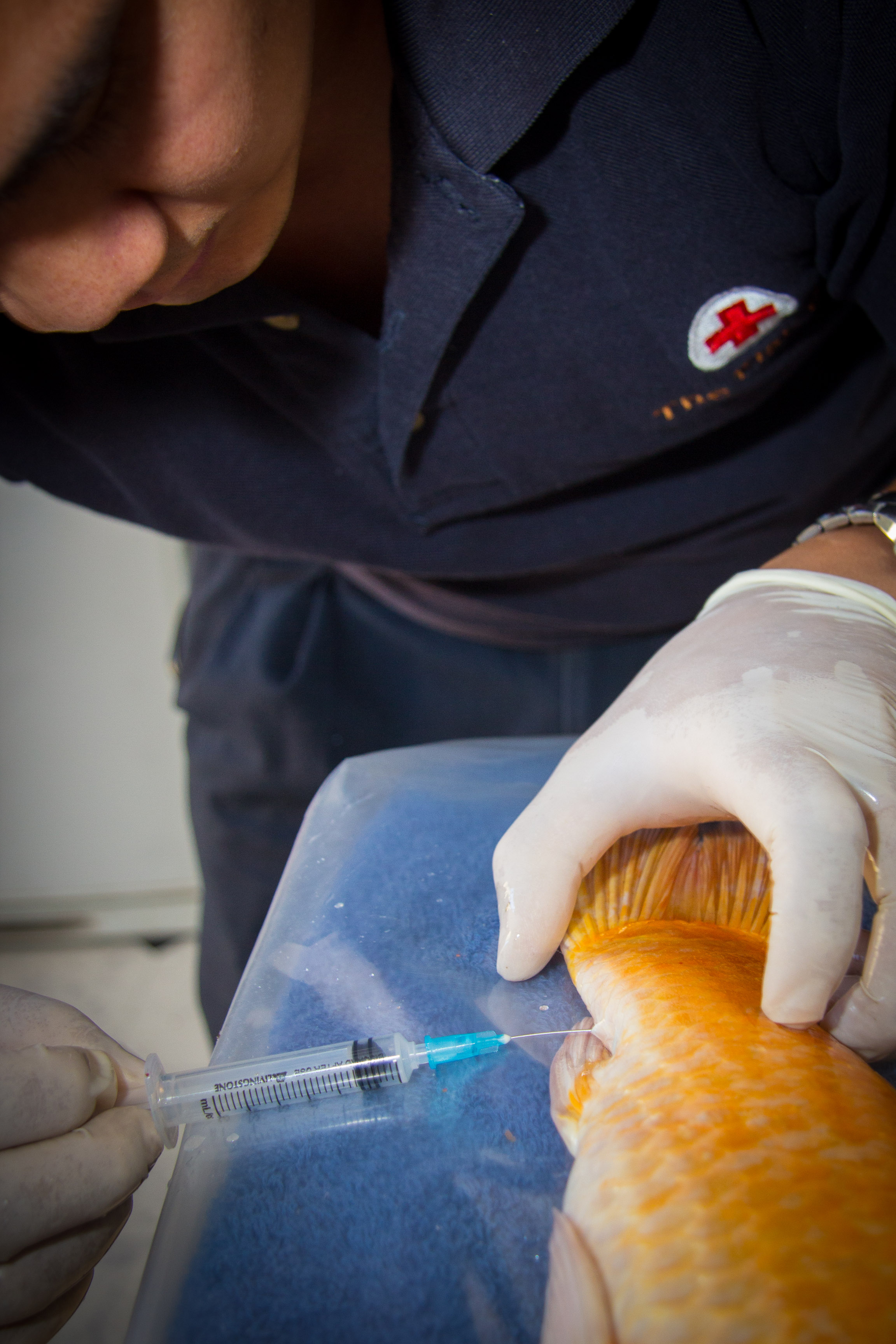
The Fish Vet takes a blood sample from a koi.

Title: “How to get your ‘flipper’ in, to become a fish vet.”
Date: Thursday, April 4, 2013
Time: 7:30 PM – 8:30 PM AEDT (Australian Eastern Daylight Saving’s time)

Time: 4:30 PM – 5:30 PM WST (Australian Western Standard time)

After registering you will receive a confirmation email containing information about joining the Webinar.NB: when you click on the link that says “purchase” you will find that there is no charge.
System Requirements
PC-based attendees
Required: Windows® 7, Vista, XP or 2003 Server
Mac®-based attendees
Required: Mac OS® X 10.6 or newer
Mobile attendees
Required: iPhone®, iPad®, Android™ phone or Android tablet

(be sure to check www.timeanddate.com/worldclock/converter.html for your local time)


DON’T MISS OUT AND REGISTER NOW!

Follow me on: Facebook “Fin Page”YouTubeBlogLinkedinTwitter


Yours sincerely,

Dr Richmond Loh
BSc, BVMS, MPhil (Vet Path), MANZCVS (Aquatics), MANZCVS (Pathobiology), DipPM.
Veterinarian | Adjunct Senior Lecturer Murdoch University | WAVMA President-Elect |
Secretary Aquatic Animal Health Chapter – Australian and New Zealand College of Veterinary Scientists (ANZCVS)
The Fish Vet, Perth, Western Australia, AUSTRALIA.

Mobile Veterinary Medical & Diagnostic Services for fish and other aquatic creatures.
http://www.thefishvet.com.au
Ph: +61 (0)421 822 383Looking for more books? Check out this site.