Dear SeaVet & AquaVet buddies, consider joining the World Aquatic Veterinary Medical Association.

Dear SeaVet & AquaVet buddies,
Going through post-graduate courses like you’ve been undertaking, you may have gathered that there is still a lot of unknowns, but at the same time, there are a lot of things that are known that have yet to be published.

Going forward, those who work in this newish field of aquatic veterinary medicine may be interested in being in the know; and may wish to create a wider network with other veterinarians and students with similar interests globally.

Some of the strengths of the World Aquatic Veterinary Medical Association (WAVMA) include the active mailing list where no question is too simple, and no question is too complex. You’ll be pleasantly surprised with all the practical advice given by members through their responses. You’ll have access to the "hall of fame" or the "gurus" of fish health. You’ll also receive quarterly publications right to your email inbox with important news, events and information. For examples of some of the publications, follow this link – http://www.wavma.org/Publications

Those of you who are about the graduate over the next few days/weeks, might even be lucky enough to sneak in and join at the student rates!

Don’t delay any longer and join now by following this link – http://www.wavma.org/Become-a-member

Follow me on: Facebook "Fin Page"YouTubeBlogLinkedinTwitter


Yours sincerely,

Dr Richmond Loh DipProjMgt, BSc, BVMS, MPhil (Pathology) Murdoch, MANZCVS (Aquatics & Pathobiology).
Veterinarian | Adjunct Lecturer Murdoch University | President-elect WAVMA |
Secretary Aquatic Animal Health Chapter – ANZCVS.
The Fish Vet, Perth, Western Australia, AUSTRALIA. Mobile Veterinary Medical & Diagnostic Services for fish and other aquatic creatures.
http://www.thefishvet.com.au
Ph: +61 (0)421 822 383
Free Webinar on “Infectious Diseases of Barramundi and Health Management”. Presented by Dr Kate Hutson.

Not to be missed, these are an excellent way to learn about fish diseases from exactly where you are!

———- Forwarded message ———-
From: <Joanne.Slater@csiro.au>
Date: Fri, Jun 7, 2013 at 7:13 AM
Subject: Neptune webinar invitation
To: Joanne.Slater@csiro.au

Dear subscribers,


I am pleased to invite you to attend an online presentation on barramundi health. Dr Kate Hutson will provide an overview of “Infectious Diseases of Barramundi and Health Management”.


The presentation is on Wednesday the 19th of June at 2pm Sydney, Australia time (for your local time, see this link).


The presentation will be held using Adobe Connect. To attend the presentation click on the link below. If you have not attended an ABIN Web Conference previously, please run the test connection link a day prior to the presentation. Audio for the presentation will be via a toll-free teleconference line, also listed below. Simply dial the number, and enter the participant passcode when prompted.

If you do not have access to the website you can still listen to the presentation on the phone, however please do not listen to the presentation over the computer. Listeners who are calling in should mute their computer speakers. Also, listeners should mute their phones until question time if possible, as background noise is sometimes audible in the presentation.


Please feel free to invite any other individuals you think would be interested. I can provide international phone numbers if necessary.

The Australian Toll-Free Number:
Phone Number: 1 800 804 723
Participant passcode: 389 131 7648


ABIN Aquatic Animal Health Webinar Room (Click on this link on the day)
https://connect.abin.org.au/aquaticanimalhealth/

ABIN Test Link (Click on this link prior to the meeting to test your browser will connect to ABINconnect)
http://connect.abin.org.au/common/help/en/support/meeting_test.htm

ABIN Helpdesk (issues and trouble-shooting)
Phone: 1 300 136 376
Email: helpdesk@abin.org.au


ABIN Helpdesk (issues on the day)
Phone: 1 300 136 376
Email: helpdesk@abin.org.au


Please do not hesitate to contact me if you have any questions.

Regards,

Marissa

Dr Marissa McNamara

Project Manager

Queensland Museum & Sciencentre

PO Box 3300 | South Brisbane BC | Queensland 4101 | Australia
t 07 3842 9173 | marissa.mcnamara@qm.qld.gov.au |
www.southbank.qm.qld.gov.au

Fanning Springs – I’ve found heaven on earth!

Today I just took a dip at Fanning Springs in Florida, USA. It’s the most amazing place and is exactly like my dreams. Beautiful crystal clear freshwater with loads of aquatic life!

Check out the pictures on my Facebook Fanpage by following this link – http://tinyurl.com/o3myzgc

Follow me on: Facebook "Fin Page"YouTubeBlogLinkedinTwitter


Yours sincerely,

Dr Richmond Loh DipProjMgt, BSc, BVMS, MPhil (Pathology) Murdoch, MANZCVS (Aquatics & Pathobiology).
Veterinarian | Adjunct Lecturer Murdoch University | President-elect WAVMA |
Secretary Aquatic Animal Health Chapter – ANZCVS.
The Fish Vet, Perth, Western Australia, AUSTRALIA. Mobile Veterinary Medical & Diagnostic Services for fish and other aquatic creatures.
http://www.thefishvet.com.au
Ph: +61 (0)421 822 383
Looking for more books? Check out this site.

Aquatic Veterinary Program @ 2013 AVMA Convention (July 20-23).

There’ll be more than 30 hours of aquatic veterinary Continuing Education & Professional Development.

Check out the schedule/content by downloading this flyer – 2013_Aquatic_Vet_Program(AVMA-Convention)Flyer2

For more information on this wonderful event, to register, book accommodation, and to subscribe to Convention updates – visit http://www.avmaconvention.org

This “Aquatic Stream” (pun intended) is organised by members of the World Aquatic Veterinary Medical Association (WAVMA).

How do you diagnose and treat white spot disease in fish?

Recently, I’ve had a spate of questions regarding this disease through email and social media. So I thought I should tackle it here. Clinical signs of white spot disease in freshwater fishes (caused by Ichthyophthirius) and in marine fishes (caused by Cryptocaryon) is almost unmistakeable. What is it? How do you recognise the signs? What does it do to the fish? How do you confirm this is the case and not anything else? Where did it come from? What’s the parasite’s life cycle? All these questions need to be answered before you can start treating the fish.

I’ve included a section below from my book “Fish Vetting Essentials”, for your information.

Click on the link to download this section.

Dr Loh’s take on WSD

NB: Consult your local veterinarian for advice on treatment options tailored to your specific aquatic system.

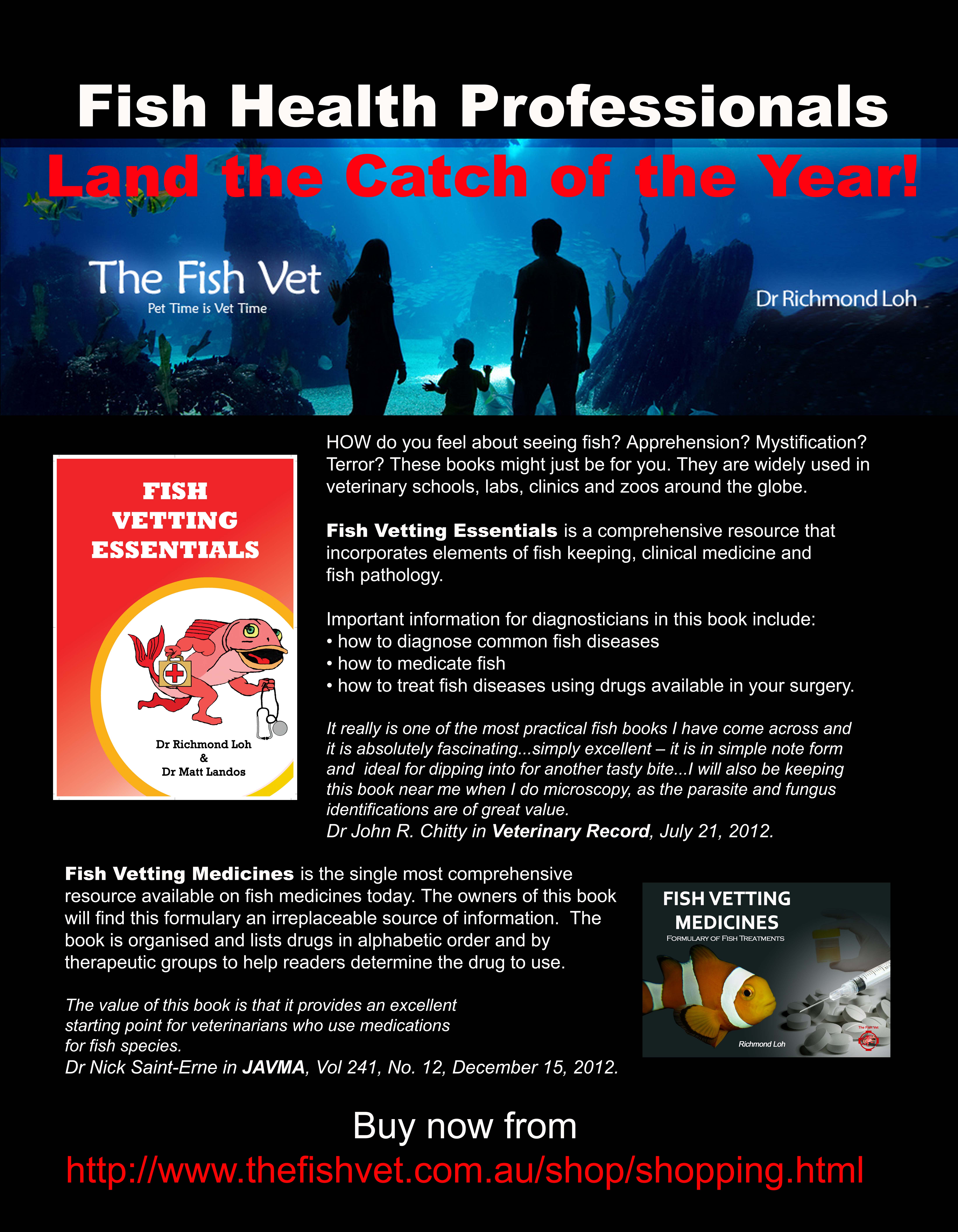
Land the catch of the day!

Fish Diseases Workshop – Perth, Western Australia – 22-24 August 2013.

This Fish Diseases Workshop will be held before the World Parasitology Conference in Perth at our Murdoch University veterinary school and will be presented by Drs Supranee Chinabut and Susan Gibson-Kueh. It will be a prequel or satellite workshop to an International Parasitology Workshop that follows right after. 

The synopsis of the 3-day fish pathology workshop is below. 
Murdoch University Pre-conference Fish Pathology Workshop, Perth, 22-24 Aug 2013:
This 3-day workshop will be held at the teaching multi-header microscope suite (VBSEC3.107) at the Murdoch University School of Veterinary Science. The workshop is designed with the fish health diagnostician as well as researcher/ postgraduate student in mind. At the end of the workshop, participants will have developed some level of confidence in carrying out sound disease investigations in finfish, appreciate normal finfish histology as well as be able to recognize significant and emerging diseases of important cultured finfish species in Asia and Australia. The finfish species covered in this workshop will include both freshwater ornamental fish and marine food fish.   There would be opportunities to spend some time on histological glass slide materials that participants are encouraged to bring along to the workshop. Participants will receive a set of DVDs of selected virtual microscopy slides reviewed during the workshop, which will serve as invaluable resource reference materials. This workshop will be an exciting forum for you to review the histological materials of emerging and significant finfish diseases, materials brought along by your peers as well as your own materials. There will be ample opportunity to seek the opinions of presenters as well as other participants during the workshop.
Contact details:       
School of Veterinary and Life Sciences
Murdoch University, South Street, Murdoch, WA 6150, Australia
Download the registration form here – Register for Fish Pathology Workshop

How do you get into aquatic animal medicine.

We are now into Day 3 of the Seavet program and I’m learning heaps of interesting stuff. One common question the students ask of their teachers is,”How do I get to work in the field of aquatic veterinary medicine?” and a related question,”How do you get experience, without experience?”

One of my co-students this week expressed that when he was applying at several places to work as their aquatic veterinarian, the various establishments often asked him whether he had the AquaVet or SeaVet certificate. This is one way of getting your foot in the door. You’ll learn heaps and create a great network of colleagues.

These questions were also asked of the teachers. Many have side-stepped their way into the aquatic field. Dr Tom Waltzek got into it by being into virology (study of viruses), Dr Don Samuelson got into it by being into ophthalmology (study of eyes), myself and Dr Ruth Francis-Floyd got into it by being into pathology (study of diseases)… and the list goes on. Some volunteered heavily earlier in their careers and gained a lot of experience and earned trust such as Dr Mike Walsh and some had shown such commitment and perseverance that he earned a recommendation for a job by his colleague/mentor (Dr Gregory Lewbart), and this is how Dr Roy Yanong got his gig at the University of Florida! I’m sure that there’ll be many more such stories from the other teachers who have yet to present at this year’s SeaVet.

The veterinary degree really opens up many possibilities beyond the more common small animal (dog and cat) work often portrayed on TV like Dr Harry Cooper, Dr Chris Brown and Dr Katrina Warren.

For those veterinarians or veterinary students who can’t get to such courses, I strongly recommend you get into the two critical networks to find out more – register in the on-line Directory and subscribe to e-News at www.AquaVetMed.info, and consider joining the World Aquatic Veterinary Medical Association (WAVMA) at http://www.wavma.org/Become-a-member.

For those of you who are not veterinarians, no need to fear. There are many, many ways of getting in on the action too. I’d like to draw your attention to the information that can be found at the following link –
http://www.iaaam.org/getting-into-aquatic-animal-medicine/

Good luck to you and I hope to meet with you in this field in the future, and to exchange notes.


Yours sincerely,

Dr Richmond Loh
DipProjMgt, BSc, BVMS, MPhil (Pathology) Murdoch, MANZCVS (Aquatics& Pathobiology).
The Fish Vet, Perth, Western Australia.
Veterinary Medicine for fish.
W: http://www.thefishvet.com.au
E: thefishvet
P: +61 (0)421 822 383

Day 1 of SeaVet 2013.

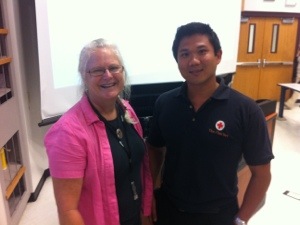
I’ve just completed Day 1 of the SeaVet intensive training course. We covered water quality for marine mammals as compared to fishes presented by Dr Ruth Francis-Floyd (pictured with me below). There were in-depth presentations on the effect of air quality on the health of Cetaceans, and on their anatomy, behaviour and medicine. This was delivered by Dr Mike Walsh who is kind enough to help fast track the attendees with what took him over 20 years to gather.

There was a lot to take in because tomorrow, we will be taking a field trip to Marineland to observe and interact with the dolphins.

This fact-finding trip has been made possible by the George Alexander International Fellowship, awarded to me by the International Specialised Skills Institute.

20130603-211947.jpg

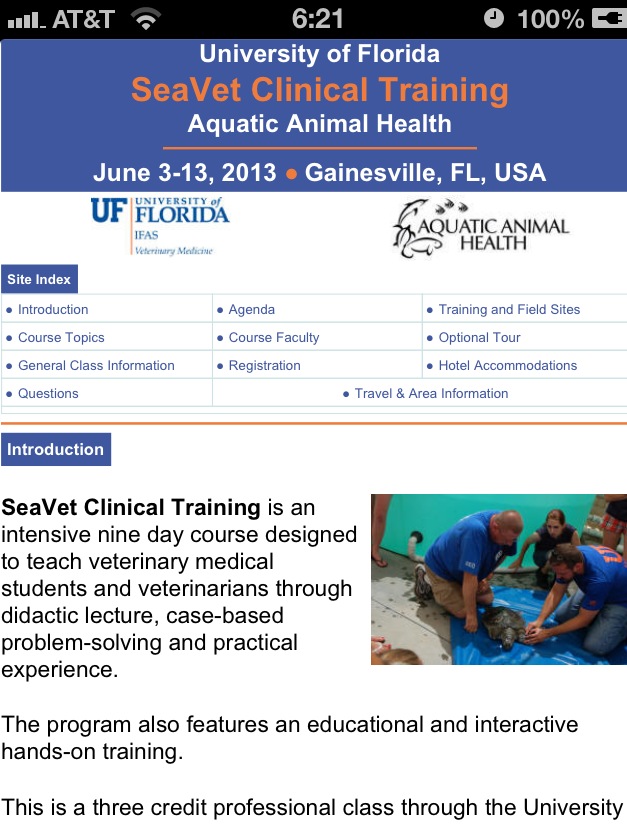
Seavet training starts today!

In just a little over 1.5 hours, I’ll be starting my Seavet training. I’m so excited that I woke up before my alarm clock!

See more about what the program delivers at this link – http://conference.ifas.ufl.edu/ame/seavet/


Yours sincerely,

Dr Richmond Loh
DipProjMgt, BSc, BVMS, MPhil (Pathology) Murdoch, MANZCVS (Aquatics& Pathobiology).
The Fish Vet, Perth, Western Australia.
Veterinary Medicine for fish.
W: http://www.thefishvet.com.au
E: thefishvet
P: +61 (0)421 822 383