This page provides vets with a one-stop shop for convenient links to APVMA news, resources and information sharing.
Special Permits for Oyster Farmers Hit by Virus.
Some good common sense at work.
Begin forwarded message:
From: “Dr. David Scarfe”
Date: 17 June 2013 5:19:25 AWST
Subject: AquaVetMed e-News: Repopulating NZ Herpesvirus Affected Oyster Farms
June 16, 2013
Special Permits for Oyster Farmers Hit by Virus
New Zealand – Special permits can now be issued to some oyster farmers whose businesses have been affected by the oyster herpes virus to gather wild (feral) Pacific oysters, which will come as a great relief to the local oyster industry.
Mike Sabin, MP for Northland commented: “I have had a number of meetings with Northland oyster farmers over the past 18 months and have a great deal of empathy for their plight, with this virus devastating their spawning stock and putting the industry on its knees, so this decision will be a real boost for local farmers.“ “Famers raised the question with me of harvesting feral oysters as a potential means for them to remain viable while solutions to the virus were being developed, something I talked over with the Minister and officials. “As it currently stands, oyster farmers are only able to gather feral oysters if they have a commercial fishing permit, something that they explained to me wasn’t a workable fit for their scenario and wasn’t viable given their difficult financial situation.
“I am pleased to announce that the Minister for Primary Industries (MPI), Nathan Guy has approved a new special purpose permit under section 97(1)(c) of the Fisheries Act 1996 enabling MPI to issue special permits to oyster farmers to collect feral oysters and transfer them onto their marine farms, for later re-harvest and sale,” said Mr Sabin.
The decision follows consultation with Maori and other affected stakeholders, Mr Sabin saying the permits will be valid for three years to allow the oyster industry to recover from the impacts of the virus and the permit would still be subject to food safety requirements. In approving the special permit purpose, Minister Guy acknowledged the unusual and special circumstances of this particular situation, providing a cost effective mechanism for farmers to recover while they try to rebuild their industry … … .
See the source (http://tinyurl.com/otfnsds) for the full story.
[For information on this special permit see http://tinyurl.com/nmrbf5p. ADS-Mod]
___________________________
AquaVetMed e-News provides information to veterinary and veterinary-allied subscribers concerning aquatic animal medicine, health, welfare, public health and seafood safety, obtained from a variety of sources (largely AquaVetMed subscribers). While provided by the American Veterinary Medical Association’s, Aquatic Veterinary Medicine Committee and are for public distribution, they do not necessarily reflect the opinion of the AVMA or the veterinary profession. See the AVMA Terms of Use (http://tinyurl.com/29h2rf) for further information.
If e-News information is used elsewhere please acknowledge AquaVetMed as the source. Encourage individuals to subscribe rather than distribute through list serves.
Messages may contain attachments that will have been scanned for known viruses.
Subscription and Contributions: Interested veterinarians and veterinary-allied professionals can subscribe, unsubscribe, or contribute pertinent news or information, by sending a message with “For AquaVetMed -” and the topic in the subject line, to dscarfe@avma.org.
Note: Undelivered e-mails will not be resent; Subscribers will be deleted from the list after repeated undelivered or bounced messages and will have to re-subscribe.
Visit our website: http://www.avma.org
________________________________
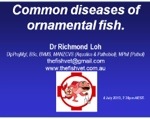
Free webinar on “Common Diseases of Ornamental Fish” presented by Dr Richmond Loh, The Fish Vet.
Dr Loh, The Fish Vet, in the company of Veterinary Classrooms invites you to a free live webinar.
|
Fish Joke for Monday-itis: carpenter.
Q: What fish works with wood?
A: A sawfish.
Read more about the fish here – http://media.murdoch.edu.au/sawfish-hits-top-international-endangered-list
Fish Pathology Workshop – deadline for registration is 1 July.
Register for Fish Pathology Workshop
Fish Pathology Workshop
Murdoch University, Perth on 22-24 Aug 2013 (Thurs-Sat)
Program for Day 1 – Thurs 22 Aug 2013
| 8.45 – 9.00 | Course Registration
Microscope suite VBSEC3.107 in Veterinary Biology Building |
| 9.00 – 9.45 | Tutorial 1.1: Overview of workshop & Introduction to fish disease investigations (VBSEC3.107)
|
| 9.45 – 10.30 | Practical glass slide session 1.1 (VBSEC3.107)
|
| 10.30 – 11.30 | Morning tea and coffee |
| 11.30 – 13.30 | Practical glass slide session 1.2 (VBSEC3.107)
|
| 13.30 – 14.30 | Lunch |
| 14.30 – 15.15 | Tutorial 1.2: Viral diseases of fish (VBSEC3.107)
|
| 15.15 – 16.00 | Practical glass slide session 1.3 (VBSEC3.107)
|
| 16.00 – 16.30 | Afternoon tea |
| 16.30 – 17.15 | Practical glass slide session 1.4 (VBSEC3.107)
|
| 17.15 – 17.30 | Wrap-up session & discussions |
Program for Day 2 – Fri 23 Aug 2013
| 8.45 – 9.00 | House-keeping session |
| 9.00 – 9.45 | Tutorial 2.1: Bacterial Diseases of Fish (VBSEC3.107)
|
| 9.45 – 10.30 | Practical glass slide session 2.1 (VBSEC3.107)
|
| 10.30 – 11.30 | Morning tea and coffee |
| 11.30 – 13.30 | Practical glass slide session 2.2 (VBSEC3.107)
|
| 13.30 – 14.30 | Lunch |
| 14.30 – 15.15 | Tutorial 2.2: Parasitic diseases of fish (VBSEC3.107)
|
| 15.15 – 16.00 | Practical glass slide session 2.3 (VBSEC3.107)
|
| 16.00 – 16.30 | Afternoon tea |
| 16.30 – 17.15 | Practical glass slide session 2.4 (VBSEC3.107)
|
| 17.15 – 17.30 | Wrap-up & discussion session |
Program for Day 3 – Sat 24 Aug 2013
| 8.45 – 9.00 | House-keeping session |
| 9.00 – 9.45 | Tutorial 3.1: Emerging & other significant diseases of fish (VBSEC3.107)
|
| 9.45 – 10.30 | Practical glass slide session 3.1 (VBSEC3.107)
|
| 10.30 – 11.30 | Morning tea and coffee |
| 11.30 – 13.30 | Practical glass slide session 3.2 (VBSEC3.107)
|
| 13.30 – 14.30 | Lunch |
| 14.30 – 15.15 | Tutorial 3.2: Investigating fish kills (VBSEC3.107)
|
| 15.15 – 16.00 | Practical glass slide session 3.3 (VBSEC3.107)
|
| 16.00 – 16.30 | Afternoon tea |
| 16.30 – 17.15 | Practical glass slide session 3.4 (VBSEC3.107)
|
| 17.15 – 17.30 | Wrap-up & discussion session |
Dr. Supranee Chinabut (Presenter)
CV in brief: Dr Supranee Chinabut received her BSc from Fisheries Faculty, Kasetsart University, M.Sc. on Fisheries Parasitology from AuburnUniversity and Ph.D. on Fish pathology from StirlingUniversity in 1989. She has over 30 years of experience in research, disease diagnosis and teaching at both the national and international levels in aquatic animal health. Dr. Supranee has authored or co-authored more than 100 technical publications and 50 general fisheries articles between 1970 and 2005. She was the Chairperson of Fish Health Section/Asian Fisheries Society from 2001-2003. She is at present a Senior Advisor on Fish Diseases for the Department of Fisheries, Thailand and sits on the Advisory Group for NACA.
Contact details: Email: supraneecb@yahoo.com
Dr. Susan Gibson-Kueh (Workshop Coordinator & Presenter)
CV in brief: Dr Susan Gibson-Kueh has a PhD in Fish Pathology from Murdoch University in 2013, an M.Sc in Aquatic Veterinary Studies from Institute of Aquaculture, University of Stirling, Scotland in 2001 and B.V.Sc from Sydney University in 1990. She currently teaches aquatic animal health and veterinary pathology at the School of Veterinary and Life Sciences, Murdoch University, and has 13 publications on fish diseases in peer reviewed international journals. Her research is focused on the pathogenesis, epidemiology and diagnosis of diseases in farmed fish.
As manager of the Aquatic Animal health Laboratory, AgriFood and Veterinary Authority of Singapore from 1995-2007, she was responsible for the quality assurance of the aquatic animal health laboratory under ISO17025 and disease diagnosis to support surveillance, disease control and health certification. She was national focal disease reporting person for aquatic animal diseases to NACA/OIE from 1995 – 2007.
Contact details: School of Veterinary and Life Sciences
Murdoch University, South Street,
Murdoch, WA 6150, Australia
Email: s.kueh@murdoch.edu.au
Synopsis of workshop:
This 3-day workshop will be held at the teaching multi-header microscope suite (VBSEC3.107) at the Murdoch University School of Veterinary Science. The workshop is designed with the fish health diagnostician as well as researcher/ postgraduate student in mind. At the end of the workshop, participants will have developed some level of confidence in carrying out sound disease investigations in finfish, appreciate normal finfish histology as well as be able to recognize significant and emerging diseases of important cultured finfish species in Asia and Australia. The finfish species covered in this workshop will include both freshwater ornamental fish and marine food fish.
There would be opportunities to spend some time on histological glass slide materials that participants are encouraged to bring along to the workshop. Participants will receive a set of DVDs of selected virtual microscopy slides reviewed during the workshop, which will serve as invaluable resource reference materials. This workshop will be an exciting forum for you to review the histological materials of emerging and significant finfish diseases, materials brought along by your peers as well as your own materials. There will be ample opportunity to seek the opinions of presenters as well as other participants during the workshop.
Some participants are going onto attend the International Parasitology Conference that follows straight after, from Sun to Thurs 25-29 Aug. There will be a special aquatic session at this conference. They have listed some accommodation at the website. Please see http://www.waavp2013perth.com/index-waavp.html and http://www.waavp2013perth.com/waavp/accommodation.html
Please note that the parasitology conference will be held at the Perth Convention Centre in the city’s CBD, but the fish pathology workshop will be held in the multiheader microscope suite at the veterinary school in Murdoch University, South Street campus – this is located 20-25 minutes by road or rail from the city. The university is connected by train from the city, so that accommodation in the city near to a train station will be convenient. The Murdoch train station is the nearest, and is connected by a short bus ride to the university. Another suitable option for accommodation is in Fremantle: Murdoch University is located about 15mins from Fremantle, which is a popular place to stay. There is limited accommodation on the campus itself during term time, but I can find out more if you would like some information. If you have trouble accessing website by clicking onto the link, please copy and paste onto a search engine such as google.
Other Information on the Fish Pathology Workshop 22-24 Aug 2013:
We are pleased to announce that Dr Supranee Chinabut, a veteran fish pathologist from Thailand will be co-presenting this workshop with Dr Susan Gibson-Kueh. Together, these two main presenters have a combined experience of over 50 years in fish diseases of relevance to Asian aquaculture. The detailed program is appended above.
We have a good collection of histology glass slide materials at Murdoch University:
- Cases from our work in Asia
- Materials sent to us from throughout Asia including Singapore, Malaysia, Indonesia, Vietnam and Australia
- Case materials from the Fish Health Laboratory, Fisheries Dept WA, who has kindly consented for them to be used at this workshop
- Reference slide materials from our Fish Pathology Master Class in Bangkok in 2007, kindly provided by some of the presenters as Prof. Barbara Nowak, University of Tasmania and Prof. Teruo Miyazaki, University of Mie, Japan.
- An internationally sourced and audited collection from the Joint Pathology Centre, formerly Armed Forces Institute of Pathology, USA.
In addition, we ask that you start thinking about some case materials you would like to review at this workshop – these glass slides can be sent ahead (if you wish) by air-mail to:
One of the key aspects of small group workshops such as this one in Perth in Aug, is the face-to-face interactions and resulting social and professional links that develop and then persist. Such workshops are so important for those working in isolation within their speciality, and more so if they are looking to consolidate and develop their skills, and to take what they have learned and share it with local and remote partners. What has been apparent from the previous Crawford/ACIAR funded aquatic health masterclass in Bangkok in 2007, is that participants have made useful links during the workshop, and then these have continued and flourished using Google Groups or other networking technologies afterwards.
This workshop will be the first when we will use internet delivery of virtual microscopy slides, using a Murdoch University online learning management platform (Moodle) that will allow participants both to access the educational material online afterwards, and perhaps share with colleagues, and to continue to share further new case material for discussion and education. The technology for large-file serving, as required for digital or virtual microscopy, has only recently matured, and is facilitated by our ability to digitally to extract key regions of interest from whole slide images, allowing high speed download of the smaller extracts. Also, we can attach educational labels and comments electronically to the images, which is important once face-to-face opportunities have finished.
We look forward to seeing you in Perth in Aug. Please do not hesitate to ask for clarifications if you have any further queries. And of course, we will welcome any suggestions for topics that will add to the learning experience at this workshop.
Susan
Luminous fish effect – Big Bang Theory
Do you think this would take off?http://bigbangtheory.wikia.com/wiki/The_Luminous_Fish_Effect
Follow me on: Facebook "Fin Page" – YouTube – Blog – Linkedin – Twitter
—
Yours sincerely,
Dr Richmond Loh DipProjMgt, BSc, BVMS, MPhil (Pathology) Murdoch, MANZCVS (Aquatics & Pathobiology).
Veterinarian | Adjunct Lecturer Murdoch University | President-elect WAVMA |
Secretary Aquatic Animal Health Chapter – ANZCVS.
The Fish Vet, Perth, Western Australia, AUSTRALIA. Mobile Veterinary Medical & Diagnostic Services for fish and other aquatic creatures.
http://www.thefishvet.com.au
Ph: +61 (0)421 822 383
Looking for more books? Check out this site.
WAVMA’s new promo video
Check out the new video about what WAVMA (World Aquatic Veterinary Medical Association) does here – http://vimeo.com/66211645
FDA offering grants for research into drugs for use in minor species (namely aquacultured fishes).
Grants (and workshops on the process) such as these would be useful if it was available in Australia.
———- Forwarded message ———-
From: Dr. David Scarfe <DScarfe@avma.org>
Date: Wed, Jun 12, 2013 at 5:27 AM
Subject: AquaVetMed e-News: FDA 2013 MUMS Grant Applications – Close Aug 16.
To:
June 11, 2013
FDA Announces Minor Use/Minor Species (MUMS) Grant Program Request for Applications Open Period due August 16, 2013
The Food and Drug Administration today announced the opening date for applications for grants to support the development of new animal drugs intended for minor species or minor uses in major species. (Major species are horses, dogs, cats, cattle, pigs, turkeys and chickens.) Applications are due electronically by August 16, 2013 at www.grants.gov.
The grant program was established by the Minor Use and Minor Species Animal Health Act of 2004, and funding was authorized to start after finalization of regulations to implement the Designation provisions of Section 573 of the Federal Food, Drug & Cosmetic Act.
Eligibility requirements to apply for a MUMS grant include:
- · the drug must be ‘designated’ by the Center for Veterinary Medicine’s (CVM) Office of Minor Use and Minor Species Animal Drug Development (OMUMS) under the MUMS Act;
- · the grant funding must be used to defray the costs of qualified safety and effectiveness testing expenses associated with the development of the drug for the designated intended use;
- · interested parties must have a study protocol that has been accepted by CVM’s Office of New Animal Drug Evaluation (ONADE) prior to submitting the grant application.
Qualified safety studies include those intended to support target animal safety, environmental safety, and human food safety. For human food safety, a separate study to validate an analytical method prior to conduct of an in-life study is eligible for funding, if a protocol for the stand-alone method validation study has been accepted by ONADE.
Grants will be available for up to $75,000 per year for up to two years for routine studies; and up to $125,000 per year for up to two years for studies of unusual complexity, duration or size. A third year of funding may be available for long-term toxicology studies. Therefore, grants could range from under $75,000 for a routine study that could be completed in less than a year, to $250,000 for a complex study requiring two years for completion, to $375,000 for a long-term toxicology study. Indirect costs are limited to 15% of direct costs.
The complete Request for Applications is available at http://grants.nih.gov/grants/guide/rfa-files/RFA-FD-12-003.html. Please note revisions to dates and text in Notice NOT-FD-13-014, at http://grants.nih.gov/grants/guide/notice-files/NOT-FD-13-014.html.
___________________________
AquaVetMed e-News provides information to veterinary and veterinary-allied subscribers concerning aquatic animal medicine, health, welfare, public health and seafood safety, obtained from a variety of sources (largely AquaVetMed subscribers). While provided by the American Veterinary Medical Association’s, Aquatic Veterinary Medicine Committee and are for public distribution, they do not necessarily reflect the opinion of the AVMA or the veterinary profession. See the AVMA Terms of Use (http://tinyurl.com/29h2rf) for further information.
If e-News information is used elsewhere please acknowledge AquaVetMed as the source. Encourage individuals to subscribe rather than distribute through list serves.
Messages may contain attachments that will have been scanned for known viruses.
Subscription and Contributions: Interested veterinarians and veterinary-allied professionals can subscribe, unsubscribe, or contribute pertinent news or information, by sending a message with “For AquaVetMed -” and the topic in the subject line, to dscarfe@avma.org.
Note: Undelivered e-mails will not be resent; Subscribers will be deleted from the list after repeated undelivered or bounced messages and will have to re-subscribe.
Visit our website: www.avma.org
________________________________
Current & New Approaches for Animal Drugs in Feeds: On-line presentations available to view.
This will be useful.
———- Forwarded message ———-
From: Dr. David Scarfe <DScarfe@avma.org>
Date: Thu, Jun 6, 2013 at 8:58 PM
Regulations involving how drugs are delivered through medicated feed in the US are undergoing major advances. To convey the information to the widest audience available, the presentations of a 2-day New Animal Drugs for Use in Feeds Workshop (which was on May 22-13, 2013) have now been made available on-line.
Intended to cover the approval process for medicated animal feeds, government agencies involved, on how medicated feeds should be used, different types of medicated feeds, labels and how medicated feeds should be used, changes in veterinary feed directives, judicious use and changes of over-the-counter (OTC) availability of antimicrobial drugs, and a number of other important issues are outlined in the following presentations.
• Medicated Feed Workshop Introduction, Logistics – Bernadette Dunham, FDA-CVM
• Introducing the Center for Veterinary Medicine: Organization and Structure – Sanja Modric, FDA-CVM
• New Animal Drugs for Use in Animal Feeds: Types and Categories – Dragan Momcilovic, FDA-CVM
• Development and Approval of Labeling for Medicated Feeds – Suzanne Sechen, FDA-CVM
• Where to Find Approved Labeling for Medicated Feed – Dragan Momcilovic and Suzanne Sechen, FDA-CVM
• Proposed Changes: Veterinary Feed Directive – Jo Gulley and Sharon Benz, FDA-CVM
• Antimicrobial Drugs in Animal Feeds: Update on FDA’s Judicious Use Strategy – Craig Lewis, FDA-CVM
• Understanding ADAA Combinations – Dan Benz, FDA-CVM
• Generic Approval Process and Biowaiver Requirements – Charli Long, FDA-CVM
• Biomass Drug Substances – Amy Simms, FDA-CVM
• Type A Medicated Articles and CMC Issues – James Nitao, FDA-CVM
• CMC Data to Support Medicated Feeds – Heather Longstaff, FDA-CVM
• Medicated Feed Assay Methods and Limits: Regulatory Perspective – Asif Rasheed, FDA-CVM
• CMC Question & Answer
• What Do Feed Mill Inspections Have to Do with Drug Approvals? – Shannon Jordre, FDA-CVM
• Interactions with CVM – Cory Herr, Elanco, Keith Baker and Paul Duquette
• Round Table Discussion
• Wrap Up and Next Steps
To view one or more of these presentations go to http://tinyurl.com/lsofm7b.
___________________________
AquaVetMed e-News provides information to veterinary and veterinary-allied subscribers concerning aquatic animal medicine, health, welfare, public health and seafood safety, obtained from a variety of sources (largely AquaVetMed subscribers). While provided by the American Veterinary Medical Association’s, Aquatic Veterinary Medicine Committee and are for public distribution, they do not necessarily reflect the opinion of the AVMA or the veterinary profession. See the AVMA Terms of Use (http://tinyurl.com/29h2rf) for further information.
If e-News information is used elsewhere please acknowledge AquaVetMed as the source. Encourage individuals to subscribe rather than distribute through list serves.
Messages may contain attachments that will have been scanned for known viruses.
Subscription and Contributions: Interested veterinarians and veterinary-allied professionals can subscribe, unsubscribe, or contribute pertinent news or information, by sending a message with “For AquaVetMed -” and the topic in the subject line, to dscarfe@avma.org.
Note: Undelivered e-mails will not be resent; Subscribers will be deleted from the list after repeated undelivered or bounced messages and will have to re-subscribe.
Visit our website: www.avma.org
________________________________
Can it really rain fish and frogs?
Tornadoes, when they occur over water and with sufficient velocity, can create a ‘water spout’. This vortex can suck up water and the organisms within the water, carry it up to 100 miles. When the winds for down, the water and fish it carried will then drop from the sky!
I saw this on The Weather Channel.