The discovery, detailed in the latest issue of the scientific journal Nature, challenges well established ideas about the separation of cartilaginous fish (such as sharks) and bony fish (which became four-legged creatures).
The zebrafish might give us clues to a cure for spinal injury sufferers.
Who would have thought that these little tiny speedy fishes could hold answers to so many human conditions?
Here’s another that research using such fish is helping us with.
How much protein should you feed your swordtail fish for improved reproductive performance?
I found this article to be quite enlightening.
Effect of dietary protein level on the reproductive performance of female swordtails Xiphophorus helleri (Poeciliidae)
- Laboratory of Fish Biology, Aquaculture Research Group, School of Biological Sciences, Universiti Sains Malaysia, 11800 Minden, Penang, Malaysia
Abstract
A study to determine the effect of increasing levels of dietary protein on swordtail (Xiphophorus helleri), a popular freshwater live bearer, was carried out. Five isocaloric semi-purified diets containing 20%, 30%, 40%, 50% and 60% dietary protein were used. Broodstock performance was evaluated based on growth parameters, proximate content and fry production of female broodstock. Results showed that while the 20% and 30% protein produced the lowest specific growth rate (SGR) values, there was no significant difference between 40% and 60% dietary treatments. The 20% dietary treatment also displayed lowest protein content in both ovaries and muscle of female fish. Fry production was highest from females fed with 50% and 60% protein, followed by the 30% and 40% protein while the diet containing 20% protein produced lowest number of fry. A significant correlation was also obtained between number of fry produced and the weight of female fish, indicating that size is a major factor influencing production. Relative fecundity was lowest for the 20% protein diet followed by the 30–40% and 40–60% protein diets. There were no significant differences in both weight and length of fry produced among the dietary treatments. Proximate analysis of fry also did not show any trend with different dietary protein levels fed to female broodstock. Dietary protein requirement of female swordtail during reproduction is therefore crucial for both the somatic growth and reproduction processes in order for fry production to be optimized. Based on our results, we suggest that a minimum of 30% protein be included in the diet of female swordtail broodstock.
Keywords
- Broodstock nutrition;
- Protein;
- Swordtails;
- Live bearers
Fish joke for Monday-itis: Pastry chef.
Q: What do you call a pastry chef fish?
A: Cookie cutter shark.
What would you suggest for ulcers on koi caused by two types of bacteria infections Aeromonas and Pseudomas?
I received this as a query:
If I may please if you don’t mind what would you suggest for ulcers on koi caused by two types of bacteria infections Aeromonas, Pseudomas” when not even bytral and treating the water with anti parasite meds plus salt does not work .
My response:
I’m confused about what pathogen you’re dealing with. Ectoparasites, or bacterial? If bacterial only, and if it’s either Aeromonas or Pseudomas, these are notorious for being multidrug resistant. So you must be guided by results from bacterial culture and antibiotic sensitivity tests.
—
Yours sincerely,
Dr Richmond Loh
DipProjMgt, BSc, BVMS, MPhil (Pathology) Murdoch, MANZCVS (Aquatics& Pathobiology), CertAqV WAVMA.
The Fish Vet, Perth, Western Australia.
Veterinary Medicine for fish.
W: http://www.thefishvet.com.au
E: thefishvet
P: +61 (0)421 822 383
How do you farm in a land-poor country like Singapore?
Vertical farming is the solution! What’s unique about this farm is that unlike regular aquaponics and hydroponics setups, it is not the water that is moved, but the plants themselves! They use old water wheel technology in this state of the art system.

Would you like to be able to identify a qualified aquatic veterinarian?
The World Aquatic Veterinary Medical Association has developed a credentialing program that recognises those veterinarians that have acquired the necessary knowledge, skills and experience through a variety of sources. The Certified Aquatic Veterinarian (CertAqV) Program is one that supports and supplements current and future efforts to ensure an adequate and well-trained global aquatic veterinary workforce.
To be credentialed by the WAVMA as a Certified Aquatic Veterinarian, individuals must be a WAVMA member, have a veterinary degree from a nationally recognised veterinary school, college or university and have demonstrated general knowledge and competency in core subject areas noted below that are currently considered unique to aquatic veterinary medicine and aquatic animals (primarily aquatic mammals, reptiles and amphibians, and finfish, crustacean and molluscs), including:
- Anatomy and physiology unique to aquatic animals.
- Life support systems & environmental evaluation (water quality) that affect the health of aquatic animals.
- Industry structure and function, including commercial aquaculture (farmed seafood and ornamental fisheries), natural resource (wild) aquaculture, and ornamental (pet) and public aquaria.
- Pathobiology and epidemiology of important aquatic animal diseases.
- Veterinary clinical diagnostic techniques and technologies for assessing important aquatic animal diseases.
- The availability and appropriate use of therapeutic and biologic agents (drugs, vaccines and bacterins) for preventing, controlling and treating important aquatic animal diseases.
- Public health, zoonotic diseases and seafood safety aspects relevant to aquatic veterinary medicine.
- International, federal, state/provincial and local legislation, regulations and standards affecting the practice of aquatic veterinary medicine.
- Principles of aquatic animal welfare
The Certified Aquatic Veterinarian Program has awarded 11 veterinarians from 6 countries to date.
You will be able to identify those veterinarians with expertise in aquatic veterinary medicine by the post-nominals CertAqV.
More information can be found at: wavma.org
—
Yours sincerely,
Dr Richmond Loh
DipProjMgt, BSc, BVMS, MPhil (Pathology) Murdoch, MANZCVS (Aquatics & Pathobiology), CertAqV.
Aquatic Veterinarian | Adjunct Lecturer Murdoch University | President-elect WAVMA |
Secretary Aquatic Animal Health Chapter – ANZCVS.
The Fish Vet, Perth, Western Australia, AUSTRALIA.
Aquatic Veterinarian | Adjunct Lecturer Murdoch University | President-elect WAVMA |
Secretary Aquatic Animal Health Chapter – ANZCVS.
The Fish Vet, Perth, Western Australia, AUSTRALIA.
Mobile Veterinary Medical & Diagnostic Services for fish and other aquatic creatures.
http://www.thefishvet.com.au
Ph: +61 (0)421 822 383
http://www.thefishvet.com.au
Ph:
 +61 (0)421 822 383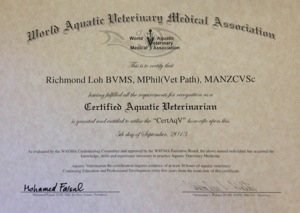
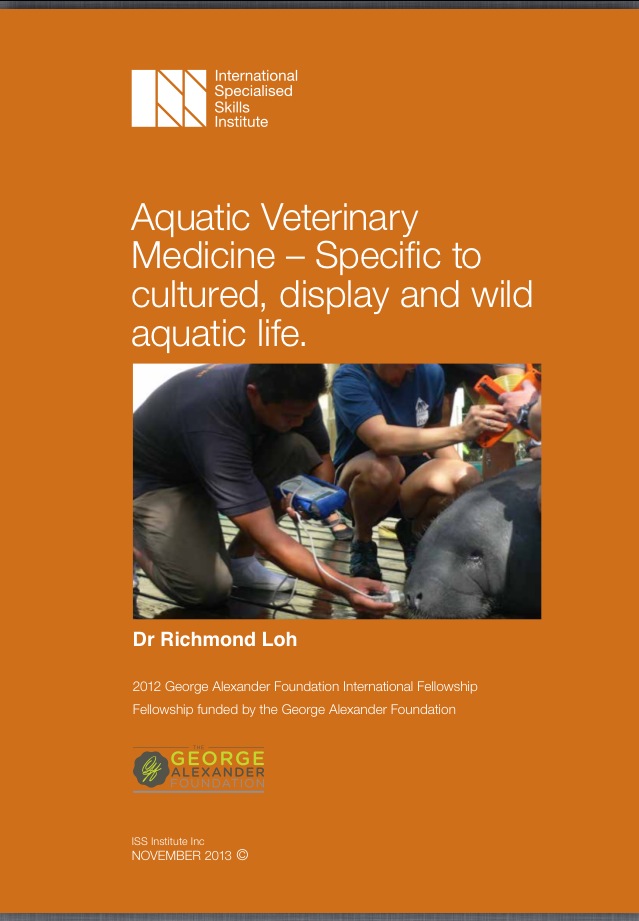
Now Available & Free to Download! Dr Richmond Loh’s Fellowship Report – Aquatic Veterinary Medicine – Specific to Cultured, Display and Wild Aquatic Life.
The Fellowship Report from my recent fact-finding trip to the USA is now published!
It covers veterinary health aspects on the following topics:
- Sharks, stingrays, bony fish, pinnipeds, cetaceans, manatees, turtles and penguins;
- Fish farming (food fish and ornamentals); and
- Aquaponics!
See email below for details on how to access the material.
From: Paul Sumner <fellowships@issinstitute.org.au>
Date: 27 November 2013 11:20:36 AWST
Subject: Fellowship Report – Dr Richmond Loh – Aquatic Veterinary Medicine – Specific to Cultured, Display and Wild Aquatic Life.
On behalf of our Board and CEO, Ms Bella Irlicht AM, please find a copy of Dr Richmond Loh’s Fellowship Report, Aquatic Veterinary Medicine – Specific to Cultured, Display and Wild Aquatic Life, which has recently been published and we believe will be of interest to you and your organisation.
Dr Loh’s ISS Institute Fellowship was sponsored by the George Alexander Foundation.
It is available for download from our website at:
http://www.issinstitute.org.au/wp-content/media/2013/11/Report-Loh-Final-LowRes.pdf
Should you require a copy of the high resolution version of the report, which is suitable for printing, please contact our office and we will arrange to forward that to you on disk or USB drive. Please feel free to circulate the Fellowship report throughout your network.
Thank you for your interest.
Kind regards,
Paul Sumner

International Specialised Skills Institute, Level 1, 189 Faraday Street, Carlton VIC 3053, AUSTRALIA
P 03 9347 4583 | F 03 9348 1474
fellowships | www.issinstitute.org.au | www.twitter.com/ISSInstitute | www.facebook.com/ISSInstitutePassionate people. Great ideas. A better skilled Australia.
……………………..
Fish flip out as sinkhole swallows pond in Sanica, Bosnia | News.com.au
Now that’s what I call a fish’s home renovation !
—
Yours sincerely,
Dr Richmond Loh
DipProjMgt, BSc, BVMS, MPhil (Pathology) Murdoch, MANZCVS (Aquatics& Pathobiology), CertAqV WAVMA.
The Fish Vet, Perth, Western Australia.
Veterinary Medicine for fish.
W: http://www.thefishvet.com.au
E: thefishvet
P: +61 (0)421 822 383
Why follow The Fish Vet on social media?
The blog at thefishvet.com has a social media impact score of 4/5 stars, according to coolsocial.net. It has 1,300 posts and has attracted more than 47,000 views since its inception in late 2011. In the last 7 months, it has been averaging 3,000 to 4,000 views per month. What attracts visitors to the blog is the personalised, practical and reliable information.
Dr Loh has published two books on aquatic veterinary medicine (“Fish Vetting Essentials” and “Fish Vetting Medicines – Formulary of Fish Treatments”) as a way to capture useful and practical information to pass to fellow veterinarians. However, the information available is growing at an exponential rate and the blog now serves several purposes. Dr Loh has set out to build trust and provide original and informative content in an understandable, summarised format and for the blog to be a repository for such information. It combines information, education and entertainment to raise the profile on fish health and welfare and to advance the special area of aquatic veterinary medicine.
Dr Loh’s approach to spreading the word and having a web presence is to:
- Debunk common myths like, “Fish have a 3 second memory”.
- Answer common trivia for example, “Do goldfish have a stomach? And what do you call a pregnant goldfish?”
- Share simple tips for instance, “How to tell the difference between sexes?”.
- Humour readers, preparing them for the working week ahead with, “Fish Joke for Monday-itis”.
- Announce opportunities for education (courses, webinars, etc.) and jobs.
- Summarise pertinent scientific findings by referring readers to journal articles Dr Loh had read.
- Bring to the attention of readers, important environmental concerns.
Thefishvet’s Facebook page has approximately 750 likes, has 550 followers on Twitter and over 2000 connections on Linkedin. These are linked to the blog and “mirrors” what is shared, and has additional input. These are complemented by a YouTube channel (thefishvetdrloh) which has nearly 20,000 views. With a good reputation and a strong internet presence, Dr Loh has recently been invited to become an Expert for eHow Now Pets on matters relating to fish health. Dr Loh will also serve as the President of the World Aquatic Veterinary Medical Association in 2014.
For more information on Dr Loh as The Fish Vet, visit the main website – thefishvet.com.au