Q: What’s the funniest fish in the ocean?
A: a clownfish!
All about Fish Vetting – Dr Richmond Loh
Q: What’s the funniest fish in the ocean?
A: a clownfish!
If you’re working in a public aquarium, or raising some large fish at home, and you feed them thawed frozen food, they might be deficient in some important vitamins and minerals. Did you know that many water-soluble nutrients such as B vitamins are lost as foods are thawed?
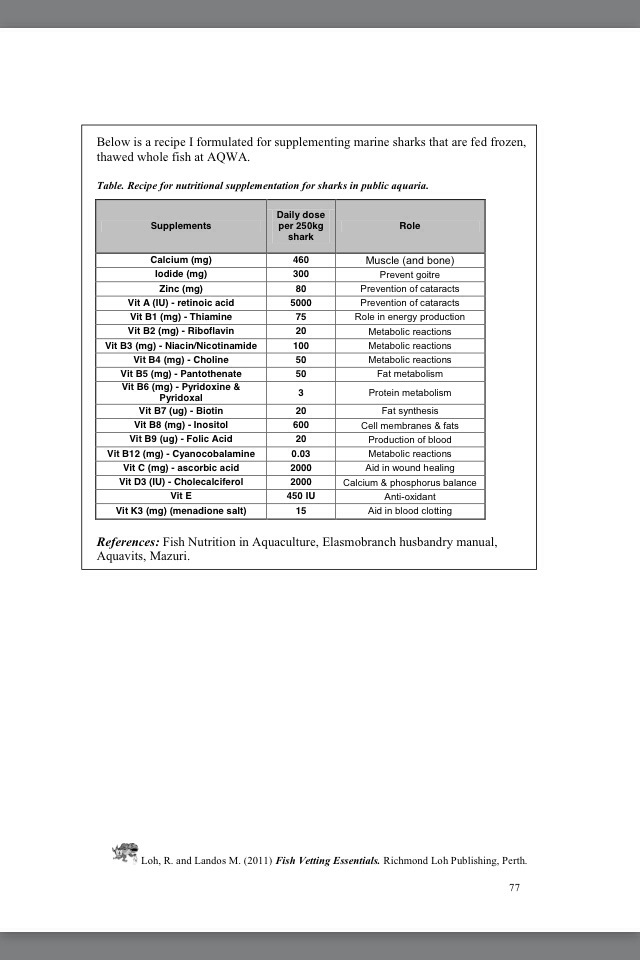
At the Aquarium of Western Australia (AQWA), I compared the commercially available nutritional supplements available for sharks, studied various scientific texts on fish nutrition, and came up with a tailored supplement for the sharks I help look after. This recipe is attached below. This recipe can also be tailored to your fish.
So if you’re serious about your fish’s health, drop me a line and let me see how I can help you and your aquarium.
This is why I love the oceans and water life!
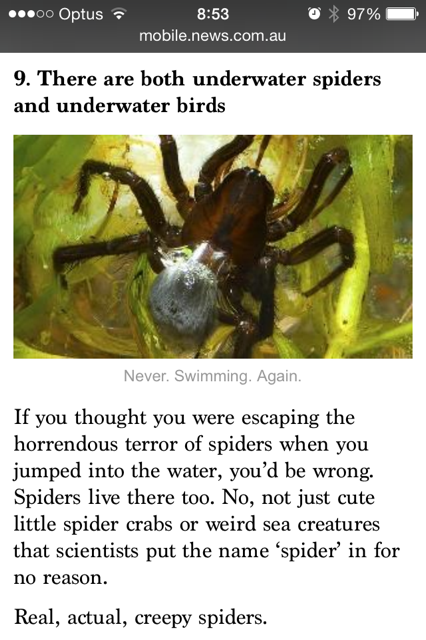
Read more at this link :
http://mobile.news.com.au/technology/environment/the-mindblowing-things-you-didnt-know-about-the-ocean/story-fnjww1so-1226880663232
—
Yours sincerely,
Dr Richmond Loh
DipProjMgt, BSc, BVMS, MPhil (Pathology) Murdoch, MANZCVS (Aquatics& Pathobiology), CertAqV, NATA Signatory.
THE FISH VET, Perth, Western Australia.
Veterinary Medicine for fish.
W: http://www.thefishvet.com.au
E: thefishvet
P: +61 (0)421 822 383
It’s great that the myth of fish having poor memories is being busted on mainstream media.
http://mobile.news.com.au/technology/science/dr-karl-busts-popular-science-myths/story-fnjwl2dr-1226873580703
A new viral disease has been discovered according to research from the Murdoch University Cetacean Research Unit (MUCRU).
It is a cetacean morbilivirus (CeMV). Already we have seen morbiliviruses jump from animal to human as in the case of the Hendra virus in horses (equine morbilivirus), that originates from bats.
Lab tests testing showed that this CeMV is closely related to similar viruses that infect land mammals! Could it potentially jump into humans? Thankfully, the marine mammal morbiliviruses are more closely related to the canine distemper. So we need to at least keep dogs away from dolphins. But based on the Hendravirus, we still need to take precautions when interacting with dolphins, particularly those that are sick. So perhaps no more kissing dolphins for me 😦
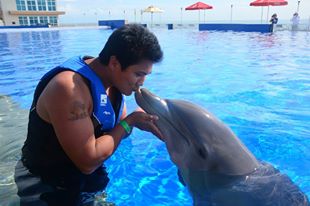
Luckily the dolphins didn’t fancy him!
Follow me on: Facebook "Fin Page" – YouTube – Blog – Linkedin – Twitter
—
Yours sincerely,
Dr Richmond Loh DipProjMgt, BSc, BVMS, MPhil (Pathology) Murdoch, MANZCVS (Aquatics & Pathobiology), CertAqV, NATA Signatory.
Aquatic Veterinarian | Adjunct Lecturer Murdoch University | President WAVMA |
Secretary Aquatic Animal Health Chapter – ANZCVS.
THE FISH VET, Perth, Western Australia, AUSTRALIA. Mobile Aquatic Veterinary Medical & Diagnostic Services.
http://www.thefishvet.com.au
Ph: +61 (0)421 822 383
Skype: thefishvet
Looking for more books? Check out this site.


The carnivorous fish, whose native habitat is in the warmer waters of the South American Amazon river basin, turned up dead in a sewer in Shropshire in central England, where Severn Trent Water inspectors found them causing a significant blockage.
But for some reason, to me, the dead fish pictures looks more like a tilapia than a piranha. Ah, but why let the facts get on the way of a good story, right?
From: “Dr. David Scarfe”
Date: 10 April 2014 2:12:01 AWST
Subject: AquaVetMed e-News: Aquatic Veterinary Student & Recent Graduate Educational Grants – application deadline April 30
April 9, 2014
Aquatic Veterinary Educational Grants for Veterinary Students & Recent Graduates – applications close April 30, 2014
Are you a student or a recently graduated veterinarian interested in finding out what aquatic veterinary medicine is all about or expanding your professional skills with aquatic animals?
The World Aquatic Veterinary Medical Association, in collaboration with the American Veterinary Medical Foundation and the American Veterinary Medical Association, will award up to 20 Aquatic Veterinary Educational Grants (up to $1,000 each) to veterinary students and recent veterinary graduates who are interested in exploring a career in aquatic veterinary medicine.
Funding from these awards can be used for a variety of aquatic veterinary educational opportunities, including attending workshops or meetings, externships or internships, or to support aquatic veterinary research projects. Awards are intended to assist veterinary students and veterinarians that have graduated in the previous two years and wish to become more involved with aquatic veterinary medicine.
All individuals that receive an award will provide a written report after completing their activity or project for possible publication in WAVMA’s quarterly publication, The Aquatic Veterinarian.
Applications for the 2014 program are now open, and will close on April 30, 2014.
Click the following links for more information, an application form or to contact a program administrator with questions about this program.
This program was established in 2010 to honor John Leland Pitts, DVM (1941-2009), who contributed significantly to advancing the discipline of aquatic veterinary medicine and the involvement of veterinary students and newly graduated veterinarians through the formation of the Student American Veterinary Medical Association.
___________________________
AquaVetMed e-News provides information to veterinary and veterinary-allied subscribers concerning aquatic animal medicine, health, welfare, public health and seafood safety, obtained from a variety of sources (largely AquaVetMed subscribers). While provided by the American Veterinary Medical Association’s, Aquatic Veterinary Medicine Committee and are for public distribution, they do not necessarily reflect the opinion of the AVMA or the veterinary profession. See the AVMA Terms of Use (http://tinyurl.com/29h2rf) for further information.
Subscription and Contributions: Interested veterinarians and veterinary-allied professionals can subscribe, unsubscribe, or contribute pertinent news or information, by sending a message with “For AquaVetMed -” and the topic in the subject line, to dscarfe@avma.org. If e-News information is used elsewhere please acknowledge AquaVetMed as the source. Encourage individuals to subscribe rather than distribute through list serves.
Note: Undelivered e-mails will not be resent; Subscribers will be deleted from the list after repeated undelivered or bounced messages and will have to re-subscribe. Messages may contain attachments that will have been scanned for known viruses.
Visit our website: http://www.avma.org
________________________________
Q: What do fish yell out when they need help?
A: KELP! Kelp!
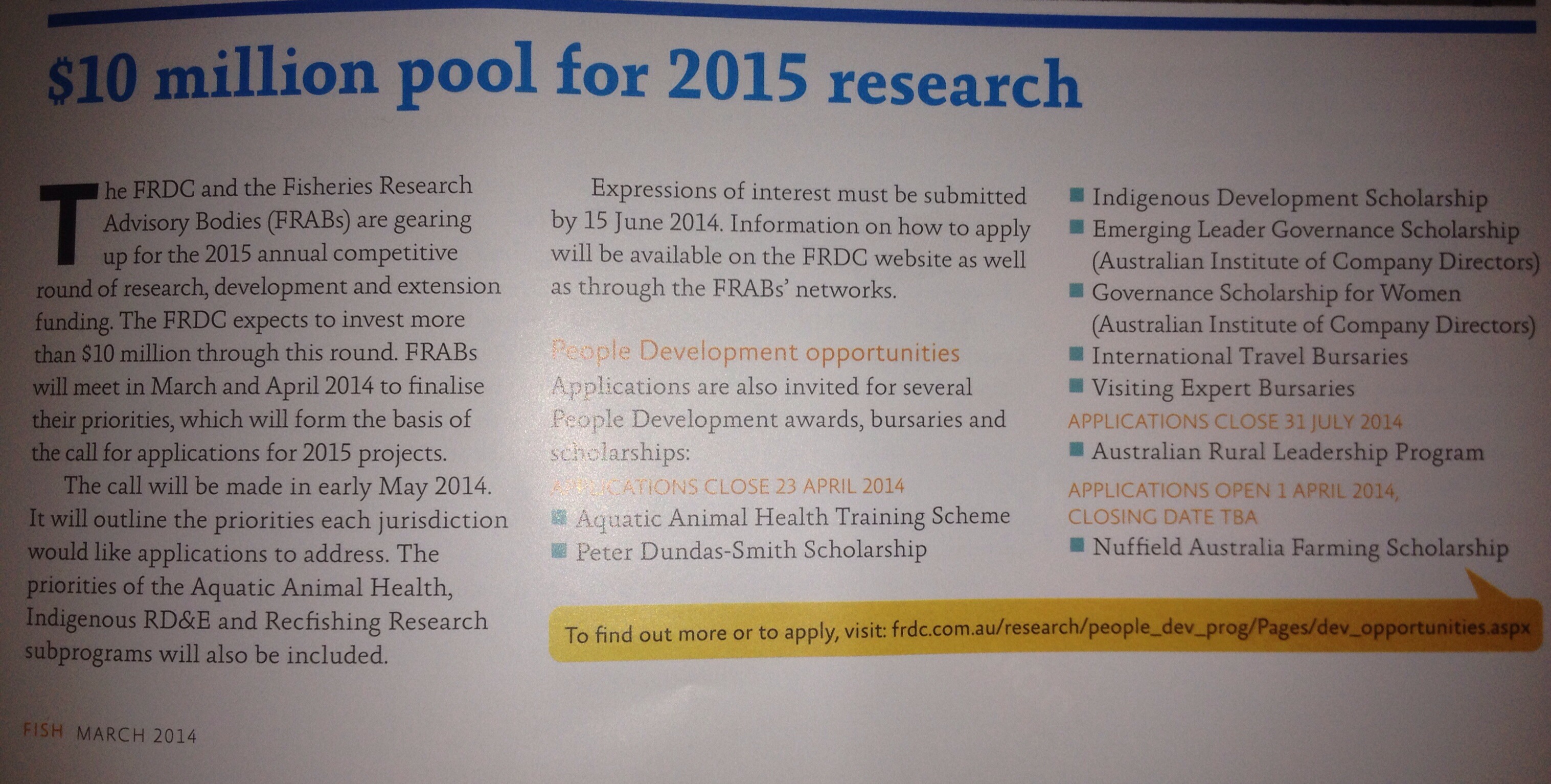
To find out how to access the funds for research and training, check out the picture below.