Doctors and Specialists of aquariums, ponds and fish health.

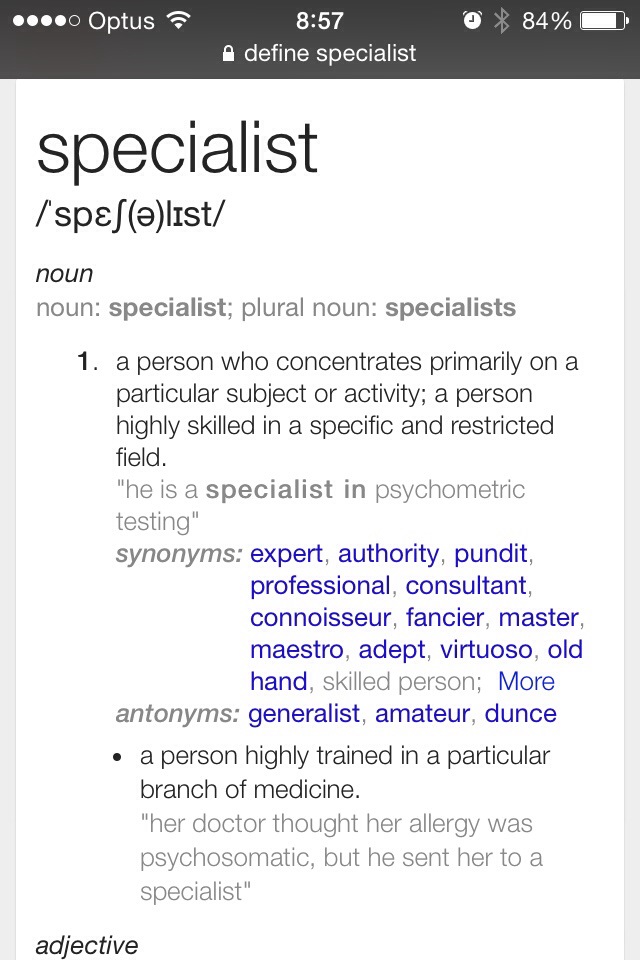
I’ve been seeing many businesses advertise they’re specialists in this and that. And so, out of curiosity, I googled the word ‘specialist’. This is what I found.
20140502-090045.jpg

Fair enough. I guess all my clients are the watery kind and that could make me a specialist.

But did you know that in the medical and veterinary profession, such relaxed use of the term ‘specialist’ is frowned upon, unless you have specialist registration in that profession.

At the moment, the highest examined qualification that veterinarians with special interest in fish is the MANZCVS in Aquatic Animal Health.

Long story short, I’d take a closer look at the qualifications of so-called doctors and specialists. Do they call themselves or their businesses ‘doctor’ because they have a degree in medicine, veterinary science or a PhD? Do they call themselves ‘specialists’ because they are registered with body as such? Some food for thought…
20140502-211625.jpg

Yours sincerely,

Dr Richmond Loh
DipProjMgt, BSc, BVMS, MPhil (Pathology) Murdoch, MANZCVS (Aquatics & Pathobiology), CertAqV, NATA Signatory.
Aquatic Veterinarian | Adjunct Lecturer Murdoch University | President WAVMA |
Secretary Aquatic Animal Health Chapter – ANZCVS.
THE FISH VET, Perth, Western Australia, AUSTRALIA.
Mobile Aquatic Veterinary Medical & Diagnostic Services.
http://www.thefishvet.com.au
Ph: +61 (0)421 822 383
Skype: thefishvet

Invitation to connect on LinkedIn

LinkedIn
Richmond Loh
From Richmond Loh

President at World Aquatic Veterinary Medical Association (WAVMA)
Perth Area, Australia

TheFishVet,

I’d like to add you to my professional network on LinkedIn.

– Richmond

Confirm that you know Richmond
You are receiving Invitation to Connect emails. Unsubscribe
© 2014, LinkedIn Corporation. 2029 Stierlin Ct. Mountain View, CA 94043, USA

67gbxi-hveh8vgu-6l.gif

Fish Joke for Monday-itis: Bump on the head.

In cartoons, when they get a bump on their head, they see birds flying around their head.

Q: What would fish see?

A: They sea stars!

What was the comedic response that earned this lucky person, a free ticket to the KSWA Awards dinner with me?

A couple of weeks ago, a competition was launched (https://thefishvet.com/2014/05/11/one-complimentary-dinner-ticket-to-give-away-koi-society-of-wa-awards-presentation-night/)
to see who’d accompany me at the main table at the awards night for best koi in their categories in Perth.

When you read his response, you can see he’s an automatic winner!

I would love to go with you Doctor,

And talk about my favorite thing – Fish…

And you will enjoy my company…

… you need me.

Hope to see you there, and I hope others will enjoy his company too 😉


Yours sincerely,

Dr Richmond Loh
DipProjMgt, BSc, BVMS, MPhil (Pathology) Murdoch, MANZCVS (Aquatics& Pathobiology), CertAqV, NATA Signatory.
THE FISH VET, Perth, Western Australia.
Veterinary Medicine for fish.
W: http://www.thefishvet.com.au
E: thefishvet
P: +61 (0)421 822 383

Lab tests suggests ocean’s rising acidity levels increase anxiety in juvenile rockfish.

A growing base of scientific evidence has shown that the absorption of human-produced carbon dioxide into the world’s oceans is causing surface waters to decline in pH, causing a rise in acidity. This ocean acidification is known to disrupt the growth of shells and skeletons of certain marine animals but other consequences such as behavioral impacts have been largely unknown.

Read more here..

Visited TheFishVet’s website recently?

THE FISH VET, Perth, Western Australia, AUSTRALIA. Mobile Aquatic Veterinary Medical & Diagnostic Services.
http://www.thefishvet.com.au
Ph: +61 (0)421 822 383
Skype: thefishvet

Looking for more books? Check out this site.

The Fish Vet - Perth, WA

Presentation by the WAVMA on Animal welfare in aquaculture

The following is taken from
.

Following the success of the World Veterinary Association (WVA) Global Seminar on Animal Welfare (held in Prague in September 2013), the WVA and the European Commission (EC) agreed to keep "alive" the global platform on Animal Welfare and to facilitate participation of veterinarians from all over the world by organising a follow up event via a webinar (on-line seminar).

The Webinar was entitled “Veterinary leadership: “Empowering tools for vets in the field of Animal Welfare”. It gave the floor to representatives from AVMA, EFSA, EC, FAO, FVE, IVSA, OIE, WAVMA, WSPA, WVA and the regions of Africa, Asia and Latin-America to present and discuss tools available for veterinarians in the different Animal Welfare fields. The Webinar was attended mostly by veterinarians and veterinary students from 56 countries.

Scope of the global webinar on animal welfare

  • To facilitate continuous dialogue and discussion between all global organisations and stakeholders in the fields of veterinary animal welfare.
  • To allow veterinarians from all over the world to participate in these discussions
  • To develop and promote the veterinary profession engagement in all animal welfare fields worldwide.

The webinar was structured around 5 cases. Participants and panel members exchanged comments and ideas on the presentations and replied to poll questions on various issues related to the Webinar topics. In the end of each session, the moderator announced the poll results.

The WAVMA presented on Animal welfare in aquaculture (link to download presentation).

The poll asked if animal welfare tools cover the needs of aquaculture. 86% of the respondents said that the available animal welfare tools do not cover the needs of aquaculture, 5% replied yes and 9% replied that it varies for the different species.

wavma.jpg?w=780

How do you fix algae problems in your pond?

I’ve had a few clients complain about algae issues recently.

Algae is a plant and so the things they need to grow include sunlight, warmth and nutrients.

Over the summer, the nutrient loads may accumulate from increased feeding, and perhaps fewer water changes (many only top up losses from evaporation). Luckily the warmth and amount of sunlight is reducing.

But what if you’re still having problem algae? What can you do?

Please find information from a previous post – https://thefishvet.com/2012/02/08/algae-treatments-for-ponds-and-aquaria/

If you’ve more questions for your situation, we can always organise a consultation
(select item from my website’s shopping cart).

What problems cause fish to float or sink? Is there a cure?

Buoyancy disorders are quite common in twin-tailed varieties of goldfish (this includes the Oranda). Normally they float, but they can also sink. Fish are normally slightly negatively buoyant and this allows them to swim with ease. Being sunken is not as big an issue as floating. The main reasons are that they won’t be in danger of drying, and do not have the stress of struggling to keep upright. Floating fish can be corrected by removing excess gas from the swimbladder, or by surgical placement of a ballast in their abdomen. On the otherhand, a sunken fish is more difficult to fix. It may require inserting air into the swimbladder (which may be difficult to locate if deflated). You’ll have to maintain the gravel clean and smooth, so that it doesn’t get infections on its ventral surfaces. See also, http://youtu.be/ita7URiO9Qs

However, we must try to find the reason for the issue. Common reasons include bacterial infection (including Mycobacteria), neoplasia (cancer), inflammatory conditions of the swimbladder and cystic kidneys. You’d need to take your fish to see an aquatic veterinarian to make the diagnosis. They may make a blood smear for examination for signs of inflammation, X-ray to find any masses that’s causing improper swimbladder function, fine needle aspirate to see what the mass is (if present), etc.

To learn more about this condition, see also

https://thefishvet.com/?s=buoyancy+disorder