How unhealthy is the Swan River.

“Toxic algal blooms have left the Swan River “dead” below two metres and pathogens harmful to humans are being recorded above the safe swimming limit, according to new research…

Symptoms included low oxygen levels, high nutrient levels and fish deaths that exceeded the Swan River Trust’s target in four of the past 10 years.”

Read more here.

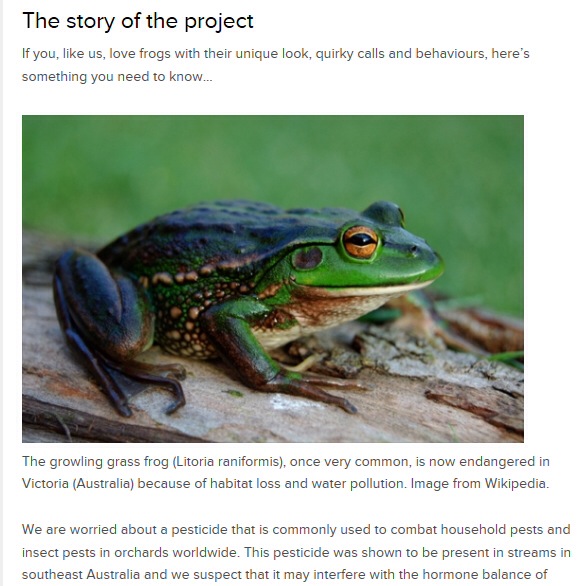
Free the frogs – an environment health check – help investigate pesticides for hormone-disrupting activity.

From: Bert De Groef

Subject: Free the frogs

My research team and I have launched a crowd funding project in an attempt to raise money to fund our research into the effect of some common pesticides (juvenile hormone analogs – a class of insect growth regulators) on the hormone balance and the development of amphibians. Amphibians, one third of which is already threatened with extinction, are particularly vulnerable to the effects of pollutants because of their aquatic lifestyle and their permeable skin. The pesticides that we are examining may not kill the animals, but are likely causing subtle effects that disturb the animals’ development, growth, immunity and reproduction. These pesticides have been detected in Australian streams, home to some of the world’s unique frogs.

We thought that this is a topic that would be of interest to Friends of the Earth members. If deemed appropriately, you could help us raise the funds by getting the word out and disseminating the link: www.pozible.com/freethefrog via social media or newsletters.

We have 60 days to raise the money if the project is to be successful, so any contribution you could make is enormously appreciated (deadline 06 October 2014)!

Thank you very much in advance!

Best regards,


Bert De Groef

Lecturer & Postgraduate Coordinator

Department of Agricultural Sciences, School of Life Sciences, La Trobe University, Bundoora VIC 3086, Australia

and

AgriBio – the Centre for Agribiosciences, 5 Ring Road, Bundoora VIC 3083, Australia

T: +61 3 9032 7436 E: b.degroef@latrobe.edu.au

IMG_5100.JPG

Taking a semen sample from a shark.

Dr Chris Brown talks about his exploits with his wetter patients.

Read more at – http://mobile.news.com.au/entertainment/tv/taking-a-semen-sample-from-a-shark-is-all-in-a-days-work-for-bondi-vet-star-dr-chris-brown/story-fn8yvfst-1227029038575


Yours sincerely,

Dr Richmond Loh
DipProjMgt, BSc, BVMS, MPhil (Pathology) Murdoch, MANZCVS (Aquatics& Pathobiology), CertAqV, CMAVA, NATA Signatory.
THE FISH VET, Perth, Western Australia.
Veterinary Medicine for fish.
W: http://www.thefishvet.com.au
E: thefishvet
P: +61 (0)421 822 383

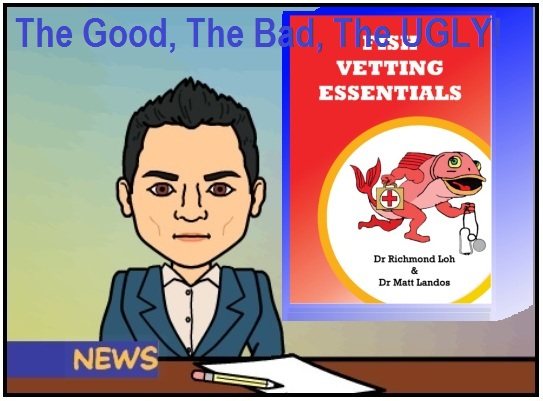
Do you think the review in the AVJ about Fish Vetting Essentials was unjust?

I’ve to admit that many who have purchased Fish Vetting Essentials have found this text very helpful. That is our exact intention; to deliver practical information to aquatic veterinarians, biologists and advanced aquarists.

On the contrary, one person holds an alternate view. Why is it so? Are their arguments justified? On what basis?

Before you check out the link to the article published in the Australian Veterinary Journal, I’d like to quote a couple of papers on what constitutes a good and bad review.

If a reviewer has a bias against the author, he/she should recuse him/herself from reviewing the paper. A reviewer must be knowledgeable about the topic and have a clear understanding of the historical context in which the work was done.

Benos DJ, Kirk KL & Hall JE (2003) How to Review a Paper. Advances in Physiology Education. Vol 27, No 2, p48.

A good review is supportive, constructive, thoughtful, and fair. It identifies both strengths and weaknesses, and offers concrete suggestions for improvements. It acknowledges the reviewer’s biases where appropriate, and justifies the reviewer’s conclusions.

A bad review is superficial, nasty, petty, self-serving, or arrogant. It indulges the reviewer’s biases with no justification. It focuses exclusively on weaknesses and offers no specific suggestions for improvement.

Bengtson, VL & MacDermid SM (2003) How to Review a Journal Article: Suggestions for First-Time Reviewers and Reminders for Seasoned Experts. NCFR.

Now here is the link to the review on Fish Vetting Essentials in the AVJ, or use this link for the excerpt of the Original book review by PHS.

What would motivate someone to write such a review? Importantly, what is the purpose of using fabricated facts, in a book review? How did this get published in a respectable international scientific journal?

Another aquatic veterinarian submitted a Letter to the Editor. The full version can be viewed by clicking on the link below.

What was submitted to be published by SBP

Sadly, this was heavily edited and the final version that went to print can be found at the link below.

What was actually published by AVJ

We really only have one reputation. We must defend it. We really should be supporting our colleagues who do good work and maintain professionalism.
AVJ news

Yours sincerely,
Dr Richmond Loh

DipProjMgt, BSc, BVMS, MPhil (Pathology) Murdoch, MANZCVS (Aquatics & Pathobiology), CertAqV.
Aquatic Veterinarian | Adjunct Lecturer Murdoch University | President WAVMA | Secretary Aquatic Animal Health Chapter – ANZCVS.
The Fish Vet, Perth, Western Australia, AUSTRALIA.

Mobile Veterinary Medical & Diagnostic Services for fish and other aquatic creatures.
W:http://www.thefishvet.com.au Ph: +61 (0)421 822 383

I’ll bet there are things you didn’t know about the amazing electric eel.

Check out this old video clip about the electric eel, with interesting experimentations to demonstrate the power of their electricity.

Enjoy –
https://www.youtube.com/watch?v=79sfc0n4Y0M

Thanks to MW.

Free WAVMA WebCEPD webinar 28 August 2014 – Field Surgical Insertion of Catfish Radio Transmitters.

The best part is, you don’t need to be a WAVMA member to attend and it’s free!

20140807-063421-23661321.jpg

WebCEPD B-1003: Field Surgical Insertion of Catfish Radio Transmitters

Join us for a free webinar on August 28, 2014. Click http://tinyurl.com/pcwgvz4 for your local time.

Speaker: Jo Bannister BVMS

In this free WAVMA WebCEPD webinar you will learn optimal veterinary approaches for inserting peritoneal radio transmitters in finfish, emphasising appropriate anesthesia, medication suture materials & techniques for maximal patient survival.

NOTE: this webinar will be recorded. If you register for the live webinar and are unable to attend, you will be sent a link to view he webinar.

Register now! https://attendee.gotowebinar.com/register/533021607107435778

20140807-063421-23661204.jpg

Want CEPD credit?
After viewing the webinar and a successfully completing a brief KSA (knowledge & skills assessment) veterinarians, veterinary students and veterinary technicians/nurses can earn up to 1.5 hrs of CEPD credit). Details will be sent to all who register.

After registering, you will receive a confirmation email containing information about joining the webinar.

View System Requirements

The 2014 AAPSP Roadshow by Dr Judith Handlinger on Aquatic Pathology, will be in Perth this month.

The Australian Animal Pathology Standards Program (AAPSP) has a fishy side!

RSVP: 15 August.

The itinerary for the 2-day workshop which will be presented in WA (Wed 27 – Thur 28 Aug, 2014):


Day 1:

  • Introduction & basic anatomical differences – what they mean for pathologists
  • Immunological and physiological differences, and how these influence pathology.
  • What is different about the pathogens and host reactions (and what is the same)?
  • Differences in routes of exposure.


Day 2

  • What is different about the pathogens and host reactions?
  • Nutritional problems – what we know.
  • Exotic diseases – national and State issues.
  • Pathology as part of the puzzle – complex cases, finding the cause.


In WA there will also be talks presented by Dr Cecile Dang (Principal Research Scientist), Dr Fran Stephens (Fish Pathologist), Dr Jo Bannister (Fish Pathologist) and Mr Paul Hillier (Fish Health Manager), all from Dept Fisheries, WA.  These talks will provide information on local issues and research.


Contact Megan Wyllie (MWyllie@animalhealthaustralia.com.au) and prepay AU$827.00 (GST exclusive) for the 2 day workshop.


See the following link for more details – aapsp fishpathology jhandlinger


Yours sincerely,

Dr Richmond Loh

DipProjMgt, BSc, BVMS, MPhil (Pathology), MANZCVS (Aquatics & Pathobiology), CertAqV, NATA Signatory.
Aquatic Veterinarian | Adjunct Lecturer Murdoch University | President WAVMA | Secretary Aquatic Animal Health Chapter – ANZCVS.
THE FISH VET, Perth, Western Australia, AUSTRALIA. Mobile Aquatic Veterinary Medical & Diagnostic Services.
http://www.thefishvet.com.au
Ph: +61 (0)421 822 383
Skype: thefishvet

The Fish Vet - Perth, WAwavma.jpg?w=780

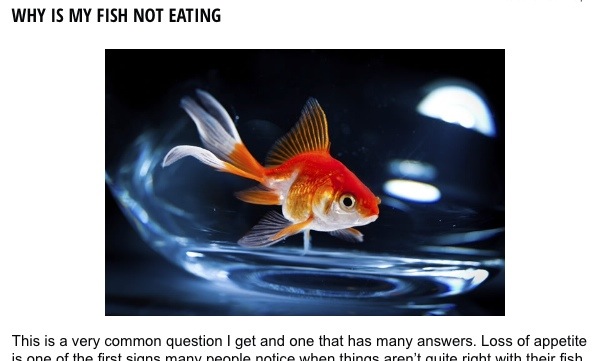
Why’s my pet fish not eating?

One of the frequently asked questions I get as a fish veterinarian is, “Why is my fish not eating?”

I had been invited to write an article about this topic by the PetWarehouse. Follow the link to the article:
http://www.mypetwarehouse.com.au/

20140805-144630-53190351.jpg