Q: what do you call a loud, coarse-mannered woman?
A: fishwife.
Then I wonder what you’d call a fish vet’s wife…
All about Fish Vetting – Dr Richmond Loh
Q: what do you call a loud, coarse-mannered woman?
A: fishwife.
Then I wonder what you’d call a fish vet’s wife…
Last Thursday, I attended a very good lecture on this topic at the University of Western Australia. Each of 3 lecturers took it in turns to present their unique findings: Prof. Shaun Collin, Assoc. Prof. Nathan Hart and Dr Ryan Kempster, all from the School of Animal Biology.
So what have we learnt?
The presentation started with describing their findings of the shark senses. Being living animals, it is not surprising that they have the 5 senses: sight, hearing, smell, taste, touch. These will be explained below.
Sight
They have found that sharks are monochromats, having peaks in receptors for the green-yellow wavelengths (with a secondary low peak at purple). Practically, this means they are somewhat “colour-blind”. Characteristics of colour-blind animals is that they are very good at detecting contrasts. They’ve found the greatest density of receptors in their eyes lie in the posterior-ventral part of the retina and this means that their line of best site is diagonally above, and in front of them. However, their visual acuity is only moderate which means they have to get close to see more clearly.
Hearing
On sound, sharks do have ears. The opening to the ear is in the dorsal surface (top) of the head, a slight distance behind the eye. It detects vibrations and hydrodynamic sounds (e.g. waves, splashing, eating, bubbles). They have good directional hearing, meaning they can tell where sound is coming from. Of the 10 shark species studied, they’ve found they can hear low frequency sounds, in the range of 10-800 Hz (cf humans 20-20,000 Hz).
Smell
Sharks have nostrils and they point downwards. They have folded skin to increase the surface area, making them able to detect as little as 1 drop of blood in a olympic-size swimming pool. This said, the olfactory bulbs in the brain of different elasmobranchs differ in size, so we can’t quite make sweeping generalisations.
Taste
Sharks have no external taste buds. Their taste buds are located in the oropharynx, basihyal (tongue) and gill arches. The highest concentration of taste buds are behind their teeth. This explains why they need to bite, or to mouth at things, in order to taste it.
Touch
I think I was late in to the lecture, and might have missed this section, or maybe they didn’t cover it. But if you’re reading this, and you were there, please do elaborate in the comments section. Thank you.
So, sharks have all the 5 senses that we have. But they have a couple more! Firstly, like all fishes, they have a “lateral line system“. These are little pits along the length of the body, each pit contains hairy cells and the pits are connected to adjacent pits by a channel. The lateral line system detects water motion and low frequency sounds (20-200 Hz). It is used for detecting obstacles.
The second special sense they have is called the “ampullae of Lorenzini“. These a small pits around the area of their snout and within the pits is a gel-like substance that helps conduct electrical currents from the environment to the electroreceptors within. These are so sensitive that they can detect electrical currents as low as 1 billionth of a volt! They use this to detect prey since all fishes produce small electric fields. Thus, electrical stimuli actually attract sharks to check things out. The abundance of these ampullae vary between species. A Port Jackson shark has only 200 pits, making them less adept at locating electrical stimuli, whereas the hammerhead shark as as many as 3000 pits, making them finely tuned. The great white shark has 800 and the shovelnose ray has 1200.
So now we know about their 7 special senses, how do we use this knowledge to our advantage? How do we create safer beaches for swimming? How do we create personal protective devices for divers?
Stay tuned to find out in my post next week.
This is a common guilt-trip question every non-enthusiasts puts to us. My argument is that it’s one of the healthiest “static” hobbies around.
Anyway, I came across a FB post by Boronia Aquarium that led me to find this humorous article on how you can decrease your power consumption.
http://www.practicalfishkeeping.co.uk/mobile/content.php?sid=6508

I’ve got to do better with my fish mobil.
Recently I gave a presentation at the koi club about the myriad reasons for koi developing skin ulcers. It’s an opportune time since they may get scrapes from the mating acts, damaged from shifting, predator attack, etc.
For uncomplicated ulcers, I’d like to point you to a video I uploaded on on how to treat fish ulcers.
“Now it seems the fish are surprisingly picky about when they ask for that help – and which eels to approach. The trout show a level of discrimination in when to collaborate, and with whom, that was thought to be unique to the likes of humans and chimpanzees.”
—
Yours sincerely,
Dr Richmond Loh
DipProjMgt, BSc, BVMS, MPhil (Pathology) Murdoch, MANZCVS (Aquatics& Pathobiology), CertAqV, CMAVA, NATA Signatory.
THE FISH VET, Perth, Western Australia.
Veterinary Medicine for fish.
W: http://www.thefishvet.com.au
E: thefishvet
P: +61 (0)421 822 383
Air dried smears are not exactly the best sample for making a diagnosis, but it can work, especially if there are numerous external parasites and that the smears are prepared correctly.
It’s ideal in situations where the remote site is without a microscope, or someone who knows how to use one, or knows what to look for. The slides can be prepared easily and sent by post to your nearest fish veterinarian to make a diagnosis.
To prepare the smears, simply follow the steps as per taking gill biopsies and skin mucus scrapes, and then smear these onto the glass slide. Do not add any water. Wave the slides in the air until dry.
Check out how the slides are examined and what you can see: http://youtu.be/ghLjcVJgyPA
For added diagnostic advantage, the commonly used Diff Quik stain can be applied to the smears.
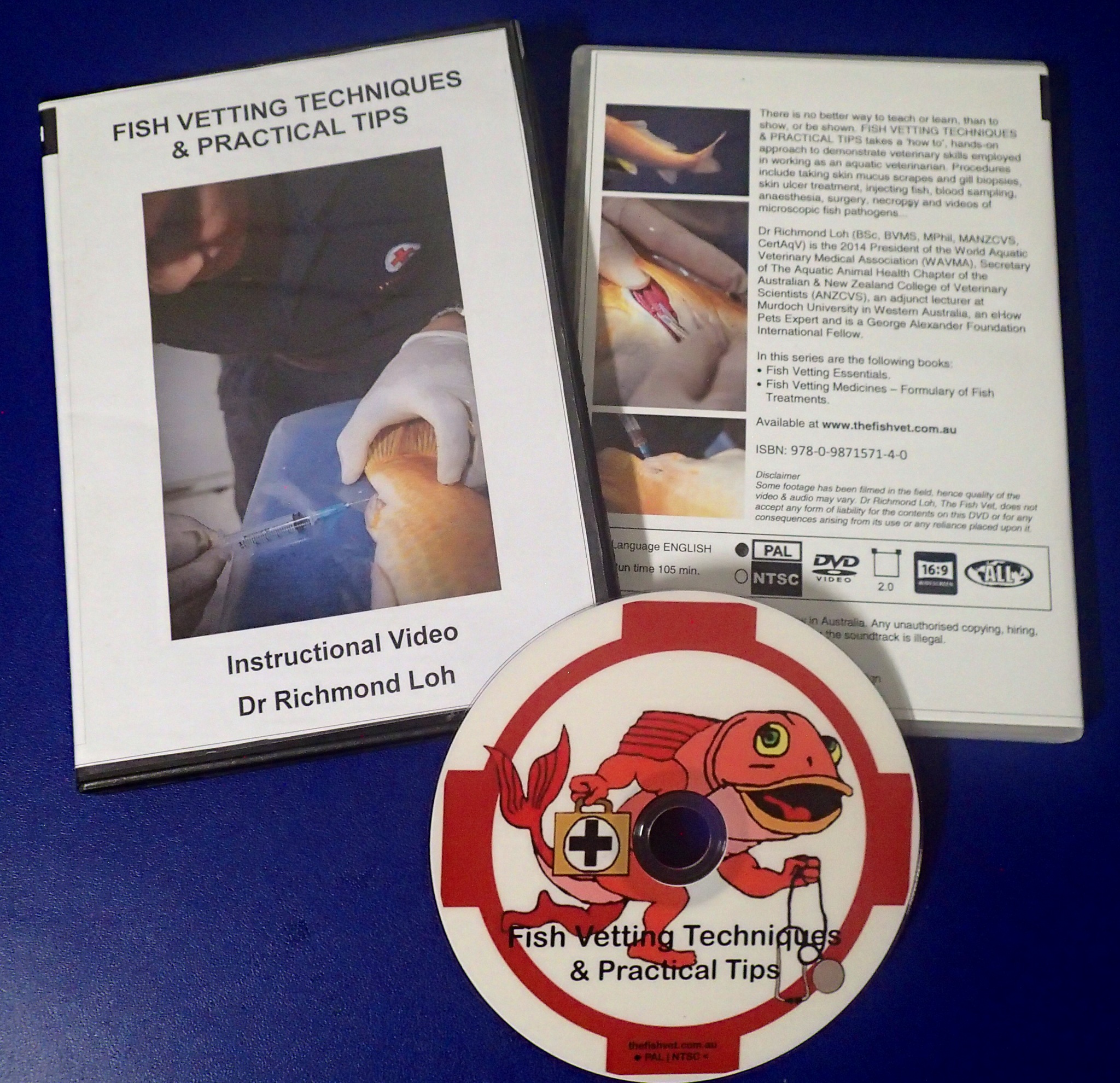
Learn more about Fish Vetting Techniques and Practical Tips in the newly released DVD, available only from the online shop at https://thefishvet.com.au/shop/shopping.html
Follow me on: Facebook "Fin Page" – YouTube – Blog – Linkedin – Twitter
—
Yours sincerely,
Dr Richmond Loh DipProjMgt, BSc, BVMS, MPhil (Pathology), MANZCVS (Aquatics & Pathobiology), CertAqV, CMAVA, NATA Signatory.
Aquatic Veterinarian | Adjunct Lecturer Murdoch University | President WAVMA |
Secretary Aquatic Animal Health Chapter – ANZCVS.
THE FISH VET, Perth, Western Australia, AUSTRALIA. Mobile Aquatic Veterinary Medical & Diagnostic Services.
http://www.thefishvet.com.au
Ph: +61 (0)421 822 383
Skype: thefishvet
Looking for more books? Check out this site.


Q: How do snow fish greet one another?
A: Ice to meet you.
Join us for a webinar B-1005 – WAVMA WebCEPD: Diseases of barramundi (Asian seabass) – developing good disease management strategies
Time: Oct 13, 2014 9:00 PM AWST (check your local time here: http://tinyurl.com/ou3vaz6)
Suitable for veterinarians and other technical personnel at all levels in the production chain who manage fish health, this webinar will cover significant diseases commonly encountered in the barramundi culture, and the principles behind sound disease investigations. It will establish some baseline information for understanding of the dynamics behind disease occurence on a farm that is necessary for implementing fish disease management plans.
Specific learning objectives include:
1. Understanding the general principles and techniques behind sound fish disease investigations;
2. Becoming familiar with common and significant diseases of barramundi; and,
3. Understanding how a disease affects the fish, and how this translates to successful disease management program.
Speaker: Dr Susan Gibson-Kueh, BVSc, MSc (Aquatic Vet. Studies), PhD (Fish Pathology).
NOTE: this webinar will be recorded. If you register for the live webinar and are unable to attend, you will be sent a link to view the webinar at a later time.
Want CEPD credit?
Registration is required. After viewing the webinar and a successfully completing a brief KSA (knowledge & skills assessment) veterinarians, veterinary students and veterinary technicians/nurses can earn up to 1.5 hrs of CEPD credit. Details will be sent to all who register.
Register now for this free live WAVMA WebCEPD webinar: https://attendee.gotowebinar.com/register/6483172817892681217
After registering, you will receive a confirmation email containing information about joining the webinar.
Follow me on: Facebook "Fin Page" – YouTube – Blog – Linkedin – Twitter
—
Yours sincerely,
Dr Richmond Loh DipProjMgt, BSc, BVMS, MPhil (Pathology), MANZCVS (Aquatics & Pathobiology), CertAqV, CMAVA, NATA Signatory.
Aquatic Veterinarian | Adjunct Lecturer Murdoch University | President WAVMA |
Secretary Aquatic Animal Health Chapter – ANZCVS.
THE FISH VET, Perth, Western Australia, AUSTRALIA. Mobile Aquatic Veterinary Medical & Diagnostic Services.
http://www.thefishvet.com.au
Ph: +61 (0)421 822 383
Skype: thefishvet
Looking for more books? Check out this site.
From: “Dr. David Scarfe”
Date: 19 September 2014 6:05:12 AWST
Subject: AquaVetMed e-News: Aquaculture feeding the world in 2030
September 17, 2014
Aquaculture considered key to feeding the world in 2030
During the II International Scientific Symposium for Innovation in Marine and Food Industry that opened in Vigo, Spain the director of the Economy and Fisheries Policy of the United Nations Food and Agriculture Organization (FAO), Lahsen Adabouch, stated the development of the aquaculture industry and an increased use of resources are two key elements given the higher global demand for seafood. According to a study carried out by the FAO, the World Bank and several scientific institutions, in 2030 aquaculture will provide nearly two-thirds of the global fish consumption, compared to the 51 per cent it currently represents. Adabouch also noted that 29 per cent of fishing grounds worldwide are overexploited so the sector faces huge losses amounting to USD 50,000 million. “Asia encompasses 91 per cent of global aquaculture production [China alone accounts for 61 per cent] so the scope for growth of the industry in other parts of the world is large”
Other future challenges include a boost of offshore aquaculture and improvement of feed quality as micronutrients intake. Adabouch suggested that postharvest losses are greater than those produced with the discards of species having little commercial interest. According to the investigation, about 1,300 million tonnes per year are thrown away because of consumers’ fault or due to deficiencies during storage. Therefore, it is important to “harmonize” and simplify ecolabelling in order to avoid misleading consumers.
During the opening ceremony of the scientific symposium, the Spanish Secretary of Science, Technology and Innovation, María Luisa Poncela, emphasized the “strength” of the Spanish food sector and the development of the associated technological research. However, she admitted that one of its “major weaknesses” is a “high fragmentation” in the productive sector, with “many very small businesses.” For his part, the President of the Xunta de Galicia, Alberto Núñez Feijoo, stated the added value that the research will provide will be “decisive” for the sea-industry complex to maintain its competitiveness and market quotas in a market increasingly globalized, EFEagency reports.
To the Galician President, the future strategy should combine growth with job creation and the boost of, environmentally friendly sustainable industry; and make a “clear commitment” for aquaculture. According to Nuñez Feijoo, it is necessary for third countries’ administrations to commit to practices that regulate and require full food producers and processors guarantees. Meanwhile, the president of the National Association of Manufacturers of Canned Fish and Shellfish (ANFACO-CECOPESCA), Jesus Alonso Escurís, recognized that the achievement of “traceability” is the biggest challenge to ensure food security.
___________________________
AquaVetMed e-News provides information to veterinary and veterinary-allied subscribers concerning aquatic animal medicine, health, welfare, public health and seafood safety, obtained from a variety of sources (largely AquaVetMed subscribers). While provided by the American Veterinary Medical Association’s, Aquatic Veterinary Medicine Committee and are for public distribution, they do not necessarily reflect the opinion of the AVMA or the veterinary profession. See the AVMA Terms of Use (http://tinyurl.com/29h2rf) for further information.
Subscription and Contributions: Interested veterinarians and veterinary-allied professionals can subscribe, unsubscribe, or contribute pertinent news or information, by sending a message with “For AquaVetMed -” and the topic in the subject line, to dscarfe@avma.org. If e-News information is used elsewhere please acknowledge AquaVetMed as the source. Encourage individuals to subscribe rather than distribute through list serves.
Note: Undelivered e-mails will not be resent; Subscribers will be deleted from the list after repeated undelivered or bounced messages and will have to re-subscribe. Messages may contain attachments that will have been scanned for known viruses.
Visit our website: http://www.avma.org
________________________________