Q: What is the longest fish in the world?
A: The canned mackeral, the head is in Japan and the body in Australia!.
With thanks to AL.
Have a FINtastic week!
R <+>{
All about Fish Vetting – Dr Richmond Loh
Q: What is the longest fish in the world?
A: The canned mackeral, the head is in Japan and the body in Australia!.
With thanks to AL.
Have a FINtastic week!
R <+>{
Says one aquarist to the other…
—
Yours sincerely,
Dr Richmond Loh
DipProjMgt, BSc, BVMS, MPhil (Pathology), MANZCVS (Aquatics& Pathobiology), CertAqV, NATA Signatory.
THE FISH VET, Perth, Western Australia, AUSTRALIA.
Mobile Aquatic Veterinary Medical & Diagnostic Services.
http://www.thefishvet.com.au
Ph: +61 (0)421 822 383
Sent from my Sony Xperia™ smartphone
From: Jan Bant
Date: Fri, Jun 26, 2015 at 2:57 PM
Subject: Fw: WETLANDS BIODIVERSITY RESOURCES FOR SCHOOLS – available for teachers to order now
Hi all
FOWST is delighted to be featured in the Ed Section of the West newspaper next term. Please bring this email to the attention of any teachers you know, so they can order these newspapers (free) and distribute them across their classes. We feel privileged to be chosen to participate in this worthwhile initiative to spread our message.
Jan Bant
Chairperson,
Friends of the Western Swamp Tortoise
0408024800
www.westernswamptortoise.com.au
ORDER NOW!
CELEBRATING WA’S WETLANDS BIODIVERSITY
Order this four part series on wetlands biodiversity for your class, which supports the Australian Curriculum: Science, Geography and Media Arts.
DISCOVER WA’S WETLANDS Activity poster – August 8
Discover the amazing biodiversity and ecology of a wetlands ecosystem.
WESTERN SWAMP TORTOISE Activity poster – August 10
Meet this unique and elusive West Australian, once thought to be extinct. Support Friends of the Western Swamp Tortoise.
WONDERFUL WETLANDS ED! feature – August 11
Learn about Perth’s wetland areas, their importance and the diversity of life they support.
PHOTOGRAPHING WETLANDS Activity poster – August 12
Get some photography tips for the Chevron Focus Environment competition.
These resources support the Chevron Focus Environment photography and caption competition for K-12 students (see below).
Thanks to support from Chevron Australia, teachers will not be invoiced.
ORDER BY AUGUST 6 HERE http://education.thewest.com.au/resources/was-wetlands-biodiversity
ENTER NOW!
CHEVRON FOCUS ENVIRONMENT COMPETITION
It’s easy to enter!
DISCOVER: Find out about WA’s unique species, the threats they face and how people can help.
PLAY: Grab a camera and spend some time developing your photography skills.
EXPLORE: Get outside and capture the diversity of our State’s plants, animals and landscapes.
SHARE: Compose a captivating caption that highlights the biodiversity story of your favourite photo.
Winning students and their schools will receive a cash prize and may have their winning photo published in ED! Magazine.
Details about the competition can be found here: education.thewest.com.au/competitions
Media Education
T: education W: education.thewest.com.au
The West Australian
50 Hasler Road
Osborne Park WA 6017
Australia
Check out this insightful video:
—
Yours sincerely,
Dr Richmond Loh
DipProjMgt, BSc, BVMS, MPhil (Pathology), MANZCVS (Aquatics& Pathobiology), CertAqV, NATA Signatory.
THE FISH VET, Perth, Western Australia, AUSTRALIA.
Mobile Aquatic Veterinary Medical & Diagnostic Services.
http://www.thefishvet.com.au
Ph: +61 (0)421 822 383
Sent from my Sony Xperia™ smartphone
See the press-release below –
No matter what species of fish you’re rearing (koi, goldfish, salmon, trout, barramundi, etc.), the fundamental principles of the health impacts of seasonally cold conditions in fish applies. If you’re growing fish below their optimal temperature range, this is a must watch!
Discover…
Why is too much aeration bad for fish?
Why is too much water flow bad for fish?
Why can the shallows be dangerous?
"Do your fish get cold?"
If you answer YES, then
this webinar is for you!
Feel free to forward this announcement to colleagues.
Join this live interactive webinar on July 15, 2015 at 9:00 PM AWST (Perth, Western Australia). – Click http://tinyurl.com/pvqxotn to see the time in your local time zone.
Register here! at https://attendee.gotowebinar.com/register/3444337089292421634.
Speaker: Dr Julius Tepper DMV, CertAqV – Long Island Fish Hospital, Shirley, New Your, USA.
This presentation introduces, and discusses problems and solutions for seasonal factors affecting the health of koi in ponds, when doing a complete veterinary diagnostic workup during the metabolically inactive cold season.
Learning Objectives – participants will learn:
1. physical and biological variables in ponds that need to be evaluated during cold weather veterinary workups.
2. how these affect the health of koi.
3. what can be done to mitigate these negative effects.
This webinar is suitable for veterinarians, vet techs/nurses, vet students and veterinary practice staff.
Interested but can’t join the live webinar? Register anyway!
Registrants will be e-mailed a link to view the webinar when the recording becomes available.
Want CEPD credit? (Registration is required)
Information on how to access the recorded webinar (at no cost), and a short knowledge & skills assessment (KSA or quiz) covering the webinar’s principle learning objectives, in order to earn veterinary Continuing Educational & Professional Development (CEPD) credit will be e-mailed to all registrants in 1-2 weeks after the webinar.
As CEPD credit can be used towards re-licensing or registration requirements to practice veterinary medicine, and requirements for becoming a WAVMA Certified Aquatic Veterinarian. We provide WAVMA Members a discount off the US$25 00 fee for earning CEPD credit ($5 for student members, $15 for all others).
Register now for this free live WAVMA WebCEPD webinar at https://attendee.gotowebinar.com/register/3444337089292421634. After registering, you will receive a confirmation email containing information about joining the webinar.
View webinar System Requirements
WAVMA WebCEPD Program Coordinator
administrators
Discover more about the World Aquatic Veterinary Medical Association at www.WAVMA.org.
Get listed in the on-line Directory of Aquatic Veterinarians and subscribe to AquaVetMed e-News by registering at www.AquaVetMed.info.
Follow me on: Facebook "Fin Page" – YouTube – Blog – Linkedin – Twitter
—
Yours sincerely,
Dr Richmond Loh
DipProjMgt, BSc, BVMS, MPhil (Pathology), MANZCVS (Aquatics & Pathobiology), CertAqV, CMAVA, NATA Signatory.
THE FISH VET, Perth, Western Australia, AUSTRALIA.
Mobile Aquatic Veterinary Medical & Diagnostic Services.
http://www.thefishvet.com.au
Ph: +61 (0)421 822 383
Skype: thefishvet
President WAVMA 2014
.
With the National Recognition of Veterinary Registration, The Fish Vet’s services are no longer confined to Western Australia. No matter what aquatic species (ornamentals, zebrafish, barramundi, silver perch, Atlantic salmon, rainbow trout, abalone, shrimp/prawn, kingfish, or tuna), I can now service fish clients in:
Western Australia
Victoria
New South Wales
Queensland
South Australia
Tasmania
So, if you need a doctor for your fish, you need The Fish Vet.
Read more below in my email to the Veterinary Surgeons Board (Queensland) :
Dear VSB,
I’m currently registed in WA and it allows me to practice in NSW, Victoria and Tasmania. I’d like to apply for secondary registration in Queensland.
VSB’s response :
Queensland has enacted legislation to allow for the National Recognition of Veterinary Registration so no longer has ‘secondary’ as a category of registration.
This means that you can work in Queensland intermittently without having to register here if you hold primary registration in another Australian jurisdiction. Please refer to the information at this link for further details http://www.vsb.qld.gov.au/national-recognition-veterinary-registration.html *Please note that South Australia now also participates in this scheme.
Follow me on: Facebook "Fin Page" – YouTube – Blog – Linkedin – Twitter
—
Yours sincerely,
Dr Richmond Loh
DipProjMgt, BSc, BVMS, MPhil (Pathology), MANZCVS (Aquatics & Pathobiology), CertAqV, CMAVA, NATA Signatory.
THE FISH VET, Perth, Western Australia, AUSTRALIA.
Mobile Aquatic Veterinary Medical & Diagnostic Services.
http://www.thefishvet.com.au
Ph: +61 (0)421 822 383
Skype: thefishvet
President WAVMA 2014
Adjunct Lecturer Murdoch University | Secretary Aquatic Animal Health Chapter – ANZCVS.
See advert on YouTube.
Love this intro, “There’s one thing all dads have in common and that’s the ability to make the corniest jokes possible. They’re so notorious, there’s actually a name for them: dad jokes. Dad jokes are just so punny, just have to roll your eyes and pretend they never happened… or else you awaken the beast.”
From
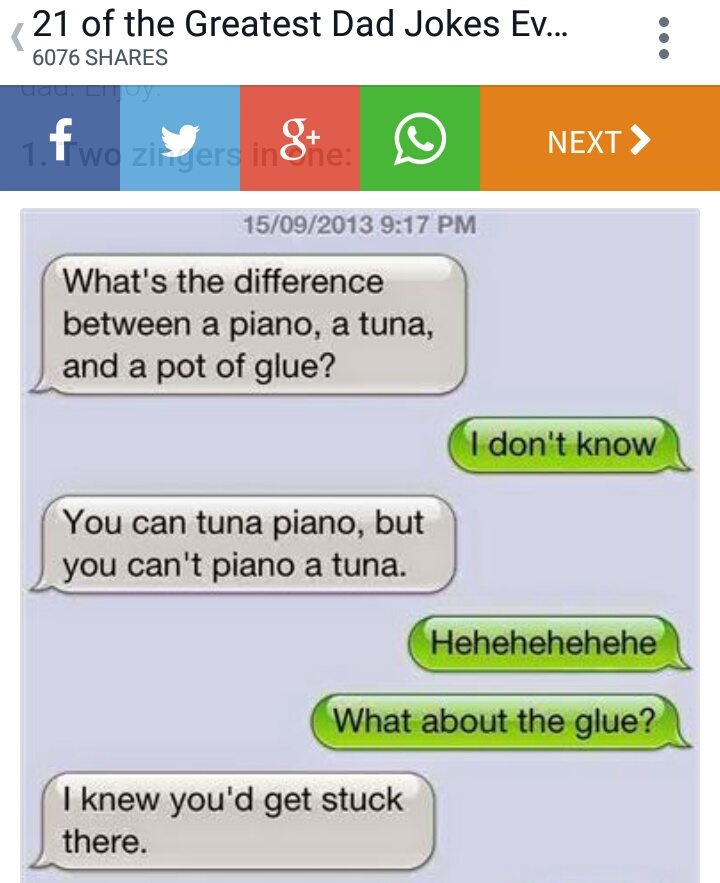
They whale 😦
Have a FINtastic week!
R <+>{