Register NOW for Free Webinar – WebCEPD B-1015 “Aquatic Veterinary Conservation Medicine” (October 31, 2015)

I’m posting this on behalf of the WAVMA.

Join us at 3:00 AM AEDT, Saturday, 31 October 2015.

Click on http://tinyurl.com/qzwa8qh for the correct time in your time zone.

Register now! https://attendee.gotowebinar.com/register/2316734041762760450

Speaker: Mohamed Faisal, DVM, PhD, CertAqV (Professor, Depts. Pathobiology & Diagnostic Investigation / Fisheries and Wildlife, College of Veterinary Medicine & College of Agriculture and Natural Resources, Michigan State University, USA).

About this webinar: In an aquatic habitat fish populations are subjected to a multitude of stressors, including disease. Over the last three decades, bacterial and viral pathogens have decimated fish populations throughout the world. Sometimes this results in large numbers of dead fish in marine and freshwater environments. In some cases high mortality may take a species to the brink of extinction. This presentation gives an overview of conservation medicine as an emerging veterinary discipline with an emphasis on the role played by aquatic veterinarians in rehabilitating wild fish stocks and managing fish health issues.

Learning Objectives

Participants will understand:
1. the discipline of Conservation Medicine.
2. the role played by pathogens in causing serious fish kills.
3. the role played by aquatic veterinarians in saving fish species from extinction.

About the Speaker

Professor Faisal started his aquatic veterinary professional career in 1977, when his doctoral thesis at the Veterinary School of the University of Munich, Germany, focused on the Spring Viremia of Carp Virus. Since then he practiced aquatic veterinary medicine in academia where he combined field observation, clinical examination, and laboratory studies harmoniously. His clinical experience included teleosts, molluscs, and amphipods. His research focused on understanding the host-pathogen interactions. Currently he directs the Aquatic Animal Medicine Program at Medicine, Michigan State University and oversees fish health issues for Michigan, including fishery rehabilitation programs. He is proud to have served as WAVMA President in 2013.

This webinar is suitable for veterinarians, vet techs/nurses, vet students and veterinary practice staff. Feel free to forward this announcement to colleagues.

Interested but can’t join the live webinar? If you register for the live webinar and are unable to attend, you will be e-mailed a link to view the webinar at a later time.

Want CEPD credit? (Registration is required)
Information on how to access the recorded webinar (at no cost), and a short knowledge & skills assessment (KSA or quiz) covering the webinar’s principle learning objectives, in order to earn veterinary Continuing Educational & Professional Development (CEPD) credit will be e-mailed to all registrants in 1-2 weeks after the webinar.

As CEPD credit can be used towards re-licensing or registration requirements to practice veterinary medicine, and requirements for becoming a WAVMA Certified Aquatic Veterinarian. We provide WAVMA Members a discount off the US$25.00 fee for earning CEPD credit ($5 for student members, $15 for all others).

Register now for this free live WAVMA WebCEPD webinar at https://attendee.gotowebinar.com/register/2316734041762760450. After registering, you will receive a confirmation e-mail containing information about joining the webinar.

View webinar System Requirements

WAVMA WebCEPD Program Coordinator

administrators

Discover more about the World Aquatic Veterinary Medical Association at www.WAVMA.org.

Get listed in the on-line Directory of Aquatic Veterinarians and subscribe to AquaVetMed e-News by registering at www.AquaVetMed.info.

Does Melafix and Pimafix work against fish skin flukes?

Just come across this interesting scientific paper.

I’ve to admit their findings are inconsistent with my field experience. I always make a diagnosis of trematodes even when they’ve treated with Pimafix, Melafix, or both.

The times I find challenging (where treatment worked to remove most ectoparasites) is when clients have used formalin-based chemicals, organophosphates, or anthelmintics. In these cases, I examine for evidence of microscopic damages in the skin and gills.

“Efficacy of commercially available products against Gyrodactylus turnbulli infections on guppies Poecilia reticulate”
>
Source: http://www.ncbi.nlm.nih.gov/pubmed/26203884
>
> Dis Aquat Organ. 2015 Jul 23;115(2):129-37. doi: 10.3354/dao02886.
>
> Efficacy of commercially available products against Gyrodactylus turnbulli infections on guppies Poecilia reticulata.
>
> Schelkle B1, Snellgrove D, Jones LL, Cable J.
>
> Author information
>
> 1School of Biosciences, Cardiff University, Museum Avenue, Cardiff CF10 3AX, UK.
>
> Abstract
>
> The demand for ornamental fish has led to a steep rise in aquaculture for the hobbyist trade, promoting the emergence, persistence and spread of various infectious diseases. Complete control of disease outbreaks with antibiotics and chemical-based medicines is rare, but plant compounds may herald potential alternatives effective against a range of pathogens. Melafix® and Pimafix® are formulated with the essential oils cajuput (Melaleuca cajuputi) and West Indian bay (Pimenta racemosa) and are marketed against bacterial and fungal infections, respectively. Previous experiments showed high efficacy of emulsified cajuput oil against gyrodactylids; the current study tested Melafix® and Pimafix® and their individual compounds against Gyrodactylus turnbulli infecting the guppies Poecilia reticulata. In particular, a combination treatment of Melafix® and Pimafix® was highly effective at reducing in vitro survival of parasites from 15 to 2 h and eradicating 95% of gyrodactylids in vivo. The unexpected high efficacy of this combination treatment is likely explained by the high content of terpenes and phenol propanoids in the cajuput and West Indian bay oils, as well as the anti-helminthic properties of the emulsifier Crovol PK 70. Hence, Melafix® and Pimafix® effectively reduce gyrodactylid burdens on fish, increasing the chances of efficient disease control in ornamental fish.
>

AgVet chemicals regulation reform – workshop dates

If you are an aquaculturist and may need to use veterinary medicines in the future, this will interest you.

The process is a public one – see www.agriculture.gov.au/agvet

I’ve made minor edits to the letter that was sent out to stakeholders.

R<+><

The Dept of Agriculture are reviewing the regulation of agricultural chemicals and veterinary medicines with the goal of lowering the cost of regulation and improving access for farmers and other users. They would like to hear more of what you have to say on these issues.

They’re looking to include those stakeholders that have a particular expertise and interest in AgVet Chemicals Regulation as they will be going in to some detail about the reforms they’re exploring.

As part of our stakeholder consultation, the Department of Agriculture and Water Resources will run a second series of workshops around the country. They would like you to attend so you can let them know what kind of reform would work best for you.

Specifically, they will seek stakeholder views on the details of some of the reforms they had discussed with stakeholders earlier in the year and to identify reforms that may be presented to government in the first half of 2016 for implementation soon after.

The workshops will also provide the opportunity for stakeholders to engage with each other about reform.

The first stakeholder engagement workshop was held in late April. Details of the reform approaches, issues, discussions and debates raised in those workshops will be published on our website in mid-October leading up to the next workshops.

The following day-long stakeholder engagement workshops will be held:

Canberra – Tuesday 27 October 2015

Perth – Thursday 29 October 2015

Brisbane – Monday 2 November 2015

Sydney – Monday 9 November 2015

Melbourne – Fri 13 Nov 2015

Feedback from these sessions will be used to develop a policy paper outlining the case for reform and presenting a package of proposed reforms. After this paper is released it will also be open for formal written submissions.

They will provide formal invitations and more details soon, but the agenda and topics will be the same for each workshop.

These sessions are open to anyone with an interest in the subject and we would appreciate it if you would share this email with others who may be interested.

Any questions or issues should be directed to agvetreform@agriculture.gov.au


Marc Kelly

Director, Agvet Chemical Reform Development and Implementation

Agvet Chemicals Regulation Reform | Sustainable Agriculture and Fisheries Division

Phone +61 2 6272 5485 | Mobile 0477 701 878| Email: marc.kelly@agriculture.gov.au

Department of Agriculture and Water Resources

18 Marcus Clarke Street, Canberra ACT 2601 Australia

GPO Box 858 Canberra ACT 2601 Australia

agriculture.gov.au/agvet


Follow me on: Facebook "Fin Page" – YouTube – Blog – Linkedin – Twitter

—
Yours sincerely,

Dr Richmond Loh DipProjMgt, BSc, BVMS, MPhil (Pathology), MANZCVS (Aquatics & Pathobiology), CertAqV, CMAVA, NATA Signatory.
Aquatic Veterinarian & Veterinary Pathologist
THE FISH VET, Perth, Western Australia, AUSTRALIA.
Mobile Aquatic Veterinary Medical & Diagnostic Services.
http://www.thefishvet.com.au
Ph: +61 (0)421 822 383
thefishvet_logo_medical-20130107.jpg
Skype: thefishvet

President WAVMA 2014

wavma.jpg?w=780

Adjunct Lecturer Murdoch University | Secretary Aquatic Animal Health Chapter – ANZCVS | 2014 President WAVMA

Looking for more books? Check out this site.

See advert on YouTube.

WAVMA Student scholarships.

The John L. Pitts Aquatic Veterinary Education Support Program

WAVMA assists veterinary students and fresh veterinary graduates to involve with aquatic veterinary medicine

Find out more here.

Help highlight the need for proper regulation of the vet nursing profession

GIVE Legal protection to the professional title ‘veterinary nurse’.

“Currently the title ‘veterinary nurse’ is not protected in law, and therefore anyone, even if they lack the relevant training and education, can refer to themselves as a veterinary nurse. The veterinary profession believes that this should change.

Registered veterinary nurses (RVNs) are true professionals, who can give medical treatment to, or carry out minor surgery on, animals. 

They follow a Code of Professional Conduct, keep their skills and knowledge up-to-date and are subject to a disciplinary process.”

Find the petition here –

https://www.linkedin.com/pulse/help-highlight-need-proper-regulation-vet-nursing-wendy-nevins

—
Yours sincerely,

Dr Richmond Loh 

DipProjMgt, BSc, BVMS, MPhil (Pathology), MANZCVS (Aquatics& Pathobiology), CertAqV, NATA Signatory.
THE FISH VET, Perth, Western Australia, AUSTRALIA. 

Mobile Aquatic Veterinary Medical & Diagnostic Services.
http://www.thefishvet.com.au
Ph: +61 (0)421 822 383

What’s the difference between a “veterinarian” and a “veterinary pathologist”? What is THE FISH VET?

Many people are familiar with what a veterinarian does. But how is it different from a veterinary pathologist?

I’ve copied these definitions from Wikipedia, with minor edits.

What is a veterinarian?
A veterinary physician, colloquially called a vet, shortened from veterinarian or veterinary surgeon, is a professional who practices veterinary medicine by treating disease, disorder, and injury in non-human animals. A veterinarian is a regulated and protected term, meaning that members of the public without the prerequisite qualifications and/or licensure are not able to use the title.  It is illegal for any person who is not registered to call themselves a veterinarian or prescribe any treatment.

What is a veterinary pathologist?
Veterinary pathologists are doctors of veterinary medicine who specialize in the diagnosis of diseases through gross examination, microscopic, and molecular examination of organs, tissues, and whole bodies (necropsy).

Other than the diagnosis of disease in animals, veterinary pathologists also have an important role in drug discovery and safety as well as in scientific research.

What is THE FISH VET?
At THE FISH VET,  you get the best of both worlds. Dr Loh is both a veterinarian (a Certified Aquatic Veterinarian at that), and is also a veterinary pathologist. He has successfully passed his Membership Examinations in the subjects of Aquatic Animal Health, and in Pathobiology. He also has a Masters in Veterinary Pathology.
image

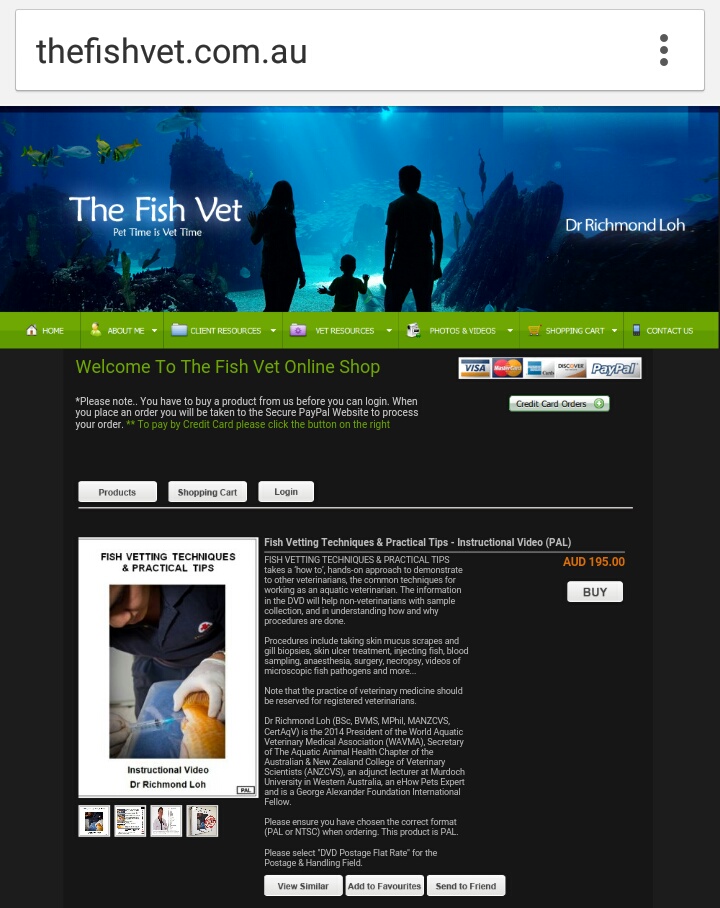
Fish Vetting Techniques and Practical Tips – instructional DVD is Now available!

Have you ever had sick fish and couldn’t get decent help for a diagnosis and cure?

Are you looking for a career in aquatic animal health?

Are you an aspiring aquatic veterinarian and would like to learn the ropes, with no one to show you?

Then, “Fish Vetting Techniques & Practical Tips – instructional video” is for you.

Why did I create this DVD? Well, from those leading questions, you can see that it’s a fish welfare issue as much as it is to help other veterinarians and fish keepers look after fish.

The title is exactly what it says it is, and there is no substitute.

FISH VETTING TECHNIQUES & PRACTICAL TIPS takes a ‘how to’, hands-on approach to demonstrate veterinary skills employed in working as an aquatic veterinarian. The 105 minute DVD comprises veterinary procedures including taking skin mucus scrapes and gill biopsies, skin ulcer treatment, injecting fish, blood sampling, anaesthesia, surgery, necropsy, histology processing, videos of live microscopic fish pathogens and more… That’s right, I’m giving away all my secrets so that fish clients can have greater access to trained aquatic veterinarians no matter where they are in the world.

This DVD is ideal for fish veterinarians, aquarists, aquaculturalists, public aquaria, local fish shops and to have handy as a training resource in veterinary schools, laboratories, clinics and zoos. It is a comprehensive resource that incorporates aquatic medicine and pathology.

Read more here – http://tinyurl.com/fvet-tech-dvd

Make your purchase NOW at http://thefishvet.com.au/shop/shopping.html

Follow me on: Facebook "Fin Page" – YouTube – Blog – Linkedin – Twitter

—
Yours sincerely,

Dr Richmond Loh
DipProjMgt, BSc, BVMS, MPhil (Pathology) Murdoch, MANZCVS (Aquatics & Pathobiology), CertAqV.
Aquatic Veterinarian | Adjunct Lecturer Murdoch University | President WAVMA |
Secretary Aquatic Animal Health Chapter – ANZCVS.
The Fish Vet, Perth, Western Australia, AUSTRALIA.
Mobile Veterinary Medical & Diagnostic Services for fish and other aquatic creatures.
http://www.thefishvet.com.au
Ph: +61 (0)421 822 383
Skype: thefishvet

Looking for more books? Check out this site.

Fish Vetting Essentials – take advantage of the low AUD and Get yours today!

Tired of contradictory information overload?

The official Fish Vetting Essentials is available for sale online!

The original handbook, published in 2007, is widely used in veterinary schools, labs, clinics and even zoos.

Like many of you, I’ve found that reliable information on fish health, disease and medicine are difficult to come by and is at best, fragmented. This book has been in preparation since 2001, and it is a compilation of essential information for veterinarians to successfully and confidently attend to fish patients – in particular, how to diagnose common fish diseases, how to medicate and treat fish diseases using drugs available in their surgery. It is also of value to advanced aquarists, fish farmers, retailers and wholesalers. Also, it would be useful at times when a fish veterinarian may not be available locally, pet fish owners may bring this book along with them to a general veterinary practitioner. This book is recommended reading for the WAVMA (World Aquatic Veterinary Medical Association) Credentialing Certification, and also for the Membership Examinations in Aquatic Animal Health at the Australian and New Zealand College of Veterinary Scientists.

The is a comprehensive resource that incorporates elements of fish keeping, clinical medicine and fish pathology.

Important information for fish health practitioners in this edition include:
• how to diagnose common fish diseases
• how to medicate fish
• how to treat fish diseases using drugs available in your surgery.

View Sample ePages: https://thefishvet.com/wp-content/uploads/2011/10/efishvetessentialswlinks.pdf

To order your copy of the latest Fish Vetting Essentials (only AUD$99 per copy plus postage and handling), visit http://www.thefishvet.com.au/

Book testimonials :

Once in a while comes a book that has the potential to become indispensable to zoos and aquariums.
Pet Scandinavia
Mr Svein A. Fosså

<><

I highly recommend Fish Vetting Essentials as a concise, easy to follow reference for both vets in practice and veterinary students. It provides excellent information on fish husbandry, disease diagnosis and treatment, supported by colour photos. A must have for any vet with an interest in fish.

Dr Kristin Warren
Senior Lecturer in Wildlife and Zoo Medicine
Academic Chair, Postgraduate Studies in Conservation Medicine
School of Veterinary and Biomedical Sciences
Faculty of Health Sciences, Murdoch University,

<><

As a veterinary clinician with an interest in the “unusual and exotic” fish species, I am frequently asked to consult with clients who present their fish for examination, diagnosis and treatment. I have an extensive medical library, and my 2007 copy of Australian Fish Vetting Essentials is by far the most useful reference on fish diseases and fish treatments.

I eagerly await the 2011 edition and hope my fellow veterinary clinicians who have an interest in fish diagnosis and treatment will join me in being one of the first to buy this essential resource for the reference shelf.

Dr James M Harris BSc, DVM, FRSPH
Mayfair Veterinary Clinic
Sandy Bay, Tasmania

<><

I use “Australian Fish Vetting Essentials” as my first reference for matters pertaining to aquatic animal health. Its clear, concise layout and colour photographs make it a highly practical source of information, and the local perspective on diseases and taxa relevant to Australia is particularly valuable. The information on diagnostic sample collection and treatment is easy to follow and has enabled us to develop the skills necessary to manage disease cases in fish effectively.

I highly recommend “Australian Fish Vetting Essentials” for veterinarians dealing with aquatic species.

Dr Simone Vitali BSc, BVMS, PhD, MACVS (Zoo Animal Medicine)
Senior Veterinarian
Perth Zoo

<><

I have owned a veterinary general practice for 30 years and my copy of Australian Fish Vetting Essentials (2007) has been an excellent resource for me when I am asked to treat exotic aquarium fish.

Previously the only readily available information on treating and diagnosing fish were anecdotal, unreliable and outdated popular press publications or high-end scientific material that was not useful from a practical point of view.

Australian Fish Vetting Essentials is concisely written and contains everything a general practitioner needs to take a logical, helpful approach to aquarium fish problems.

Dr Owen Lavers BVSc
Earlville Vet Surgery
Cairns, Queensland