Forums are a great place for hobbyists to help each other out. And it’s always a good place for beginners. However, when issues become a little more complex, misinformation may sometimes appear due to misinterpretation of research or when information is utilised in isolation.
My one sentence summary would be – be careful what you believe because many people can sound very convincing.
An example is provided below. What do you think of this post about successful treatment of hexamitiasis?
This was forwarded to me by my client (details of the author and forum has been suppressed):
Treating for Hexamita aka Spironucleus Treating Hexamita aka Spironucleus with Epsom Salt Solution
This is a rather safe way to treat any newly imported fish, as a prophylactic, just as one would use a de-wormer. It’s not
only an extremely cheap way to treat fish, the active ingredients are readily available world-wide, and it’s also much
safer than using most forms of medication. Unlike most medications, there should be no worries about flagellates/
pathogens building up a resistance to it, and excess magnesium is easily flushed from a fishes system. In my
experience, it’s very easy on fish, even very young juvenile fish. The best part – it works! (If the fish has worms when
arriving, the epsom salt solution in the feed will also help with purging any worms) While Metronidazole has always been the drug of choice when combating internal parasites such as hexamita and/or
spironucleus, metro (or any other type of medication) should never be used on a regular basis as a prophylactic, and
doing so may cause flagellates/parasites to develop a resistance to the medication, and possibly even mutate and
become super bugs. It’s also been stated by at least one researcher that excessive use of metronidazole can cause
organ damage in fish. “In fish, an excessive use of metronidazole can damage kidneys and other internal organs.(Bassleer, 1983)” Other cons with metronidazole is its solubility in water is very poor, in aquarium settings it has been suggested that it
can precipitate out of solution within 6-8 hours, and it can become rather expensive when treating large systems. While doing some online research on spironucleus I came across an interesting study that mentioned the use of
Magnesium sulphate (Epsom salt) in treating internal parasites in angel fish. http://scholar.lib.vt.edu/theses/ava…cted/ANGEL.PDF A long read (200+ pages) but the idea of using something as basic as epsom salt to treat internal parasites in fish
intrigued me, which in turn lead me to dig deeper. This is where it got interesting …….. The Israeli Journal of Aquaculture – Bamidgeh 57(2), 2005, 97-104. http://siamb.org.il/uploads/57_2_Ogut.pdf “Mortality ceased with application of medicated feed (magnesium sulfate at 3% of the feed)” – Hexamita salmonis. “In early June 2004, a treatment of magnesium sulfate (3% of feed for three days) lowered the parasite load to almost
undetectable levels.” In his book; Fish Disease: diagnosis and treatment, Edward J. Noga mentions treating hexamita (spironucleus) orally
with Magnesium sulphate. This is certainly encouraging news for anyone who’s fish is still eating, or begins eating after treatment with Metro. Not
only does Epsom salt assist in recovery when added directly to the aquarium (as per the links above), but according to
the research posted above it has a deadly effect on hexamita when ingested. Dr. Edward J. Noga, MS, DVM, is a highly respected professor of aquatic medicine and immunology, and he has been
published approx. 150 times in related papers/journals. His lab at NC State University specializes in the study of
infectious diseases of finfish and shellfish. As a side note for Discus keepers, Dr. Noga’s book on fish disease is the
book that Andrew Soh often refers to for disease/treatment information. Now for the treatment …… For a 3% solution of Magnesium sulphate, add 1 level tablespoon (15 grams) magnesium sulphate to 500 milliliters of
distilled water. Stir, and it’s good to go. Use an eye dropper or pipette to add to pellet food (or any other food that will readily absorb it), and stop dripping water
once the pellets become saturated. Use only enough water to saturate the food, with no excess water, so that the water
soluble vitamins in the food remain intact. Feed twice a day, for 3-5 days. (I went with 5 days) In extreme cases, the oral solution could be administered to a fish via a pipette.Just make sure to use a flexible tip so
as not to damage the fishes esophagus when squirting the solution down the fishes throat. Only a small amount is
required, but repeat daily until the fish is accepting pre-soaked pellets, and continue treatment for 5 days. My own experience with this treatment …….. so far it’s proven to be a life saver, where all other previous ‘textbook’
methods of treatment for internal parasites have failed, including several days of treating with 500mg Metro per 10
gallons, while feeding Metro soaked food at the same time. (fish was chewing & spitting, but was eating some food
twice a day) In less than 48 hrs of the 3% Magnesium sulphate treatment, for the first time in 30 days the fish was no longer
shedding the mucous lining of his intestine. (white/clear feces) After 5 days of feeding the 3% solution via pellets, the
fish had made a complete recovery & was back eating like gang busters. Hopefully some members here will find this information useful.
My response:
I’ve read your email and read the articles given by the two links.
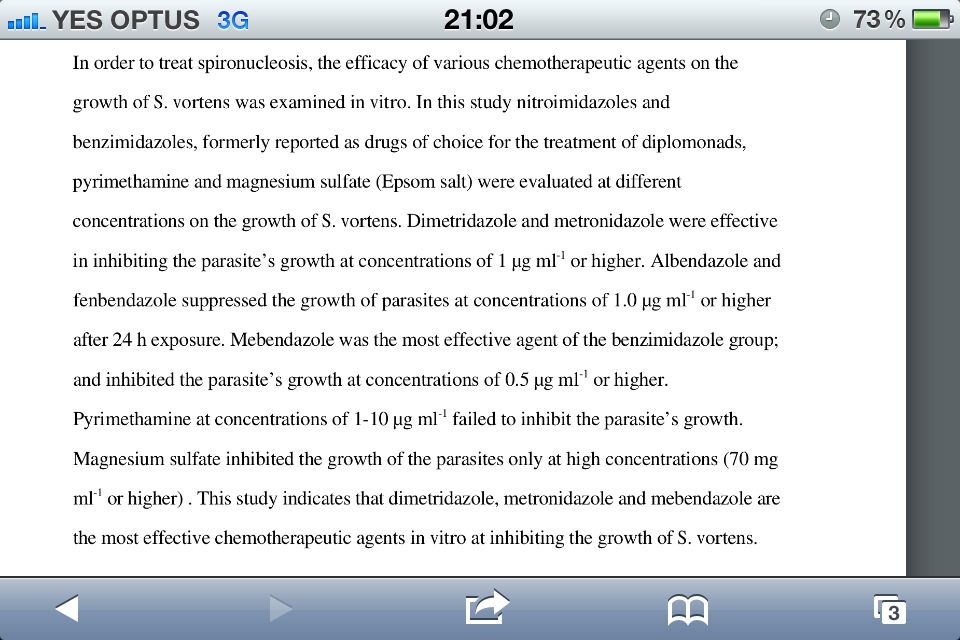
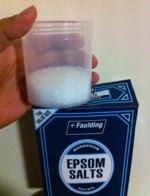
In the first link (the link didn’t work but i found the article at http://scholar.lib.vt.edu/theses/available/etd-120399-140825/unrestricted/ANGEL.PDF), the last line states that dmz & metro are the best (see picture below). Also note that these experiments were done in vitro (meaning in a test tube, not in live fish). So any effects they found with Epsom salt, would be debatable since I think it might be due to osmotic challenge/dehydration in effect. In their experiment they used 70mg/ml (which would be equivalent to 70g/L). This would be very hard water.
I’ve measured out 70g of Epsom salt for 1L of water in the picture below.
I trailed it with my own Tropheus duboisi and he showed distress within 5-10 minutes of being in a solution of that concentration. At 15 minutes, he became positive buoyant, with his dorsal fin and back above the water surface, had laboured opercular movements and started to lose balance, tilting to the side. There was also a slight increase in mucus production over the operculum. I doubt that a bath treatment of this duration can create an effect on the internal parasites.
The second link
The Israeli Journal of Aquaculture – Bamidgeh 57(2), 2005, 97-104.http://siamb.org.il/uploads/57_2_Ogut.pdf”
It doesn’t say how it worked, but I’m thinking it caused the fish to have diarrhoea and effectively ‘flushed out’ the parasites. This would work in a flow through system as they had described, but in a recirculating aquarium situation, I think flushing out the parasites from the gut may lead to massive reinfection and spread of the disease.
In Noga’s text, Epsom salt at 3% in feed for 2-3days is described as being useful to treat salmonids of hexamitosis. From my experience working in Tasmania, salmonids are typically reared in flow through systems. Again, flushing out the gut of parasites are effective unless you’re operating a recirculating system (which most private home aquaria have).
In summary, there is a lot of good free information available out there, but you’d need the wisdom to interpret them.