What are fish veterinarians? What do they do?

Whenever I meet new people, and whenever some stranger sees the plates on my car, everyone asks with surprise,"What is a fish vet?" I think in my head…, "What a FAQ!"

Why do some veterinarians call themselves fish vets, aquatic vets or aquarium vets? These terms are used synonymously by my colleagues and me. Who are the veterinarians that call themselves aquatic veterinarians?

In Australia, there are 21 recognised veterinary specialties (see link). Some veterinarians specialise in surgery, dentistry, radiography or pathology. Aquatic veterinarians take on extra training and interest in aquatic animal health beyond their BVMS, BVSc, DVM or VMD. Some pursue a formal post-graduate aquaculture degrees or courses, and eventually sit rigorous examinations in aquatic animal health (e.g. ANZCVS Membership and Fellowship Examinations – see link), to complement their veterinary training. Those Veterinarians who have had significant skills and experience, looking to be a certified aquatic veterinarian can do so through the WAVMA’s CertAqV program (see link).

Moreover some aquatic veterinarians have additional qualifications that help them provide their clients with yet another perspective to solving their problems. Those with backgrounds in veterinary pathology and veterinary epidemiology are particularly useful, depending on the issues that need to be resolved.

Aquatic veterinarians work in a variety of roles. They can attend to your sick pet goldfish, treat sharks at public aquaria, help solve problems aquaculturists have, teach at educational institutions, do research and development (of new diagnostic tools), work in veterinary pathology laboratories, or work with national and international bodies on policies that affect aquatic animal health. At TheFishVet, these are only some of the many works we do.

So, no matter how aquatic veterinarians come to be, we thrive amid the challenging environment where every case is different, and a large degree of practical lateral thinking is required. Together we are pushing the boundaries of knowledge in aquatic veterinary medicine.

We are ready to serve the public, its fishes, and the veterinary profession by providing high quality service in the discipline of aquatic animal health.

Follow me on: Facebook "Fin Page"YouTubeBlogLinkedinTwitter


Yours sincerely,

Dr Richmond Loh DipProjMgt, BSc, BVMS, MPhil (Pathology), MANZCVS (Aquatics & Pathobiology), CertAqV, CMAVA, NATA Signatory.
Aquatic Veterinarian & Veterinary Pathologist
THE FISH VET, Perth, Western Australia, AUSTRALIA.
Mobile Aquatic Veterinary Medical & Diagnostic Services.
http://www.thefishvet.com.au
Ph: +61 (0)421 822 383
thefishvet_logo_medical-20130107.jpg
Skype: thefishvet

President WAVMA 2014

wavma.jpg?w=780

Adjunct Lecturer Murdoch University | Secretary Aquatic Animal Health Chapter – ANZCVS | 2014 President WAVMA

See advert on YouTube.

Investigation after 700 fish wash up on shore at Cockburn Sound | Perth, Western Australia

This is worrying…

Read more here –
http://www.perthnow.com.au/news/western-australia/investigation-after-700-fish-wash-up-on-shore-at-cockburn-sound/news-story/4641241a4afa1b151de07c05a1909c9f?sv=d06efe80c72d9507f111ba3bac1bb22a&utm_source=Perth%20Now&utm_medium=email&utm_campaign=editorial

Fish Joke for Monday-itis: What did the aquarist say to his two loaches?

Come here both ya! (Botia sp.) 

With thanks to AL.
 
Have a FINtastic week! R <+>{

Follow me on: Facebook “Fin Page” – YouTube  – Blog –Linkedin – Twitter
 

Yours sincerely,

Dr Richmond Loh 

DipProjMgt, BSc, BVMS, MPhil (Pathology), MANZCVS (AquaticsPathobiology), CertAqV, CMAVA, NATA Signatory.
THE FISH VET, Perth, Western Australia, AUSTRALIA. 

Mobile Aquatic Veterinary Medical & Diagnostic Services.
http://www.thefishvet.com.au
Ph: +61 (0)421 822 383

Skype: thefishvet


President WAVMA 2014


Adjunct Lecturer Murdoch University | Secretary Aquatic Animal Health Chapter – ANZCVS.

Medicine and Management of Aquaculture Species – ANZCVS MEMBERSHIP Examinations GUIDELINES.

Do you think you have sufficient knowledge of and experience in aquatic animal health? Would you be game to be examined, and earn the post-graduate qualifications to be a Member of the Aquatic Animal Health Chapter of the ANZCVS?

Then see the revised guidelines that has been uploaded to the ANZ College of Veterinary Scientists website at this link (if link doesn’t work, right-click and select "save target as").

On another note, I’m glad to say that a couple of my publications are in the recommended reading lists 🙂

Fish clinical medicine:

Loh, R & Landos M. 2011. Fish Vetting Essentials. Richmond Loh Publishing, Perth.

Text Books – not essential but useful for reference if available

Loh, R. 2013. Aquatic Veterinary Medicine – Specific to cultured, display and wild aquatic life. ISS Institute. (download free)

Follow me on: Facebook "Fin Page" YouTube Blog Linkedin Twitter


Yours sincerely,

Dr Richmond Loh
DipProjMgt, BSc, BVMS, MPhil (Pathology), MANZCVS (Aquatics & Pathobiology), CertAqV, CMAVA, NATA Signatory.
Aquatic Veterinarian & Veterinary Pathologist
THE FISH VET, Perth, Western Australia, AUSTRALIA.
Mobile Aquatic Veterinary Medical & Diagnostic Services.
http://www.thefishvet.com.au
Ph: +61 (0)421 822 383
Skype: thefishvet

President WAVMA 2014

Adjunct Lecturer Murdoch University | Secretary Aquatic Animal Health Chapter – ANZCVS | 2014 President WAVMA

See advert on YouTube.

Fish hook removed from Paris Hilton (the oblong turtle).

“It’s quite common to see injuries caused by rubbish and debris that’s been left in the water,” she said.

“If you do accidentally hook a turtle, don’t just cut the line and let it go because that turtle will die slowly.

“Grab that turtle and take it straight to a vet clinic.”

Read more here.

Easy Guide to Health Screening of post-larvae (PL) prawns – a must read!

Examining PL health status of shrimp can be challenging. However, this management tool can be the difference between achieving maximum success, or become the beginning of your problems.

Investing on training and hatchery management strategies to improve post-larvae health status is not waste of money or time.

Having high quality prawn post-larvae guarantees great economic return for your business.

In the document link below, we provide a simplified Guide for screening PL quality.

How to choose post-larvae prawns.pdf

Follow me on: Facebook "Fin Page" YouTube Blog Linkedin Twitter


Yours sincerely,

Dr Richmond Loh
DipProjMgt, BSc, BVMS, MPhil (Pathology), MANZCVS (Aquatics & Pathobiology), CertAqV, CMAVA, NATA Signatory.
Aquatic Veterinarian & Veterinary Pathologist
THE FISH VET, Perth, Western Australia, AUSTRALIA.
Mobile Aquatic Veterinary Medical & Diagnostic Services.
http://www.thefishvet.com.au
Ph: +61 (0)421 822 383
Skype: thefishvet

President WAVMA 2014

Adjunct Lecturer Murdoch University | Secretary Aquatic Animal Health Chapter – ANZCVS | 2014 President WAVMA
See advert on YouTube

Veterinarians are cooler than physicians.

[veterinarians are] the medical equivalent of the Swiss Army knife!

Read more here –
http://veterinarybusiness.dvm360.com/veterinarians-are-cooler-physicians

What are the major disease risks when introducing new koi fish?

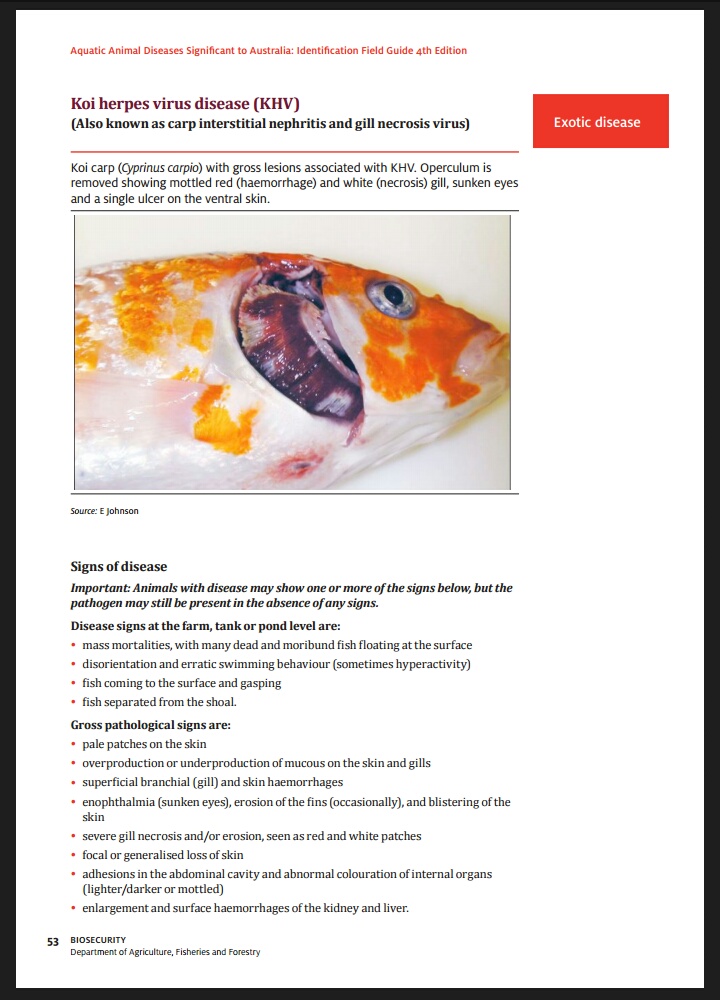
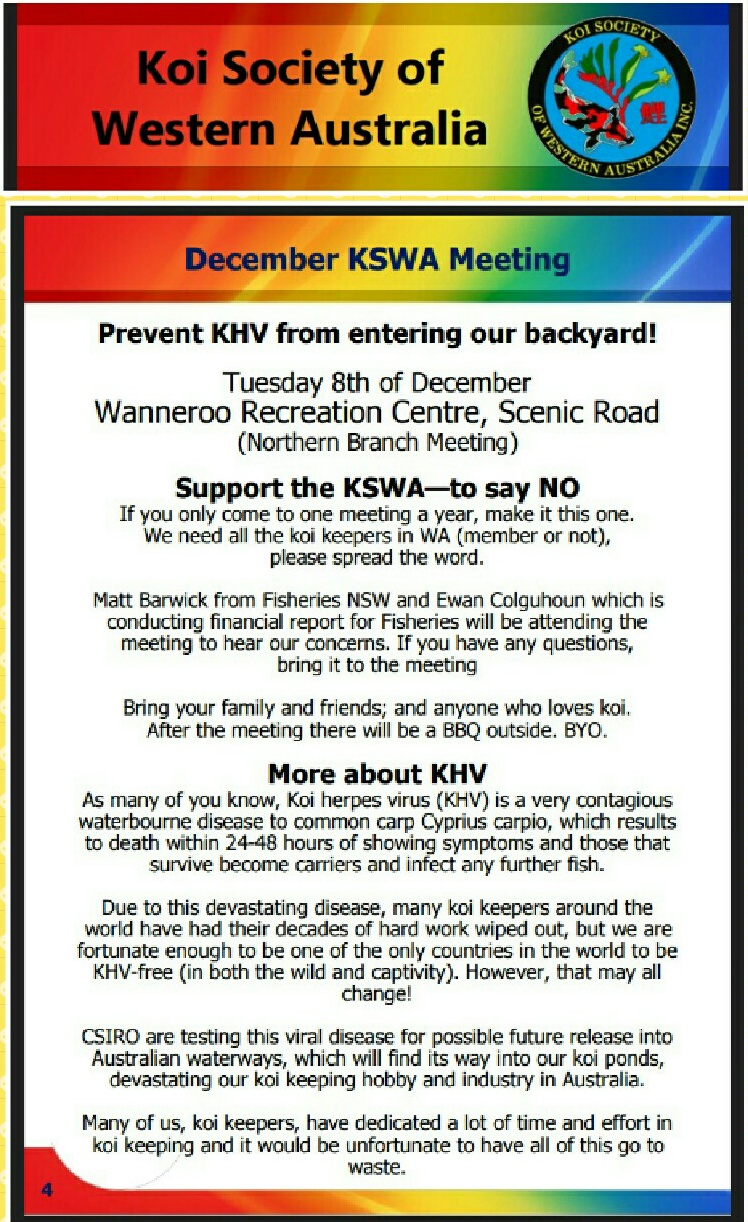
The biggest threat to our prized koi fish is Koi Herpesvirus (KHV is currently exotic to Australia) and bacterial diseases. Such disease agents can spell disaster because they can happen so quickly and cause very high death rates. Working on the assumption that any new koi could introduce any of these diseases, I have provided some measures to mitigate risks in the document below.

New Koi Protocol.pdf