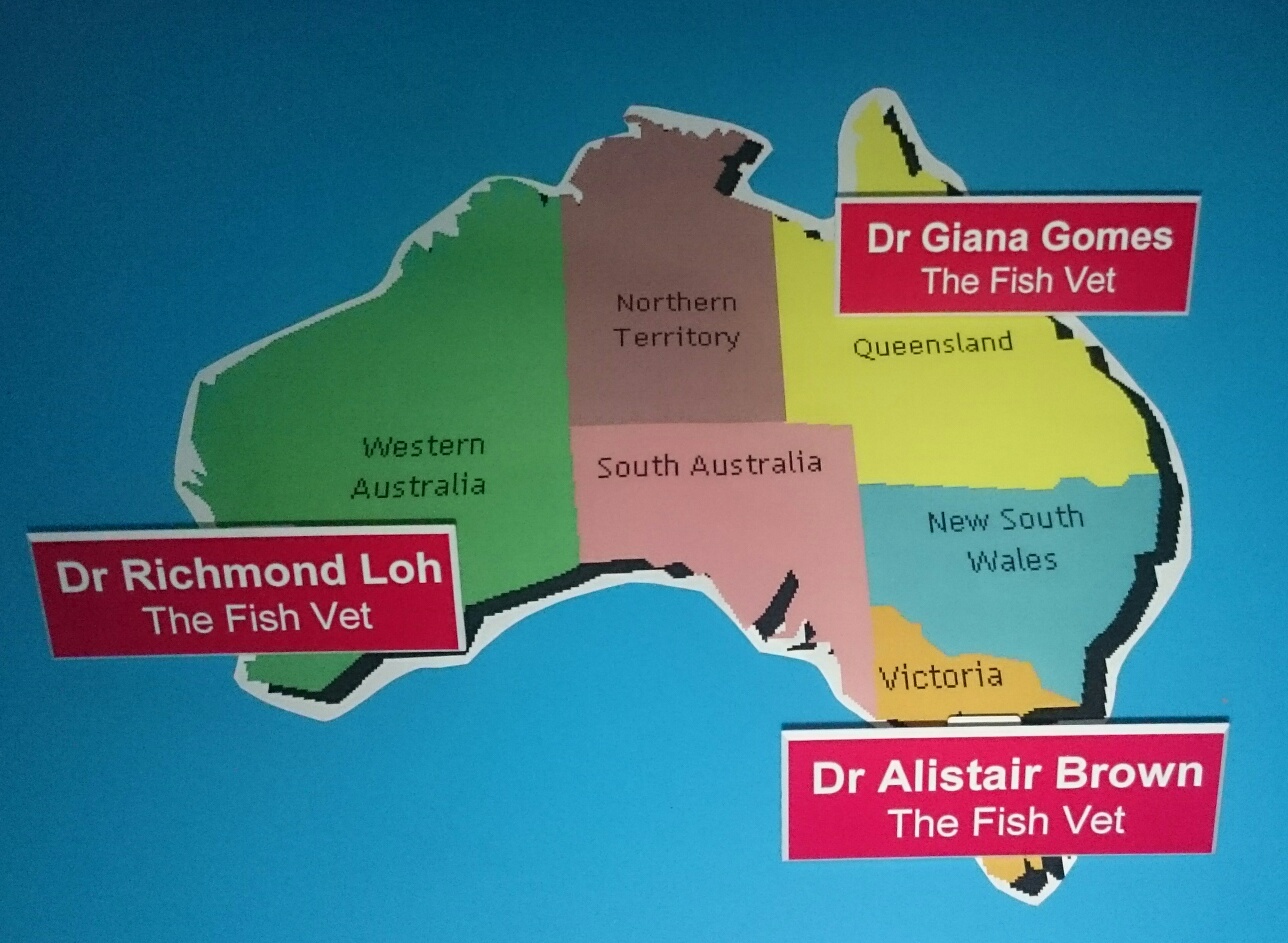
We now have representatives in Perth (WA), Townsville (Qld), and Melbourne (Victoria).
Contact us now, to give your fish a health check-up.
http://thefishvet.com.au/contact_us.html
All about Fish Vetting – Dr Richmond Loh
We now have representatives in Perth (WA), Townsville (Qld), and Melbourne (Victoria).
Contact us now, to give your fish a health check-up.
http://thefishvet.com.au/contact_us.html
Government of Western Australia media statement – Fisheries Minister Ken Baston and Environment Minister Albert Jacob
Media statement
Four millionth prawn for Swan and Canning rivers:
Fishing licence fees help support restocking projects in WA
Brings to four million the number of juvenile prawns released since 2013
Successful prawn breeding techniques developed in Western Australia are improving restocking efforts in the Swan and Canning rivers, with another 1.5 million juvenile prawns released so far during 2015-16.
The latest release of 400,000 western school prawns occurred today near Canning Bridge and Matilda Bay – all cultured by the Australian Centre for Applied Aquaculture Research (ACAAR) in Fremantle.
The Department of Parks and Wildlife, Department of Fisheries, Recfishwest, the WA Fish Foundation, ACAAR, Murdoch University, Prawn Watch and the Fisheries Research and Development Corporation are working together on the project.
Fisheries Minister Ken Baston said the partnership between government and community groups was helping restore the popular recreational activity of prawning for Perth families.
The historically popular recreational drag netting for prawns had all but disappeared as prawn numbers fell over time. Restocking began in 2013, using fishing licence fees to fund the project.
Between May 2013 and March 2015, 2.5 million juvenile prawns were released into the rivers. Another 1.1 million prawns were released in December 2015. The release this week brings the total number to four million.
“The prawn culture work by ACAAR has stepped up release rates as the staff involved refine their techniques and knowledge,” Mr Baston said.
“This is another example of how recreational fishing licence fees are being re-invested in projects to benefit recreational fishing.”
Environment Minister Albert Jacob said the restocking work had been run in conjunction with the citizen science Prawn Watch program, to encourage stewardship of the rivers.
“We are keen to see the community connect with the river and to experience the pleasure of prawning. They can share information on their catch with us by using the Prawn Watch app,” Mr Jacob said.
Follow me on: Facebook "Fin Page" – YouTube – Blog – Linkedin – Twitter
—
Yours sincerely,
Dr Richmond Loh
DipProjMgt, BSc, BVMS, MPh (Pathology), MANZCVS (Aquatics & Pathobiology), CertAqV, CMAVA, NATA Signatory.
Aquatic Veterinarian & Veterinary Pathologist
THE FISH VET, Perth, Western Australia, AUSTRALIA.
Mobile Aquatic Veterinary Medical & Diagnostic Services.
http://www.thefishvet.com.au
Ph: +61 (0)421 822 383
Skype: thefishvet
President WAVMA 2014
Adjunct Lecturer Murdoch University
Looking for more books? Check out this site.
See advert on YouTube.
Our TheFishVet team member, Giana Bastos Gomes, was the overall winner of the 2016 Science and Innovation Award for Young People in Agriculture, Fisheries and Forestry in Australia. Giana is creating a digital device to identify the type and quality of a pathogen on an aquaculture farm. This will avoid the long wait while samples are analysed off site, and allow farmers to treat fish before they show signs of infection. Originally from Brazil, Giana is completing a PhD at James Cook University in Townsville, Australia, with support of the Fisheries Research and Development Corporation. Mandy Gyles spoke with Giana after she received her prize.
https://soundcloud.com/mandygyles/detecting-fish-pathogens
Follow me on: Facebook "Fin Page" – YouTube – Blog – Linkedin – Twitter
—
Yours sincerely,
Dr Richmond Loh DipProjMgt, BSc, BVMS, MPh (Pathology), MANZCVS (Aquatics & Pathobiology), CertAqV, CMAVA, NATA Signatory.
Aquatic Veterinarian & Veterinary Pathologist
THE FISH VET, Perth, Western Australia, AUSTRALIA.
Mobile Aquatic Veterinary Medical & Diagnostic Services.
http://www.thefishvet.com.au
Ph: +61 (0)421 822 383

Skype: thefishvet
President WAVMA 2014
Adjunct Lecturer Murdoch University
Dolphins, trumpeter, and now sharks in the Swan River! The waterways have really deviated from pre-European times. There are even artificial oxygenation plants to “improve the health of the rivers.”
—
Yours sincerely,
Dr Richmond Loh
DipProjMgt, BSc, BVMS, MPhil (Pathology), MANZCVS (Aquatics& Pathobiology), CertAqV, NATA Signatory.
THE FISH VET, Perth, Western Australia, AUSTRALIA.
Mobile Aquatic Veterinary Medical & Diagnostic Services.
http://www.thefishvet.com.au
Ph: +61 (0)421 822 383
A: swimming trunks
Have a FINtastic week! R <+>{
The WAVMA have a great site on Veterinary Student Externships.
I’ve been asked many times, what’s the best crash course you can do for aquatics. If you’re into Aquatic Veterinary Pathology, you cannot go past the Aquavet 2 course. I, and a number of my colleagues, have been fortunate enough to attend this very excellent course. Not only is the content great, but you forge a lot of networks especially because you’re with a tight-knit group, with similar interests, learning from sunrise through till after dinner, staying in the same quarters for the intensive course. The teachers are experts in their fields and are approachable and happy to help even years after you’ve attended the course.
Read more about the content in this report I prepared for the FRDC.
—
Yours sincerely,
Dr Richmond Loh
DipProjMgt, BSc, BVMS, MPhil (Pathology), MANZCVS (Aquatics& Pathobiology), CertAqV, NATA Signatory.
THE FISH VET, Perth, Western Australia, AUSTRALIA.
Mobile Aquatic Veterinary Medical & Diagnostic Services.
http://www.thefishvet.com.au
Ph: +61 (0)421 822 383
a synopis
This postgraduate unit will equip students with advanced knowledge in the discipline of aquatic biosecurity essential for developing policies involving biosecurity, protection of natural ecosystems and safeguarding aquaculture food production and aquatic livelihoods. Students will gain an understanding of complex interactions between infectious and non-infectious factors that impact aquatic animal health, human activities that impact aquatic biosecurity, and develop specialised technical skills via field visits to natural ecosystems, aquaculture facilities, processing plants for aquatic products, and laboratory sessions.
There will be two intensive 4-day workshops:
29th Mar – 01st Apr 2016 and
26th – 29th Apr 2016
These two intensive workshops will comprise of lectures, labs and field trips. These activities will be held at the lecture theatre (VBS3.023) and teaching laboratory (VBSEC3.107) in the Veterinary Biology Building, Murdoch University. The venue of field trips will be advised at the start of each workshop.
The first workshop is designed to give a background on diseases of aquatic organisms and impart practical skills in investigating aquatic disease outbreaks. Guest speakers will give a variety of lectures around aquatic biosecurity. These lectures will likely be given in the format of approximately 30-40 minute presentations, each followed by a 20-30 minute discussion forum. There will be ample opportunities to interact, ask questions and seek the opinions of presenters as well as other participants around the topic of Aquatic Biosecurity during the workshops.
The second workshop will be focused on current issues around aquatic biosecurity, such as the impact of invasive alien aquatic species, preserving the health of natural aquatic ecosystems and native fish from threats of increasing anthropogenic activities, the principles of assessing environmental impacts from aquaculture activities, biosecurity vs fish health management, translocation of aquatic disease and organisms, and the benefits of aquaculture zoning.
For more information, please see http://handbook.murdoch.edu.au/units/details?unit=BIO606
Or download this document
BIO606 2016 Workshop programs.pdf
Please contact the unit coordinator, Dr Susan Gibson-Kueh at S.Kueh@murdoch. edu.au, to lodge an expression of interests.
Follow me on: Facebook "Fin Page" – YouTube – Blog – Linkedin – Twitter
—
Yours sincerely,
Dr Richmond Loh
DipProjMgt, BSc, BVMS, MPh (Pathology), MANZCVS (Aquatics & Pathobiology), CertAqV, CMAVA, NATA Signatory.
Aquatic Veterinarian & Veterinary Pathologist
THE FISH VET, Perth, Western Australia, AUSTRALIA.
Mobile Aquatic Veterinary Medical & Diagnostic Services.
http://www.thefishvet.com.au
Ph: +61 (0)421 822 383
Skype: thefishvet
President WAVMA 2014
Adjunct Lecturer Murdoch University
Media Release from the Hon. Barnaby Joyce MP, Deputy Prime Minster and Minster for Agriculture and Water Resources.
Young Innovators Driving the Next Generation of Ag Productivity
Barnaby Joyce, yesterday welcomed the latest crop of leading young researchers, innovators and scientists to emerge in the development of smarter and more profitable agricultural, fisheries and forestry industries in Australia.
Minister Joyce said 12 young Australians had been selected to receive a share of $260,000 in grants to further research that will drive the ongoing success of Australia’s farming future.
“The Science and Innovation Awards for Young People in Agriculture, Fisheries and Forestry recognises the best emerging Australian talent in our rural industries and rewards them with grants of up to $22,000,” Minister Joyce said.
“These are the innovators who will underpin Australia’s ability to meet the growing global demand for high-value, high-quality produce across our primary industries.
“It’s exciting work for those who understand the implications.”
Each year, one grant recipient is also selected to receive the Minister’s Award for an extended research project with additional grant funding.
“I am pleased to announce that the 2016 Minister’s Award winner is Giana Bastos Gomes from James Cook University,” Minister Joyce said.
“Giana is working to prevent catastrophic disease outbreaks on aquaculture farms by creating a digital device to identify diseases at the source and avoid a time-consuming wait for samples to be analysed off-site.”
“This would enable farmers to treat their fish before they show signs of infection – it is research that couldn’t be more timely, or important to securing our export future and the returns our primary producers receive.”
Follow me on: Facebook "Fin Page" – YouTube – Blog – Linkedin – Twitter
—
Yours sincerely,
Dr Richmond Loh
DipProjMgt, BSc, BVMS, MPh (Pathology), MANZCVS (Aquatics & Pathobiology), CertAqV, CMAVA, NATA Signatory.
Aquatic Veterinarian & Veterinary Pathologist
THE FISH VET, Perth, Western Australia, AUSTRALIA.
Mobile Aquatic Veterinary Medical & Diagnostic Services.
http://www.thefishvet.com.au
Ph: +61 (0)421 822 383
Skype: thefishvet
President WAVMA 2014
Adjunct Lecturer Murdoch University


Click on https://attendee.gotowebinar.com/register/5521269479844781313

About this webinar: This presentation will give an overview of well-known and emerging tilapia bacterial and viral diseases. As a commercially important food fish, tilapia are the second-most common farmed finfish species, worldwide, belonging to the family Cichlidae. Although they are hardy, prolific, fast-growing tropical fish, and have been farmed for more than 2,500 years, with intensive aquaculture production there has been an increase in incidence and severity of disease. This webinar is suitable for veterinarians, vet techs/nurses, vet students and veterinary practice staff.
Learning Objectives – participants will understand:
1. Important common and emerging viral and bacterial diseases in tilapia;
2. How these disease affect tilapia and tilapia production; and,
3. Approaches to diagnosing, treating and/or preventing infections
About the speaker: Dr. Esteban Soto Martinez received his veterinary degree from, Universidad Nacional, Costa Rica in 2005. He then completed a Master’s degree program in at Mississippi State University in 2007, and a PhD in Louisiana State University in 2010. He joined the Department of Medicine and Epidemiology at UC Davis on May 2015. Dr. Soto became a certified fish pathologist by the AFS-FHS in 2010, board certified by the ACVM in 2013, and CertAqV by the WAVMA in 2015. His main research interests are to understand the pathogenesis of important infectious diseases of wild and aquatic animals, and to develop strategies to protect animals from these diseases.
Join us on March 16, 2016 at 7:00 AM (PST- N. America) for this free webinar.
Click on http://tinyurl.com/zly276u to see the time in your time zone anywhere around the world.
Interested but can’t join the live webinar? If you register for the live webinar and are unable to attend, you will be e-mailed a link to view the webinar at a later time.
Feel free to forward this announcement to colleagues.
Follow me on: Facebook "Fin Page" – YouTube – Blog – Linkedin – Twitter
—
Yours sincerely,
Dr Richmond Loh DipProjMgt, BSc, BVMS, MPh (Pathology), MANZCVS (Aquatics & Pathobiology), CertAqV, CMAVA, NATA Signatory.
Aquatic Veterinarian & Veterinary Pathologist
THE FISH VET, Perth, Western Australia, AUSTRALIA.
Mobile Aquatic Veterinary Medical & Diagnostic Services.
http://www.thefishvet.com.au
Ph: +61 (0)421 822 383
Skype: thefishvet
President WAVMA 2014
Adjunct Lecturer Murdoch University
Looking for more books? Check out this site.
See advert on YouTube.