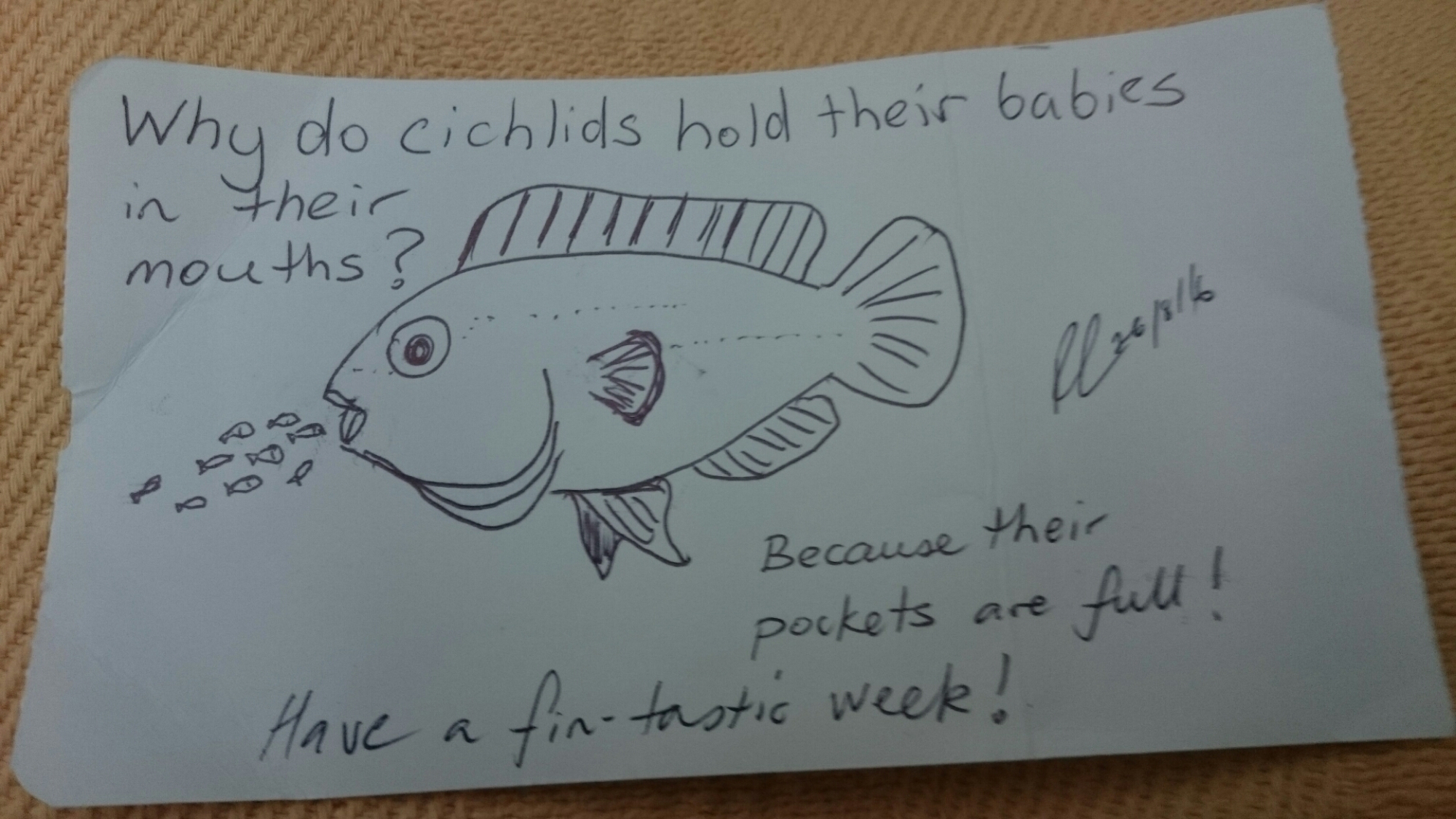
Q: Why do cichlids carry their babies in their mouths?
A: Because they don’t have pockets!
Have a FINtastic week! R <+>{
All about Fish Vetting – Dr Richmond Loh
Q: Why do cichlids carry their babies in their mouths?
A: Because they don’t have pockets!
Have a FINtastic week! R <+>{
Fish Case Reviews
Webinars
TOOLS
—
Yours sincerely,
Dr Richmond Loh
DipProjMgt, BSc, BVMS, MPhil (Pathology), MANZCVS (Aquatics& Pathobiology), CertAqV, NATA Signatory.
Aquatic Veterinarian & Veterinary Pathologist.
PERTH | MELBOURNE | TOWNSVILLE
THE FISH VET – AUSTRALIA.
Aquatic Veterinary Medical & Diagnostic Services.
http://www.thefishvet.com.au
Ph: +61 421 822 383
WebCEPD B-1027 – Iridovirus Infections of Fish
Join us on September 15, 2016 at 11:01am AWST (Perth WA, Australia / 03:01 GMT/UTC) for this free webinar. Click on http://tinyurl.com/h4xuyz5 to see the time in your local time zone, anywhere around the world.
Register now! Simply click on www.wavma.org/Webinars/webcepd-b-1027-iridovirus-infections-of-fish
About this webinar: This webinar will cover Iridoviridae that includes three genera of viruses relevant to fish health: Lymphocystivirus, Ranavirus and Megalocytivirus. Ranaviruses are emerging global pathogens that have a broad host range across reptile, amphibian and piscine hosts. These viruses have the potential for inter-class transmission and can have devastating ecological and food production impacts when introduced to naïve hosts and environments. Megalocytiviruses also cause high mortality disease characterised by systemic necrosis Biosecurity is a key disease control mechanism for iridoviral diseases and in the case of Red sea bream iridovirus (RSIV) and Epizootic Haematopoietic necrosis virus (EHNV), that includes the regulation of trade with a notifiable status listed by the World Organisation for Animal Health (OIE).
Learning Objectives – Participants will understand:
1. A framework for diagnosis of diseases of fish caused by iridoviruses, and a taxonomic framework to differentiate disease-causing viruses;
2. How to select and interpret the appropriate diagnostic laboratory tests results for iridoviruses; and,
3. An approach to biosecurity for the control of iridoviral diseases in unique aquaculture settings.
About the speaker: Dr. Paul Hick’s career has included time as a general mixed practice veterinarian and in a government diagnostic virology laboratory. He earned a PhD in aquatic virology at the University of Sydney studying nodavirus infections of barramundi and is currently a lecturer in Veterinary Virology (Farm Animal, Aquatic and Ecosystem Health) with the Faculty of Veterinary Science. The University is a co-host for the OIE reference laboratory for EHNV and ranavirus infection of amphibians.
This webinar is suitable for veterinarians, vet techs/nurses, vet students and veterinary practice staff. Feel free to forward this announcement to colleagues.
Interested but can’t join the live webinar? If you register for the live webinar and are unable to attend, you will be e-mailed a link to view the webinar at a later time.
Register now! Click on www.wavma.org/Webinars/webcepd-b-1027-iridovirus-infections-of-fish.
After registering, you will receive a confirmation email containing information about joining the webinar.
View webinar System Requirements
WAVMA WebCEPD Program Coordinator
administrators
Discover more about the World Aquatic Veterinary Medical Association at www.WAVMA.org.
Get listed in the on-line Directory of Aquatic Veterinarians and subscribe to AquaVetMed e-News by registering at www.AquaVetMed.info.
Here are some fish-keeper activities non-fish people just don’t get.
Just a warning it’s not the PG-rated usual “dad-joke”.
You should never do charades for:
#1. Turning on a tap and checking the water temperature.
#2. Starting the gravel siphon with back-and-forth pump action.
#3. Starting the siphon using your mouth.
#4. Starting the siphon using your mouth, and then spitting out the disgusting tank water!
:]
Have a FINtastic week! R <+>{
This is concerning; water park opening and continued to operate despite health concerns –
http://www.perthnow.com.au/news/western-australia/elizabeth-quay-health-concerns-known-before-water-park-opening/news-story/4030dc3f79bdb3e1ddad5592d3b41a2c
Some excellent FAQ on the mentioned amoeba – Naegleria fowleri:
http://conditions.health.qld.gov.au/HealthCondition/condition/14/165/101/Naegleria-fowleri-Qs-As
I wonder if the solution may be as simple as using salt/brackish water…
—
Yours sincerely,
Dr Richmond Loh
DipProjMgt, BSc, BVMS, MPhil (Pathology), MANZCVS (Aquatics& Pathobiology), CertAqV, NATA Signatory.
Aquatic Veterinarian & Veterinary Pathologist.
PERTH | MELBOURNE | TOWNSVILLE
THE FISH VET – AUSTRALIA.
Aquatic Veterinary Medical & Diagnostic Services.
http://www.thefishvet.com.au
Ph: +61 421 822 383
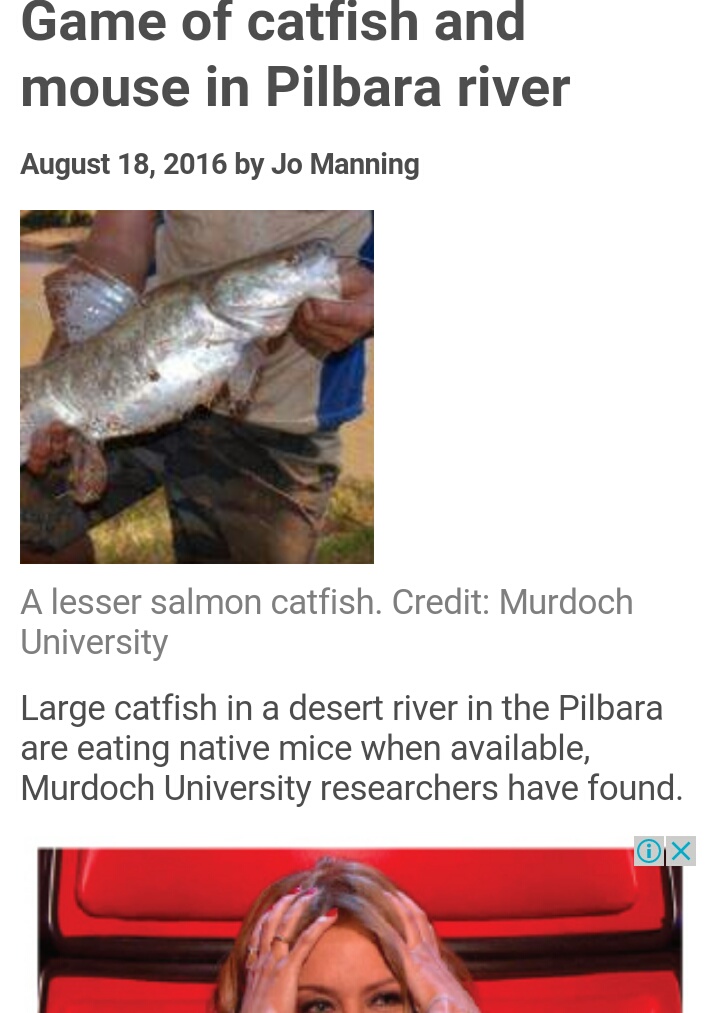
This catfish eats mouse for breakfast!
Check this out!
http://m.phys.org/news/2016-08-game-catfish-mouse-pilbara-river.html
—
Yours sincerely,
Dr Richmond Loh
DipProjMgt, BSc, BVMS, MPhil (Pathology), MANZCVS (Aquatics& Pathobiology), CertAqV, NATA Signatory.
Aquatic Veterinarian & Veterinary Pathologist.
PERTH | MELBOURNE | TOWNSVILLE
THE FISH VET – AUSTRALIA.
Aquatic Veterinary Medical & Diagnostic Services.
http://www.thefishvet.com.au
Ph: +61 421 822 383
For this month of August-only, you’re Seeing Double!
Fish Vetting Techniques & Practical Tips reveals the best ways to treat any type of fish.
This DVD is the most valuable resource for all fish vets, aquarists, fish shop owners, vet schools and zoos.
All your questions about veterinary procedures on treating all fish types are answered in this DVD.
Experienced Australian fish vet Dr Richmond Loh takes you on an absorbing journey into the world of fish vetting: learn how to take skin mucus scrapes and blood samples, inject fish and even perform surgery.
You need this, and you can get it now.
Soon you will be able to treat any fish with full confidence!
Don’t wait!
Order a copy of Fish Vetting Techniques & Practical Tips with this special offer
through
http://thefishvet.com.au/contact_us.html
Remember to mention this advert, and not valid with any other offers.
—
Yours sincerely,
Dr Richmond Loh
DipProjMgt, BSc, BVMS, MPhil (Pathology), MANZCVS (Aquatics& Pathobiology), CertAqV, NATA Signatory.
Aquatic Veterinarian & Veterinary Pathologist.
PERTH | MELBOURNE | TOWNSVILLE
THE FISH VET – AUSTRALIA.
Aquatic Veterinary Medical & Diagnostic Services.
http://www.thefishvet.com.au
Ph: +61 421 822 383
For those who like slapstick comedy, check out -https://youtu.be/mWP7-VwdNJY
Have a FINtastic week! R <+>{
Veterinary Pathologists use a light microscope to examine thin cross-sections of fish tissues mounted on glass slides. We search for abnormalities in the tissues – in terms of inflammatory cell infiltration, degeneration, cell size and shape, presence of pathogens, among other indicators. Check out some images on how useful a light microscope can be in disease diagnosis at this link – http://tinyurl.com/tfv-scope
It is the go-to test for when you don’t know what’s going on. It the least specific test that can give you indications of where to go next with testing. In fish, we routinely examine the gills, skin, muscle, liver, pancreas, fat, kidney, heart, spleen, brain and gut. For certain diseases, we include eyes, nares, spinal cord, and fins. Those working in toxicologic pathology would include testing for endocrine organs such as the pituitary, chromaffin tissue, corpuscles of Stannius, pancreatic islets, pineal, thyroid and more.
Pathology as it is practiced now can be rather subjective in some instances, and it takes years (>5-10 years) to become competent. The minimum standard for Veterinary Pathologists in NATA-accredited laboratories are those who have successfully completed their ANZCVS Membership examinations in Pathobiology. Those pathologists with specific field/clinical experience with the species, often have better insight into diseases.
At The Fish Vet, our team of fish veterinarians, pathologist and aquatic animal health specialists are either Certified Aquatic Veterinarians, and/or have their ANZCVS Memberships in Aquatic Animal Health, and/or Pathobiology.
the Fish Vet’s team will give you that edge when it comes to solving problems with your fish. Whether it be your aquarium fish, or your fish farm, we’ve got the knowledge, skills and experience to handle it.
Download and keep our Services Manual handy.
TFV Services and Fees 2016.pdf
Follow me on: Facebook “Fin Page” – YouTube – Blog – Linkedin – Twitter
—
Yours sincerely,
Dr Richmond Loh DipProjMgt, BSc, BVMS, MPhil (Pathology), MANZCVS (Aquatics & Pathobiology), CertAqV, CMAVA, NATA Signatory.
Aquatic Veterinarian & Veterinary Pathologist
THE FISH VET, AUSTRALIA – PERTH | MELBOURNE | TOWNSVILLE
Mobile Aquatic Veterinary Medical & Diagnostic Services.

Check out the video here – https://youtu.be/n38almzkg5U
Follow me on: Facebook "Fin Page" – YouTube – Blog – Linkedin – Twitter
—
Yours sincerely,
Dr Richmond Loh DipProjMgt, BSc, BVMS, MPhil (Pathology), MANZCVS (Aquatics & Pathobiology), CertAqV, CMAVA, NATA Signatory.
Aquatic Veterinarian & Veterinary Pathologist
THE FISH VET, AUSTRALIA – PERTH | MELBOURNE | TOWNSVILLE
Mobile Aquatic Veterinary Medical & Diagnostic Services.