This week will be a bit crusty.

The theme for this week’s blogs will be about crustacea.

Trust me when I say it’s not all about crab!

—
Yours sincerely,

Dr Richmond Loh
DipProjMgt, BSc, BVMS, MPhil (Pathology), MANZCVS (Aquatics& Pathobiology), CertAqV, NATA Signatory.

Aquatic Veterinarian & Veterinary Pathologist.
PERTH | MELBOURNE | SYDNEY | TOWNSVILLE | BRIBIE ISLAND.
THE FISH VET – AUSTRALIA.

Aquatic Veterinary Medical & Diagnostic Services.
http://www.thefishvet.com.au
Ph: +61 421 822 383

Fish joke for Monday-itis: female sea monkey name. 

​​Question: What name do you call a female sea monkey? 

Answer: Briony Shrimp. 
Brine shrimp (or Artemia) are sold as novelty gifts under the marketing name Sea-Monkeys or Aqua Dragons.

Have a FINtastic week! R <+>{


How to save your beloved fish from dying with KHV?

There’s no cure for the killer koi disease, but there may be a way to save them from dying.

Scientists have found that fish do regulate their busy temperature to fight off infections. This has been shown with Zebrafish research, where sick individuals seek warmer waters, almost to replicate what we experience as fevers.

Similarly, carp do the same, when faced with KHV. Speaking with my Israeli colleague, Danny Benjamin (who is a koi farmer), he says in the face of a KHV outbreak, crank up the water temperature, and hold it between 30-32 degrees Celsius for about a month. Your koi will gain immunity, and will not die from the viral disease.

Though, survivors are likely going to be carriers of the herpesvirus, and could spread to non-immune fish, or reactivation of the virus in times of stress (transport, change in seasons, spawning) could prove fatal. Like a ticking time bomb.

This also goes for vaccination of fish for the virus.

It’s imperative that you consult your fish veterinarian about the options you have. 

Best ways to control algae in lakes and ponds.

​With the dry season, there’s reduced flushing/dilution of waterways. In fact, in many water bodies, there is increased evaporation, causing concentration of nutrients that algae love.

This creates a nasty looking pond or lake. Based on basic principles, here are possible options for controlling algae:

  • Prevent further nutrients from entering the lake – deviating run off, encouraging more marginal plant growth;

  • Diluting the nutrients by flushing with water;

  • Locking up the nutrients with PhosLock or similar compound;

  • Dredging/vacuuming the bottom of the lake to remove nutrients;

  • Seed the water body with other algae that can out compete the toxic algae;

  • Stock lake with herbivorous organisms that will eat the algae (and in turn be eaten by larger fauna and hence remove nutrients) – e.g. rotifers, brine shrimp, fish (e.g. grass carp, but this is not in Australia);

  • Apply algaecides – natural (barley straw or its extract, grapefruit seed extract) or chemical (e.g. simazine, Diazinon, Endosulfan, Propiconazole, Thiram, Ziram, Quinomanid, Irgarol-1051 and Hydrogen peroxide) – check safety for aquatic organisms where present ;

  • Limit light entering the system – e.g. putting dyes in the water, providing more shade;

  • Allowing the lake to dry out (in fish-less ornamental ponds).


Who is The Fish Vet’s Team?

Dr Richmond Loh graduated as a veterinarian from Murdoch University in 2001. Through post-graduate examination he became a college-accredited aquatic veterinarian in 2006. In the same year he was awarded his Masters degree in veterinary pathology. Then in 2009, he became a college accredited veterinary pathologist and a NATA-accredited signatory. Dr Loh is recognised as a Certified Aquatic Veterinarian by the World Aquatic Veterinary Medical Association (2013).

The Fish Vet now comprises of a team of hand-selected veterinary graduates, with post-graduate qualifications or experiences in aquatic animal health.

+ Dr Alistair Brown BSc, BVMS, CertFHP, MANZCVS (Aquatic Animal Health).

+ Dr Giana Bastos-Gomes BVM, MVM, CertAqV.

+ Dr Lucie Nedved BVSc (Hons) BScAgr (Hons).

+ Dr Orachun Hayakijkosol BVSc, MSc, PhD, CertAqV.

Dr Loh and his colleagues across Australia provide veterinary related services including site visits for the purpose of diagnosis and treatment of fish diseases. Our team caters for pet fish, through to production species, and everything in-between.

The Fish Vet, truly a one-stop-shop when it comes to Doctors for Fishes.

+ Dr Richmond Loh DipProjMgt, BSc, BVMS, MPhil (Pathology), MANZCVS (Aquatics& Pathobiology), CertAqV, NATA Signatory.

Web: http://www.thefishvet.com.au

Ph: +61 421 822 383
DOWNLOAD our Services Manual.
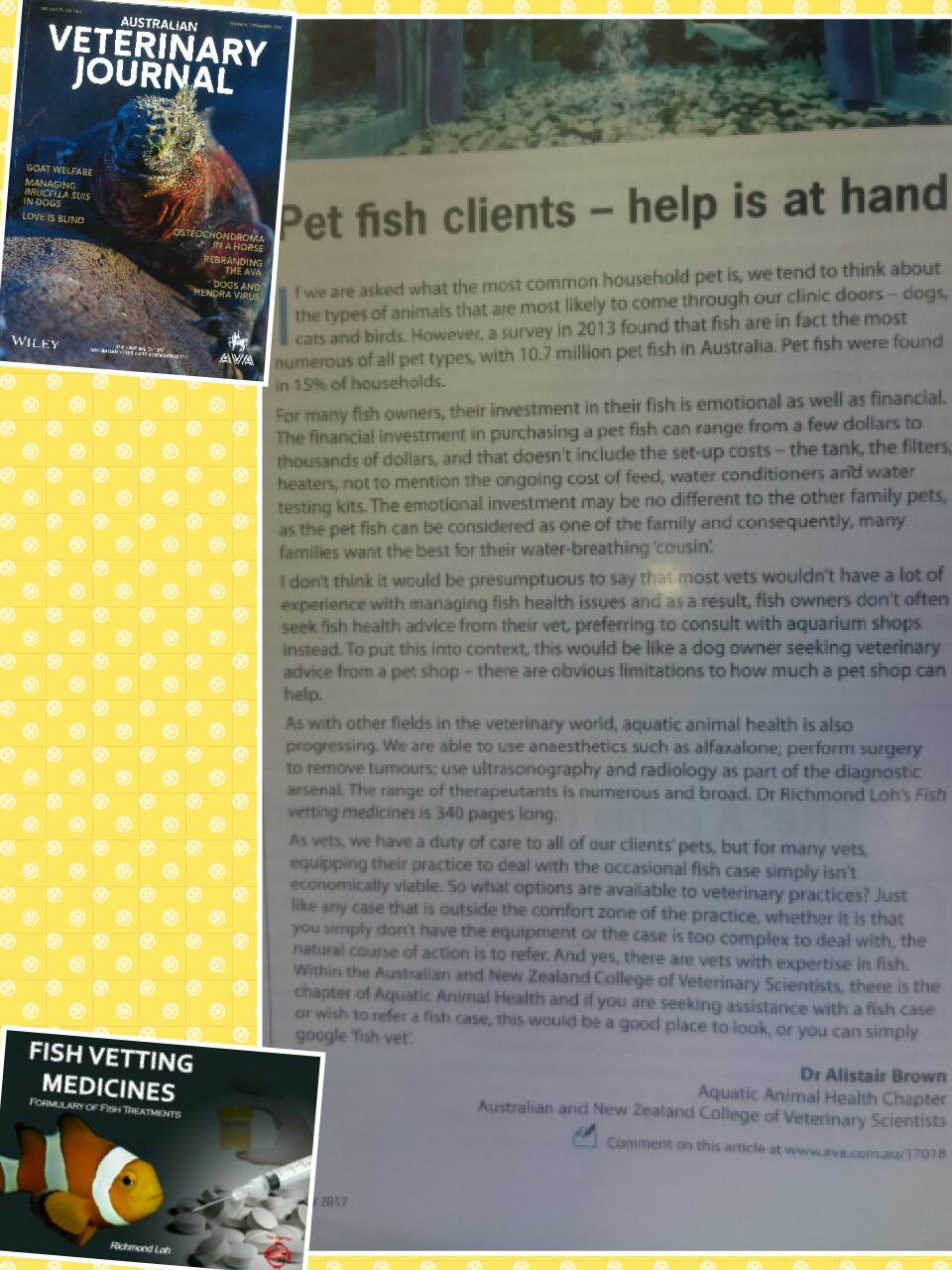
Aquaponics tips and economics

I thoroughly enjoyed this presentation on aquaponics since I dabble with it in my backyard (see link), and attended a conference on it in Hawaii.

I especially liked the part the speaker presented on finding the optimal pH requirements that accounts for needs of plants, fish and bacteria. They also present little rules-of-thumb for feeding, planting:fish ratios, and supplementation.

Watch the presentation here – Aquaponics: How to Do It Yourself

Follow me on: Facebook "Fin Page" – YouTube – Blog – Linkedin – Twitter

—
Yours sincerely,

Dr Richmond Loh
DipProjMgt, BSc, BVMS, MPhil (Pathology), MANZCVS (Aquatics & Pathobiology), CertAqV, CMAVA, NATA Signatory.
Aquatic Veterinarian & Veterinary Pathologist
THE FISH VET, AUSTRALIA – PERTH | SYDNEY | MELBOURNE | TOWNSVILLE | BRIBIE ISLAND
Mobile Aquatic Veterinary Medical & Diagnostic Services.

W: http://www.thefishvet.com.au
Ph: +61 (0)421 822 383
Skype: thefishvet
President WAVMA 2014
Adjunct Lecturer Murdoch University
See advert on YouTube.
Looking for more books? Check out this site.

​All too often we just say, “We’ll never know why.” when fish are ill. 

The title was inspired by out Twitter follower.
Since 2002, we’ve shown our clients, that we can do better than that.
The Fish Vet can help you, whether you’re a fish farmer, managing a zebrafish colony, or have pet fishes. 

We offer site visits and laboratory diagnostic services for all types of fish and shellfish.
So if you have any sick fish, we can help you solve your problems.
Call us on 0421 822 383.

Or use our online contact form. 

We’re here for you.

DOWNLOAD our Services Manual